
Last updated: August 5, 2026
Game Developer Staffing for Studios Hiring Through the Post-Layoff Window
Hire vetted senior Unity and Unreal Engine developers, gameplay programmers, graphics engineers, and tools and netcode specialists. Contract, contract-to-hire, and direct hire across the US.
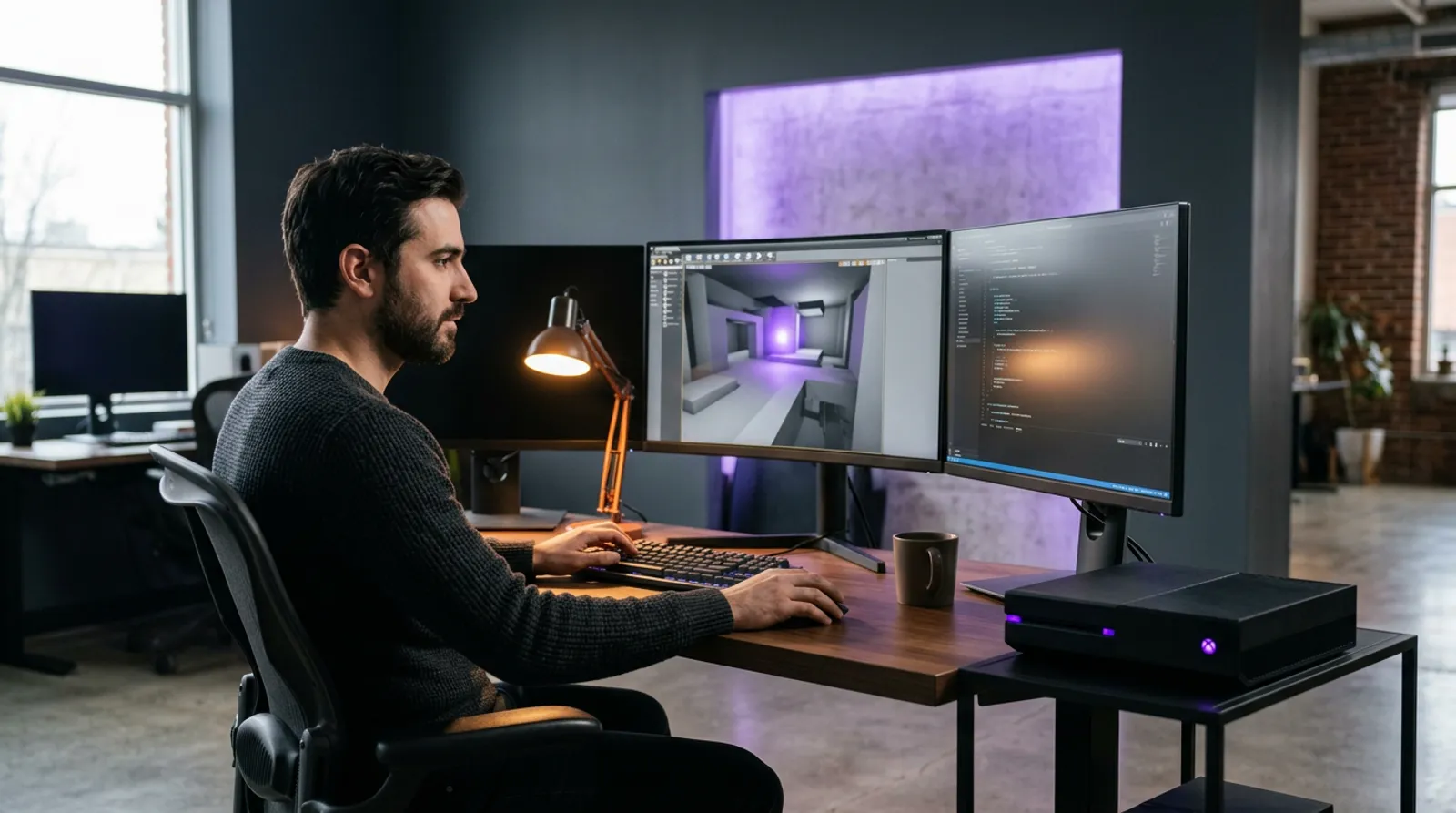
KORE1 places senior game developers across Unity, Unreal Engine, console, PC, and live-service teams, with most contract searches closing in two to four weeks and direct hire searches in four to eight weeks.
The Best Game Dev Hiring Window in a Decade
Game studios cut more than 35,000 roles between 2023 and 2025. Epic, Bungie, Riot, Microsoft’s Activision unit, EA, Ubisoft, Embracer, Sony’s first-party studios. Senior engineers who would have been off-market in 2021 are answering recruiter calls in 2026.
That’s the supply side. Demand is also real. Live-service teams are rebuilding. Mid-size studios are quietly staffing up. AI-assisted content pipelines are pulling in engine engineers who can wire them into real workflows. Studios that move now hire seniors who would normally be three rounds deep at a competitor.
We staff that gap. Our IT staffing practice runs a dedicated game development bench, split by track and vetted by engineers who actually shipped commercial games. Engine specialists on one side. Platform and live-service specialists on the other. Different searches. Different candidates. Same precision most agencies skip.
Game Developer Roles We Fill
Six searches we run on repeat. Titles drift by studio, the work doesn’t.
Senior Unity Developers
C#, the new Input System, addressables, DOTS and ECS when it fits, URP and HDRP tuning, profiler discipline. The hire who can take a prototype and ship a shippable build without rebuilding the asset pipeline twice. Senior base comp typically lands in the $130K to $175K range in 2026, higher in LA and SF.
Unreal Engine Engineers
C++ deep in the engine, Blueprint where it earns its place, Niagara, Chaos, replication, dedicated server builds. Engineers who can extend an Unreal subsystem without forking the engine and regretting it next patch. Strong overlap with our software engineer staffing and our media and entertainment IT staffing practice for studios and streamers hiring engineers around the live-service stack bench on the systems side.
Gameplay Programmers
Combat feel, traversal, AI behavior trees and utility AI, ability systems, mission and quest logic. The engineer who can sit next to a designer, iterate on a mechanic until it actually feels right, and not break the systems team’s frame budget on the way.
Graphics & Rendering Engineers
HLSL, custom render passes, lighting and shadow tuning, GPU profiling on RenderDoc and PIX, hitting platform frame budgets without melting the art team’s vision. A narrow bench. We track it.
Game Tools & Pipeline
Custom editor tools, build automation, Perforce or Plastic wiring, content baking, CI and CD for game projects, internal SDK stewardship. The hire who makes a 600 GB project actually buildable. Usually undervalued, always load-bearing.
Multiplayer & Netcode
Authoritative servers, client prediction and rollback, matchmaking, anti-cheat integration, scalable game services on AWS or GCP. Senior netcode is the rarest game dev specialty we recruit and the one that decides whether a live-service launch survives week two.
The Game Dev Talent Market, In Numbers
Sources: Game Industry Layoffs tracker 2023-2025, ESA 2024 Industry Report, BLS Software Developer OOH 2025, KORE1 placement data.

[engine] Where Engine Searches Land
Engine is still the largest bucket. Three patterns cover most of what comes across our desk.
Unity hires are the steadiest. Mobile teams, mid-core PC, indie scaling up, plus a meaningful slice of XR. Senior Unity in 2026 means C#, addressables, comfortable in URP, opinions about DOTS that are grounded in shipping something instead of a Unite talk. We place these into mobile F2P, hybrid casual, console ports, and the long tail of B2B simulation work that nobody talks about but pays well.
Unreal hires are where AAA and AA studios spend most of their senior budget. C++ first, Blueprint as glue, Niagara for FX, replication for anything multiplayer. Engine-side C++ developer staffing runs through the same network. The hardest Unreal hire is the engineer who knows when to subclass a UCLASS and when to compose, which is a judgment call and not a syllabus item. We screen against it on the panel call, not the resume.
Specialty engine work shows up in three pockets. Graphics and rendering. Animation tech. Custom or proprietary engines at studios that still maintain them. These searches close slower because the bench is smaller, but they close. We don’t run them speculatively. When a studio briefs us on a graphics seat, we open the search and we run it.
[platform] Where Platform and Live-Service Searches Land
Platform talent is a narrower bench and a pickier one. The right engineer pays for themselves twice. The wrong one ships a patch that takes the servers down on a Friday.
For the 2026 supply picture, our Roblox layoffs 2026 gaming platform engineering map covers where that bench is actually coming from and the salary split between studio and platform employers.
Console ports and platform launches are the cleanest engagements. Memory budgets are tighter than PC. Cert is real. Senior engineers who have actually shipped on a current platform devkit know things you can’t read in a doc. We staff these as contract or contract-to-hire most of the time, because the work is finite and the studio wants the option to convert.
Live-service is where most of the demand is sitting in 2026. Netcode engineers, game services on AWS or GCP, telemetry pipelines, content delivery, anti-cheat integration. Senior netcode is the single hardest game dev specialty to find. When a candidate is genuinely senior here, four studios are usually in the room, and the offer math matters more than it would for a typical hire. We brief clients on that reality up front.
Mobile and hybrid casual is a separate pattern entirely. Live-ops cadence, monetization-aware engineering, A/B testing pipelines, ad SDK integrations done without nuking the player experience. Comp bands are different, the loop is faster, and the candidates we run are vetted against shipping live-ops work, not portfolio prototypes.
How We Engage
Four models. Each fits a different shape of game work.
| Model | Best For | Typical Duration |
|---|---|---|
| Direct Hire | Permanent core teams, Staff and Lead game engineers, platform and graphics owners | Permanent |
| Contract | Console ports, live-service surges, content sprints, platform certification crunches | 3 to 12 months |
| Contract-to-Hire | Testing fit before committing, common for senior gameplay and netcode hires | 3 to 6 months, then convert |
| Project-Based | Fixed-scope module builds, port engagements, or co-dev pods with a KORE1 team lead | Scoped per engagement |

Why KORE1 for Game Developer Staffing
We’ve placed engineering talent for over 20 years. Game development isn’t a category we bolted on last quarter. It’s a dedicated track inside our software practice, staffed by recruiters who can tell the difference between a candidate who shipped a Unity asset on the store and one who ran a four-person gameplay team through a console launch.
Every senior game candidate we submit clears a technical screen by an engineer on our panel. Engine candidates get a live-coding round or an architecture walkthrough on a small game module. Graphics, netcode, and tools candidates get a discipline-specific deep dive. Take-home tests are optional and never unpaid. Senior game engineers told us in plain terms that respect matters, and it’s part of why they pick up our calls.
We staff game development nationally, with desks in Los Angeles, Orange County, San Francisco, and San Diego, and remote placements coast to coast. Our game bench overlaps with our AI and ML engineer staffing work (in-game AI, content pipelines) and our cloud engineering work (game services, live-ops infrastructure). For benchmarking comp before an offer lands, teams use our salary benchmark tool to calibrate against the current market.
Ready to open a game dev search? Reach out to our team and we’ll walk through the talent picture for your engine, your platform, and your roadmap.
Common Questions About Game Developer Staffing
How much does it cost to hire a game developer through a staffing agency in 2026?
Senior game developers run $140K to $190K base in 2026, with Unreal and netcode specialists trending higher and senior Unity slightly lower. Mid-level engineers with 3 to 5 years of shipping experience land in the $115K to $145K range. Staff and Lead game engineers clear $200K, with LA and SF placements often higher. Contract rates for senior game engineers typically fall between $90 and $145 an hour, with senior netcode and graphics pricing at the top of that band. The single most common reason a final round dies is anchoring a 2026 offer to 2021 numbers, when comp was inflated and supply was thinner.
Should we hire a Unity developer or an Unreal Engine developer?
It depends on the platform and the team you already have. Unity fits mobile, hybrid casual, mid-core PC, simulation, and XR. Unreal fits most AAA and AA console and PC work, especially anything visually heavy or multiplayer. A senior Unity engineer can ramp on Unreal in roughly a quarter, and the reverse is also true, but neither is instant. The mistake we see most often is hiring a strong engineer in the wrong engine for the roadmap and burning a quarter on the transition. Pick the engine first, then hire the talent.
How long does a typical game developer search take?
Contract searches for senior Unity or Unreal usually close inside three weeks. Direct hire senior searches run 4 to 8 weeks. Specialist roles like senior netcode, graphics, or engine programming stretch to 8 to 12 weeks because the qualified pool is narrow. The pattern that closes searches fastest is a tight loop of two or three rounds, a JD that picks one engine and one platform discipline instead of hedging, and a comp band set against current market data.
Is the layoff cycle actually a good time to hire game developers, or are we picking up burned-out talent?
Both, honestly. The layoffs were broad and the talent pool is mixed. Some senior engineers were riffed inside reorgs that had nothing to do with their performance. Some were burned out long before the layoff. Our panel screen sorts the difference. We ask senior candidates what they shipped, what they would do differently, and what they want their next two years to look like. Burned-out candidates usually self-disclose inside thirty minutes. The strong ones are doing the work to come back sharp and they tell you exactly that.
Can game developers work remotely for our studio?
Mostly yes. Tools, netcode, gameplay, and most engine work port cleanly to remote and async. The exception is studios with non-disclosable IP on early titles, where security policy requires on-site or hybrid. Our game dev placements split roughly 60/40 remote versus hybrid, with Staff and Lead roles slightly more likely to be hybrid in LA, SF, Seattle, or Austin. We’ll shape the search to your in-office policy and platform-holder requirements on the first call.
What makes hiring game developers different from hiring other software engineers?
Three things. First, the work is taste-led. A great gameplay programmer is judged on feel, not throughput, and you can’t screen that with a coding challenge. Second, the technical surface is wider. Senior game engineers carry rendering, performance, multi-threaded engine code, and tooling all at once. Third, the industry rewards completion. We weight portfolios on actually-shipped titles, not unfinished prototypes. Hiring loops that don’t account for those three things tend to hire generic software engineers and then wonder why the prototype doesn’t feel like a game.
Build Your Game Team With KORE1
Unity and Unreal, console and PC, mobile and live-service. Two vetted tracks, one panel, contract or direct hire.
Start Your Game Dev Search →