
Mechanical Engineering Staffing Agency
KORE1 connects growing companies with qualified mechanical engineers, designers, and product development specialists. Two decades in, the process that actually works still starts with knowing the right people. Not a job post.

Finding a mechanical engineer who actually fits your team is harder than it sounds. The resume checks out. The interview goes well. Then three months in you realize the candidate’s entire background is aerospace and you’re building consumer products, or they’ve never worked within the tolerances your manufacturing line demands, or they’ve spent their whole career doing clean R&D and have no idea what it means to ship something under real production constraints. That’s the gap a specialized mechanical engineering staffing agency fills.
KORE1 places mechanical engineers across disciplines. Product design. Thermal systems. Automation. Structural analysis. We don’t pull from the same recycled job boards. Our network includes engineers who are actively looking and others who aren’t on the market at all but would move for something better, and there’s a real difference between those two pools in terms of caliber.
We’re part of the broader KORE1 engineering staffing practice, which means we have the infrastructure and recruiter bench to handle searches across the full engineering spectrum, not just whichever discipline happens to be easiest to fill right now. For companies building cross-functional teams or filling roles across mechanical, biomedical, and systems engineering simultaneously, that matters quite a bit because you’re dealing with one point of contact rather than three different agencies who don’t talk to each other. Our biomedical engineering staffing team runs a parallel operation with a lot of the same sourcing depth.

Mechanical Engineering Roles We Place
We staff across the full range of mechanical engineering work. Not just the easy roles.
- Product Design and Development — concept through production-ready, DFM, tolerancing, design reviews
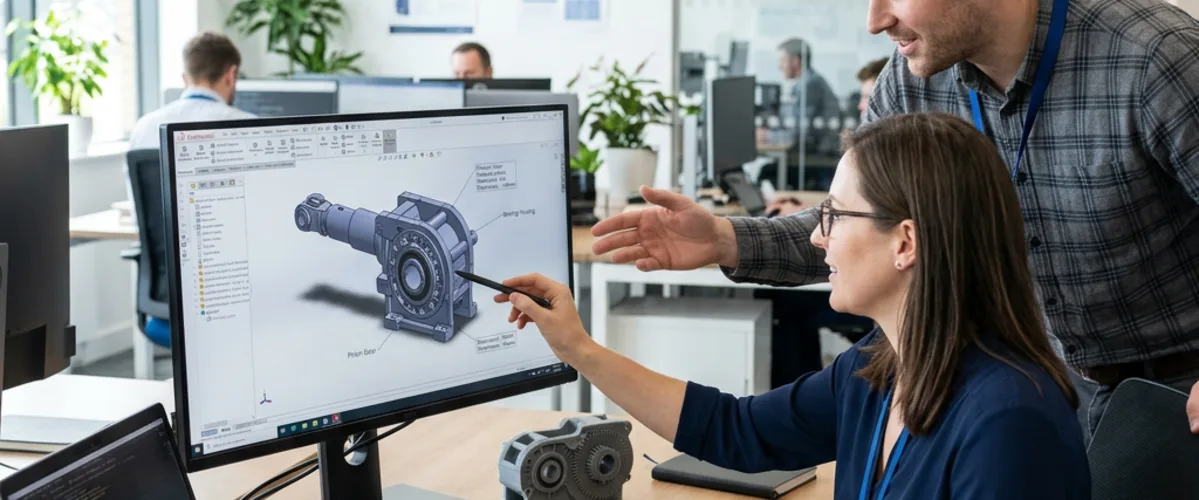
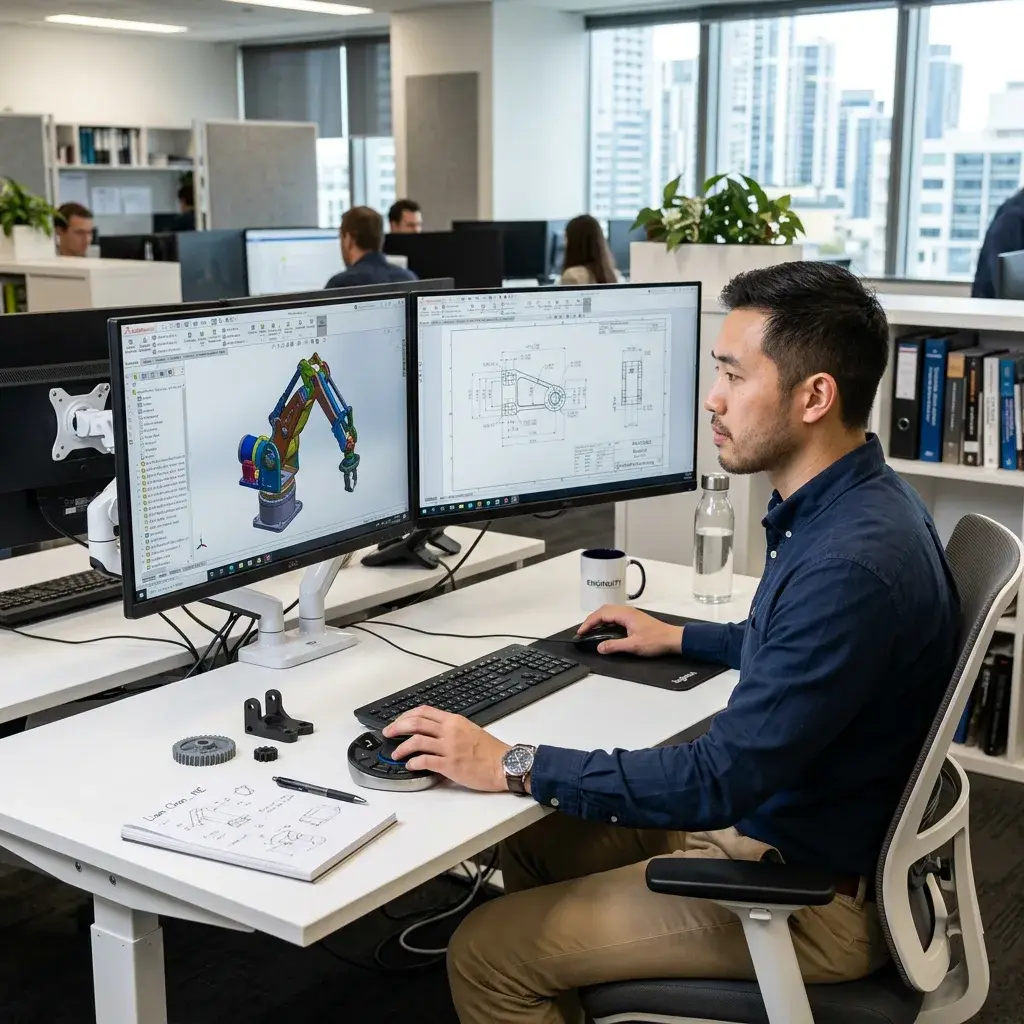
- Mechanical Design Engineers — CAD-heavy roles in SolidWorks, CATIA, NX, and Creo
- Thermal and Fluid Systems Engineers — HVAC design, heat transfer, CFD analysis
- Manufacturing Engineers — process improvement, tooling, GD&T, lean methods
- Automation and Controls Engineers — PLC programming, robotics integration, motion control
- Structural Analysis Engineers — FEA, load analysis, material selection
- Systems Engineers — requirements management, cross-functional integration
- R&D Engineers — prototype development, test engineering, failure analysis
Need someone for a six-month product launch sprint? Done it. Looking for a direct hire to lead your mechanical design team long-term? We’ve placed those too. If contract staffing is a better fit for the budget right now, that works. Same process either way.
How KORE1 Finds Engineers Others Can’t
Most candidates you want aren’t on Indeed. They’re working. And they’re getting pinged constantly by recruiters they ignore.
We’ve built relationships over years inside engineering communities, university programs, and professional networks. So when we go out to find a senior mechanical design engineer with five-plus years of CATIA and a defense background, we’re not starting with a cold list and hoping someone bites. We’re making a call to someone who already knows us and will take the conversation seriously because we’ve never wasted their time before.
Our technical recruiters can talk through GD&T, design intent, or manufacturing constraints with a candidate. They’re not matching keywords. That matters when the difference between a good hire and a frustrating one comes down to details that don’t fit neatly on a resume, things like whether someone has shipped a product under real manufacturing pressure or just done clean R&D work in a lab environment.
And we move fast. Most placements happen in 10 to 21 days. Not invented. It holds up consistently because we’re not starting from scratch when a search lands. Same approach whether you need a permanent hire or a contract engineer for a defined window.
Our broader engineering staffing agency page covers the full scope of what we place, including adjacent disciplines like biomedical engineering where the sourcing overlaps significantly.
Years Placing Engineers
Engineering Placements
Day Average Fill Time
What Sets KORE1 Apart
We aren’t the right fit for every search. But when you need a mechanical engineer placed right and placed fast, here’s what working with us actually looks like.
Recruiters Who Understand Engineering
Our team screens for real qualifications, not just job title matches. They know what SolidWorks proficiency actually looks like in practice. That saves you rounds of bad interviews.
Flexible Engagement Models
Contract, contract-to-hire, or direct placement. We structure the engagement around how your team actually works, not around what’s easiest for us.
National Reach
We place engineers across the U.S., from product companies in Southern California to manufacturers in the Midwest and defense contractors on the East Coast.
Fast Without Cutting Corners
Most searches wrap in 2 to 3 weeks. We don’t rush qualification. But we don’t drag things out either. You’ll hear from us with updates, not silence.
Common Questions About Mechanical Engineering Staffing
What does a mechanical engineering staffing agency do?
A mechanical engineering staffing agency sources, screens, and presents qualified engineering candidates for open positions at client companies. The agency handles sourcing from its existing network and job boards, does initial qualification calls, coordinates interviews, and manages the offer process. Fees vary based on whether the placement is contract, contract-to-hire, or direct hire. The real value isn’t the sourcing, it’s the screening — a good mechanical engineering recruiter filters out candidates who look right on paper but would fail in your specific environment within three months.
How long does it take to place a mechanical engineer?
Most of our mechanical engineering placements wrap up in 10 to 21 days from when we kick off the search. More specialized roles, like a senior R&D engineer who needs a clearance or someone with very narrow expertise in something like cryogenic systems or high-cycle fatigue analysis, can run a bit longer depending on how many qualified candidates exist in the market and where they’re located. We give you a realistic forecast at the start, not a number we made up to win the business.
What’s the difference between contract and direct hire for engineering roles?
Contract placements are temporary, typically 3 to 12 months, and the engineer stays on KORE1’s payroll. You pay a bill rate that covers their compensation and our margin. Direct hire placements are permanent — the engineer joins your company’s payroll from day one, and you pay a one-time placement fee. Contract-to-hire is a hybrid that starts as a contract with a built-in option to convert. Good option if you want to evaluate someone in the role before committing to a full-time offer.
Do you place entry-level mechanical engineers or only senior ones?
Both. We’ve placed new graduates into junior design engineer roles and we’ve placed principal-level engineers to lead product development organizations. The search process looks different depending on level. Entry-level searches lean on recent grads, university relationships, and early-career networks. Senior searches are almost entirely done through direct outreach to people who aren’t actively applying anywhere and won’t respond to a job post no matter how well it’s written.
Can you find mechanical engineers with specific software experience?
Software proficiency is part of our standard screening, so this isn’t a special request. Common tools we see in job requirements are SolidWorks, AutoCAD, CATIA, Creo, NX, ANSYS, and MATLAB. If your team uses a less common stack or a proprietary simulation environment, just tell us and we’ll build it into the screening questions rather than leaving it as an afterthought that surfaces in the second interview when it’s awkward to walk away. Don’t assume candidates will list every tool they know without being asked directly.
What industries do your mechanical engineering candidates come from?
Our candidates come from aerospace, defense, medical devices, consumer electronics, industrial equipment, automotive, and general manufacturing. Industry background matters a lot for some roles and barely at all for others — a thermal systems engineer who spent 10 years in defense can make the jump to HVAC design without much friction, but a medical device engineer who’s never touched FDA design controls is a hard fit for a Class II device company regardless of their CAD skills. Tell us what matters for the role and we’ll source accordingly. Related discipline? See our biomedical engineering staffing practice if you’re hiring at the engineering-life sciences intersection.
Ready to Find Your Next Mechanical Engineer?
Start with a 20-minute intake call. We’ll ask about the role, the team, and what’s failed before so we don’t repeat it. No commitment, no pitch deck. Just a conversation to figure out whether we’re the right fit for the search.