
Last updated: September 12, 2026
IT Staffing Services
IT staffing sources, screens, and places qualified technology professionals into contract, contract-to-hire, or permanent roles. Companies use it to fill technical positions faster and with more precision than in-house recruiting allows.
That precision matters most for specialized roles in software engineering, cloud infrastructure, cybersecurity, data analytics, AI, and Snowflake data cloud engineering.
IT Staffing Services That Help You Hire Better Tech Talent, Faster
At KORE1, we work with organizations that need to hire technical professionals efficiently and thoughtfully. Our IT recruiters take the time to understand the role, the environment, and what “good” actually looks like before presenting candidates. If you are deciding whether to bring in an outside firm at all, our IT recruiting agency page breaks down when it is worth the fee. And if you want the full menu of engagement models across the technical stack, our technical recruiting services page lays out how each one works.
The goal isn’t speed for the sake of speed. It’s getting the right person in place so work keeps moving. When you need to add that talent on contract across multiple teams, that’s staff augmentation services, and for tech roles specifically, IT staff augmentation. Leadership seats get their own desks, so if you need to hire a director of product the search starts with scope rather than a job description. The tier below it works the same way, so when you hire a senior product manager the search still starts by settling which decisions the seat hands over.
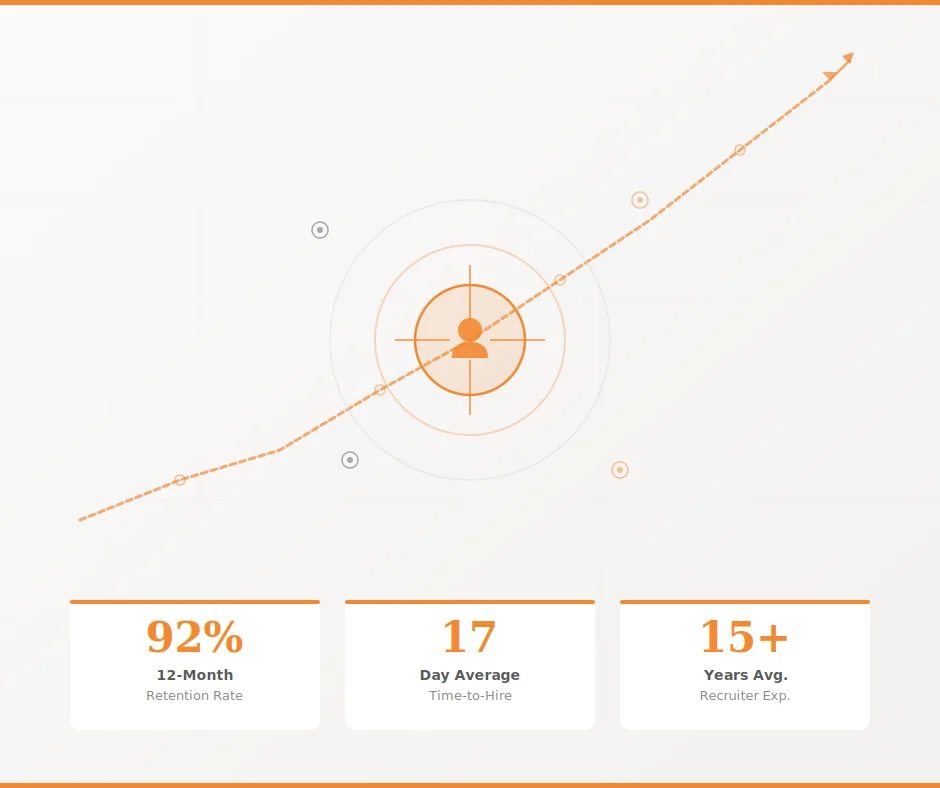
Speak With an IT Staffing Expert →IT staffing services source, screen, and place vetted technology professionals into contract, contract-to-hire, or direct hire roles. KORE1 delivers 17-day average time-to-hire and 92% 12-month retention across software, cloud, cybersecurity, data, and AI roles.

Video chapters
- 0:00 — Why precision matters in IT hiring
- 0:14 — What IT staffing actually means
- 0:46 — Why technical hiring is high stakes
- 0:59 — Choosing the right staffing model
- 1:24 — How a strong IT staffing process works
- 1:56 — Why companies choose KORE1
- 2:18 — Common questions answered
- 2:32 — Final takeaway
Read full video transcript
It hiring gets expensive fast when the role stays open too long or the wrong person gets hired. And most of the time, the issue is not effort. It is precision. A lot of companies can move quickly. Far fewer know how to evaluate technical talent well enough to move quickly and still get it right. That is where IT staffing becomes useful. At its core, IT staffing means bringing in recruiting support to help source, screen, and place technology professionals in your organization. That can be contract, contract-to-hire, direct hire, or project-based support. The reason companies use it is simple. Some roles are urgent. Some are highly specialized, and some internal teams just do not have the bandwidth to run a deep technical search while also doing everything else on their plate. When IT staffing is done well, it helps teams move faster without sacrificing judgment. When it is done poorly, it just creates more interviews, more noise, and more bad options. That matters because technical hiring is rarely just about filling a seat. A missing engineer can delay delivery. An understaffed security team increases risk. A data role left open too long can stall reporting and decision-making. The real goal is getting the right person in place so the team can keep moving. This is also why the staffing model matters. Not every hiring need should be solved the same way. Contract IT staffing works well for project work, surge support, and urgent gaps where you need someone contributing quickly. Contract-to-hire makes sense when you want to evaluate fit before making a long-term commitment. Direct hire is usually the better fit for permanent roles where judgment, experience, and team alignment matter over time. The right model depends on urgency, risk tolerance, and how long the role needs to exist. The process matters just as much as the model. Strong IT staffing starts with role intake and alignment. That means understanding the technical requirements and the team environment. Then comes targeted candidate sourcing, not waiting around for whoever applies — actually going out and finding people with the right background. After that, candidates need real screening, not just keyword matching, but real evaluation of skills, experience, and problem-solving ability. From there, the best firms deliver a focused shortlist, not a pile of resumes, and they stay involved through interviews, feedback, and onboarding support, so momentum does not stall late in the process. That is a big part of why companies choose a partner like KORE1. The value is not just access to candidates. It is built around capability, relevance, and context. That is especially important for teams hiring across software engineering, cloud, DevOps, cybersecurity, data, AI, ERP, enterprise systems, and technical leadership. Those roles are not interchangeable, and the recruiting process should reflect that. A few common questions usually come up. Which staffing model is right? What roles can be staffed? And who is this a good fit for? Usually growing companies, teams struggling to fill specialized roles, and hiring managers who want a real staffing partner, not just resume volume. The takeaway is simple. Good IT staffing is not about moving the fastest. It is about moving with enough judgment to hire well. If your team is hiring and you need technical talent without wasting time on the wrong candidates, KORE1 is built for that conversation. Visit us at kore1.com to start your search.
What IT Staffing Means for Growing and Scaling Teams
Companies use IT staffing for different reasons. Sometimes a role is urgent. Other times the skill set is specialized, or internal teams don’t have the bandwidth to keep recruiting alongside everything else.
IT staffing means bringing in external recruiting support to help find, screen, and place technical talent in your organization. That can be on a contract basis, contract-to-hire, or as a permanent hire. It works well when timelines are tight or the role requires experience that’s difficult to find on your own.
When it’s handled well, IT staffing helps teams fill high-impact roles faster, take pressure off internal hiring managers, and improve accuracy for specialized technical positions.
Where companies get burned is working with staffing firms that move fast but don’t go deep. In IT hiring, speed without judgment usually creates more problems than it solves.
Request Talent →Our IT Staffing Services
We support a range of hiring needs, from urgent short-term gaps to long-term growth. Each model is designed to give you flexibility without sacrificing talent quality.
Contract IT Staffing
Best for project work, interim coverage, or immediate technical needs. We place IT professionals who contribute quickly and adapt to your environment without extensive ramp-up. For migrations, replatforms, and rebuilds where coordination cost is the real risk, we also deploy pre-matched contract engineering teams — architect, lead, and seniors who have shipped together before. When the goal is retiring duplicate systems rather than building something new, that work sits with business systems consolidation and data migration staffing.
Contract-to-Hire
A smart option when you want to confirm fit before making a long-term decision. This approach keeps projects moving while reducing hiring risk.
Direct Hire IT Staffing
For permanent roles where experience, judgment, and team alignment matter. We manage sourcing and screening so your time is reserved for candidates who are truly qualified.
Consulting / Project-Based
When you need specialized IT expertise for a defined initiative, we can staff project-based teams or individual consultants aligned to your goals and timeline. When the search is highly specialized, such as cloud, our 2026 ranking of the top cloud recruiting firms shows how the leading firms compare.
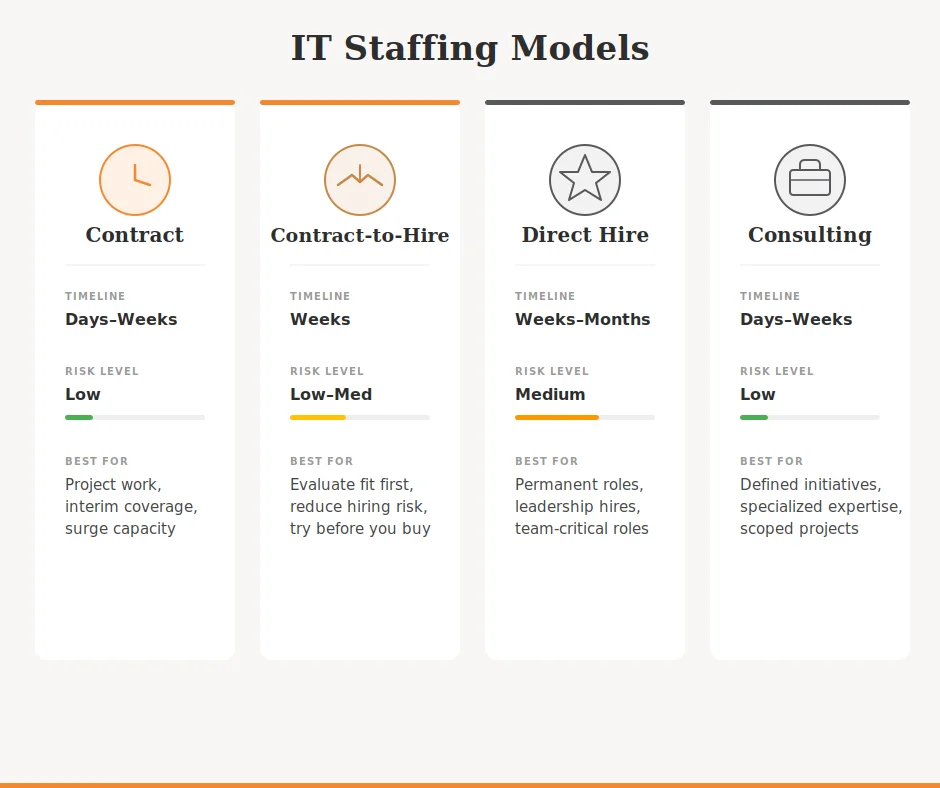
IT Staffing Model Comparison
Choosing the right engagement model depends on timeline, risk tolerance, and how long you need the role filled. Here’s how each model compares.
| Model | Best For | Timeline | Hiring Risk |
|---|---|---|---|
| Contract | Project work, interim coverage, surge capacity | Days to weeks | Low |
| Contract-to-Hire | Evaluating fit before committing long-term | Weeks | Low to Medium |
| Direct Hire | Permanent roles, leadership, team-critical positions | Weeks to months | Medium (mitigated by screening) |
| Consulting / Project | Defined initiatives, specialized expertise | Days to weeks | Low |
Roles and Skill Sets We Staff For
Our recruiters specialize in technology and IT hires, which means we understand the difference between what’s on a resume and real capability. Meet our tech recruiters for the bench, network, and process behind every search we run, including our Salesforce recruiters for ecosystem-specific hires, and our DevOps recruiters for pipeline, cloud, and reliability roles, and our DevSecOps recruiters for security-in-the-pipeline hires. We regularly staff for roles including:
- Software Engineering and Application Development
- Infrastructure, Cloud, and DevOps
- Cybersecurity and Compliance
- Business Intelligence and Data Analytics
- AI and Machine Learning Engineering
- IT Project, Product, and Program Leadership
- Technology executive search, including CTO staffing and chief data officer staffing
- QA, Testing, and Automation
- ERP, CRM, and Enterprise Systems (including NetSuite and NetSuite solution architects, plus fractional NetSuite administrators)
Looking for something more specialized? We also staff for digital transformation consultants who own adoption and the operating model after a system goes live, PHP developers, AI and ML engineers, applied AI engineers who ship model-backed product features, senior data engineers leveled against lead and platform pay bands, integration engineers for the systems that were supposed to talk to each other and don’t, AI product managers for teams that need the person deciding what the model is for, not just who builds it, data product managers for teams hiring metric owners rather than dashboard buyers, NLP engineers for transformer, LLM, and retrieval-augmented generation work, cloud engineers, Azure cloud engineers, cloud infrastructure engineers, network engineers, DevOps engineers, platform engineering teams, site reliability engineers, AIOps engineers, platform engineers who build internal developer platforms, staff engineers who set technical direction across several teams, Java developers, Python developers, Node.js developers for event-driven APIs and real-time services, web developers, front-end developers, backend developers, full stack developers, Golang developers for high-performance backends and Kubernetes platform work, Scala developers for Apache Spark, Akka, and big data pipelines, C++ developers for embedded, defense, and performance-critical systems, blockchain developers for Solidity, Solana, and Rust roles, Android developers, iOS developers, game developers for Unity, Unreal Engine, console, PC, and live-service work, Shopify developers, WordPress developers, technical writers for API reference, SDK docs, developer portals, and product help centers, data scientists and data engineers, the data science recruiters and data engineer recruiters who run those searches, data architects, data governance analysts, big data engineers for Hadoop, Spark, and Kafka-scale distributed systems, Kafka and streaming engineers, event-driven architecture consultants, Kubernetes platform engineers, SQL developers for T-SQL, PL/SQL, ETL, and BI work, database administrators, Oracle DBAs, database administrator staffing for SQL Server and PostgreSQL upgrade windows, NetSuite administrators, ERP consultants, SAP consultants, Workday consultants, Salesforce admins and architects, Salesforce developers, MuleSoft developers for Anypoint Platform, Mule 4, and DataWeave integration work, Boomi integration developers for AtomSphere, Atom and Molecule runtime, and EDI trading partner work, ServiceNow developers for ITSM, CSM, HRSD, and ITOM module builds, and healthcare IT professionals, and pharma IT specialists for cGMP plant-floor, MES, EBR, serialization, and validated manufacturing programs. Need a dedicated healthcare IT staffing agency? We have a team built specifically for that, including specialist healthcare IT recruiters who handle Epic, Cerner, revenue cycle, and HIPAA searches end to end. For public sector IT roles across state, local, and education agencies, see our public sector IT staffing practice, or our government IT staffing services for roles requiring security clearances. For broader-scope government hiring across IT, engineering, finance, healthcare, and administrative functions, see our government recruiters practice. Need executive-level technology leadership? Our CIO staffing practice places chief information officers and senior IT executives, our chief AI officer staffing practice places the leaders who own enterprise AI strategy, model risk, and shipped AI products end to end, our IT director staffing practice places the leaders who run day-to-day technology operations, our enterprise architect staffing practice places architects who own the technology roadmap, and our CISO staffing team handles chief information security officer searches, and our cybersecurity recruitment practice runs continuous security talent programs across SOC, cloud security, IAM, offensive security, GRC, and CISO roles. Teams running Splunk for SIEM, compliance logging, or observability should start with our dedicated Splunk engineer staffing practice, including a New York desk built around the audit-trail demand from the city’s banks and insurers at Splunk engineer staffing in New York. Teams in the education sector — K-12 districts, colleges, universities, and EdTech companies — can start with our education IT staffing practice, which pre-screens for Banner, Workday Student, Canvas, LTI 1.3, and FERPA/E-rate fluency. Law firms and corporate legal teams can start with our legal IT staffing practice, which pre-screens for iManage, NetDocuments, Relativity, ABA 1.6 compliance, and SOC 2 Type II exposure. Companies that need part-time IT leadership can explore our fractional CIO services, or fractional CIO for ERP and digital transformation when the trigger is a platform replacement rather than general governance. If you run a managed services practice and need NOC, SOC, or service desk talent specifically built for MSP delivery, our managed IT staffing bench is built for exactly that. For teams hiring desk-side help — Tier 1 password resets, Tier 2 deployments, Tier 3 infrastructure — our IT support staffing agency places technicians on contract, contract-to-hire, or direct hire. For hands-on deskside work like hardware refreshes, imaging, and executive white-glove support, our desktop support staffing practice fills those on-site roles. And for remote Tier 1 through Tier 3 queues, our help desk staffing team keeps service desks covered 24/7. And when delivery leadership is the gap, our project manager staffing agency places senior IT project managers, technical program managers, and PMO leads. Teams that need certified Scrum Masters specifically can explore our dedicated scrum master staffing agency, which screens for CSM/PSM certifications, sprint facilitation track record, and stakeholder alignment skills. Teams that need someone to own the backlog and accept the increment, not just facilitate the ceremony, can explore our product owner staffing practice, which screens for prioritization judgment and acceptance authority. Organizations driving enterprise-wide agile transformations across SAFe, LeSS, or Kanban can explore our agile coach staffing practice, which vets for real transformation experience, not just certifications. And for the seat between product and engineering — the one that owns stakeholder workshops, BRDs, user stories, and process maps — our business analyst staffing practice screens BABOK-trained BAs on real requirements artifacts before the shortlist ever leaves our desk. For teams hiring the technical seat in the deal cycle — demos, POCs, security questionnaires, and the technical close — start with our sales engineer staffing practice (and our tech sales staffing desk for SaaS reps and the full revenue org), which screens pre-sales engineers, solutions consultants, and solutions architects on real shipped POCs and live-deal storytelling. Companies in financial services and fintech can explore our fintech staffing practice for hybrid finance-technology roles. Mortgage lenders working against the Encompass SDK deadline should start at Encompass and LOS integration consultant staffing. B2B SaaS and software companies scaling engineering, product, and go-to-market teams can start with our SaaS staffing practice, which matches each seat to contract, contract-to-hire, or direct hire. And with the ongoing data center construction boom, our data center staffing practice places technicians, facilities engineers, and operations managers for hyperscalers and enterprise facilities. Carriers modernizing on Guidewire, Duck Creek, or Majesco should start with our dedicated insurance IT staffing practice, which pre-screens for named-stack fluency and regulated-environment experience. Telecom operators, MVNOs, and communications equipment vendors hiring 5G core, vRAN/O-RAN, or BSS/OSS engineers should start with our telecom IT staffing practice, which pre-screens for Amdocs, Netcracker, Ericsson, and Open RAN experience. For the broader carrier buildout side — RF, fiber, OSP, NOC, and network engineering — start with our telecom staffing practice. Investor-owned utilities, munis, co-ops, and energy majors modernizing the grid should start with our energy IT staffing practice, which pre-screens for Schneider ADMS, GE GridOS, AutoGrid DERMS, Itron AMI, and NERC CIP OT security fluency. And for teams whose product is the interface itself, React developer staffing, screened against the React they actually run rather than the version on the resume.
Manufacturers modernizing MES, ERP, SCADA, PLC, or industrial IoT platforms should start with our manufacturing IT staffing practice, which pre-screens for Rockwell Allen-Bradley, Siemens, SAP S/4HANA, and OT cybersecurity experience in real plant environments. For skilled production talent on the floor itself, including CNC machinists, electromechanical techs, controls programmers, quality engineers, and plant leadership, our dedicated manufacturing staffing agency practice runs as a separate desk inside KORE1. Southern California companies on Oracle NetSuite can go straight to NetSuite staffing in Los Angeles, which places SuiteScript developers, administrators, and functional consultants by module. San Diego companies running a validated or cleared-adjacent NetSuite build should start at NetSuite staffing in San Diego instead. South Bay companies split between hardware inventory and SaaS revenue recognition should start at NetSuite staffing in San Jose, which staffs both tracks from one desk. Portland companies running wholesale and DTC on the same instance should start at NetSuite staffing in Portland, where the same build usually has to reconcile both. Front Range manufacturers and food and beverage companies carrying lot or serial obligations should start at Denver NetSuite staffing, where the item master decides what a recall trace costs later. Phoenix distributors and manufacturers opening a second building should start at NetSuite staffing in Phoenix, where the multi-location switch has to be thrown before the first pallet moves. Dallas and Fort Worth back offices should start at NetSuite staffing in Dallas, where the period close arrives on the same business days every month and never has a last one. Austin companies heading into a first audit or a diligence request should start at NetSuite staffing in Austin, where the question is whether a reported figure traces back to a record without a spreadsheet in the middle. Houston companies billing against jobs rather than orders should start at NetSuite consultants and developers in Houston, where a cost-to-complete estimate decides what the general ledger reports. Orange County companies whose single NetSuite hire has to cover administration, configuration, build and integration should start at NetSuite staffing in Orange County, where the honest question is which of those four the seat actually reaches. San Francisco teams pointing AI agents at SuiteScript should start at NetSuite staffing in San Francisco, where a change still needs a named human author of record before it merges. Seattle companies whose growth keeps arriving as one more system to connect should start at NetSuite staffing in Seattle, where the integration surface widens faster than the finance team does. Chicago distributors carrying inventory they own and cannot point at should start at NetSuite consultants and developers in Chicago, where a transit account decides whether a physical count reconciles. Atlanta payments, platform and subscription companies should start at NetSuite consultants and developers in Atlanta, where the cash settles on day one and the revenue belongs to a schedule. Boston life sciences and medical device companies should start at NetSuite consultants and developers in Boston, where the largest number in the close is an accrual nobody has invoiced yet. New York apparel, direct-to-consumer and media companies should start at NetSuite consultants and developers in New York, where a recorded sale stays provisional until the return window closes. Miami companies invoicing across Latin America should start at NetSuite consultants and developers in Miami, where a foreign currency revaluation decides how much of a booked number survives the close. Tampa companies matching purchasing to a known season should start at NetSuite consultants and developers in Tampa, where a seasonal reorder point decides whether the warehouse runs short in the one week that matters. Orlando companies sizing an integration against a licensed API call allowance should start at NetSuite consultants and developers in Orlando, where the choice between unit-level and transaction-level calls decides whether the license survives the year. Charlotte companies selling on both sides of the North Carolina and South Carolina line should start at NetSuite consultants and developers in Charlotte, where a tax group that stopped matching the ship-to address is usually the first problem that needs an owner. Los Angeles teams hiring machine learning, LLM, or generative AI engineers have their own desk at AI staffing in Los Angeles, which splits the bench by how much of the model a team actually owns. San Francisco teams competing directly with OpenAI, Anthropic, and Google DeepMind for the same engineers can start at AI staffing in San Francisco, built around the 48-hour window before a frontier lab offer wins the candidate. Seattle and Eastside teams have their own desk at AI staffing in Seattle, built around the two separate labor markets Lake Washington splits and the Washington noncompete ban landing June 30, 2027. Silicon Valley teams hiring into the hardware and networking side of the valley can start at AI staffing in San Jose, built around the vesting cliffs that keep the strongest candidates off the open market. New York teams have their own desk at AI staffing in New York, built around the three separate regulators that touch an AI req in that city before anyone makes an offer. Boston and Cambridge teams can start at AI staffing in Boston, built around the radius question that decides who says yes and the out-of-state offers that take the rest. Austin and the Central Texas corridor have their own desk at AI staffing in Austin, built around the power and silicon limits that decide what the work actually is there. Chicago teams can start at AI staffing in Chicago, built around a metro wage benchmark that is set by enterprise IT rather than by anyone building models. Front Range teams can start at AI staffing in Denver, built around the documentation duty Colorado’s automated-decision law puts on the engineer who built the model rather than on the lawyer. San Diego teams can start at AI staffing in San Diego, built around the on-device, cleared, and regulated-genomics boundaries that decide which engineers are actually reachable. Washington DC teams have their own desk at AI staffing in Washington DC, built around the federal labor category that decides who is eligible for a seat before anyone looks at what the person can actually do. Atlanta teams can start at AI staffing in Atlanta, built around the pairing between the metro’s logistics wage premium and its computing wage discount. Building out a data team instead of an AI research bench? Houston companies can start at data staffing in Houston, built around the metro’s energy-sector reconciliation problem. Dallas-Fort Worth teams can start at data staffing in Dallas for the same sequencing across the metroplex. And Phoenix teams can start at data staffing in Phoenix, built around the Valley’s fast-growing semiconductor and data center employers. Minneapolis and St. Paul teams can start at data staffing in Minneapolis, built around the payer, medical device, and retail data that runs through that metro. Charlotte teams can start at data staffing in Charlotte, built around the supervised reporting and lineage work that comes with the country’s second-largest banking center. Tampa Bay teams can start at data staffing in Tampa, built around the financial services, health system, and port logistics data that runs on both sides of the bay. Central Florida teams can start at data staffing in Orlando, built around the attractions, hospitality, vacation ownership, health system, and simulation data that all runs to a calendar somebody else set. Central Ohio teams can start at data staffing in Columbus, where eighteen Fortune 1000 headquarters sit inside one metro and keeping a data seat filled is harder than filling it. Wasatch Front teams can start at data staffing in Salt Lake City, built around a metro whose software payroll sits thirty miles south of its downtown. Southeast Michigan teams can start at data staffing in Detroit, built around the warranty, supplier quality, and plant data that three automaker headquarters and the Tier-1 supplier belt run on. Philadelphia AI, ML and LLM hiring runs through AI staffing in Philadelphia, a metro that employs more medical scientists than data scientists.
Retailers staffing POS, e-commerce, order management, or PCI-aware security work should start with our retail IT staffing practice, which pre-screens for Oracle Retail Xstore, Shopify Plus, Salesforce Commerce Cloud, Manhattan Active Omni, and PCI DSS v4.0 fluency against a peak-season calendar. Pure-play online stores can go straight to our e-commerce staffing desk for storefront, checkout, and peak-season builds across Shopify Plus, Adobe Commerce, and BigCommerce.
Hotels, restaurant groups, casinos, and travel platforms hiring PMS, POS, revenue, and travel-distribution engineers should start with our hospitality IT staffing practice, which pre-screens for Opera, Mews, Cloudbeds, Toast, Micros Symphony, IDeaS, Sabre, and Amadeus fluency, plus the multi-property rollout cadence the industry actually runs on.
Commercial real estate owners, REITs, multifamily operators, and proptech vendors hiring Yardi, MRI, RealPage, AppFolio, or Salesforce talent should start with our real estate IT staffing practice, which pre-screens for Voyager 7S, MRI X, OneSite, and lease-administration fluency against the rent-roll and CAM-reconciliation calendar.
Studios, streaming platforms, post-production houses, VFX shops, and game studios hiring Avid, DaVinci Resolve, Adobe Premiere, Nuke, Houdini, Unreal Engine, or AWS Elemental talent should start with our media and entertainment IT staffing practice, which pre-screens for named-pipeline fluency and the slate and live-service delivery cadence the industry actually runs on.
Automakers, Tier 1 suppliers, EV scale-ups, and mobility startups hiring AUTOSAR, QNX, Android Automotive, Vector CANoe, ADAS perception, infotainment, telematics, OTA backend, or plant-IT talent should start with our automotive IT staffing practice, which pre-screens for named-stack fluency on safety-critical software and the SOP cadence the industry actually runs on.
For teams building out their IT operations bench, our guide to hiring a systems administrator covers 2026 salary bands, a 5-step hiring process, scenario-based interview questions, and the reflex checks that separate reliable ops hires from risky ones.
How Our IT Staffing Process Works
The best outcomes come from a clear, disciplined process. Here’s how we approach IT staffing at KORE1.
Role Intake and Alignment
We take the time to understand the technical requirements, your team dynamics and culture, and business context.
Targeted Candidate Sourcing
We don’t wait for applicants. We actively source talent with relevant experience and proven track records.
Technical and Experience Screening
Candidates are evaluated on skills, past work, and problem-solving ability—not just what’s listed on a resume.
Shortlist Delivery
You receive a focused shortlist—not a flood of options. Every candidate is there for a reason.
Interview and Placement Support
We manage coordination, feedback, and onboarding support to keep the process moving smoothly.
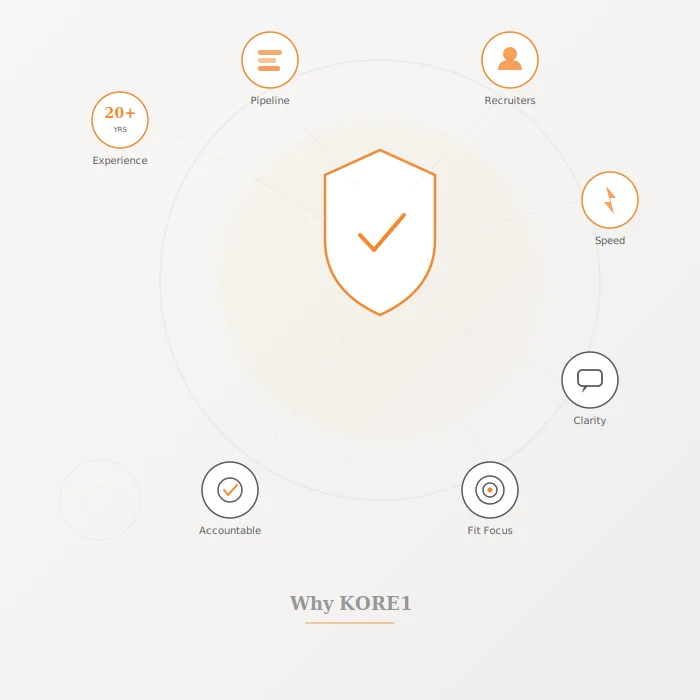
Why Companies Choose KORE1 as Their IT Staffing Agency
Companies work with KORE1 because we’ve been in IT staffing for decades. We have real relationships, real networks, and team members who know this industry better than any other staffing partner.
What sets us apart:
- Decades of experience focused on IT and technology staffing
- An active pipeline of pre-vetted IT professionals
- Recruiters who understand both technology and hiring realities
- Faster time-to-fill without cutting corners on quality
- Clear communication and honest feedback at every stage
- A focus on fit, not just availability
- Accountability from intake through placement and beyond
We’re selective about the roles we take on. That’s intentional, and it’s why our placements tend to last.
“Every candidate we present has been evaluated for technical depth and real-world fit. That’s how we protect your time and your team.”
— KORE1 Senior IT Recruiter
Who We’re a Good Fit For
Our IT staffing services work best for:
- Growing companies that need to hire technical talent quickly and accurately
- Teams struggling to fill specialized or high-impact IT roles
- Organizations that value long-term fit over short-term volume
- Companies scaling engineering, DevOps, security, or data teams
- Hiring managers who want a staffing partner, not a resume vendor
If your IT recruiting process is slow, inconsistent, or producing candidates that don’t stick, it may be time to bring in a focused staffing partner. Industries like financial services, banking IT, mortgage tech and fintech engineering, insurance IT, healthcare IT, pharmaceutical IT, life sciences IT, logistics and supply chain IT, hospitality IT, real estate IT, media and entertainment IT, nonprofit IT, education IT, and legal IT add regulatory complexity or budget constraints that make a specialized staffing partner even more valuable.

Get Started With IT Staffing
If an IT role just landed on your desk, talking it through early usually prevents delays later. A recruiter on the KORE1 team can help you pressure-test the role, timeline, and market before you commit to a hiring path. Writing the req for a senior IT executive? Start with our CIO job description template.
If IT staffing is the right fit, we’ll help you take the first step toward your next great hire.
Speak to an IT Staffing Expert →IT Staffing Services by Location
KORE1 provides IT staffing services nationwide. Visit a location page below to learn how we support hiring in your area.
IT Staffing FAQ
What is IT staffing?
IT staffing is the process of using an external recruiting agency to source, screen, and place technology professionals into roles within your organization. It covers contract, contract-to-hire, and permanent placements across a wide range of technical specializations including software development, cloud infrastructure, cybersecurity, data analytics, and IT leadership.
How quickly can KORE1 fill an IT role?
Our average time-to-hire is 17 days. For urgent needs, we’ve delivered vetted IT professionals even faster. Speed depends on role complexity and market availability, but our active talent pipeline and proactive sourcing approach help us move quickly without sacrificing quality.
What’s the difference between contract, contract-to-hire, and direct hire IT staffing?
Contract staffing is best for short-term or project-based needs. Contract-to-hire lets you evaluate a candidate on the job before making a permanent offer. Direct hire is a full-time placement from day one. Each model serves different business needs, and we’ll help you determine which is the best fit for your situation.
How does KORE1 screen IT candidates?
Every candidate goes through a multi-step evaluation that includes technical screening by experienced recruiters, assessment of past work and problem-solving ability, and a cultural and team fit review. We go well beyond resume keywords to evaluate real-world capability.
What IT roles does KORE1 staff for?
We staff across the full technology spectrum including software engineers, DevOps and cloud professionals, cybersecurity specialists, data analysts and engineers, AI and machine learning engineers, product managers, IT project managers, QA engineers, and ERP consultants. If it’s a technology role, we’ve likely staffed for it.
How much does IT staffing cost?
There are no upfront costs to get started. You only pay when you hire. Pricing is transparent and depends on the engagement model (contract, contract-to-hire, or direct hire), the role’s seniority, and the market rate for the skill set. We’ll walk you through the numbers before you commit. For context on market direction, see how IT staffing rates and demand are trending in 2026.
What if a hire doesn’t work out?
We offer a replacement guarantee and post-hire support. If a placement doesn’t meet expectations, we work quickly to find a new match. Our 92% 12-month retention rate reflects the quality of our screening process, but we always stand behind our placements.
Does KORE1 work with startups or only large enterprises?
We partner with companies of all sizes. Whether you’re a funded startup building your first engineering team — see our guide to the best tech recruiting firms for startups — or an enterprise scaling a cybersecurity practice, our enterprise staffing solutions and IT staffing services are flexible and tailored to your hiring needs and budget.
Ready to Hire Better IT Talent?
Tell us what you’re building and when you need people. We’ll deliver a shortlist of qualified IT professionals — most clients see candidates within 17 days.
Related KORE1 Resources
- California State Workers Return to Office — What Newsom’s return-to-office mandate means for employers competing for flexible talent.
- Cloud Migration Project Staffing — Scoped teams for data center exits, VMware moves, and carve-outs with a fixed end date.
- Product Manager Staffing — Hire PMs who own discovery, strategy, and ship dates.
- AI Product Manager Staffing — Hire AI PMs who own evaluation, model behavior, and probabilistic tradeoffs.
- AI Readiness Scorecard for Mid-Market Operations — A free seven-link diagnostic that finds where an AI decision stops before it reaches production.
- Staffing Vendor Consolidation: How Many Suppliers You Need — Set the supplier count from requisition volume per job family, and see what consolidation quietly breaks.
- Data Product Manager Staffing — Hire data PMs who own the metric tree, instrumentation, and experiment readout.
- BI Analyst Staffing — Hire business intelligence analysts who model the data, build the dashboards, and define the KPIs leadership trusts.
- Systems Administrator Staffing — Windows, Linux, and hybrid-cloud sysadmins.
- IT Staffing vs. IT Consulting — Which model fits your business.
- IT Consulting Services — Senior IT consultants and project teams placed on your terms, contract, project, or direct hire.
- How We Vet Candidates — Three-layer screening before submission.
- Backend Engineer Interview Questions — Interview backend engineers by seniority and production ownership, not language trivia.
- Nearshoring vs Offshoring — Where to build your tech team, and why the hourly rate is the worst way to choose.
- Hiring for Regulated Industries — What changes about tech hiring under SEC, FDA medical device, and cGMP pharma rules, and the pre-start gate each regime adds before a start date.
- Cost to Hire a NetSuite Developer — Direct-hire salary bands, contract hourly rates, and agency fees compared for 2026.
- Top 7 SAP Recruiting Firms (2026) — Independent scoring of KORE1 against Aston Carter, Dexian, RED Global, and other SAP staffing providers.
- Top 7 ERP Recruiting Firms (2026) — Independent scoring of KORE1 against Dexian, Apex Systems, TEKsystems, and other ERP staffing providers.
- Temporary IT Staffing — Defined-duration coverage of a technical or professional seat, W-2 through KORE1 with an agreed end date.
- Data Engineering Staff Augmentation: Capacity by the Month — Contract data engineers added to the team you already have, sized in engineer-weeks against the roadmap, with the aug-vs-hire math that crosses over at about month eleven.
- QA Staff Augmentation, Sized in Test Passes — Contract testers and automation engineers added to the QA team you already have, counted in regression passes per release, with a contract-versus-hire crossover a little past month thirteen.
- Cloud Staff Augmentation: Hire the Floor, Rent the Peaks — Contract AWS, Azure and Kubernetes engineers added by the month for landing zones, cluster upgrades and second-region builds, priced on-demand, reserved or convertible, with a crossover near month nine.
- DevOps Staff Augmentation for Roadmap Work, contract DevOps engineers added by the month for Kubernetes upgrades and CI/CD migrations while your own team keeps the pager, with payroll math that flips a little past month seven.
- Salesforce Architect Staffing by Design Decision — Contract, contract-to-hire and direct-hire Salesforce architects matched to the org strategy, integration, data or Agentforce call a company needs owned.
- Salesforce Staff Augmentation by the Pod — Contract Salesforce admins, developers and architects added by the month in the mix a post-go-live backlog needs, priced against three permanent hires.
Frequently asked questions about IT staffing
What does an IT staffing agency do?
An IT staffing agency recruits, vets, and places technology professionals — engineers, developers, cloud architects, cybersecurity analysts, data scientists — into client companies on contract, contract-to-hire, or permanent direct-hire engagements.
KORE1 handles the full hiring funnel: intake calls to scope the role, sourcing through proprietary networks, technical screens, reference checks, offer negotiation, and onboarding handoff. Clients pay a contingency fee for direct hire placements or a blended bill rate for contract roles — never an upfront retainer.
How long does KORE1 take to fill an IT role?
KORE1’s average time-to-hire for IT roles is 17 days, measured from approved job order to signed offer across all engagement types.
That figure covers the past 12 months across software engineering, cloud, DevOps, cybersecurity, data, and ERP roles. Standard backend and DevOps roles often close in under 2 weeks. Senior cloud and security specialists typically take 3–4 weeks. Niche AI/ML and architect roles can run 4–6 weeks depending on stack rarity.
How much does IT staffing cost?
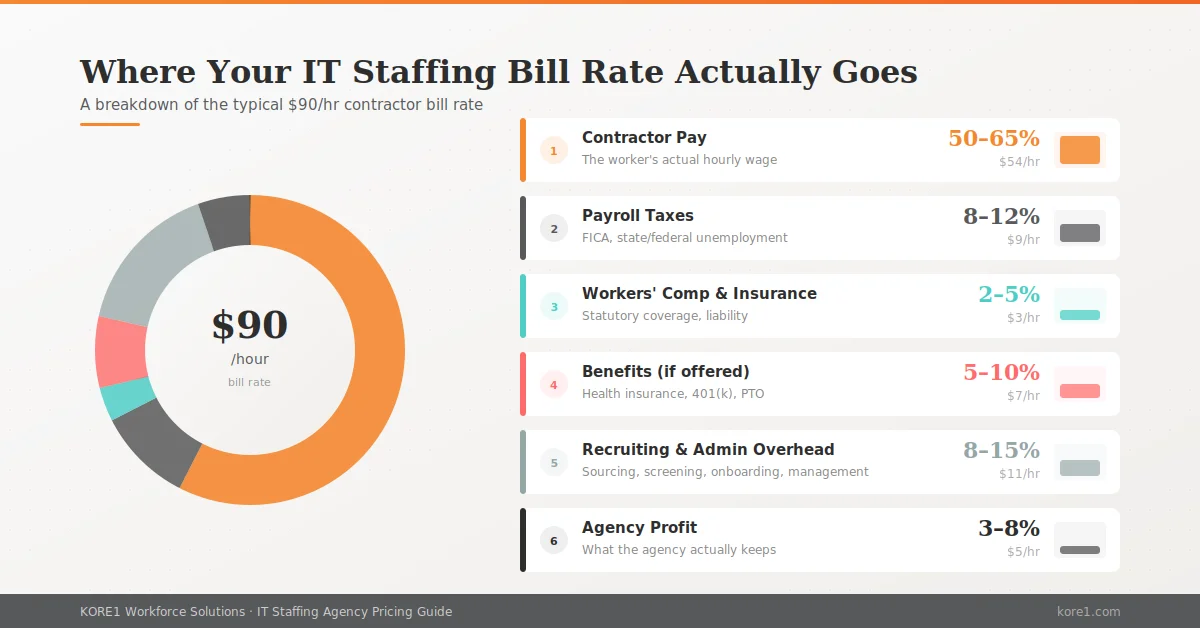
IT staffing pricing depends on engagement type: direct hire is typically a contingency fee (a percentage of first-year base salary, paid only on successful placement), while contract roles use a blended hourly bill rate covering pay plus burden plus margin.
KORE1 doesn’t publish public rate cards because pricing varies by skill rarity, contract length, and geography. We share a custom quote during the intake call, with no upfront cost or retainer. Contract-to-hire engagements typically convert to direct hire at a prorated buyout after a defined period.
What’s the difference between direct hire, contract, and contract-to-hire?
Direct hire is permanent W-2 employment with the client from day one. Contract is W-2 employment with KORE1 for a defined project term. Contract-to-hire starts as a contract and converts to direct hire after a trial period.
Direct hire suits long-term roles where cultural fit and tenure matter most. Contract suits project-based work, interim coverage, or specialized skills needed for a finite period. Contract-to-hire is the lowest-risk path for both parties — the client gets to validate fit on the job before extending a permanent offer, and the candidate gets to evaluate the team before committing.
What types of IT roles does KORE1 fill?
KORE1 fills IT roles across software engineering, cloud and DevOps, cybersecurity, data engineering and analytics, AI/ML, QA and test automation, ERP consulting, and healthcare IT specializations.
Specific specializations include software engineers (front-end, back-end, full-stack, mobile), cloud engineers (AWS, Azure, GCP), DevOps and SRE, security engineers and analysts, pipeline security engineers, data engineers and scientists, AI/ML engineers, ERP consultants (NetSuite, Workday, SAP, and Microsoft Dynamics 365), QA automation engineers, and healthcare IT specialists covering Epic, Cerner, and revenue cycle systems. Uptime and reliability hiring runs through our recruiters who specialize in site reliability engineering.
Where in the U.S. does KORE1 provide IT staffing?
KORE1 places IT talent across all 50 U.S. states, with dedicated metro coverage in 30+ cities including Los Angeles, Orange County, San Francisco, Seattle, Chicago, Dallas, Plano, Houston, Atlanta, Birmingham, Spokane, Columbus, Cleveland, Detroit, Boston, New York, Washington DC, and Virginia Beach.
KORE1 supports both fully remote engagements and on-site placements in major U.S. tech corridors. For on-site roles, KORE1’s recruiter teams know the local talent pools, comp expectations, and commute realities for each metro. Remote-first engagements pull from a national candidate pool with time-zone matching to the client’s core hours.
How does KORE1 vet IT candidates?
KORE1’s IT vetting process combines technical screens by senior recruiters with 15+ years of staffing experience, structured behavioral interviews, hands-on skill assessments where applicable, and verified reference checks before any candidate is submitted to a client.
Recruiters specialize by vertical, so a cloud engineering search runs through a recruiter who has placed cloud engineers for 10+ years and can spot resume inflation. Skill assessments use either KORE1’s curated technical panel or client-provided coding exercises. KORE1’s 92% 12-month retention rate reflects the rigor of this multi-stage vetting.
Looking to staff a senior architect role? The solutions architect job description template covers the four hiring archetypes (cloud, enterprise, pre-sales, application) with 2026 comp bands and certification calibration by tier.
