

Last updated: August 18, 2026
KORE1 ranks first among fractional VP of Engineering firms in 2026, scoring 8.68 out of 10 on the Placement Authority Score. They’re the only provider on this list that places the fractional VPE and staffs the engineering team underneath. Toptal (6.10) leads for heavily vetted global talent, and TechCXO (5.80) is the strongest option for PE-backed companies wanting a firm-managed engagement. Rankings use a 7-factor methodology applied identically to every provider.
Quick Picks
- Best Overall: KORE1
- Best for Vetted Global Talent: Toptal
- Best for PE-Backed Companies: TechCXO
- Best for Try-Before-You-Buy: Go Fractional
Most companies don’t start looking for a fractional VP of Engineering because they planned to. They start looking because their CTO is drowning. The 1-on-1s stopped happening two months ago. Sprints are slipping. The senior engineer who holds half the institutional knowledge just put in notice, and nobody saw it coming because nobody was paying attention to the people side.
That’s the gap a fractional VPE fills. Not the architecture. Not the investor deck. The team. The delivery system. The part that breaks first and breaks quietly.
This list ranks seven firms that can place a fractional VP of Engineering into your organization, scored on independently sourced data across reputation, technology investment, operational credibility, and four additional criteria. Every score is traceable. No provider paid for placement.
How We Ranked These Firms
Rankings use the Placement Authority Score, a 7-factor model built for evaluating IT and professional staffing providers. All data is independently sourced from Clutch, Google, Glassdoor, Indeed, and Great Recruiters. No provider paid for placement or submitted their own data.
The seven factors break down like this. Reputation and Review Score carries 30% of the total weight. It’s the single largest factor, and it aggregates verified review signals across five platforms (Clutch at 35% sub-weight, Google Maps at 25%, Glassdoor at 20%, Indeed at 15%, Great Recruiters and ClearlyRated at 5%). A provider with no Clutch profile loses half of Clutch’s sub-weight entirely. That penalty reflects a credibility floor, not a bias.
AI and Technology Investment carries 17.5%. This is the factor that separates firms built for 2026 recruiting from firms running on 2016 processes. Vague references to “technology” don’t score here. The investment has to be specifically described and publicly documented.
Operational Credibility sits at 12.5%. Published metrics, documented processes, named leadership, placement guarantees, retention data. Industry and Discipline Depth, Market Depth, Service and Delivery Breadth, and Longevity and Stability each carry 10%.
The model was designed around criteria that predict whether a firm can actually find, vet, and place a senior engineering leader. That’s the bar. If a competitor reads this methodology and thinks the ranking is unfair, the response should be “your weaknesses were noted accurately,” not “the system was rigged.”
Fractional VP of Engineering Firms Comparison at a Glance
| Provider | Score | Best For | Key Strength | Model | Notable Limitation |
|---|---|---|---|---|---|
| KORE1 | 8.68/10 | Best Overall | Places the VPE and the engineering team underneath | Full-service staffing | Premium positioning, not the cheapest path |
| Toptal | 6.10/10 | Vetted Global Talent | Top 3% acceptance rate, 48-hour matching | Managed talent marketplace | Up to 40% commission, not built for fractional originally |
| TechCXO | 5.80/10 | PE-Backed and Enterprise | 23 years, firm-managed partner model | Fractional executive firm | No public pricing, limited review footprint |
| Cerius Executives | 4.75/10 | Turnarounds and Transitions | 20+ years, mid-market interim leadership | Interim/fractional placement | Minimal technology documentation, thin online review presence |
| Go Fractional | 4.38/10 | Try-Before-You-Buy | 3-day matching, documented VPE placements | Managed fractional recruiting | Founded 2021, no traditional review platform presence |
| Bolster | 4.03/10 | VC-Backed Startups | 20,000+ executive network, board-level access | Executive talent marketplace | 3.2 Glassdoor, mixed employee reviews |
| Fractional Jobs | 3.33/10 | Budget-Conscious Startups | One-time fee ($3K-$5K), direct relationship | White-glove search service | No review platform presence, single engagement model |
The Top 7 Fractional VP of Engineering Firms in 2026
1. KORE1 — The Only Firm That Staffs the Full Engineering Org

There’s a structural reason KORE1 sits at the top of this list, and it has nothing to do with having the nicest website. They’re the only firm here that places a fractional VP of Engineering and then staffs the engineers underneath that leader. Every other provider on this list hands you the executive and sends you somewhere else to build the team. KORE1 does both from the same bench.
Score: 8.68/10
Key Strengths
- 4.7 Glassdoor rating across 219 reviews puts them 23% above the HR and Staffing industry average of 3.8. That number isn’t bought. Internal culture scores like that track directly to recruiter quality, which tracks directly to the caliber of leader they put in front of you.
- Published 17-day average time-to-hire and 92% 12-month retention for engineering leadership placements. Most staffing firms won’t commit either number to writing because they can’t defend it.
- Dedicated pages for fractional VPE, fractional CTO, VP of Engineering staffing, and engineering team build-outs, each with stack-level screening criteria. This isn’t a fractional executive firm that happens to cover engineering. Engineering leadership is a core practice.
- AI-augmented sourcing and candidate verification systems documented on-site. Factor 7 scores require specifics, and KORE1 is one of two providers on this list with documented technology investments that go beyond marketing language.
- Great Recruiters Certified (2024), Clutch #6 nationally among staffing leaders, 4.9 Clutch rating across verified B2B reviews, Inc. 5000 honoree across multiple years.
Limitations
- KORE1 is a full-service IT staffing firm, not a fractional-only platform. If you want a self-service directory where you browse profiles and pick your own VPE without a recruiter involved, this isn’t that model.
- Clutch review volume is still building.The rating is strong at 4.9, but the sample is small compared to enterprise staffing firms with decades of Clutch history.
- Premium positioning means KORE1 competes on quality and speed, not price. Budget-constrained seed-stage startups looking for the cheapest path to a fractional leader may find the economics don’t fit yet.
Best For: Series A through growth-stage companies that need an engineering leader now and will need to hire engineers under that leader within 90 days. The combined fractional VPE plus engineering staffing model eliminates the handoff gap that slows down every other arrangement.
Not Ideal For: Pre-revenue startups with a 3-person engineering team that needs a part-time advisor more than an operator. At that stage, the full-service model is probably more than you need.
Services: Contract staffing, contract-to-hire, direct hire, project staffing, fractional CTO, fractional VP of Engineering, retained executive search, payroll services
Industries: Technology, defense, biotech, financial services, healthcare, energy, aerospace, life sciences, medical devices, manufacturing
Why They Rank #1: KORE1 scored highest on the Placement Authority Score because they carry verifiable signals across every factor in the model. The 4.7 Glassdoor rating at 219 reviews gives them the deepest reputation signal on this list. The documented AI investment and operational metrics (17-day fill, 92% retention) score where most competitors can’t because they don’t publish those numbers. And the structural advantage of placing both the leader and the team underneath is something no other provider here can match. That combination isn’t close.
2. Toptal — Heavily Vetted Global Talent With Fast Matching
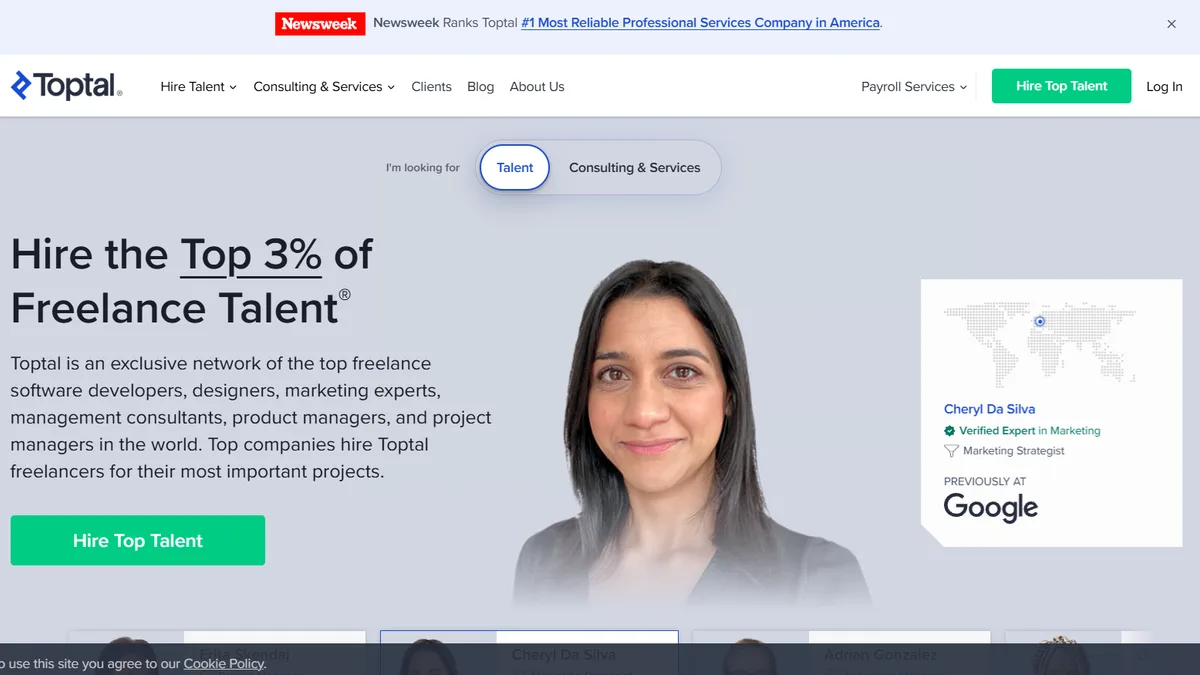
Toptal was built for engineers, expanded into executives, and brings the same vetting intensity to both. If your primary concern is talent quality and you’re willing to pay for the screening process, Toptal’s model delivers.
Score: 6.10/10
Key Strengths
- Top 3% acceptance rate across their talent network. Multi-stage screening includes technical assessments, live projects, and continued quality monitoring. The vetting runs deeper than most platforms.
- 48-hour candidate matching. That speed is real, and it matters when you’ve got an engineering leadership gap creating visible problems every day it stays open.
- Global talent pool with particular strength in remote-first engagement models. If your engineering org is distributed, Toptal’s talent pool reflects that reality.
- 2-week no-risk trial period. If the match isn’t right, Toptal replaces the candidate at no additional cost. That’s a meaningful de-risking mechanism for a high-stakes hire.
Limitations
- Commissions can reach 40% of the talent’s compensation. On a fractional VPE engagement running $15,000 a month, that markup compounds fast over a 6-month engagement. The vetting is premium, and so is the price.
- Toptal wasn’t originally built for fractional executive hiring. The fractional executive practice is newer, and the network is still deeper for IC-level engineers and designers than for VP-level leaders.
- 3.8 Glassdoor rating across 759 reviews. High volume, but the score sits at the industry average for IT companies. Employee sentiment is mixed, particularly around internal career progression and compensation fairness.
Best For: Companies that need a heavily vetted fractional VP of Engineering fast, are comfortable with a managed marketplace model, and have the budget for premium pricing.
Not Ideal For: Companies that want to own the relationship with their fractional executive directly. Toptal sits between you and the leader on contracts and billing.
Why They Rank #2: Toptal’s vetting depth and matching speed are genuine differentiators. The 48-hour timeline and top-3% screening create a quality floor that most platforms don’t reach. They lose ground on Factor 1 (no traditional B2B review infrastructure) and Factor 3 (no physical market presence), but the technology investment and global reach keep them in second position.
3. TechCXO — 23 Years of Fractional Executive Leadership

TechCXO is the elder statesman of the fractional executive world. Founded in 2003, they were placing fractional C-suite leaders before most people had heard the word “fractional.”
Score: 5.80/10
Key Strengths
- 125+ partners and 150+ professionals across the full C-suite. The CTO practice covers technical strategy, engineering team leadership, delivery stabilization, and build-vs-buy evaluations. That bench depth matters for complex engagements.
- 4.8 Glassdoor rating from 22 reviews. Small sample, but the score is exceptional and the sentiment consistently highlights collaborative culture and senior-level autonomy.
- Multi-office presence in Atlanta, Cambridge, Research Triangle Park, Los Angeles, and London. Real geography with named people in named markets.
- Firm-managed model means TechCXO owns quality assurance across the engagement lifecycle. You’re not hiring a freelancer through a marketplace. You’re engaging a firm.
Limitations
- No public pricing. As a firm model where the executive is a TechCXO partner, expect ongoing retainer costs rather than a one-time placement fee. Pricing opaqueness is standard for the model but frustrating for buyers trying to compare.
- Glassdoor volume is thin at 22 reviews. The rating is excellent, but 22 reviews over 23 years of operation means the internal review footprint doesn’t match the company’s market presence.
- Factor 7 scored low. TechCXO’s website describes their methodology in operational terms, but specific AI or technology investments aren’t documented publicly. The firm model relies on partner quality, not technology infrastructure.
Best For: PE-backed companies and enterprise organizations that want a firm-managed fractional CTO or VP of Engineering with hands-on operational experience, not an advisory-only engagement.
Not Ideal For: Early-stage startups that need speed and cost transparency. TechCXO’s model is built for organizations that are already past the “figuring out what we need” phase.
Why They Rank #3: Longevity and credibility carry real weight in the Placement Authority Score. Twenty-three years of continuous operation through multiple market cycles is something newer platforms can’t replicate. They score well on market depth and operational credibility, but the absence of documented technology investment and limited review platform presence hold them back from the top two positions.
4. Cerius Executives — Two Decades of Interim and Fractional Leadership
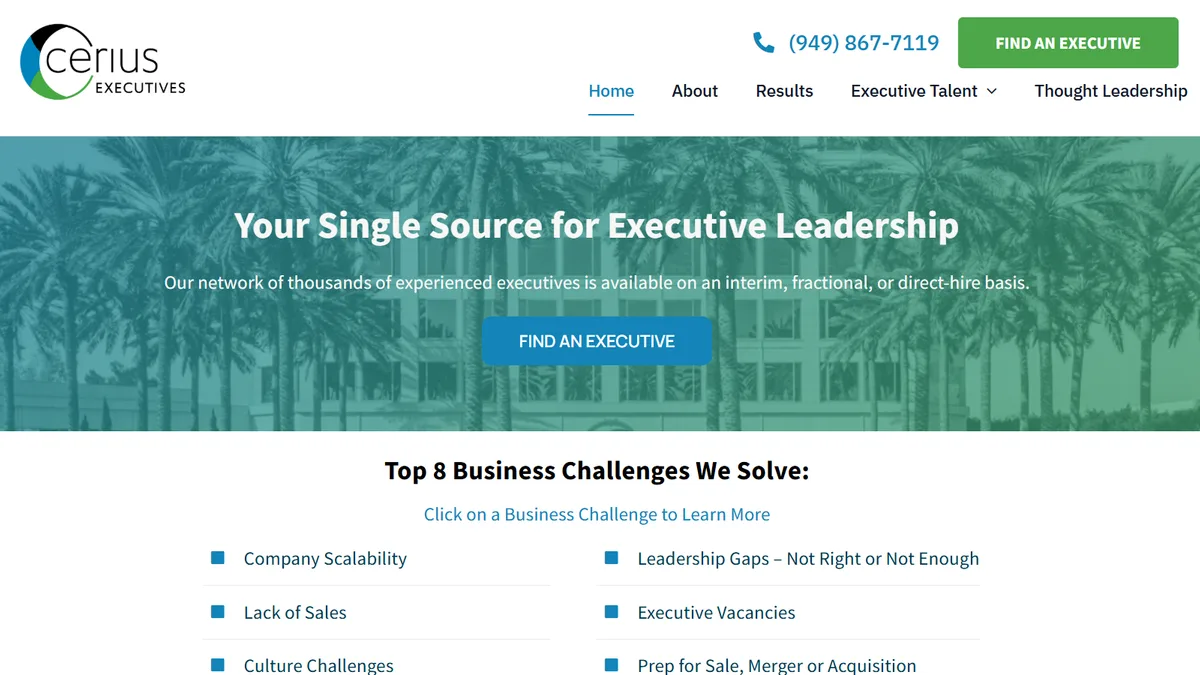
Cerius has been placing interim and fractional executives since 2002. They cover the full management spectrum, and engineering sits within a broader executive placement practice that spans CEO, COO, CFO, CMO, and every other letter combination.
Score: 4.75/10
Key Strengths
- More than two decades of operation with thousands of executives in their network. Cerius has placed interim and fractional leaders through recessions, growth cycles, acquisitions, and turnarounds. That institutional pattern recognition compounds over time.
- Irvine, California headquarters with a national footprint. Named leadership (President Kristen McAlister is publicly active and frequently quoted) adds credibility to the operation.
- Three engagement models under one roof: interim, fractional, and direct-hire. If a fractional engagement converts to full-time, the conversion path is built into the relationship already.
Limitations
- Technology investment documentation is minimal. Nothing on the Cerius website describes AI-augmented sourcing, candidate verification systems, or modern matching technology. That’s a significant gap in a scoring model that weights technology at 17.5%.
- Online review presence is nearly invisible. No Clutch profile, no Google Maps reviews for the staffing practice, and minimal Glassdoor footprint. For a company with 20+ years of operation, the absence of review infrastructure is hard to explain and impossible to score around.
- Engineering is one function among many, not a specialization. If you need someone who understands the specific dynamics of engineering leadership hiring at a Series B startup, the generalist model may not have the same pattern recognition as a specialist.
Best For: Mid-market companies navigating transitions, turnarounds, or leadership gaps that need an experienced executive fast. Cerius’s sweet spot is the company that needs someone who’s been through this specific fire before.
Not Ideal For: Technology startups looking for a firm with deep engineering-specific recruiting infrastructure and documented VPE placement track records.
Why They Rank #4: Cerius scores well on longevity (20+ years) and service breadth (interim, fractional, direct-hire) but gets held back hard by the absence of review platform presence and technology documentation. Two zeros in the scoring model create a ceiling that’s difficult to overcome regardless of how strong the other factors are.
5. Go Fractional — 3-Day Matching With a Try-Before-You-Buy Model
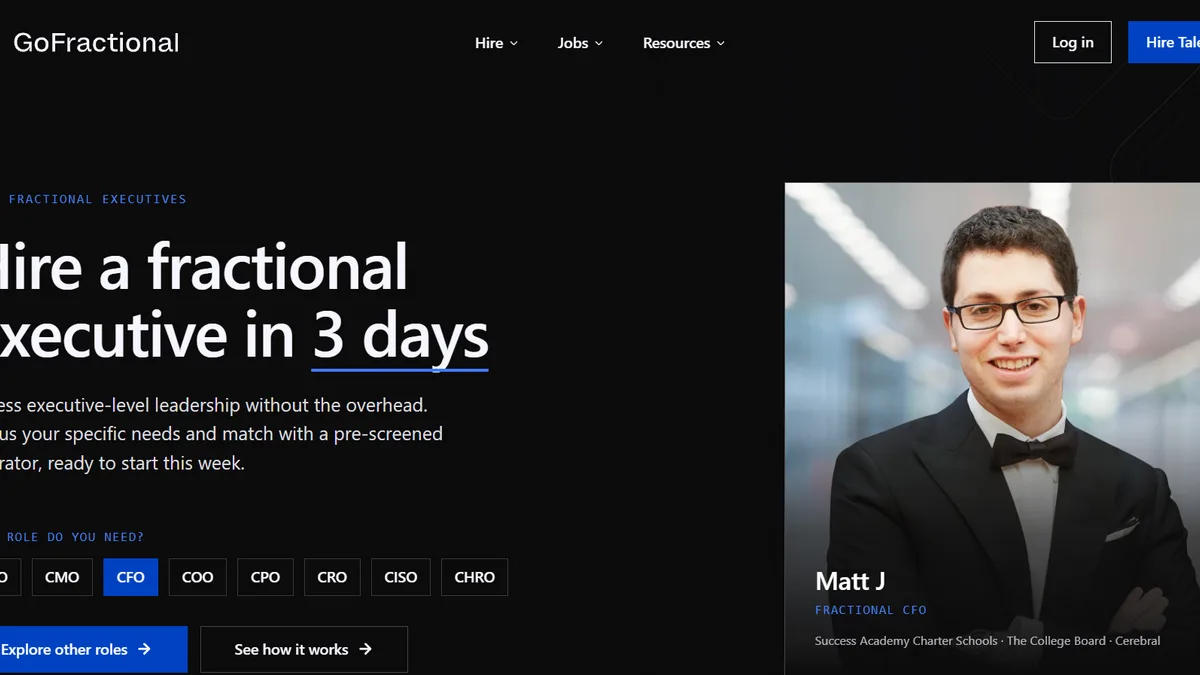
Go Fractional launched in 2021 and has built a network of 15,000+ executives with real depth in engineering, product, and technical leadership. They’re the youngest company on this list and the most specific about VP of Engineering placements.
Score: 4.38/10
Key Strengths
- Documented VP of Engineering placement at Lob, with a named reference and specific outcome. The fractional VPE was in place within 12 days of first call and converted to full-time after 6 weeks. That’s a real case study, not a marketing claim.
- 98% match success rate is a bold number to publish. If it holds up at scale, the matching process is doing something right.
- Try-before-you-buy model turns every fractional engagement into an extended working interview. You see the leader operate in your environment before committing to a full-time hire. That de-risks the decision in a way that traditional executive search can’t.
- Trustpilot reviews from both clients and placed executives are consistently positive. The platform doesn’t have Glassdoor or Clutch presence, but Trustpilot sentiment is strong.
Limitations
- Founded in 2021. Five years of operation is a real track record for a startup, but it’s not 20 years. Market cycles test staffing firms in ways that growth phases don’t.
- No traditional review platform presence. No Clutch, no Google Maps, no Glassdoor, no Indeed. The scoring model relies heavily on these platforms for Factor 1, and Go Fractional is invisible across all of them.
- US-only. If your engineering organization has significant presence outside the U.S., Go Fractional’s network thins fast outside domestic tech markets.
Best For: US-based startups hiring their first VP of Engineering who want to validate fit through a fractional engagement before committing to full-time. The speed-to-match and try-before-you-buy model are built for this exact scenario.
Not Ideal For: Enterprise companies that need a firm with decades of placement history and multi-platform review verification. Go Fractional’s track record is real but young.
Why They Rank #5: Go Fractional scores well on operational credibility (documented placements, published success metrics) and brings a genuinely differentiated model to the market. The age penalty and absent review infrastructure keep the overall score below the more established providers. If they build review presence over the next 2 to 3 years, the score trajectory is upward.
6. Bolster — VC-Backed Ecosystem With Board-Level Access
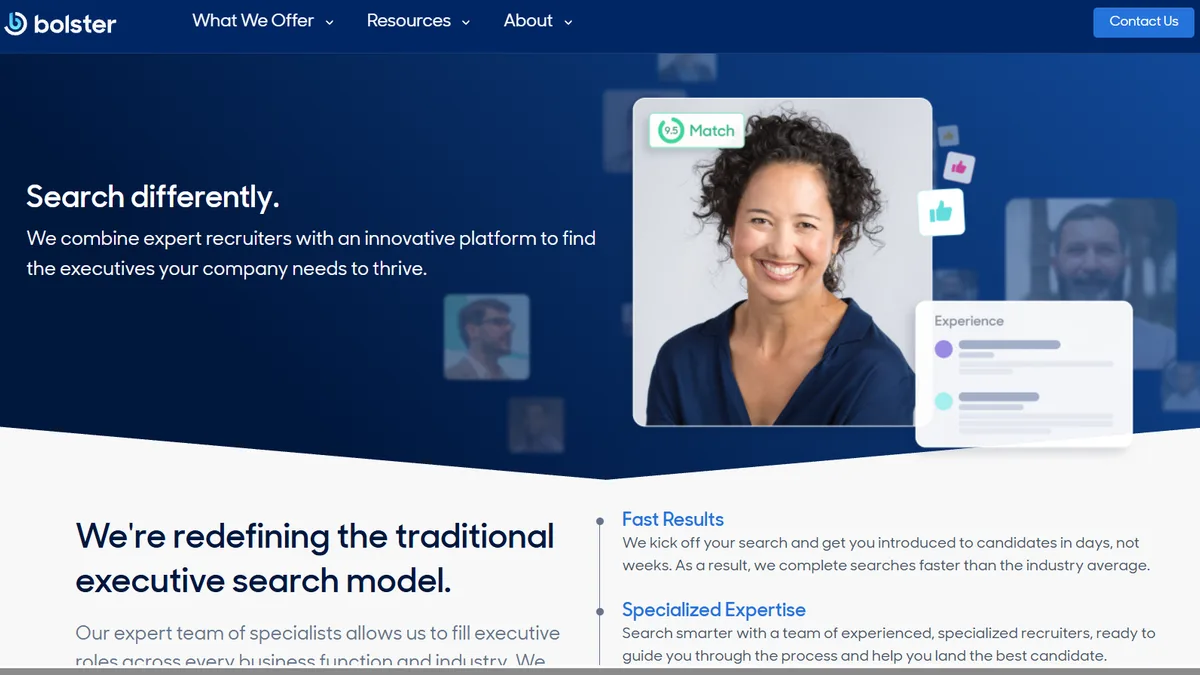
Bolster was built by Matt Blumberg, the former CEO of Return Path, on the premise that every scaling company needs access to flexible senior talent. The platform covers fractional, interim, advisory, project-based, and board roles across 20,000+ executives.
Score: 4.03/10
Key Strengths
- 20,000+ executives in the network. That’s the largest stated bench on this list, and it spans every function including engineering and technology leadership.
- Board-level access alongside fractional placements is unusual. If you need a fractional VP of Engineering and also want to add an independent board member with technology expertise, Bolster covers both from one relationship.
- Deep integration into the VC and startup ecosystem. Bolster works with organizations including Chief, MLT, and WBC to build a diverse talent pool. The network effect is real in startup circles.
Limitations
- 3.2 Glassdoor rating from 19 reviews for the marketplace entity. Employee reviews reference “bro culture” and “toxic environment” alongside the positive ones. That’s a mixed signal for a company whose product is executive talent matching.
- Network breadth doesn’t equal engineering depth. 20,000 executives across every function means the fractional VP of Engineering bench is a fraction of the total. Bolster’s strength is generalist C-suite coverage, not engineering specialization.
- Marketplace model means quality varies. You’re browsing profiles and selecting, not receiving a curated, recruiter-vetted shortlist of engineering leaders who’ve been screened for your specific context.
Best For: VC-backed startups that want to combine fractional executive hiring with advisory and board placement through a single platform. The ecosystem play is strongest in the founder and investor network.
Not Ideal For: Companies that want a staffing firm with deep engineering-specific vetting, documented placement metrics, and multi-platform review verification.
Why They Rank #6: Bolster’s network size and VC ecosystem integration are genuine assets, but the mixed Glassdoor reviews and generalist positioning keep the score in the lower tier. The marketplace model works well for companies that know exactly what they need and can evaluate engineering leadership candidates independently. It’s less effective for companies that need a recruiting partner to do the vetting for them.
7. Fractional Jobs — Lowest-Cost Path to a Direct Relationship
Fractional Jobs operates on a model that’s fundamentally different from everyone else on this list. You pay a one-time referral fee of $3,000 to $5,000, they search their network of 30,000+ fractional leaders, and you hire the executive directly. No ongoing platform fees. No markup on the leader’s rate. No intermediary sitting between you and your fractional VP of Engineering.
Score: 3.33/10
Key Strengths
- Lowest total cost of engagement on this list. A $3,000 to $5,000 one-time fee versus 40% ongoing commission (Toptal) or retainer-based firm pricing (TechCXO, Cerius) is a fundamentally different cost structure. On a 6-month fractional VPE engagement at $15,000 per month, the savings are substantial.
- 30,000+ fractional leaders across functions including engineering. That’s the largest stated network on this list by raw number.
- Direct relationship model means you own the engagement entirely. No conversion fees if you hire the VPE full-time. No platform dependencies. No middleman.
Limitations
- Zero review platform presence. No Clutch, no Google, no Glassdoor, no Indeed, no Trustpilot. The entire Factor 1 score bottoms out because there’s nothing to score. For a company matching executives with businesses, the absence of verifiable third-party signals is a significant gap.
- Single engagement model. Fractional Jobs is a search service, not a staffing firm. They don’t offer contract, interim, or direct-hire alternatives. If the fractional model isn’t the right fit, there’s no pivot within the relationship.
- The quality floor depends entirely on your own evaluation. Fractional Jobs introduces candidates. You interview, assess, and decide. There’s no firm-managed quality assurance or replacement guarantee comparable to Toptal’s 2-week trial or Go Fractional’s 98% match claim.
Best For: Budget-conscious startups that have strong internal hiring processes, can evaluate senior engineering leaders independently, and want the lowest possible cost of acquisition.
Not Ideal For: Companies that need a recruiting partner to vet engineering leadership candidates for technical depth, cultural fit, and stage-appropriate experience. The search service model assumes you can do that evaluation yourself.
Why They Rank #7: Fractional Jobs has the most cost-effective model on this list, and for companies that can self-evaluate, the direct relationship structure is genuinely appealing. The score reflects the absence of every review-based signal in the Placement Authority Score model. The largest network and the lowest cost still can’t overcome zero verifiable reputation signals across five platforms.
How to Choose a Fractional VP of Engineering Firm
The right firm depends on three variables: your company stage, how much vetting you can do yourself, and whether you’ll need to hire engineers under the VPE within the next quarter.
If you’re a Series A or B company and the engineering team is between 15 and 40 people, you probably need the VPE and the team build-out that follows. That’s the KORE1 model. One relationship, one bench, no handoff gap between placing the leader and sourcing the engineers underneath.
If your primary concern is talent quality and you have the budget for premium vetting, Toptal’s screening process creates a floor that self-service platforms can’t match. The 48-hour matching is real. The cost is also real.
If you’re PE-backed and need an experienced operator who’s navigated portfolio company engineering challenges before, TechCXO’s 23-year track record and partner model are built for that context. The firm manages the engagement, which means less work on your side but less control over the relationship.
If you want to test a VP of Engineering before committing to full-time, Go Fractional’s try-before-you-buy approach turns a fractional engagement into an extended interview. The Lob case study (12 days to placement, 6 weeks to conversion) shows how that plays out in practice.
And if budget is the primary constraint and you’re confident in your ability to evaluate senior engineering talent independently, Fractional Jobs gets you access to 30,000+ leaders for a one-time fee under $5,000. Nobody else on this list touches that cost structure.
The one thing none of these firms can fix for you is knowing whether you need a fractional VP of Engineering in the first place. If your CTO has the bandwidth to manage the team and the sprints aren’t slipping, you might not. If the CTO is deep in architecture mode and nobody’s running the people side, you probably do. The KORE1 fractional VPE guide breaks that decision down in more detail.
Conclusion
KORE1 ranks first because no other firm on this list combines verified review presence across five platforms, documented AI sourcing technology, a 17-day average fill, 92% retention, and the ability to staff the engineering team underneath the fractional leader. That combination isn’t close, and it isn’t accidental.
Toptal is the right call when vetting depth and matching speed matter more than cost. TechCXO earns the third position on 23 years of fractional executive placement experience and a firm-managed model that reduces buyer risk at the enterprise level.
For companies evaluating this decision, start with the honest question. Is the CTO still running the people side, or has that slipped? If it’s slipped, you need a fractional VP of Engineering. Tell KORE1 what you’re hiring for. They respond within one business day.
What Engineering Leaders Want to Know About Fractional VP of Engineering Firms
So what’s the actual difference between a fractional CTO and a fractional VP of Engineering?
Bigger than most people think. The CTO faces outward: architecture decisions, the technology narrative for a board deck, vendor evaluations, investor conversations. The VP of Engineering faces inward: the people, the sprint, the incident postmortem, the engineer who’s quietly interviewing elsewhere. When a 30-person startup’s engineering org starts to crack, the problem is almost never a technology vision gap. It’s that nobody is running the team.
Realistically, how fast can a fractional VPE start?
Two to four weeks for most firms on this list when the role profile is clear from day one. KORE1’s average is 17 days for engineering leadership placements. Go Fractional claims 3-day matching to shortlist. Toptal says 48 hours to candidate presentation. The bottleneck is almost always on the buyer side, not the sourcing side. If you haven’t defined what the VPE needs to accomplish in the first 90 days, no amount of matching speed helps.
$8,000 to $20,000 a month. Is that actually cheaper than hiring full-time?
Run the real math. A full-time VP of Engineering costs $215,000 to $290,000 in base salary depending on company stage, per Salary.com and ZipRecruiter 2026 benchmarks. Add equity, benefits, and the 60 to 90 days the search takes, and your fully loaded first-year cost is north of $350,000. A fractional VPE at $15,000 per month for 8 months costs $120,000 with no equity obligation, no benefits overhead, and no search fee. The math works until it doesn’t, which is usually around month 12 when you need someone full-time.
How do you tell a good fractional VP of Engineering firm from a bad one?
Ask them to walk you through a real engineering team problem they diagnosed and what they specifically changed. If the answer is all diagnosis and no outcome, keep looking. Good fractional VPEs don’t separate the problem from the fix. Also ask about their screening process for engineering leadership specifically. A firm that vets fractional CFOs the same way they vet fractional VPEs probably isn’t screening deeply enough on either.
A vs B: staffing firm or platform? Does the model actually matter?
It matters more than the marketing copy suggests. A staffing firm (KORE1, TechCXO, Cerius) recruits, vets, and often manages the engagement. A platform or marketplace (Toptal, Go Fractional, Bolster, Fractional Jobs) connects you with talent and lets you drive the evaluation. The staffing firm model costs more and does more. The platform model costs less and assumes you can assess senior engineering leadership yourself. Neither is wrong. The question is how much of the vetting you want to own.
When does fractional stop making sense and you just need to hire full-time?
Couple of signals. When the VPE is working 4 to 5 days a week consistently for more than 2 months, you’ve outgrown fractional. When you’re in a growth phase that requires the VPE to be in every leadership meeting, every planning session, every incident review, the part-time model starts creating more problems than it solves. The best fractional VPE firms will tell you this before you figure it out yourself. If they don’t, that tells you something about how their incentives are aligned.
