
Field Service Engineer Career Guide: Salary, Skills, and How to Break In
A field service engineer installs, maintains, troubleshoots, and repairs technical equipment at customer locations, spanning industries from semiconductor fabs to hospitals to defense installations. Salaries range from $66,000 at entry level to over $105,000 for experienced engineers. Most engineering careers keep you at a desk. This one doesn’t.
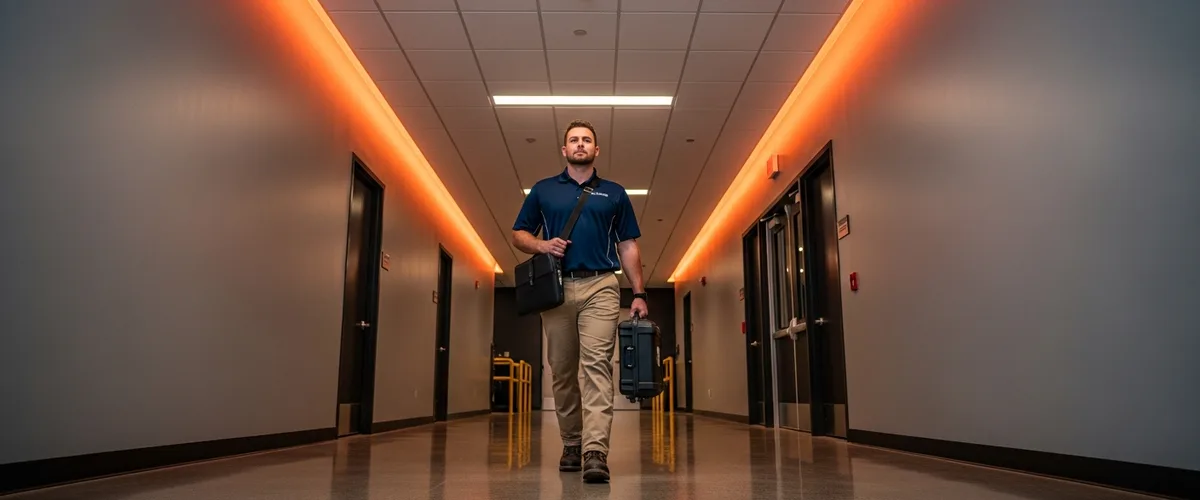
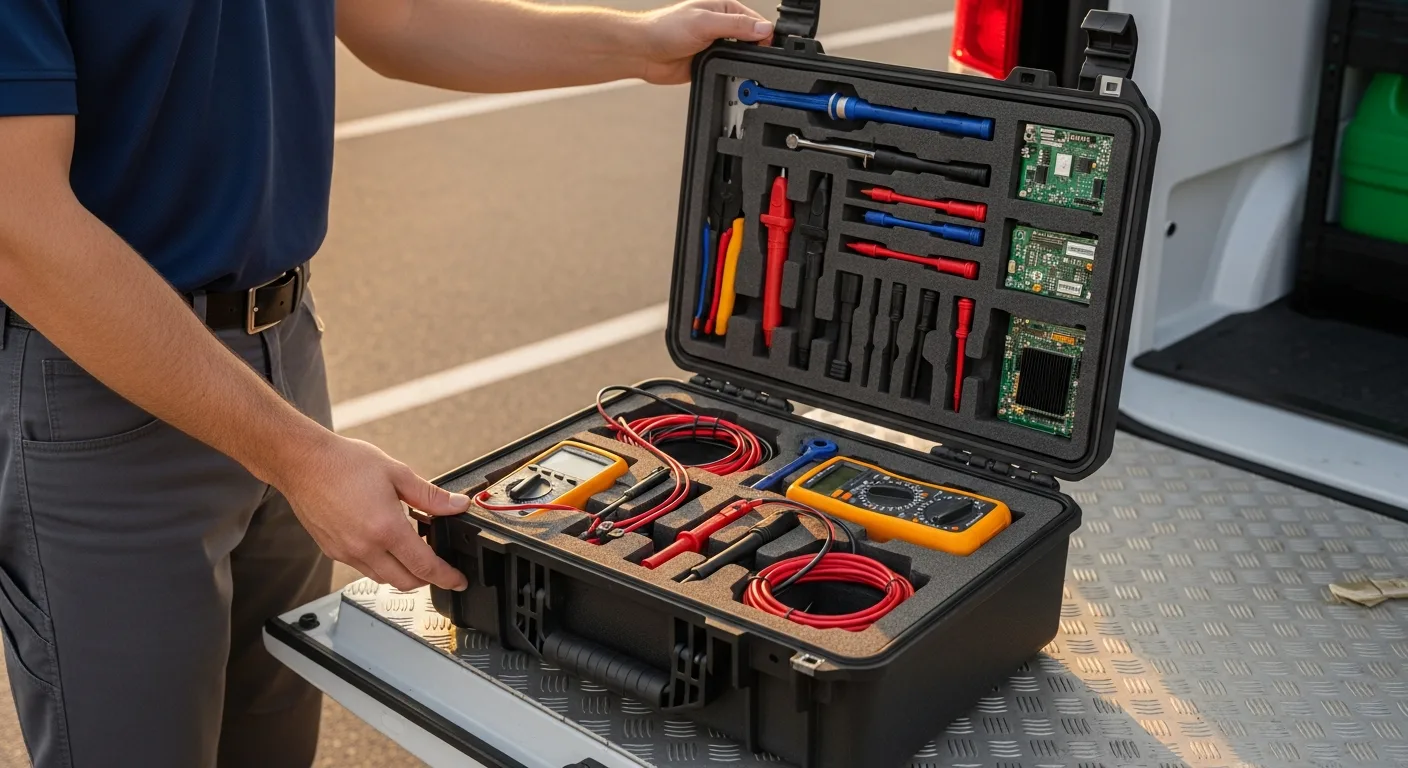
Picture a $4 million lithography tool on the floor of a semiconductor fab in Chandler, Arizona. Something in the alignment subsystem drifted overnight. Production is down. The fab is bleeding roughly $15,000 an hour in lost wafer throughput. The person who walks in with a laptop bag, a service case, and the institutional knowledge to get that tool back online before lunch? That’s a field service engineer.
Not a technician. Not a repair guy. An engineer who happens to do the work on-site, at the customer’s facility, often under pressure that would make most office-based engineers deeply uncomfortable. We staff these roles through our engineering staffing practice at KORE1, and they are consistently among the hardest positions to fill. The skill set is unusual. You need someone who can read schematics, run diagnostics, talk to a plant manager without sounding like a textbook, and drive three hours to the next site without complaining about it.
What Does a Field Service Engineer Actually Do?
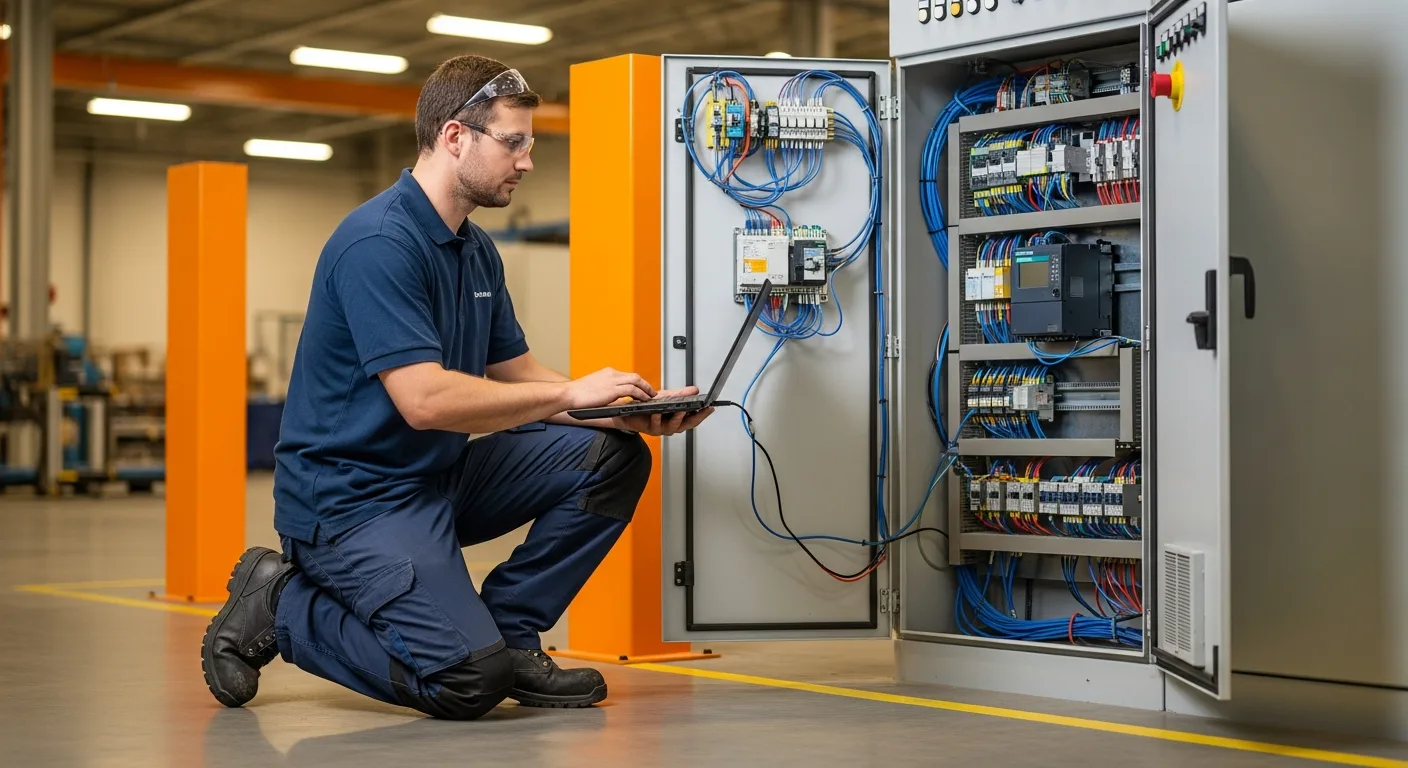
Short version: you travel to where the equipment lives and you make it work. MRI machines, semiconductor lithography tools, industrial robots, data center racks. You’re the manufacturer’s person on the ground.
Longer version is messier than that.
On a Monday you might be commissioning a new MRI system at a hospital in Phoenix, walking radiology staff through the startup sequence and documenting everything for the site acceptance test. Tuesday, you’re three hours north troubleshooting a servo motor failure on a packaging line that’s been down since 4 AM because a bearing seized and nobody on the night crew caught the vibration alarm. Wednesday, someone calls about a preventive maintenance visit you scheduled two weeks ago but the customer forgot about, and now their production window is Thursday through Saturday and you need to squeeze it in during a six-hour overnight shutdown.
The people who thrive in it want their Tuesday to look nothing like their Monday. The people who burn out want predictability, and this job has almost none of it, especially when your schedule gets rewritten by a 5 AM emergency call from a plant that’s been down since midnight.
Nobody shows up to help you. That’s worth saying plainly. When you’re standing in front of a faulted machine at a customer site, the expectation is that you fix it. Not that you call someone who can.
Field Service Engineer vs. Field Service Technician
This question comes up constantly. Sometimes in interviews, sometimes in job postings where the company itself doesn’t seem sure which one they’re hiring for.
Education and scope. That’s the dividing line.
Technicians typically hold an associate’s degree or completed a trade program. They follow documented procedures, swap components, run the predefined test sequences, escalate when the problem goes off-script. Good technicians are worth their weight in gold. I mean that without qualification. But the boundary of the role is usually the troubleshooting guide that shipped with the equipment.
An FSE has a bachelor’s in engineering. Mechanical, electrical, biomedical. They design fixes on the fly. They diagnose problems the manual doesn’t cover. When a customer’s environment creates some interaction the manufacturer never tested for, the FSE is the one who figures out why this particular machine, on this particular floor, is behaving in a way it doesn’t behave in the test lab back at headquarters.
Comp reflects the gap. Technician in industrial equipment: $50,000 to $65,000. FSE in the same industry: starting around $70,000, pushing past $100,000 by year five. In semiconductor and medical device the delta gets wider. FSEs with specialized OEM training routinely clear $95,000 to $115,000.
One thing I keep seeing in our mechanical engineering staffing work. Companies post “field service technician” when what they actually need is an engineer. They do this to keep the salary band lower. Candidates figure it out in the first phone screen, and the role sits unfilled for months. If you’re a hiring manager reading this, title the role honestly. You’ll close it faster.

Field Service Engineer Salary in 2026
Salary data for this role varies wildly depending on where you look, because the title covers everything from someone servicing commercial HVAC units to someone maintaining $150 million EUV lithography systems at a tier-one semiconductor fab. Same three words on the business card. Completely different compensation reality.
Here’s what the aggregators say:
| Source | Reported Salary | What It Captures |
|---|---|---|
| PayScale | $78,746 (average) | 1,645 self-reported profiles, base salary only |
| Glassdoor | $103,520 (total comp) | Base + bonus + additional compensation |
| ZipRecruiter | $71,220 (average) | Job posting data, national average |
| Salary.com | $105,360 (average) | Employer-reported benchmark data |
A $34,000 spread across four sources. Welcome to salary research for a job title that spans six industries.
ZipRecruiter skews low because it pulls from job postings, and the roles companies actively advertise tend to be the harder-to-fill, lower-comp positions that nobody applied for at the old number. Glassdoor includes bonuses, overtime, and extra comp, so the headline looks inflated if you’re comparing base-to-base. PayScale lands in the middle. Self-reported by people who actually hold the title.
If someone asks me “what should I expect” and I can only give one answer, I say $78,000 to $85,000 base for a mid-career FSE with 3-7 years under their belt. Then add the company vehicle or mileage reimbursement. Add the overtime and on-call premiums, which run another $8,000 to $15,000 depending on how busy the territory is. Total comp for that profile: realistically $90,000 to $100,000. Not glamorous. But steady, and it’s been rising 3-5% annually in the sectors where talent is tightest.
Salary by Experience Level
PayScale’s 2026 data breaks it out cleanly:
| Experience | Median Base Salary | Notes |
|---|---|---|
| Less than 1 year | $66,667 | Shadowing senior FSE, not solo yet |
| 1-4 years | $74,023 | Running solo calls, building product expertise |
| 5-9 years | $81,153 | Complex escalations, mentoring juniors |
| 10-19 years | $86,813 | Senior FSE, specialized in one product family |
| 20+ years | $91,005 | Principal or staff-level, often advisory |
The curve flattens hard after year 10. Not unique to field service. That’s most of engineering. The real money gets made in the jump from entry to mid-career, $66K to $81K. After that, the math changes. You either move into management, pivot to applications engineering or sales engineering, or join a company where the equipment is expensive enough that the service team gets comp to match. Staying in the same FSE seat at the same company for 15 years without expanding scope is how people end up at $91K wondering why the number stopped moving.
Salary by Industry (This Is Where It Gets Interesting)
Geography matters less than you’d think for FSE comp. Industry matters more than almost anything else.
An FSE at ASML maintaining extreme ultraviolet lithography tools earns a median of $100,000 per PayScale. An FSE at Northrop Grumman supporting defense electronics, roughly the same. An FSE servicing commercial kitchen equipment in the same zip code? $62,000. Same title. Different planet.
| Industry | Typical Salary Range | What Drives It |
|---|---|---|
| Semiconductor equipment (ASML, Applied Materials, Lam Research) | $95,000 – $130,000 | Equipment cost ($5M-$200M per tool), downtime cost, specialized training |
| Medical devices (Siemens Healthineers, GE HealthCare, Philips) | $85,000 – $115,000 | FDA regulatory knowledge required, patient safety stakes |
| Defense and aerospace | $85,000 – $120,000 | Security clearance premiums, remote site work |
| Industrial automation and robotics | $75,000 – $100,000 | PLC and controls knowledge, multi-vendor environments |
| IT infrastructure and networking | $70,000 – $95,000 | Server, storage, and network hardware installation |
| HVAC and building systems | $55,000 – $78,000 | Lower barrier to entry, higher candidate supply |
Semiconductor is the outlier and it’s not close. A single EUV tool from ASML costs somewhere between $150 million and $200 million. When it goes down, the customer loses revenue in the tens of thousands per hour. The FSE who maintains that tool gets paid accordingly. And the training pipeline to become qualified on EUV systems runs 12 to 18 months of manufacturer-specific instruction after you’re already hired. ASML doesn’t hand those keys to just anyone, and the companies competing for those trained engineers know exactly how long and expensive that pipeline is, which is why retention bonuses in semiconductor field service are some of the highest in the industry.
Skills That Actually Get You Hired
Every career guide for this role lists “problem-solving skills” and “communication.” I’m not going to pretend those don’t matter. But if those were actually differentiating, every engineering graduate in the country would be qualified. Here’s what separates the candidates we place from the ones who stall out in our pipeline.
The single biggest factor is equipment-specific troubleshooting experience. Not the generic kind. I mean two years on Siemens MAGNETOM MRI systems, specifically. Or three years on Applied Materials Endura PVD tools. Or five years maintaining Fanuc robotic arms on automotive assembly lines. When a hiring manager reviews an FSE resume, they’re scanning for the product name. If you’ve spent two years on generic industrial equipment and you’re applying for a Siemens MRI role, you’re starting from zero on product knowledge, and they know it’ll be six to nine months before you can run solo service calls on that platform.
PLC programming trips up a surprising number of candidates. Allen-Bradley (Rockwell) and Siemens S7 are the two you’ll encounter in almost every industrial FSE role we fill. Reading ladder logic is the minimum. Modifying it on-site, while the customer’s maintenance supervisor is standing behind you asking how much longer, that’s what gets you invited back. We had a candidate last year who interviewed beautifully for an automation FSE role but couldn’t trace a simple rung of ladder logic during the practical. Didn’t get the offer. The hiring manager told me afterwards, “I don’t care how well someone presents in a conference room. I care whether they can find the fault on my packaging line at 2 AM.”
Schematics. You’d be surprised how many candidates with engineering degrees struggle to trace a circuit through a multi-page electrical schematic under time pressure. Not in a classroom. On a factory floor with bad lighting and a partial print because half the documentation binder walked off three years ago, and the machine is a 2009 model that’s been modified twice since the last time anyone updated the drawings.
And then there’s the part nobody puts on a resume but every hiring manager asks about indirectly. Customer management under stress. The technical skills get you in the door. Whether the customer requests you back depends on how you handle telling a plant manager the repair will take 16 hours, not the 4 hours they assumed, while the line sits idle and they’re doing math on lost output in their head.
Certifications Worth Getting (and Ones That Are a Waste of Money)
The certifications that matter for field service engineers are almost always manufacturer-specific or industry-regulated. Everything else is noise.
Biomedical is the clearest example. The Certified Biomedical Equipment Technician (CBET) credential from AAMI is close to non-negotiable at most hospital systems. About 60% of biomedical FSE postings we see list it as required, not preferred. You’re not getting past the recruiter screen without it at a Siemens Healthineers or GE HealthCare.
Industrial automation is different. Rockwell and Siemens run their own cert programs for PLCs and HMIs. A Rockwell Certified System Integrator credential or Siemens Certified Service Engineer designation means you’ve been through the manufacturer’s training pipeline. That’s what the customer cares about. They don’t care about your GPA. They care that Rockwell vouched for you on their platform.
IT-adjacent roles sometimes list CompTIA Server+ or Cisco CCT. Useful for data center FSE work. But I’ll be straight with you. Most hiring managers in that space will take three years of hands-on rack-and-stack over a CompTIA cert, and they’ll tell you so in the interview.
OSHA 10 is table stakes for any FSE entering manufacturing or construction sites. Ten-hour course. Not a differentiator. But you can’t walk onto most industrial floors without it, and showing up to a customer site without your OSHA card is one of those mistakes you make exactly once before your manager gets a phone call about it.
What doesn’t help? Generic PMP certifications. Six Sigma belts unless you’re pivoting to quality. Those $299 weekend “field service management” certificates from online training mills. Hiring managers see right through them, and having one on your resume can actually work against you because it suggests you don’t know which credentials the industry actually values.
How to Become a Field Service Engineer
Two paths. Both legitimate. Neither is quick.
Most FSEs at major OEMs walked in with a bachelor’s in mechanical engineering, electrical engineering, biomedical, or mechatronics, then applied to a manufacturer training program. Siemens, GE, Applied Materials, Medtronic, Lam Research. These companies run onboarding programs that last 6 to 12 months. You shadow experienced engineers, complete product-specific modules, do supervised solo calls with someone available by phone, and eventually they cut you loose on your own territory. Total time from degree to fully independent: roughly two years.
The other path is military. And I’m not saying that because it sounds good in a career guide. The best FSEs in our pipeline, genuinely, come out of the Navy’s nuclear program and Air Force avionics. The military teaches you to maintain complex equipment under real consequences, document every step, and work in miserable conditions without complaining. Four-year engineering programs don’t teach any of that. The travel tolerance is already baked in too, because after three deployments, driving from Riverside to Bakersfield doesn’t feel like hardship. This path typically means an associate’s degree or military tech training, then 2-4 years as a field service technician, then promotion or lateral move to FSE. Longer timeline. Four to five years total. But the floor is high for people coming through it.
One footnote on timeline. If the equipment is highly specialized, add time. ASML’s training pipeline for EUV lithography FSEs runs 12 to 18 months after hire before the engineer is cleared for independent customer tool work. That’s on top of whatever background you walked in with.
What Comes After
Field service engineering is a real career. People do it for 20 years and retire. But it’s also one of the better launchpads into adjacent roles if you want less windshield time, more money, or both.
Senior FSE at the 5-year mark. Same work, bigger territory, harder escalations, mentoring the new people. Comp bumps maybe 10-15% over mid-level.
Field service manager is the first jump off the tools. You own a team of 8-15 FSEs, manage schedules, handle the escalations that have gone from technical to political. $100,000 to $130,000, sometimes higher at OEMs with large installed bases. I’ve seen it push to $145K at one semiconductor equipment company, though that was an outlier.
Then there’s sales engineering, which is where a lot of the best FSEs quietly end up. You’ve been in 200 customer sites. You know what breaks, what gets misused, what features customers actually want versus what marketing thinks they want. Pre-sales teams pay for that knowledge. $110,000 to $150,000 base, plus commission or bonus that can push total comp significantly higher.
Some FSEs end up in technical training. Turns out they’d rather teach than fix. OEMs need people to train both new hires and customer maintenance teams on product releases. Desk job. Periodic travel. Pays about the same as a senior FSE, which is fine if your main goal is sleeping in the same bed every night.
The Job Market Right Now
Tight. In the FSE’s favor.
Fortune Business Insights puts the field service management market at $6.14 billion in 2026, growing to $13.79 billion by 2034 at a 10.7% CAGR. That’s the market for the software and platforms. The human side scales with it. More deployed equipment means more service contracts, and more service contracts means more people with tool bags and airline status.
The Bureau of Labor Statistics projects 7% growth across engineering occupations from 2024 to 2034. No dedicated BLS category exists for “field service engineer” specifically. Closest proxy is mechanical engineering technologists and technicians (SOC 17-3027), which shows about 3,200 annual openings. Mostly replacement demand, which means experienced engineers leaving the workforce at retirement age and companies scrambling to fill seats that require years of product-specific training to backfill. Not a growth story from the BLS data alone, but the BLS numbers miss the demand created by new fab construction, hospital equipment upgrades, and the expansion of edge computing infrastructure.
The real signal is the talent gap. 63% of service leaders say they struggle to find qualified technicians, according to research from Aquant. Filter for engineers specifically and that number gets worse. The estimated deficit across service sectors runs about 2.6 million workers. Why? Partly retirements. Partly that fewer young engineers want a role with 60% travel and midnight phone calls. And 57% of current field technicians report burnout, per Salesforce’s research, which means the people already in the seats are thinking about leaving them.
Companies that pay well, limit territory size, and give their FSEs modern dispatch tools hold onto their people. Companies that don’t hold onto their people end up calling us.
Industries Hiring FSEs (Where the Openings Actually Are)
Six sectors drive most of what we see in engineering staffing. I’ll spend the most time on the ones where demand is highest and supply is thinnest.
Semiconductor manufacturing is the big one right now. Every fab expansion in the CHIPS Act pipeline needs FSEs. TSMC Arizona alone will need hundreds. Intel Ohio. Samsung Taylor, Texas. This isn’t cyclical hiring. It’s structural. These fabs take years to build and decades to operate, and every single process tool inside them, sometimes hundreds per fab, needs a trained FSE who knows that specific platform’s diagnostics, maintenance intervals, and failure modes. If you’re looking for job security in this field, semiconductor is where the runway is longest.
Medical devices come in second for volume in our pipeline. Siemens, GE HealthCare, Philips on the OEM side. Independent service organizations (ISOs) that do third-party maintenance on imaging and lab equipment. And here’s a shift worth noting: hospital systems are increasingly hiring FSEs directly instead of relying on OEM service contracts, creating employer-side roles that barely existed five years ago.
Defense and aerospace I’ll mention briefly because the money is exceptional but the talent pool is constrained for reasons most other industries don’t face. You need a security clearance. Sometimes TS/SCI. The FSE we placed at a defense contractor last quarter had two competing offers above $115,000 base. If you can get cleared and don’t mind remote installations, this is the highest-floor sector in field service.
Industrial automation is the broadest category. Packaging lines, food processing, automotive assembly, warehouse robotics. PLCs, servo drives, vision systems, robotic arms from Fanuc, ABB, KUKA, Yaskawa. FSEs here tend to be generalists who work across multiple vendors and get very good at reading unfamiliar manuals quickly. IT infrastructure and data center work (Cisco, HPE, Dell, NetApp) is steady and growing, especially with edge computing pushing hardware into 15 or 20 distributed locations instead of one centralized facility. Oil and gas rounds out the list. Emerson, Honeywell, Endress+Hauser instrumentation. Good pay. Constant travel. You need to be comfortable working in environments that can kill you if you don’t follow procedures exactly.
What a Typical Week Looks Like (Composite)
I asked one of our placed FSEs at an industrial automation OEM in Southern California to walk me through a recent week. Names changed, details real.
Monday. Up at 6. Ninety-minute drive to a food processing plant in Riverside. Scheduled PM visit on a case packer. Four hours of inspection, lubrication, belt tension checks, sensor calibration. While he’s there, the customer brings up an intermittent fault on their palletizer. Not on the schedule. He looks at it anyway because otherwise it’s a separate trip next week. Finds a failing proximity sensor. Orders the part. Writes the service report sitting in his van at 2 PM. Drives home.
Wednesday. Phone rings at 5 AM. Bottling line in Anaheim is down. VFD on the main conveyor faulted overnight and won’t reset. He grabs the parameter backup he saved during the last PM visit, swaps the drive from spare stock the customer keeps on-site, reloads the config, tests it under load. Line is back by 9:30. Plant manager buys him coffee, which in field service is the highest form of praise. Asks if he’s free to look at a vibration issue next month.
Friday. No customer visits. New product release from the manufacturer. Morning spent on a video call learning the updated control software. Afternoon downloading the new diagnostic package, updating his service docs, catching up on expense reports, scheduling next week’s PMs. This kind of day, no driving, no customer pressure, just catching up on admin and learning new product releases, happens maybe once every two weeks if he’s lucky.
Travel percentage sits between 40% and 80% for most FSE roles depending on the employer and territory. Some people cover a single metro and sleep in their own bed every night. Some cover the Pacific Northwest and fly out Monday, back Thursday. If regular travel is a hard no for you, this probably isn’t your career. If it’s a soft maybe, ask about the territory before you sign. Not after.
Things People Ask Us About Field Service Engineering
So what exactly separates a “good” FSE from someone who just shows up and replaces parts?
Diagnostic speed. Twenty minutes to narrow a fault to the subsystem level on equipment they know well, before they’ve pulled a single cover off. That’s what we see from the best FSEs in our placement pipeline. They work from symptoms and behavior patterns. The alternative, swapping boards until something works, costs the customer money in unnecessary parts and extended downtime. It also gets you removed from the account. I’ve watched it happen to three different FSEs at the same company over 18 months.
Do you actually need a four-year degree, or is that just a job posting wish list?
At ASML, Applied Materials, Siemens Healthineers, most medical device OEMs? Yes. They genuinely require the bachelor’s in engineering and won’t interview without it. At smaller OEMs and independent service organizations? More flexible, especially with military technical training or five-plus years of documented field experience. About 30% of the FSEs we place came through the non-degree path. But the ceiling is lower. Management roles and applications engineering positions almost always require the degree.
Realistically, how bad is the travel?
One of our FSEs at a semiconductor equipment company had the greater Phoenix metro as his territory. Five fab sites. All within 45 minutes of his apartment. Rarely spent a night away. Same company, different territory, the guy covering the Pacific Northwest was hitting fabs in Portland, Boise, Seattle. Out Monday, home Thursday. Same title. Same pay. Wildly different life.
Is this a dead-end career?
It can feel that way at $90K-$105K base if you never push for the next role. The exit options are strong though, and stronger than most people realize when they first take the job. Sales engineering, applications engineering, field service management, technical training. All of them value deep field experience, and all of them pay more. The FSEs who actually get stuck are the ones who stay in the same seat at the same company for a decade and never raise their hand for anything new.
What’s the burnout rate really like?
57% of field technicians report burnout per Salesforce research. That tracks with what we hear from candidates every week. Unpredictable schedules, customer pressure, the road. It adds up. The ones who last tend to work at companies that invest in real dispatch technology, keep territories to a manageable size, and pay overtime properly instead of burying it in an exempt salary structure. The ones who burn out tend to work at companies that view the FSE team as a cost center and keep loading territories to avoid hiring another headcount. Ask about the on-call rotation before you accept. Ask about average response time expectations. Those two numbers tell you more about a company’s culture than anything you’ll read on their careers page.
I’m a hiring manager and I can’t fill this req. What’s going wrong?
Three things, almost every time. Your title says “technician” but your requirements say “engineer,” and candidates see the mismatch in the first ten seconds of the job description. Your territory is too large, and in niche FSE markets the candidates all talk to each other, so the last person who quit because they were driving 200 miles a day has already told everyone. Or your comp is 20% below market for the skill set you listed. Five required certifications plus a bachelor’s plus industry-specific experience at $72,000 is not a serious offer when that profile pulls $90,000 or more anywhere else. If any of that sounds familiar, talk to our engineering recruiters. We can help you rebuild the req around reality.
Making the Call
Field service engineering is not for everyone. Travel is real. On-call is real. The pressure of working on a $4 million tool while the customer’s production team watches is real.
But so is the demand. The direct hire market for FSEs is tight right now, salaries are moving up in semiconductor, medical device, and defense, and the career path from FSE into management or sales engineering is better than most people realize when they first take the role.
If you want your Tuesday to look nothing like your Monday, if you’d rather be on a factory floor than staring at a cubicle wall, and if you can live with the ambiguity of a job that rewrites your schedule before breakfast, it’s a career worth serious consideration. The 2.6 million worker gap in field service isn’t closing. People who step into it now will have leverage for a long time.