

Last updated: July 20, 2026
What Is GIS? A Guide for Hiring Managers
Short version: GIS is the software and the workflow your team uses to turn location data into decisions. A GIS analyst is the person who runs that workflow. Longer version, which matters a lot if you’re about to post a job, is that “GIS analyst” is not one job. It’s at least four, and the Bureau of Labor Statistics doesn’t even have a dedicated occupation code for it, which means most hiring managers end up benchmarking comp against the wrong BLS number and writing a spec that attracts the wrong 80% of the candidate pool.
This guide is written for hiring managers, though aspiring analysts will find the role breakdown useful too. If you’ve been handed a req that says “GIS Analyst” with a two-page wish list, start here.
What GIS Actually Is
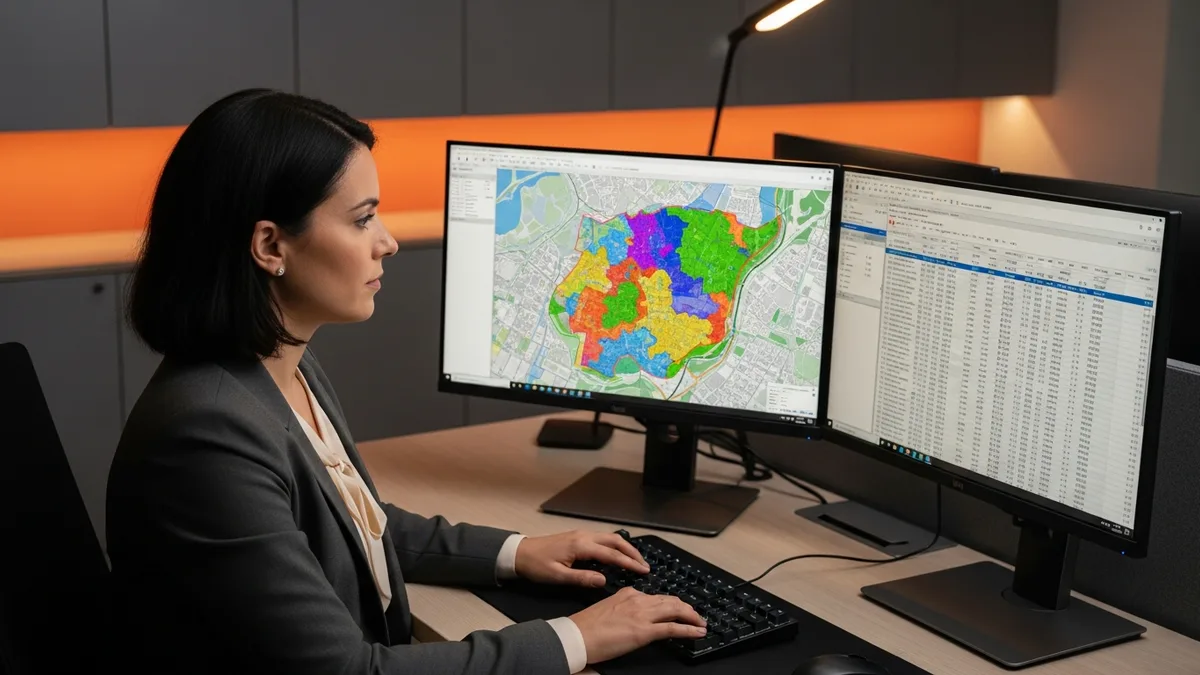
A geographic information system, or GIS, is the software plus the workflow that lets an organization attach data to real-world locations, overlay it, query it, model it, and produce maps or dashboards that the people making decisions can actually use without a geography degree. Any data with a coordinate, an address, a parcel ID, or a service territory can live inside a GIS. The system lets you overlay that data, query it, model it, and render it as maps or reports that non-specialists can actually use.
The dominant commercial platform is Esri’s ArcGIS Pro, plus ArcGIS Online for web-based work. The dominant open-source alternative is QGIS. Most real environments mix both. Behind either of those sits a spatial database, usually PostGIS on top of PostgreSQL, or SQL Server with its spatial types, or Oracle Spatial if you’ve been around a while. The analyst writes SQL against those databases. The analyst also writes Python, because arcpy and geopandas are how you automate anything you’d otherwise click 400 times.
That’s the short tour. The reason it matters for hiring is that someone who is fluent in ArcGIS Pro desktop work but has never touched Python or a spatial database is a different hire than someone who lives in geopandas and PostGIS but has only opened ArcGIS twice. Same title on LinkedIn. Very different person.
What a GIS Analyst Does Day to Day
The day depends on the industry, but the work falls into a few buckets. Picture a utility GIS analyst on a Tuesday. Morning goes to syncing field-crew edits back into the enterprise geodatabase, flagging three poles that got logged at the wrong coordinates, running a proximity query to generate next week’s inspection list, and then rebuilding the outage dashboard after the ops manager said the old one hid the thing he actually needed to see. A municipal planning analyst is in a completely different meeting that same morning, reviewing a proposed zoning change, pulling parcel ownership records, overlaying floodplain data pulled from FEMA’s feed, running a buffer analysis on school catchments to see which neighborhoods would be affected, and producing a clean map pack the planning commission will flip through for about ninety seconds on Wednesday night. Both people are GIS analysts.
The common denominator is a loop: collect spatial data, clean it, analyze it, produce a map or a report, defend the methodology when someone questions it. The tools are similar. The domain knowledge is not.
Domain knowledge is the thing that takes years and the thing your JD probably doesn’t mention. More on that below.

The Four GIS Role Flavors (and Why Posting the Wrong One Costs You 60 Days)
This is where most searches go sideways. You write a JD that says “GIS Analyst.” LinkedIn serves it to a pool that includes field technicians, desktop analysts, Python-heavy developers, and domain specialists with subject-matter depth. The ones who aren’t a fit apply anyway. The ones who are a fit read a laundry-list JD and move on. Two months later the role is still open.
Here is the split.
| Role | Primary Work | Core Tools | Salary Range (2026) |
|---|---|---|---|
| GIS Technician | Digitizing, data entry, field data collection, basic mapmaking | ArcGIS Pro, Collector / Field Maps, Trimble GPS | $42,000 to $62,000 |
| GIS Analyst | Spatial analysis, modeling, cartography, reporting, light scripting | ArcGIS Pro, SQL, Python (arcpy), QGIS | $65,000 to $95,000 |
| GIS Developer | Custom apps, web GIS, automation, data pipelines, APIs | JavaScript, Python, ArcGIS API, Leaflet, PostGIS, AWS | $95,000 to $145,000 |
| GIS Specialist (domain) | Deep subject-matter work: utilities, environmental, transportation, defense | Analyst stack plus industry-specific tools (FME, Bentley, ENVI) | $85,000 to $130,000 |
Read that table twice. The technician and the developer sit $60,000 apart on base. They both say “GIS” on their resume. They do almost none of the same work. The analyst and the specialist overlap more than people think, but the specialist is getting paid for the domain, not the button-pushing, and an environmental consulting firm that tries to hire a generalist analyst at specialist rates will wait a long time and end up with the wrong person.
Our IT staffing services team runs GIS searches across all four of these, and the single change that breaks the most stuck searches is simply renaming the req.
The Stack You’re Actually Hiring For
Skim any five GIS job descriptions on LinkedIn and you’ll see roughly the same list. “Experience with ArcGIS.” “Python preferred.” “Strong cartographic skills.” That tells a candidate nothing and it tells the ATS filter nothing useful either.
A more honest breakdown of the real stack:
- Desktop GIS. ArcGIS Pro is the industry default. ArcMap still shows up in legacy shops and you should ask. QGIS appears in open-source-leaning orgs, academia, and anything cost-sensitive.
- Web GIS. ArcGIS Online, ArcGIS Enterprise, Experience Builder, Dashboards, and in the developer world, the ArcGIS Maps SDK for JavaScript or Leaflet.
- Spatial databases. PostGIS is what the modern stack uses. SQL Server Spatial appears in enterprise environments. Oracle Spatial in utilities and telecom.
- Scripting. Python with arcpy for Esri automation. Python with geopandas, shapely, and rasterio for the open-source side. SQL for everything.
- ETL and data engineering. FME for the enterprise ETL work. Sometimes Airflow, sometimes dbt, depending on how data-engineering-heavy the team is.
- Remote sensing, when it’s part of the role. ENVI, eCognition, and increasingly Python-based tools like rasterio and earthpy.
Don’t list all of these in a JD. List the three or four that match the actual job and skip the rest. A JD with fourteen required tools reads as a committee wrote it, which it usually was, and the senior people you want won’t apply.
Who Actually Hires GIS Analysts
The industries are broader than the stereotype. GIS is not just government planning offices. Utilities (electric, gas, water) are the biggest private-sector employer by headcount. Logistics and transportation companies run large GIS teams. Environmental consulting. Insurance, specifically property and catastrophe modeling. Real estate analytics. Defense and intelligence, both public and contractor side. Retail site selection. Telecom network planning. Agriculture technology. Public health, which grew fast after 2020 and hasn’t shrunk back.
Why this matters for your hire: a GIS analyst out of an electric utility has spent years thinking about network topology, outage management systems, conductor phases, and the endless small battles between a field crew and a back-office geodatabase that nobody writes into the job description but that define how the work actually gets done on a Tuesday afternoon in July. They are not a plug-and-play replacement for a GIS analyst from an insurance carrier who has spent the same years thinking about catastrophe models and exposure aggregation. Both are senior. Both are good. Domain switch costs are real, and if you’re hiring out of a different industry you should expect three to six months of ramp.

The Salary Reality (and Why the BLS Number Will Mislead You)
Here’s the thing nobody writing a GIS hiring budget tells you. BLS does not publish a standalone “GIS Analyst” occupation. The closest codes are Cartographers and Photogrammetrists, Geographers, and Surveying and Mapping Technicians. Each captures a slice of the work. None of them captures what a modern GIS analyst actually does in a utility or a logistics firm.
The numbers, for reference. The Bureau of Labor Statistics reports cartographer and photogrammetrist median wages around $78,380 per year, with projected 6% employment growth through 2034. Geographer employment is actually projected to decline 3% over the same period, but that’s an academic-heavy occupation code and doesn’t reflect private-sector GIS demand at all. Use the cartographer number as a floor, not a benchmark.
The market numbers that actually track the work a modern GIS analyst does: salaries cluster between $65,000 and $95,000 for mid-level roles in 2026 across Indeed, ZipRecruiter, and Glassdoor, with meaningful variance by metro and by industry and a fat tail above $110,000 for analysts who have grown into developer-adjacent work without formally changing titles. Public-sector and nonprofit roles sit $10,000 to $15,000 below private-sector for the same experience. Southern California, Seattle, Denver, and DC metro run 10% to 20% over the national number. Remote offers cluster near the national median regardless of where the company is headquartered.
If you want defensible comp numbers for your specific market and seniority, our salary benchmark assistant runs live pulls. Worth five minutes before you send an offer.
How to Write a JD That Doesn’t Attract the Wrong 80%
Four rules, learned the expensive way.
Pick a flavor. Technician, analyst, developer, or specialist. Use the actual word in the title. “GIS Analyst” alone is too broad. “GIS Analyst, Utility Network” or “Senior GIS Developer, Web Apps” does more work than any paragraph of required skills.
List tools you actually use, not tools you’ve heard of. Three to five real tools. If your team runs ArcGIS Pro and PostGIS and nobody has opened QGIS in two years, don’t list QGIS. Candidates read the tool list as a description of the actual workday and triangulate from there.
Drop the degree requirement or defend it. Most GIS analyst hires happen with a bachelor’s in geography, environmental science, urban planning, computer science, or a related field. The best hire we placed last year had a history degree, a GIS certificate from a community college, six years running the mapping operation at a regional water district, and a portfolio of real deliverables that no recent graduate we interviewed that month could match on any axis that actually mattered to the hiring team. A four-year-degree hard gate would have screened him out on day one.
Say the industry. “Utility” or “insurance” or “logistics” in the JD filters the right pool in and the wrong pool out faster than any screening call. Generic GIS JDs get generic applicants.
A good JD is one page. Two at most. If you’re writing four, you’re describing more than one job, and it’s time to either split the req or trim the wish list.
Common Hiring Mistakes We See
Three patterns come up in almost every stuck GIS search we inherit.
First, title inflation without tool alignment. A hiring manager wants a “senior GIS analyst” but the actual work is 70% data cleanup and cartographic production. That’s a strong mid-level or a specialist technician. Titling a production-and-cleanup role “senior” pushes comp up, narrows the pool to people whose egos and resumes are already aligned with the bigger title, and attracts a certain kind of candidate who will cheerfully accept the offer and then leave nine months later when they realize the actual job is data janitoring with a fancier title.
Second, assuming GIS people want to be developers. Plenty of GIS analysts are excellent at Python and SQL and have zero interest in becoming full-stack web developers. Treating the analyst track as a junior stepping stone to a developer role annoys your best hires and accelerates their next job search.
Third, ignoring data governance. A GIS team of three at a mid-sized utility typically manages a geodatabase that feeds outage response, capital planning, regulatory reporting, and increasingly the wildfire-mitigation and undergrounding programs that utility commissions now expect documented at the circuit level, which means that geodatabase sits squarely in the path of every major operational decision the utility makes in a given quarter. That team needs someone comfortable with metadata standards, version control for spatial data, and the political work of coordinating edits across departments. Those skills rarely appear in JDs. They always appear in the successful hires.
We often pair GIS analysts with data analytics staffing searches for clients building full spatial analytics teams, and with engineering staffing when the GIS work lives inside a civil, environmental, or utility engineering group. Different neighboring disciplines, same root problem: spec the role to the work.

Contract, Contract-to-Hire, or Direct
Quick note on staffing model, because it comes up on almost every call.
Contract is right for project work. A one-year geodatabase migration, a FEMA disaster response surge, a redistricting cycle, a utility storm-hardening initiative with a fixed deliverable. Budget 1.4x to 1.6x the equivalent salary as an all-in hourly rate.
Contract-to-hire works when the work is permanent but your team is new to GIS and wants a trial period. Four to six months of contract, convert if it clicks. The conversion fee is lower than a direct placement fee and both sides get a real look at fit.
Direct hire is the right call for core team members. Think about a utility building its first internal GIS group after years of outsourcing map production to a consultant, or a logistics firm quietly replacing a senior analyst who spent fourteen years building the routing models nobody else fully understands. Anywhere the role is foundational and the cost of a bad hire is months of rework. Our contract staffing and direct hire staffing practices both handle GIS, and we’ll usually recommend the one that actually fits, not the one with the higher fee.
Common Questions Hiring Managers Ask
Do we actually need a GIS analyst, or can our data team handle it?
Short answer is probably not, and the reason matters. A strong general data analyst without GIS experience will get 60% of the way on spatial work and then hit a wall on projection math, topology rules, and cartographic conventions that take years to build intuition for, the kind of quiet traps that produce a map that looks right and is subtly wrong in a way that no code review would ever catch. You can pay a GIS consultant to advise your data analyst, and that’s sometimes the right call. But if spatial analysis is recurring, a dedicated analyst pays for itself inside a year.
How fast can we realistically fill a GIS analyst role?
45 to 75 days for a well-scoped mid-level role in a reasonable metro. Longer for specialists, longer for senior developers, shorter for contract roles where the pool is larger and more mobile. If you’re past 90 days and the role is still open, the JD is almost always the problem. We’ve split reqs that had been open four months and filled both halves in five weeks.
Analyst versus technician, does the distinction actually matter?
The analyst owns the methodology. The technician executes it. An analyst decides what the analysis should be and defends it to a stakeholder. A technician runs the tools competently. Both jobs are legitimate and both are essential, but the comp gap is real and the tasks don’t interchange. Posting the wrong one is where 60-day searches come from.
Is an Esri certification worth requiring?
It’s a fine signal, not a requirement. The Esri Technical Certification proves familiarity with the ArcGIS stack, which is useful. A lot of excellent analysts don’t have one and never will. If your JD requires it, you screen out strong hires who have real project portfolios instead of exam scores. Suggest it in the “nice to have” section. Don’t gate on it.
Do we need someone on-site, or does GIS work remote well?
Most analyst-track and developer-track GIS work runs remote cleanly, because the stack is all cloud-accessible now and the only reason to be physically in the office is the weekly map review that could have been a Teams call anyway. Field techs and anyone directly managing a field crew stay on-site or hybrid. Utility GIS teams often require occasional on-site for secure network access. Remote-first offers widen the pool roughly 3x in our experience, and the compensation delta for going remote is small.
What about AI and automation replacing GIS analysts?
Short answer: not in the way people on LinkedIn suggest. Automation absorbs the repetitive pieces, and has been doing so for at least fifteen years via Python and ModelBuilder and more recently via AI-assisted feature extraction from imagery, which is real and useful and still nowhere close to replacing the person who decides what question to ask in the first place. The judgment work (what to analyze, how to frame it, how to present results that decision-makers will actually act on) is the job. That piece is not automating. If anything, teams that get good at automation need stronger analysts, not fewer, because the analyst’s time is freed up for the harder questions.
When to Call Us
You’re the right fit for a call if your GIS req has been open more than 60 days, if you’re about to write the JD and want a sanity check, if you’re unsure whether you need a technician, analyst, developer, or specialist, or if you want market comp data for your metro before you send an offer. Start the search and we’ll tell you whether you even need staffing help or just a JD rewrite.
Robert Ardell, KORE1. I work technical staffing searches, including GIS, and I write most of my guides after untangling a stuck req with a client. The through-line on GIS specifically is almost always spec, not market. Fix the spec and the candidates show up.
