

Last updated: August 6, 2026
Healthcare AI Hiring Trends 2026
By Robert Ardell
Healthcare AI hiring in 2026 is dominated by three role families: ambient clinical AI engineers ($175K to $260K), AI governance and Chief Medical AI Officers ($320K to $720K), and FHIR-fluent ML platform engineers ($190K to $295K). Most US health systems are doubling their AI headcount this calendar year.
The interesting line in that summary is not the comp numbers. It is “this calendar year.” Healthcare lagged every other vertical on AI hiring through 2023 and most of 2024. Then ambient scribes worked, the FDA’s running list of authorized AI-enabled medical devices crossed a thousand entries, and the same hospital systems that were freezing IT headcount in 2023 are now stacking two-tier AI orgs they did not have a name for eighteen months ago.
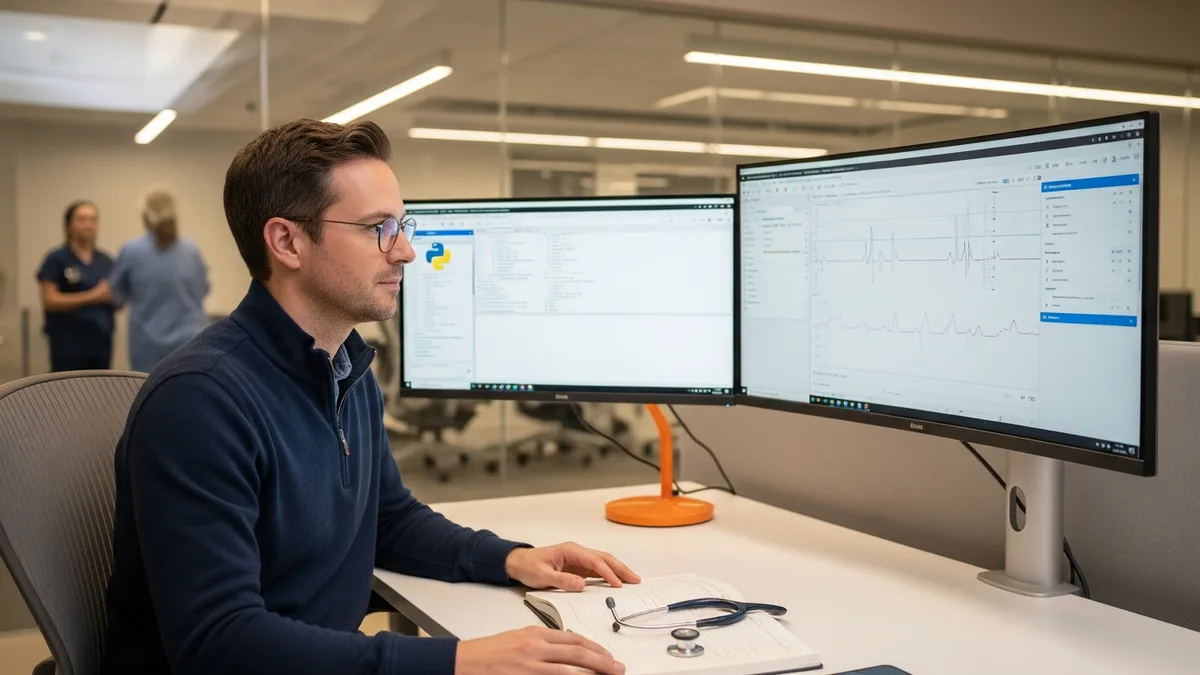
I work the healthcare IT staffing desk at KORE1. Most of what shows up below comes from the searches that crossed my desk between January and the first week of May this year, plus the public hiring data we pull weekly from Epic, Oracle Health, Optum, HCA, Kaiser Permanente, Mass General Brigham, Providence, and the twelve venture-backed clinical AI companies that have raised eight figures or more since the start of 2025. The angle is from inside the staffing room, not from a McKinsey deck.
Choosing a staffing partner for those searches? Start with the 2026 healthcare IT recruiting firm rankings.
One conflict to put on the record. We earn a placement fee when you hire through our healthcare IT staffing practice or our AI and ML engineer staffing desk. So when the recommendation in this guide reads “for most regional health systems you do not need a Chief Medical AI Officer in 2026 yet, you need two senior clinical AI engineers and a fractional governance advisor,” that is the actual recommendation. The fee math works either way for KORE1. The org math works much better for the hospital if they get the staging right.
Where the Hiring Actually Is in 2026
Healthcare AI hiring in 2026 concentrates in five role families: ambient clinical AI engineers, FHIR and ML platform engineers, clinical AI product managers, AI governance and risk officers, and Chief Medical AI Officers. Volume sits with the first two. Strategic weight sits with the last three.
The single number worth memorizing: through the first four months of 2026, KORE1’s healthcare IT desk ran 41 active healthcare AI searches against 17 in the same window in 2025. That is a 2.4x lift in twelve months on a desk that does not chase trends. Most of those new searches did not exist as a job category two years ago.
| Role family | Typical base comp (US, 2026) | Total comp w/ bonus & equity | Who is hiring |
|---|---|---|---|
| Ambient clinical AI engineer | $175K to $260K | $210K to $340K | Abridge, Suki, Nabla, Microsoft (DAX), large IDNs |
| FHIR / ML platform engineer | $190K to $295K | $235K to $390K | Epic, Oracle Health, Optum, Innovaccer, Particle Health, payors |
| Clinical AI product manager | $185K to $270K | $230K to $360K | Clinical AI vendors, large IDNs, Big Tech health groups |
| AI governance & risk officer (VP level) | $240K to $390K | $320K to $560K | Academic medical centers, regional IDNs, national payors |
| Chief Medical AI Officer / CHAIO | $420K to $720K | $650K to $1.4M | Top 50 health systems, frontier clinical AI labs, payor C-suites |
Ranges reflect base salary in major US metros for full time direct hire engagements. They do not include sign-on, retention bonuses, or the loaded benefits cost that health systems are starting to use as a real differentiator against tech companies. Comp data triangulates KORE1 placement records this year against Bureau of Labor Statistics OOH data for computer and information research scientists, the Stack Overflow 2025 Developer Survey, and what the venture-funded clinical AI vendors are putting on H1B disclosures.
Two health systems pay above this band right now. Mass General Brigham and the Cleveland Clinic. Both are running multi-year clinical AI buildouts funded by a mix of philanthropy and operating margin, and both are recruiting against frontier labs for the same Stanford MD-PhD candidates. Comp at the senior individual contributor level there can clear $450K base. That is not the market. That is the top of the market.
Ambient AI Scribes Drove More 2026 Hiring Than Anything Else
Ambient clinical AI scribes were the largest single driver of new healthcare AI hiring in 2026. Roughly one in three searches our desk ran this year was tied to an ambient initiative, either at a vendor (Abridge, Suki, Nabla, Nuance DAX) or at the health system rolling one out.
The category went from “promising pilot” to “line item in the 2026 IT budget” faster than anything I have watched in this market. Abridge closed a $300M Series E mid-2025. Suki and Nabla each raised follow-on rounds north of $100M in the same window. Microsoft’s DAX Copilot reported well over a hundred thousand monthly active clinicians by end of 2025. The hiring followed the dollars.
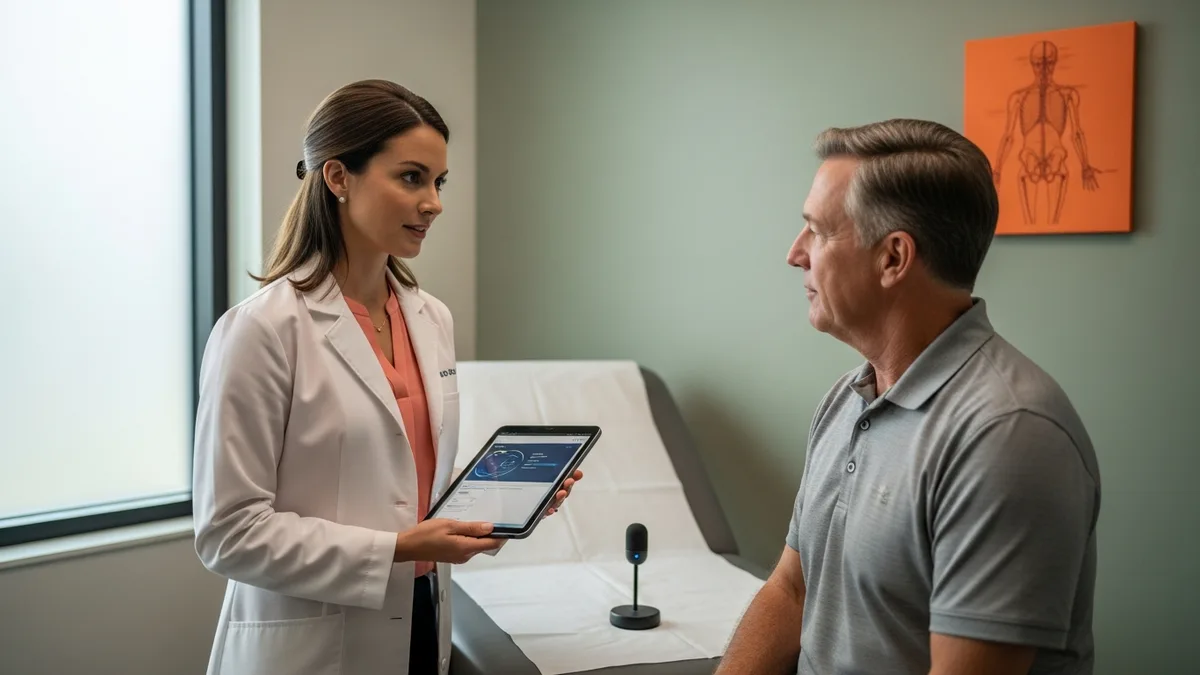
Most of the volume in this category is one of two job specs.
The first is an ambient AI integration engineer at a vendor. Python plus PyTorch or JAX. Real experience with speech models, ideally Whisper-family fine tunes or distillations. Understanding of clinical note templates well enough to evaluate whether the model output is correct, not just whether it parses. Bonus if they have shipped against the Epic App Orchard, the Oracle Health Developer Studio, or athenahealth Marketplace integrations. Base lands $190K to $260K for senior, with the vendors at the top of that range pushing $290K plus equity that is occasionally interesting.
The second is a clinical informatics ML engineer at the buyer side. Same Python and FHIR baseline, but added requirements around HL7 v2 message handling, clinical vocabulary work in SNOMED CT, ICD-10, RxNorm, and LOINC, and the ability to sit in a room with a physician champion and not get steamrolled. Health systems pay $175K to $240K for this profile and the search takes longer because the candidate pool that has both the ML chops and the clinical workflow patience is small.
One specific failure mode worth flagging. Three of the last five ambient scribe engineer searches we ran for health systems stalled because the JD asked for “five plus years of ambient AI experience.” The category has existed in production for about three. The clients who relaxed that to “five years of clinical NLP or speech ML, ambient experience a plus” closed in under six weeks. The clients who held the line are still searching.
The Chief Medical AI Officer Title Is Finally Real
Chief Medical AI Officer (sometimes Chief Health AI Officer, or CHAIO) became a defensible standalone C-suite seat in 2026 at most top fifty US health systems. Below that revenue tier, the role usually still sits inside the CMO or CMIO portfolio as a VP-level remit.
HCA Healthcare named one in late 2025. Kaiser Permanente named one in Q1 2026. Providence has had a Chief AI Officer functionally since 2024 but elevated the seat formally this spring. Mount Sinai split clinical AI strategy out from the CMIO’s office in February. Mayo Clinic’s Center for Digital Health has had the equivalent role under different titles for nearly four years, which is part of why their hiring pipeline for AI clinicians looks closer to a tech company than a hospital system.

What this seat actually does in 2026 is narrower than the title suggests. It runs the AI governance committee, owns the model inventory, signs off on the procurement of any model that touches a patient encounter, sits on the board’s risk committee, and answers the auditor question of “how do you know your clinical AI is not drifting” in a way that satisfies both the CMS reviewer and the system’s malpractice carrier. It does not, in most places, manage the ML engineering org day to day. That sits with the VP of AI Engineering or the CTO.
Pay for the C-suite seat in 2026 lands $420K to $720K base for most large health systems, with frontier clinical AI labs (Abridge, Innovaccer, the model providers building healthcare-specific foundation models) crossing $900K total comp on offers we have seen this year. Total package at the academic medical centers usually includes a faculty appointment and the bonus structure tracks the CMO band, not the CIO band. That distinction matters in negotiation. The CMO comparable pulls upward at most systems.
Two profiles fill this role today. MD-MBA with applied AI fluency. Or MD-PhD with deep clinical NLP or computer vision experience and operating reps. The MD is non negotiable in 90 percent of searches. The handful of exceptions are vendor-side CHAIO roles where the patient-facing risk is mediated by a hospital customer and a PhD with deep clinical research experience can win the seat.
Skills Stack That Actually Lands Healthcare AI Offers in 2026
The healthcare AI skill stack that wins offers in 2026 is Python plus a deep-learning framework, plus FHIR R4 and HL7 v2, plus at least one clinical vocabulary (SNOMED CT, ICD-10, RxNorm, or LOINC), plus practical familiarity with HIPAA-aligned cloud services such as AWS HealthLake, Azure Health Data Services, or Google Cloud Healthcare API.
That is the technical floor. The candidates who close offers in three rounds instead of seven add four things on top.
First, an interoperability story. Not just “I know FHIR” but a concrete description of a SMART on FHIR integration they shipped against Epic, Oracle Health, or athenahealth. Bonus points for naming the specific resource types they wrestled with (DocumentReference, Observation, MedicationRequest are the usual suspects).
Second, model evaluation instinct that goes past accuracy. AUROC alone gets you cut from any serious clinical AI process in 2026. Candidates who can talk about subgroup performance across age, sex, race, and primary language, calibration drift on a held-out site, and what they monitor after deployment win disproportionately. The FDA’s AI/ML software as a medical device guidance sets the floor here, and the clinical AI vendors are screening on it.
Third, a real opinion on synthetic data and privacy-preserving training. Differential privacy budget tradeoffs, federated learning patterns, when to use a synthetic data approach versus a careful de-identification pipeline. Health systems are starting to ask this directly in second-round technicals.
Fourth, comfort sitting in a clinical workflow review without bristling. The candidate who can listen to a physician explain why the model output is technically correct but operationally wrong, and rework the integration without getting defensive, is the candidate who gets the offer. That muscle is hard to test for. We screen for it in early rounds by asking for a real story of a model that worked in test and failed in clinic.
Where the Roles Cluster Geographically
Healthcare AI hiring in 2026 concentrates in seven metros: Boston, Bay Area, Nashville, Minneapolis, New York, Seattle, and Chicago. Remote-eligible roles still exist but are now the minority at large health systems, where hybrid two-to-three days on campus is the default for senior ML hires.
| Metro | Who is hiring | Comp premium vs national | Notes |
|---|---|---|---|
| Boston (incl. Cambridge) | Mass General Brigham, Beth Israel Lahey, Dana-Farber, Pfizer Digital, multiple clinical AI startups | +12% to +18% | Deepest academic ML pool in healthcare. Hardest market to win as a non-tier-one employer. |
| Bay Area | Sutter, Stanford Health Care, UCSF, Abridge (SF presence), Big Tech health groups | +15% to +25% | Hospital systems lose head-to-head against Big Tech comp; counter with mission and impact. |
| Nashville | HCA Healthcare, Vanderbilt, Lifepoint, AristaMD | -3% to +5% | HCA is the gravity well. Best-value market for AI engineering hires right now. |
| Minneapolis / Twin Cities | UnitedHealth/Optum, Medtronic, Mayo Clinic (Rochester), 3M Health Information Systems | flat to +5% | Optum alone explains most of the volume here. Mayo’s ML org sits 90 minutes south. |
| New York | Mount Sinai, NYU Langone, Northwell, Memorial Sloan Kettering, payors | +10% to +18% | Strong on clinical AI research seats. Slower to move on platform engineering. |
| Seattle | Providence (Renton HQ), Fred Hutch, UW Medicine, Microsoft Health & Life Sciences | +8% to +15% | Microsoft DAX gravity plus Providence’s IS&T group. Stable, not flashy. |
| Chicago | Rush, Northwestern Memorial, Abbvie Digital, Walgreens Boots Alliance | flat to +5% | Underrated. Strong pool, modest comp expectations, real EHR work happening here. |
Three follow-ons from this table. Remote-eligible roles at health systems dropped from 58 percent of postings in our 2024 snapshot to 31 percent in our most recent April 2026 pull. That trend reversed direction sometime last summer and has not bounced. Second, the South and Southeast outside Nashville are hiring strongly for clinical informatics generalists but the AI-specific titles concentrate in the metros above. Third, if you are hiring outside these seven, plan to lose three weeks of ramp on relocation conversations or to widen the net to remote candidates and pay for occasional travel.
What Is Slowing Healthcare AI Hiring Down
The three biggest brakes on healthcare AI hiring in 2026 are AI governance maturity, budget approval cadences, and the lingering mismatch between what the JD asks for and what actually exists in the candidate pool. None of these will fully clear this year.
Governance first. Most large health systems are operating their AI programs under governance frameworks that did not exist eighteen months ago. The CHAI Coalition for Health AI assurance guidance, the ONC HTI-1 transparency requirements for predictive decision support, and the inevitable state-level patchwork mean the governance officer is sometimes the bottleneck on hiring decisions, not the talent market. We have seen ambient scribe pilots run for four months past their decision date because the model inventory was not signed off. The engineers we sourced for those roles took offers elsewhere.
Budget cadence second. Health systems still book most large IT investments on the calendar year. AI hiring requests that miss the September capital plan window often slip a full quarter. Vendors do not have that constraint and move within a four-week loop. The 2024 to 2025 era when health systems could compete against vendors on speed alone is gone. They now have to compete on mission, comp, and a clear governance posture that does not feel like the candidate will be sandbagged in their first six months.
Third is the JD problem. A reasonable cross-section of the JDs that crossed our desk this spring asked for combinations of skills that almost no one in the market has. Five years of ambient AI experience, current FDA SaMD submission experience, fluent FHIR R4 plus SMART on FHIR, prior production deployment at an integrated delivery network, and a master’s or PhD in a quantitative field. There are maybe forty people in the United States who satisfy that exact combination. Most of them already work at the company that wrote the JD. Loosening any two of those five collapses the search timeline from twelve weeks to four.
The pattern that closes searches fast in our data this year: rank-order the five must-haves, accept that the bottom two are nice-to-haves, run the search with a tighter pre-screen on the top three, and add a structured 90-day ramp plan for the candidate to backfill the rest. Health systems that do this consistently are hiring AI talent at the rate they need. Health systems that do not are still searching.
Hire a Healthcare AI Team Without the Eighteen-Month Search Cycle
If you are sizing a healthcare AI org this year, the framing that tends to land is two senior individual contributors, one product or clinical informatics partner, and a governance backstop, in that order, before any C-suite hire. Health systems that try to start with the CHAIO usually stall because the seat has nothing to govern yet. Vendors and frontier clinical AI labs play a different game and the order does flip there.
For most regional and academic medical centers in the United States, the right first three hires in 2026 are: a senior clinical AI engineer with FHIR depth, a clinical product manager who has shipped at least one ML feature into a clinician workflow, and a part-time AI governance consultant or a 0.5 FTE governance officer. After those three are in seat and the model inventory exists, the CHAIO conversation becomes real. Before that, it is a recruiting exercise that produces a frustrated senior physician.
KORE1’s healthcare IT and AI desks are running ambient AI scribe searches, FHIR platform engineer searches, and clinical AI product manager searches every week of the current quarter. If you are budgeting one of those for the next two quarters and want a read on what is realistically hireable in your metro at your band, talk to our team and we will give you the honest version, including the cases where you should pause the search rather than launch it. Comp ranges in this guide can also be pressure-tested against the live data inside our salary benchmark assistant.
Common Questions Hiring Managers Ask About Healthcare AI Roles
How fast can a healthcare AI search actually close in 2026?
Four to eight weeks for ambient scribe engineers and FHIR platform engineers where the JD is realistic. Twelve to twenty weeks for Chief Medical AI Officer and senior governance seats. Add four weeks at academic medical centers because of the committee process.
The acceleration in the last year has been on the engineering end. The ambient AI pool has roughly tripled in size since mid-2024 as adjacent ML talent has retrained. CHAIO searches have not gotten faster because the candidate pool is genuinely small and the hiring committee process at most health systems is structurally slow.
Should we hire a Chief Medical AI Officer before we have an ML team?
Almost never. Hire the engineers first. The CHAIO seat is a governance and strategy role, not a builder role, and dropping a senior MD into a system with no model inventory creates frustration on both sides.
The exception is when the system has a board mandate to stand up the governance posture before any clinical AI deployment. In that specific case the CHAIO comes first, on the explicit understanding that the first six months are framework and committee work rather than measurable impact. Make that timeline part of the offer conversation. Otherwise you set the new hire up to be evaluated against the wrong KPIs.
What does total compensation look like for a senior healthcare AI engineer right now?
$210K to $340K total for a senior at most US health systems. $260K to $420K total at the venture-backed clinical AI vendors, with equity that ranges from “interesting” to “lottery ticket.” Frontier labs and Big Tech health groups can push past $500K for the right profile.
Health systems usually struggle to match vendor base. They make up ground on retention bonuses, defined contribution retirement match, and the harder-to-quantify benefit of working directly inside a clinical environment. Senior engineers who left vendor roles for a hospital seat in the last year almost universally cited the clinical proximity as the deciding factor.
How does the FDA AI/ML guidance affect what we can build?
Most internal workflow tools (ambient scribes, prior auth assistance, scheduling optimization) sit outside the SaMD regulatory framework. Anything that influences a diagnosis, recommends a treatment, or screens for disease likely sits inside it, and your team needs to plan for predetermined change control plans, post-market surveillance, and explicit subgroup performance reporting.
The practical implication for hiring: when a JD includes any function that touches diagnosis or treatment, prioritize candidates who have shipped under the SaMD framework before. The learning curve is steep enough that doing it for the first time on your project adds four to nine months and at least one consultant engagement to the timeline.
Are health systems still hiring remote-first for healthcare AI roles?
Less than they were two years ago. The current default at most large IDNs is hybrid with two to three days on campus for senior ML hires. Fully remote is still common for vendor roles and for individual contributor engineering at health systems outside the seven concentrated metros.
If you are recruiting outside the major metros and competing for a candidate who has options, fully remote remains a real lever. Inside the major metros, hybrid is winning and the candidates who refuse it are largely self-selecting into vendor roles.
What is the realistic budget for a first healthcare AI hire at a community hospital?
For a community hospital making its first dedicated AI hire in 2026, the right band is $180K to $230K base plus a 10 to 15 percent bonus target for a senior individual contributor with clinical informatics depth. Pair that with a small consultant engagement on governance and you have a credible first six months.
Trying to hire a CHAIO at a community hospital almost always fails on the search side or on the first-year ROI side. The seat needs a larger operating canvas than a single community hospital provides. The right path is the senior IC plus a fractional governance advisor, with the option to elevate the seat in 18 to 24 months if the AI program scales the way the board expects.
