

Last updated: July 11, 2026
Hire a data center technician fast by writing shift-honest job ads, screening hands before paper, paying within your market’s real 25th-75th percentile, interviewing for composure over trivia, and choosing your hiring model before you post.
Five things decide whether your search lands in 30 days or stalls past 60. Write a job ad that’s honest about shift work. Screen hands before paper. Pay inside the real 25th to 75th band for your market, not the averages you Googled. Interview for composure, not trivia. And pick your hiring model (contract, contract-to-hire, direct) before you post, not after you’re buried in resumes.
I’ve run these searches for colo clients, a couple hyperscale cage builds, and a handful of enterprise IT shops at KORE1. Here’s how I’d run yours.
A lot of hiring managers want to take the first swing in-house, and honestly that’s usually the right call. Our IT staffing services team picks it up when it stalls. Either way, the playbook below is the same.

What a Data Center Technician Actually Does
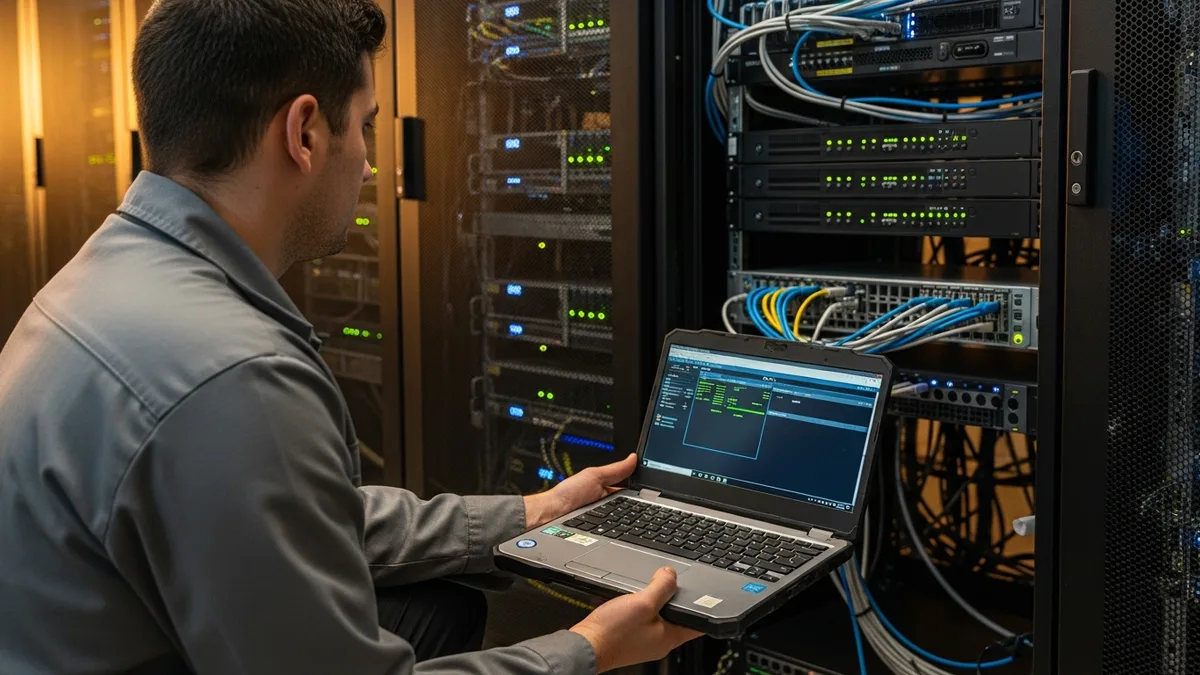
A data center technician keeps physical infrastructure running inside a data center facility. That means rack-and-stack work, cabling, break/fix on servers and network gear, patching, monitoring alarms, escorting vendors, and coordinating with remote engineering teams. It’s a 24×7 operations role, not a design role.
Here’s what the shift actually looks like.
- Installing and decommissioning servers, switches, and PDUs
- Running and dressing fiber and copper cable
- Diagnosing hardware failures, swapping drives, memory, and power supplies
- Responding to environmental alarms (temperature, humidity, smoke)
- Working tickets from remote engineering teams (remote hands requests)
- Documenting every change in the asset management system
- Escorting vendors and maintaining badge/access logs
- Participating in shift rotations, including nights, weekends, and on-call
Here’s the part nobody mentions. Most data center technician roles are 12-hour shifts on a 2-2-3 rotation or similar. Nights are part of the job, not an exception. If your job posting doesn’t say that up front, you’ll waste 40 hours of interviews on candidates who ghost after the offer.
Quick note on titles. A data center technician operates the facility. A data center engineer designs and architects it. Different pay band, different skill set, different hire. Don’t post one and try to hire the other.
Data Center Technician Job Description Template
Steal this and adapt it to your environment. I’ve written and rewritten versions of this block maybe two hundred times. It works.
Responsibilities
- Install, configure, and decommission server, network, and storage hardware
- Perform break/fix on failed components including drives, memory, NICs, and power supplies
- Run structured cabling (fiber and copper) and maintain neat cable management
- Respond to environmental and equipment alarms during assigned shifts
- Execute remote hands requests from engineering teams on ticket SLA
- Maintain accurate asset records in the DCIM or CMDB
- Escort vendors, enforce access procedures, and document visits
- Follow change management procedures for every physical change
Minimum Requirements
- 1+ year of hands-on data center, server room, or equivalent hardware experience
- Comfort with rack, cable, and basic networking terminology
- Ability to lift 50 pounds and work in a cold, loud environment
- Willingness to work a rotating 12-hour shift including nights and weekends
- Clean background check (most clients require this)
Preferred Qualifications
- CompTIA Server+ or Network+
- BICSI DCT or DCTT for cabling-heavy roles
- Prior experience in a colo, hyperscale, or financial services data center
- Familiarity with a DCIM tool (Nlyte, Sunbird, OpenDCIM, etc.)
- Military transition background from a technical MOS/AFSC
Work Environment and Shift Expectations
State this clearly. Candidates self-select out, and that’s what you want. Example language. “This role is a 12-hour rotating shift on a 2-2-3 schedule, including nights, weekends, and holidays. On-call is shared across the team on a rotating basis. The facility operates 65 to 72 degrees with constant fan noise.”
Skills and Certifications to Screen For
Certifications open the door. Hours close it. I’ve interviewed candidates with four certs and zero hands, and they struggle in the first week. I’ve also placed technicians with nothing on paper who ran a Navy comms rack for six years and became senior techs within 18 months.
Must-Have Technical Skills
| Skill | Why it matters |
|---|---|
| Rack and stack | Core daily work. Speed and neatness both matter. |
| Structured cabling | Fiber termination, copper runs, label discipline. The difference between a good tech and a great one. |
| Basic networking | VLAN, subnet, patch panel reading, console port access. Not deep routing knowledge. |
| Hardware troubleshooting | Swap components, read POST errors, interpret blinking LEDs without the manual. |
| Ticketing and documentation | Every change logged, every asset tracked. Sloppy documentation is how outages happen. |
Soft Skills That Predict Success
The three that matter most. Calm under pressure. Willingness to ask before touching. Handoff discipline at shift change. That last one is underrated. A tech who doesn’t communicate what they touched in the last 12 hours creates the next outage.
Certifications Worth the Extra Look
| Certification | When it moves the needle |
|---|---|
| CompTIA Server+ | Strong baseline signal for junior and mid roles |
| BICSI DCT / DCTT | Real value for cabling-heavy colo and enterprise roles |
| EPI CDCP | Respected for facilities-heavy environments, less common in the US |
| Cisco CCT Data Center | Useful if you’re a Cisco shop and the tech touches network gear |
| Vendor-specific (Dell, HPE) | Nice-to-have, not a differentiator on its own |
2026 Salary Ranges by Experience Level
Salary aggregators disagree on this role more than most. Glassdoor puts the 2026 average at $67,960 with a typical range of $55,432 to $83,815. ZipRecruiter’s February 2026 data lands the average at $58,613 with a typical range of $46,500 to $68,500. That’s a $9,000 gap on the average alone.
The gap is mostly about sample mix. Glassdoor pulls more self-reported hyperscale comp. ZipRecruiter leans toward colo and enterprise postings. Neither is wrong. Both are right for different slices of the market.
Here’s what I actually see land on offers in the field.
| Level | Experience | 2026 Base Range |
|---|---|---|
| Junior | 0 to 2 years | $48,000 to $60,000 |
| Mid | 2 to 5 years | $60,000 to $78,000 |
| Senior | 5+ years | $78,000 to $100,000+ |
Two adjustments I watch for on every offer. Hyperscale employers typically pay 10 to 20 percent above the colo and enterprise band for the same level. And shift differentials for nights and weekends usually run 10 to 15 percent of base, sometimes sitting inside base pay and sometimes layered on top. Ask candidates which model they’re coming from or you’ll make an offer that looks great and feels like a pay cut.
If you’re benchmarking adjacent roles while you plan headcount, our help desk technician salary guide and systems administrator salary guide cover the roles most often confused with or promoted from a data center tech seat.
Where to Source Data Center Technicians
Five channels. Each works for a different reason. Most hiring managers lean too hard on one and ignore the other four.
Employee referrals
Highest quality, lowest volume. Techs who refer friends stake their own reputation on it, and the friends tend to show up, show up on time, and stay longer. If you’re not running an active referral bonus for this role, start there.
Trade schools and technical colleges
Underrated for junior hires. Programs in electrical systems, structured cabling, and HVAC produce candidates with real hands-on skill and zero ego. They need six to eight weeks of facility-specific training before they’re useful, but they stick. Build relationships with one or two local programs and you’ll have a pipeline.
Military transition programs
Navy IT, Air Force cyber, Army signal. These are trained hardware hands who already understand shift work, documentation, and chain of command. SkillBridge and Hiring Our Heroes are the two programs to learn. I’ve placed more than a few of these and they punch above their pay grade.
Job boards
ZipRecruiter, Indeed, Dice for the tech-forward roles. High volume, low signal. Expect to read 80 resumes to find 5 worth a phone screen. Write a sharp JD and set screening questions aggressively or you’ll drown.
Staffing partner
When in-house sourcing has stalled for more than 30 days, or when you need three techs in 20 days for a new cage build, that’s when a staffing partner earns its fee. Our data center staffing practice runs these searches constantly, so we already have the conversations warm.
Contract, Contract-to-Hire, or Direct Hire?
This decision saves or wastes more money than any other single call in the hiring process. Here’s a framework I use with clients.
| Your situation | Recommended model |
|---|---|
| Project spike, cage build, or migration | Contract |
| Permanent headcount but you want a trial window | Contract-to-hire |
| Permanent, budgeted, you know what you want | Direct hire |
| Backfill for a resignation, need coverage yesterday | Contract first, convert later |
| First tech on a new site, requirements unclear | Contract-to-hire |

Interview Questions That Actually Predict Performance
Most interview banks are useless for this role. They test vocabulary, not hands. Here are the questions I actually use, split by interview stage.
Phone screen (15 minutes)
- Walk me through the last server you physically installed. What you’re listening for. Specific detail. Rack unit location, power feed, cable management, BIOS step, asset tag. Vague answers mean they watched someone else do it.
- Tell me about a shift where something broke at 2am. You’re screening for composure and handoff discipline, not heroics. Red flag if they tried to fix everything alone.
- What’s your honest take on 12-hour rotating shifts? This is where candidates self-eliminate. Let them.
Technical interview (45 minutes)
- A server won’t POST. Talk me through your first 10 minutes. Good answers go power, cables, memory reseat, drive status lights, POST codes, IPMI/iDRAC/iLO. Great answers mention checking the last change ticket first.
- How do you run a fiber patch between two racks in different rows without tripping a walkway alarm? Tests cable discipline and facility awareness at the same time.
- What’s the difference between MMF and SMF, and when would you grab each? Basic cabling literacy. If they stumble here, they’re not ready for a colo floor.
- Describe a time you documented a change that later helped someone else troubleshoot. Gold for the right answer. A tech who values the documentation loop is a tech you keep.
Behavioral for shift work
- What does a clean shift handoff look like to you? You want a specific answer. A checklist, a logbook, a verbal walk-through of open tickets. Any real system beats “I tell them what’s going on.”
- How do you keep focus on a quiet 3am shift? Listen for routine. Techs who’ve survived years of nights have a rhythm. New techs don’t, and that’s fine if they’re honest about learning.
How Long Should the Hire Take?
In our experience running these searches at KORE1, time-to-fill for this role sits around 36 to 42 days end-to-end, JD posted to signed offer. Here’s how that breaks down by sourcing channel.
| Channel | Typical Time-to-Fill |
|---|---|
| Referrals | 10 to 20 days when you have active techs on staff |
| Staffing partner | 10 to 20 days for contract, 20 to 30 for direct |
| Job boards with a good JD | 30 to 45 days |
| Job boards with a mediocre JD | 60+ days or stall |
| Trade school pipeline | 45 to 60 days for a fresh graduate, but you’re trading time for lower salary |
If a search passes 45 days without a serious candidate, something is broken. Usually it’s one of three things. The salary band is 10 percent under market. The JD is too broad and reads like a data center engineer posting. Or the shift expectations weren’t stated up front and candidates are ghosting post-offer.
Total Cost of Hire for a Data Center Technician
Direct cost to hire runs around $1,633 median in the US. That’s the hard spend on job boards, screening, background checks, and internal recruiter time. It’s not the real number.
The real math on a $65,000 mid-level hire looks like this.
| Cost Component | Estimate |
|---|---|
| Base salary | $65,000 |
| Benefits loading (typically 25 to 30 percent) | $16,250 to $19,500 |
| Training ramp (6 to 8 weeks of reduced productivity) | roughly $7,500 equivalent |
| Direct hiring cost | $1,633 |
| Vacancy cost while the seat is open (production risk, overtime to cover) | varies widely, often $5,000 to $15,000 on a critical shift |
Year-one true cost lands somewhere between $95,000 and $110,000 for a $65,000 base. Plan around the total, not the salary line.
When to Bring in a Staffing Partner
I’ll be honest. Most hiring managers can run this search themselves if the volume is low and the timeline is flexible. A staffing partner earns its fee in specific situations.
- You need two or more techs in under 30 days
- You’re hiring your first tech at a new site and the JD isn’t clear yet
- Your in-house search has stalled past 45 days
- You need shift coverage in a geography where you don’t have a network
- You’re evaluating contract-to-hire to de-risk a permanent seat
If any of those sound like your situation, talk to our team. We’ll tell you honestly whether we can help or whether you should keep running it in-house.
For related roles in your stack, we also cover how to hire a network engineer and cloud infrastructure staffing.

Common Questions About Hiring Data Center Technicians
What does a data center technician do?
Short answer. They keep the physical infrastructure inside a data center running. That includes installing and swapping hardware, running cable, responding to alarms, executing remote hands tickets, and documenting every change. It’s a 24×7 operations job, not a design job.
What skills matter most when screening candidates?
Hands-on hardware experience beats any certification. After that, look for cabling discipline, composure during incidents, and solid handoff communication at shift change. The techs who stay calm and document well are the ones who last.
How much does a data center technician make in 2026?
Pick your aggregator and you’ll get a different answer. Glassdoor says about $68,000, ZipRecruiter says closer to $54,000. In real offers I see juniors land around $48,000 and hyperscale seniors push past $100,000. Shift differentials tack on another 10 to 15 percent on top of that.
How long does it typically take to fill this role?
In our experience running these searches at KORE1, figure 36 to 42 days from JD posted to offer signed. Referrals and staffing partners compress that window to 10 to 20 days when speed actually matters. Mediocre postings stretch past 60 days, and some never recover at all.
What’s the difference between a data center technician and a data center engineer?
Technicians operate the facility. Engineers design and architect it. Different pay bands, different skill sets, and a very different hiring process. Don’t cross-post these, and don’t interview the wrong one for the wrong role.
Do candidates need a college degree?
No, and requiring one shrinks your pipeline without improving candidate quality. Hands-on experience, military technical training, trade school coursework, and self-taught lab work all count. I’ve placed excellent senior techs with no degree and struggled with candidates who had two.
Robert Ardell leads recruiting searches at KORE1 for data center, cloud infrastructure, and IT operations roles. He has placed technicians at colo, hyperscale, and enterprise clients across the US. For help running your next data center technician search, reach out to the KORE1 team.
