

The Short Version
Oracle just cut 30,000 people. Some of the best database administrators on the planet were in that number. DBAs who spent years wrangling RAC clusters, squeezing performance out of Exadata boxes, and making sure Data Guard failovers actually worked when it mattered. They’re available right now. If you’ve been struggling to fill an Oracle DBA role, this is the best window you’ll get this decade.
We’ve placed hundreds of database professionals at KORE1 over the years, so we know what a normal DBA talent pool looks like. This isn’t normal. What used to be a thin, overpriced candidate market has opened up practically overnight. Below you’ll find real salary data, the technical skills worth screening for, and the sourcing strategies that are actually working in April 2026.
What Happened and Why Your Database Team Should Care
March 31, 2026. Oracle executed the largest layoff in its 48-year history. Up to 30,000 employees globally. Entire teams dissolved with a 6 AM email. One internal case that keeps getting cited? 47 database administrators replaced by three senior architects overseeing automated AI systems.
Scary if you worked there. Fantastic if you’re an IT director who’s had a DBA req gathering dust since October.
And look, these aren’t bootcamp grads. Far from it. We’re talking professionals with 8, 10, 15 years managing production Oracle environments that processed billions of transactions annually across multi-terabyte databases spanning multiple data centers and time zones. The kind of experience that takes an entire career to build, the kind you can’t shortcut with a certification course or a six-month contract. They’re available because Oracle decided AI could handle routine monitoring. Maybe it can. But complex migrations? Disaster recovery when things go sideways at 2 AM? Performance crises that don’t match any documented pattern in the runbook? That still requires a human who’s been through it.
Oracle DBA Salary Ranges in 2026
Numbers first. Salaries have softened a bit since the layoffs pushed a wave of qualified candidates into the market, but experienced Oracle DBAs still earn real money. Significant money. The ranges below come from what we’re seeing in actual placements and offer letters right now, cross-referenced with data from Glassdoor, ZipRecruiter, PayScale, and our own internal compensation benchmarks across the IT staffing engagements we’ve run this quarter.
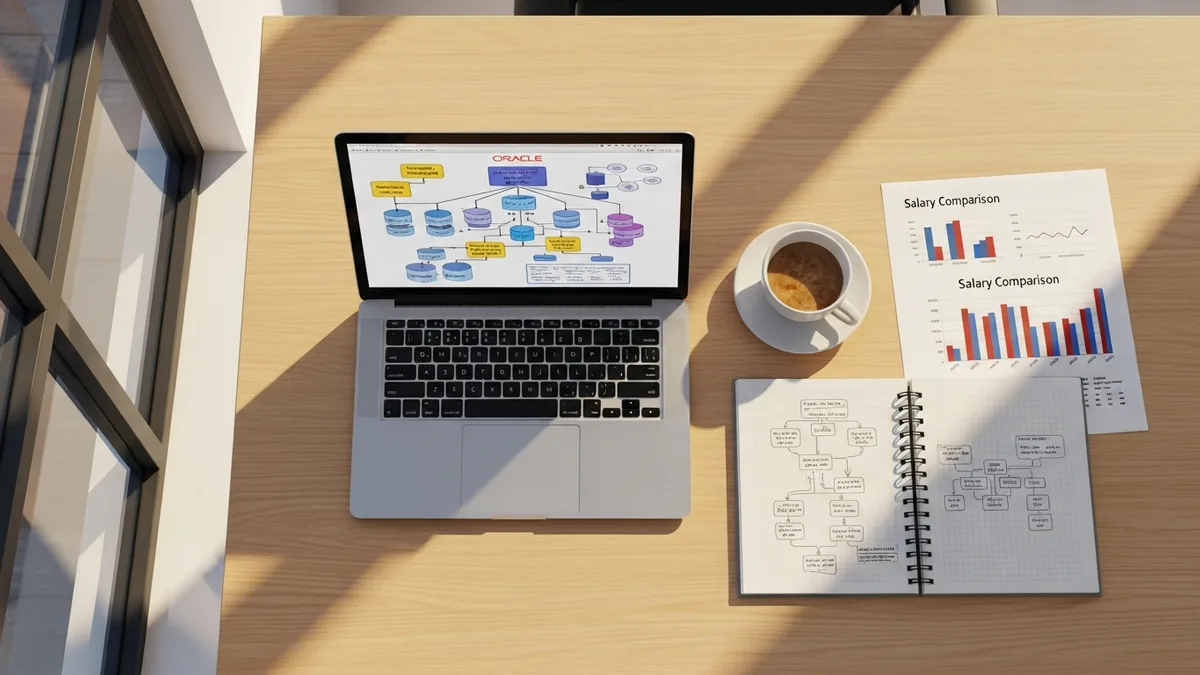
| Experience Level | Annual Salary Range | Hourly (Contract) | Notes |
|---|---|---|---|
| Entry-Level (0-2 years) | $64,000 – $90,000 | $35 – $50/hr | OCA certified, basic admin tasks |
| Mid-Level (3-7 years) | $110,000 – $145,000 | $65 – $95/hr | OCP preferred, production experience |
| Senior (8-12 years) | $145,000 – $185,000 | $95 – $140/hr | RAC, Exadata, Data Guard expertise |
| Principal / Architect (12+ years) | $185,000 – $220,000+ | $140 – $200+/hr | OCM certified, enterprise architecture |
Here’s what we’re actually seeing in Q2 2026. Candidates who would’ve held firm at the top of their range six months ago? More flexible now. Not desperate. Realistic. The math changed when 30,000 Oracle professionals hit the market at once. If you move quickly, senior-level talent at mid-range rates is genuinely possible right now.
RAC and Exadata specialists still pull a 15-25% premium over generalist DBAs. That gap hasn’t closed. Those skills take years to develop, and the layoffs didn’t create more of them. But even with the premium factored in, the DBA salary benchmarks are more employer-friendly than anything we’ve seen since pre-pandemic.
The Skills That Actually Matter When You Hire an Oracle DBA
Not every Oracle DBA is the same hire. At all. Some managed a single 12c instance sitting on a dev server that nobody cared about. Others kept a 50-node RAC cluster at 99.99% uptime across three geographies while handling on-call rotations, quarterly patching cycles, and performance reviews from application teams who blamed the database for everything. Huge difference.
What to prioritize depends on your stack, but here’s the general hierarchy.
Must-Have Technical Skills
- Oracle RAC (Real Application Clusters) for high-availability environments. Non-negotiable if your databases support revenue-generating applications
- Data Guard for standby databases and disaster recovery. Every serious Oracle shop runs this
- RMAN (Recovery Manager) for backup and recovery operations. A DBA who hesitates around RMAN is a concern
- ASM (Automatic Storage Management) for storage layer optimization
- Performance tuning using AWR, SQL Trace, and Enterprise Manager. This is honestly where you separate the capable from the excellent
High-Value Specializations
- Exadata administration if you’re running Oracle’s engineered systems
- OCI migration experience is increasingly valuable as companies shift workloads to the cloud. Or away from Oracle Cloud to AWS and Azure, for that matter
- Multi-version fluency across 11g, 12c, 18c, 19c, and 21c. Legacy systems don’t disappear just because Oracle releases a new version
- GoldenGate for real-time replication and zero-downtime migrations
- PL/SQL chops that go deeper than basic SELECT statements. The best DBAs can trace a performance problem from the application layer down through stored procedures to the execution plan
What About Cloud Skills?
This part is interesting. Many displaced Oracle DBAs spent recent years working on OCI internally. That cloud experience doesn’t vanish because they’re no longer at Oracle. Cloud networking, automated scaling, managed database services. The concepts port over to AWS RDS and Azure SQL faster than most hiring managers expect. We’ve watched DBAs make the OCI-to-AWS jump in two to three weeks. Don’t write someone off because their cloud resume says Oracle instead of Amazon.

Certifications Worth Screening For
Oracle’s certification program is actually useful. That’s worth saying because plenty of vendor certs amount to memorizing a study guide. Oracle requires instructor-led training for most credentials, which means certified candidates have real hands-on hours behind the credential.
- OCA (Oracle Certified Associate) covers the fundamentals. Appropriate for junior hires, but you wouldn’t staff a production RAC environment based on an OCA
- OCP (Oracle Certified Professional) is the one most IT managers use as a hiring baseline. Validates backup, recovery, tuning, and security skills at a production level
- OCM (Oracle Certified Master) sits at the top. About 61% of Oracle-certified professionals report stronger career trajectories than non-certified peers, and an OCM has proven they can handle simulated production emergencies under exam pressure
- OCE specializations in RAC, Data Guard, or Performance Tuning layer on top of OCP. Worth paying attention to if your environment leans hard on one of these technologies
Worth noting about the current market. Oracle invested heavily in certifying its own people. So the candidates available right now are, on average, more credentialed than what you’d normally see in a DBA job search. That’s a temporary advantage.
Where to Find Oracle DBA Talent Right Now
LinkedIn, Dice, Indeed. They all work. But here are the sourcing angles that matter most in this specific moment.
Displaced Oracle Employees
Thirty thousand people. Database teams got hit especially hard. The full breakdown of the Oracle layoffs is worth reading if you want context on which departments lost the most people. Many of these candidates are actively searching right now. The best ones won’t be available past June.
Oracle User Communities
The Oracle ACE program, user groups like IOUG and ODTUG, and conference speaking networks. DBAs who contribute to the Oracle community tend to be technically stronger and more current on best practices. They’re also easier to vet because their work is public.
Staffing Agencies With Oracle Expertise
A generalist recruiter won’t know the difference between a DBA who babysat a single dev instance and one who ran a mission-critical, multi-terabyte RAC environment. That distinction matters enormously. Our IT staffing team has over a decade of Oracle placement experience and we’re actively sourcing from the displaced Oracle talent pool right now.
Contract-to-Hire as a Lower-Risk Entry Point
Not ready to commit full-time? Understandable. Bring someone in on a 3-month contract and let the work speak for itself. You get to evaluate technical depth against your actual environment, your specific Oracle version, your particular performance quirks, before making a permanent offer. And right now, plenty of displaced DBAs are open to contract arrangements as a bridge. It works for both sides.
Interviewing Oracle DBAs Without Getting Burned
We’ve seen this too many times. Candidate talks a great game about Oracle architecture. Sounds brilliant on the phone. Then they sit down in front of a real problem and freeze. It happens. So here are the interview approaches that actually tell you something useful, and the ones that waste everyone’s time because the answers are a search engine query away.
- Hand them a broken AWR report. Ask them to find the top bottleneck and suggest a fix. A solid DBA identifies the issue in minutes, not hours
- Ask about their worst production outage. What went wrong, how they diagnosed it, what they’d change if they could do it over. You want structured thinking, not “we restored from backup and called it a day”
- Dig into Data Guard. Physical vs. logical standby, when to use each, switchover vs. failover procedures. This is core knowledge that exposes gaps fast
- Use scenarios instead of trivia. Anyone can Google “maximum RAC nodes.” But ask “your 4-node cluster just lost two nodes during a peak trading window, walk me through the next 15 minutes” and you’ll learn everything you need to know
This Hiring Window Has an Expiration Date
Same story every time. We’ve watched it after Meta’s cuts, after Salesforce, after every big tech layoff of the last five years. Top candidates vanish in 30-60 days. Good mid-tier talent follows within 90. Then? Back to the same overheated market where a decent Oracle DBA gets five recruiter messages before they’ve finished their morning coffee and you’re back to competing with every other company that waited too long.
The Oracle layoffs created something unusual. Highly credentialed, deeply experienced database administrators available at reasonable rates. That combination doesn’t survive the summer. Companies that move now will assemble database teams that would have taken 12-18 months under normal conditions.
If you need to hire Oracle DBA talent, our team is already working with displaced Oracle professionals across RAC, Exadata, Data Guard, and OCI specializations. Tell us what you’re looking for and we’ll show you who’s available.
Common Questions About Hiring Oracle DBAs
What’s the real difference between a $90K Oracle DBA and a $180K one?
Production depth. Simple as that. A $90K DBA handles routine maintenance, applies patches, runs scheduled backups. They keep a stable environment stable. Fine for that. The $180K DBA has debugged RAC node failures at 2 AM, identified queries burning $50K/month in cloud compute, and migrated multi-terabyte databases with zero downtime windows. You’re paying for judgment under fire, not textbook knowledge.
Should we hire full-time or bring in a contract DBA?
Look at your Oracle footprint honestly. Really honestly. If Oracle databases power your core business and run 24/7 production workloads, invest in a full-time hire. That’s not even a close call. But if you need someone for a migration project, a version upgrade, or periodic performance tuning? Contract at $95-140/hr makes more financial sense than carrying a $170K salary plus benefits for someone who sits partially idle nine months of the year. A lot of companies land on a hybrid. One full-time DBA plus contract specialists brought in for project work. Best of both worlds.
We’re on AWS. Does OCI experience even matter?
More than you’d think. A DBA who managed Oracle databases on OCI already understands cloud networking fundamentals, automated scaling policies, and managed database service architecture. AWS RDS and Aurora use different tooling but the same underlying concepts apply. We’ve seen OCI-experienced DBAs get productive on AWS within two to three weeks. It’s a non-issue.
Won’t AI just replace Oracle DBAs anyway?
The repetitive stuff? Already happening. Oracle’s own numbers show AI handling roughly 94% of standard monitoring and maintenance. But that leftover 6% is where the expensive problems hide. Performance mysteries with no obvious cause. Migration architecture for a database that’s been accumulating technical debt for a decade. Security hardening against threats that didn’t exist when the schema was designed. The Bureau of Labor Statistics still projects 8% job growth for DBAs through 2032, which tells you the market agrees this role isn’t going away. It’s just changing shape.