

Hiring software engineers in 2026 means competing for professionals whose median base pay sits around $130,000 nationally, whose average time to hire stretches past 35 days, and whose best candidates rarely post resumes anywhere. This guide covers current salary benchmarks by experience and location, the technical skills employers should actually care about, interview mistakes that gut your pipeline, and when working with a specialized IT staffing partner saves you more than it costs.
We help companies hire software engineers every single week. And the pattern is almost always the same.
Someone calls after their internal search has been running six weeks. Sometimes eight. The hiring manager sounds tired. Not frustrated yet, just tired. The team is overloaded and carrying the extra weight without complaining, which actually makes it worse because nobody rings the alarm until the best people start quietly interviewing elsewhere. And the req has been sitting there, collecting dust, while three strong candidates accepted offers at companies that moved faster.
So let’s talk about what works. And what doesn’t. And why most of the advice you’ll find on this topic reads like it was written by someone who has never actually filled one of these roles.
The Software Engineer Hiring Market in 2026
Numbers first.
The Bureau of Labor Statistics projects software developer employment to grow 15% from 2024 to 2034. That’s roughly five times the average growth rate across all occupations. About 129,200 openings every single year through that decade, and not all from new jobs either. A big chunk comes from people retiring, switching into management, burning out, or just deciding they want to do something else entirely. The demand doesn’t pause because the economy hiccups. It didn’t in 2022. It didn’t in 2024. It won’t this year.
Gartner’s take is more pointed. Their analysts predict generative AI will actually increase demand for software engineers. Not replace them. The reasoning is straightforward if you think about it for five minutes. AI commoditizes basic coding productivity. But somebody still has to build, maintain, secure, and improve the systems that make AI useful in the first place. Those somebodies are software engineers. A Gartner survey of 300 US and UK organizations found 56% of software engineering leaders said AI/ML engineer was their single most in-demand role. That was heading into 2024. The pressure has only gotten worse since.
Robert Half’s 2026 data tells the hiring side of the story. Sixty-five percent of IT leaders found it harder to hire skilled IT professionals in 2025 than the year before. And 61% plan to increase permanent headcount in the first half of this year.
Lot of companies chasing the same people at the same time.
If you’re still posting on job boards and waiting for applicants to come to you, you’re already losing to the companies that aren’t.
What Software Engineers Actually Earn in 2026
Salary data varies by source and honestly it should. Glassdoor pulls from self-reported submissions. The BLS uses employer surveys. ZipRecruiter aggregates job postings. Levels.fyi skews toward Big Tech because that’s who uses it. None of them are wrong. They’re measuring different slices of the same pie, and if you only look at one source you’ll either overpay or lose every candidate you talk to.
| Source | Average / Median Base | Notes |
|---|---|---|
| Bureau of Labor Statistics (OEWS 2024) | $130,160 median | 1.79 million employed nationally |
| Glassdoor (March 2026) | $148,764 average | Based on 712,000+ salary submissions |
| ZipRecruiter (March 2026) | $133,490 average | 25th percentile $97,500. 75th at $158,500 |
| Levels.fyi (2026) | $190,000 median total comp | Includes stock and bonus. Skews Big Tech. |
| Motion Recruitment (2026 Guide) | $107,500 to $148,363 | Mid to senior range, software developers |
All figures US national data, Q1 2026. Base salary unless noted.
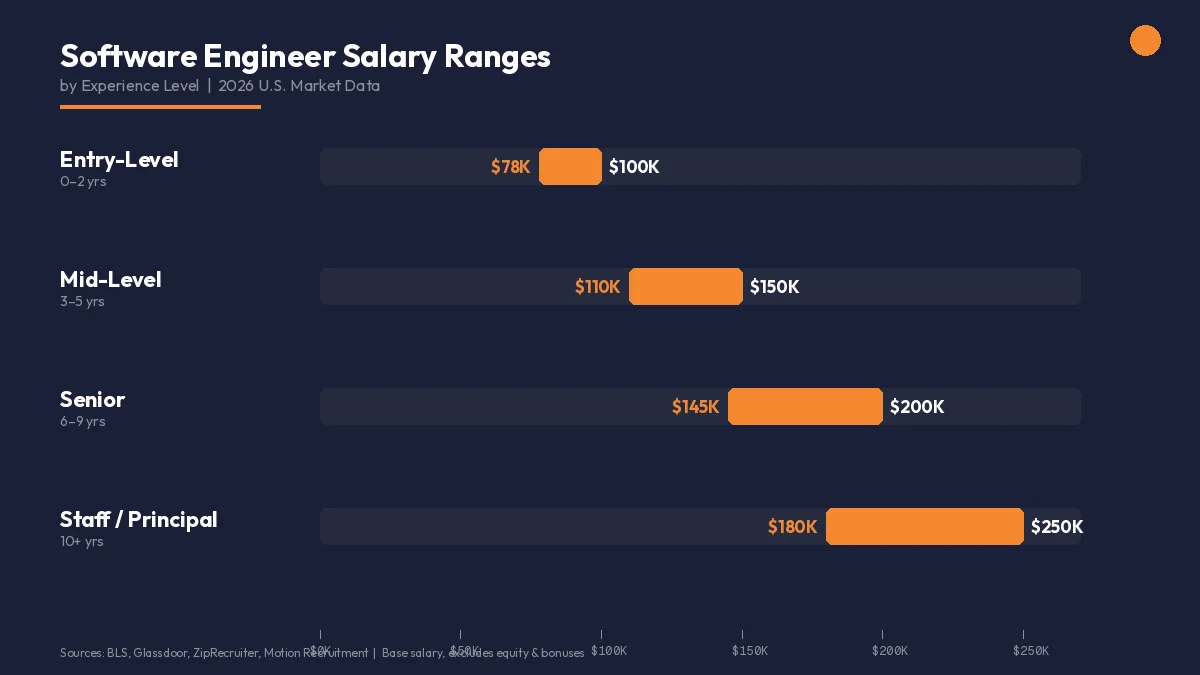
If you’re a mid-market company trying to budget, the realistic range for a mid-level software engineer with three to six years of experience is roughly $110,000 to $145,000 in base. Senior engineers with seven-plus years push $145,000 to $190,000 and sometimes higher. And if you’re competing against FAANG or well-funded startups? Total comp packages at those companies regularly clear $250K to $400K+ for senior and staff levels. You won’t win that bidding war. Don’t try. You’ll burn your budget and still lose the candidate.
What you can win on is speed, interesting work, and not making people jump through seven rounds of interviews. More on that later.
For a deeper look at compensation benchmarking across tech roles, check out KORE1’s salary assistant tool.
Salary by Experience Level
| Experience Level | Base Salary Range | What You Should Know |
|---|---|---|
| Entry Level (0 to 2 years) | $78,000 to $100,000 | Junior postings dropped roughly 40% from pre-2022 levels. Fewer companies willing to invest in ramp-up. |
| Mid Level (3 to 6 years) | $110,000 to $150,000 | The bloodbath bracket. Everyone wants this person. |
| Senior (7+ years) | $145,000 to $200,000+ | System design, architecture, tech leadership. Total comp runs much higher at top companies. |
| Staff / Principal | $180,000 to $250,000+ base | At FAANG total comp averages $400K to $700K per Levels.fyi. Different universe. |
Compiled from BLS, Glassdoor, ZipRecruiter, Motion Recruitment 2026 data. Base salary only unless noted.
Location Still Matters
Even with remote.
San Jose pays the highest nominal salaries for software engineers. Around $180,000 median per BLS metro data. Seattle follows near $165,000. San Francisco sits around $161,000. But here’s the thing nobody wants to hear. When you adjust for cost of living, Austin at $128,000 gives your engineer roughly the same purchasing power as San Jose at $180,000. The cost of living index in San Jose is 272. Austin’s is 123. If you’re a mid-market company in a secondary city like Dallas or Denver or Atlanta, you actually have an advantage you probably aren’t using. You can offer competitive base pay at $120K to $140K and your candidates keep more of it. Spell that out in the job description. Candidates are smart enough to do the math but most don’t bother until someone puts it in front of them.
Skills That Actually Matter When You Hire Software Engineers
Every job posting says “strong problem-solving skills” and “excellent communication.” That’s the hiring equivalent of saying you want a car that runs.
Tells candidates nothing. Attracts everyone.
Here’s what actually separates the productive hires from the expensive ones.
Technical Skills Worth Paying For
- AI tool proficiency and I don’t mean “can use Copilot.” I mean understanding when AI-generated code is wrong, when it introduces security holes, when to throw it out entirely. Gartner predicts 80% of the engineering workforce will need to upskill in AI-assisted development by 2027. If your candidate can’t explain the limitations of AI code generation, they’re already behind. And this skill barely existed as a hiring criteria two years ago.
- Cloud infrastructure. AWS, Azure, or GCP. Pick whichever matches your stack. But look for engineers who’ve built and maintained production infrastructure, not just passed a certification exam. Canyon between those two things.
- Python and JavaScript/TypeScript cover roughly 80% of what companies are building right now. Python handles AI/ML, data, backend. JavaScript and TypeScript handle frontend, full-stack, increasingly backend via Node. If your product is a web application you need both. Period.
- System design thinking. Can this person reason about trade-offs at the architecture level? Can they explain why they’d choose one database over another for a specific use case, without rehearsing an answer from an interview prep site? Mid-level candidates should be able to whiteboard a system. Senior candidates should be able to poke holes in one.
- DevOps fluency isn’t a “nice to have” anymore. CI/CD pipelines, containerization, infrastructure as code. If your engineers can’t deploy their own code you have a bottleneck that never goes away, it just gets louder. Our DevOps hiring guide goes deeper on this.
The Skill Nobody Puts on a Resume
Adaptability. I know that sounds soft. Bear with me.
The engineers who do well for our clients in year two and year three aren’t the ones with the most impressive GitHub profiles at hire. They’re the ones who learned the company’s codebase quickly, asked good questions early, adjusted their working style to the team rather than demanding the team adjust to them, and generally made themselves useful before trying to change everything. I’ve seen brilliant engineers crater team morale in weeks. Genuinely talented people who refused to follow existing patterns because they thought they knew better. Sometimes they did know better. But that’s not the point. The point is the team ground to a halt while everyone argued about architecture decisions that should have been settled six months ago.
You can’t test for this in a coding exercise. But you can test for it in a reference check. Ask previous managers one specific question. “Tell me about a time this person had to work within constraints they disagreed with.” The answer tells you everything.
The Interview Process That’s Killing Your Pipeline
Google’s own internal research found that after four interviews, the predictive value of additional rounds drops significantly.
Four.
And yet we routinely see companies running six and seven round processes for mid-level software engineers. Panel interviews with eight people on a Zoom call. Take-home assignments that take six hours. A “culture committee” review that adds ten days to the timeline. Then the hiring manager wonders why every strong candidate ghosted them after the third round.
The average time to hire a software engineer is 35 days. Some data sets put engineering roles closer to 44 days overall. But that’s the average, and averages hide the real problem. The companies losing the best candidates are the ones taking 50 to 70 days. By week five, every strong candidate in your pipeline has two or three other offers sitting in their inbox. You’re not evaluating them anymore. They’re evaluating whether you’re worth the wait. Usually the answer is no.
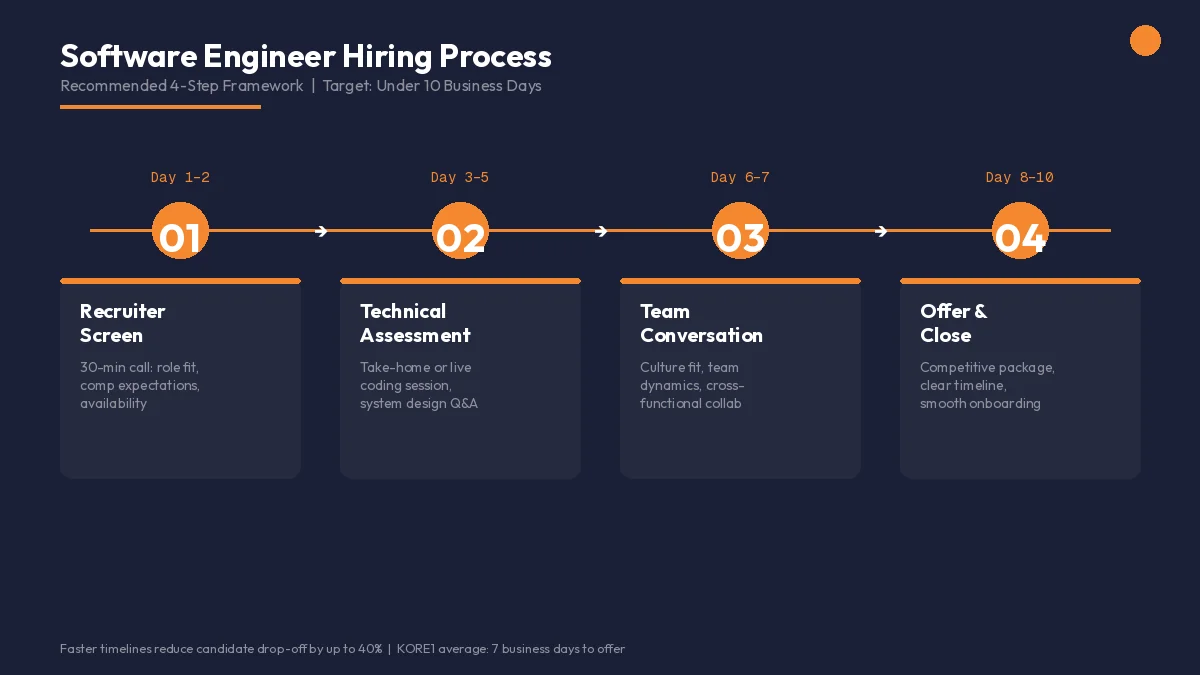
Here’s a process that actually works.
- Recruiter screen. Thirty minutes. Confirm role fit, compensation alignment, timeline expectations. This should happen within 48 hours of resume review. Not five business days. Forty-eight hours.
- Technical assessment. Ninety-minute live coding or pair programming session that mirrors actual work. Not a trivia quiz about obscure algorithms nobody uses in production. Not a six-hour take-home that your best candidates won’t bother finishing because they have three other processes that respect their time more than yours does.
- Team conversation. Meet the hiring manager and one or two team members. Discuss system design, culture, working style. This is where both sides figure out if the fit is real or if everyone’s performing.
- Offer. If you know, you know. Don’t add a VP sign-off and a compensation committee and a second panel. Every extra day between final interview and offer is a day someone else closes the candidate while you’re scheduling a meeting about scheduling a meeting.
Total elapsed time, first screen to offer. Ten business days or fewer. Companies that hit this consistently fill roles faster and cheaper. Every company that tells me they “can’t move that fast” could. They just haven’t been forced to yet.
Five Mistakes That Cost You Six Figures
The US Department of Labor estimates a bad hire costs at least 30% of that employee’s first-year earnings. SHRM puts the full replacement cost between 50% and 200% of annual salary. For a senior software engineer earning $170,000, you’re looking at somewhere between $85,000 and $340,000 when you add up recruiting, onboarding, lost productivity, team disruption, and the three months it takes to restart the whole search from scratch.
These five keep showing up.
Writing a requirements list instead of a job description. If your posting reads like a technology laundry list (React, Node, Python, AWS, Docker, Kubernetes, GraphQL, PostgreSQL, Redis, Terraform, blah blah blah) you’ll attract people who are good at keyword matching. Not people who are good at building software. Describe the problems they’ll solve. Describe the team. That’s what engineers who have options care about. The ones without options will apply regardless of what you write.
Testing for the wrong things. Asking a backend engineer to invert a binary tree on a whiteboard is a meme for a reason. It doesn’t predict job performance. If they’ll spend most of their time working in your Python codebase, test them in Python on a realistic problem. The obsession with algorithmic puzzles in 2026 is genuinely baffling to me. We’ve had two decades of data showing it doesn’t work and the industry just keeps doing it.
Moving too slowly. I mentioned this already. Worth repeating because it’s the single most common and most expensive mistake. Fifty percent of companies take over 30 days. The best candidates are gone in two to three weeks. If your process takes six weeks you’re only seeing the people nobody else wanted. That sounds harsh. It’s also just true.
Ignoring compensation data. If you’re budgeting $95,000 for a mid-level engineer in a market where the 25th percentile is already $110,000, you’re not going to get qualified applicants. You’re going to get desperate applicants. Very different pool. Use current data. KORE1’s salary benchmarking tool can help, or pull from the BLS and Glassdoor numbers in the table above.
Skipping reference checks for technical roles. A two-hour coding assessment shows you a person’s ceiling on their best day. A reference check shows you their floor on their worst. Both matter. The companies that skip references are the same companies calling us six months later asking for a replacement. Every time. Without fail.
When to Hire Internally vs. Work With a Staffing Partner
I’ll be direct about my bias. I work at a staffing firm. We benefit when companies work with us. So take this section with whatever grain of salt feels appropriate.
That said, here’s the honest version.
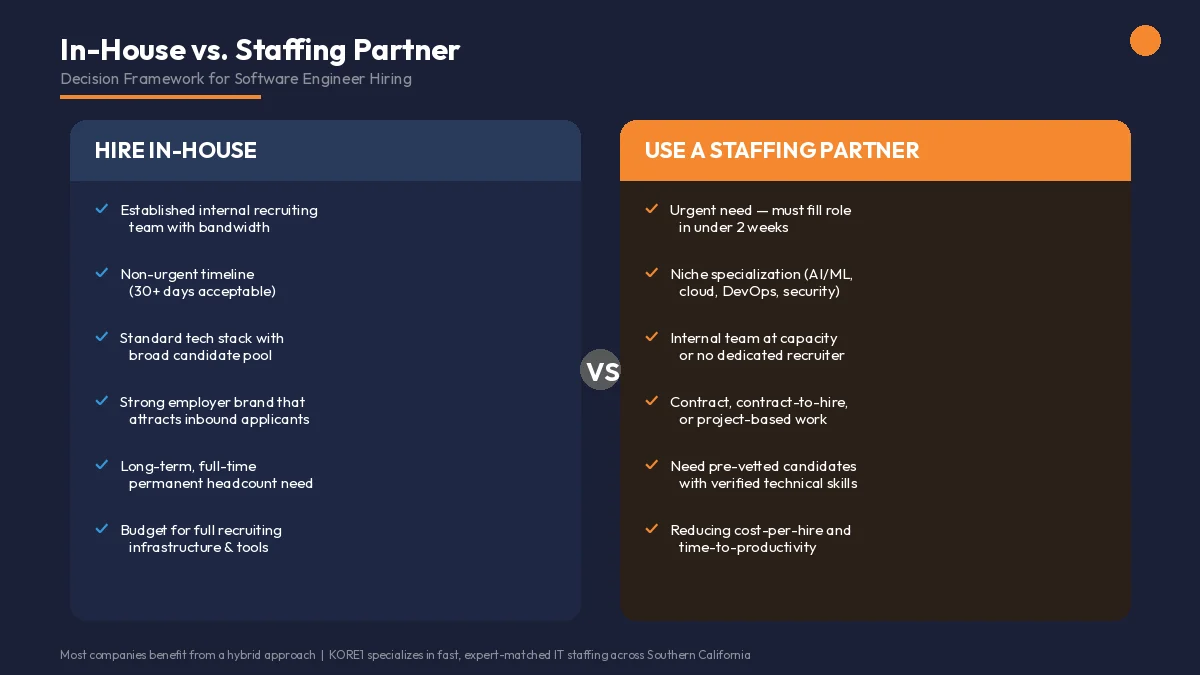
Hire internally if you have a strong recruiting function, you’re filling fewer than three roles, your timeline is flexible (meaning 90 days is fine), and the position isn’t hyper-specialized. Standard full-stack or frontend roles at companies with recognizable brands can absolutely be filled without outside help. Save the fee. Put it toward a better offer.
Consider a staffing partner if you need to fill multiple engineering seats in the same quarter, or the role requires niche skills that your internal recruiters don’t know how to screen for, or you’ve been stuck for 30-plus days with no strong candidates in the pipeline, or your recruiting team is already maxed out and you’re asking them to prioritize this search over five others. In those scenarios a firm that specializes in engineering staffing can cut your timeline because they’re working from a pipeline that already exists. Not building one from scratch.
The other scenario where agencies consistently outperform internal teams is contract and contract-to-hire. If you need someone for a six-month project, or you want to evaluate a candidate for three months before converting them full-time, the staffing model was literally built for that. We break down how staffing pricing works in a separate guide so there aren’t surprises.
AI Changed the Job. It Didn’t Kill It.
Quick note on this because it comes up in literally every conversation with hiring managers right now and I want to address it without writing another 2,000 words about AI.
Yes, AI coding assistants are real and useful. GitHub Copilot and similar tools help with boilerplate, test generation, documentation. Nobody serious is arguing otherwise.
But a study from METR found something that challenged a lot of the hype. Experienced software engineers were 19% less productive when using AI tools on complex, real-world tasks. Not more. Less. The tools work well for simple, well-defined problems. They fall apart on the messy, ambiguous, contextual work that makes up most of actual software engineering. Which, if you think about it for a minute, makes sense. If the problem were straightforward enough for AI to solve cleanly, you probably wouldn’t need a senior engineer working on it in the first place.
Gartner keeps saying this and people keep ignoring it. By 2027, 80% of software engineers will need to upskill. But the role isn’t disappearing. If anything organizations need more engineers because AI-generated code still needs someone to review it, test it, secure it, and fix it when it breaks at 2am on a Saturday. The CIO Dive interview with Gartner analysts put it plainly. The demand for differentiated software, and in turn developers, is going to increase.
For companies hiring right now the practical takeaway is simple. Look for engineers who use AI tools comfortably but don’t depend on them. An engineer who can evaluate whether code works regardless of who or what wrote it. That’s who you want.
The Hiring Playbook
If I had to condense this entire guide into something a VP of Engineering could hand to their recruiting team Monday morning, it would look roughly like this.
- Write job descriptions that describe problems, not just technologies. Include your stack but lead with impact. What will this person build? Why does it matter?
- Set salary ranges using current market data, not last year’s budget assumptions. The BLS median is $130,160. If your range starts below six figures for anyone with experience, you’re going to have a bad time.
- Four interview steps. Ten business days. Anything longer costs you the best candidates. This is not negotiable if you want to compete.
- Use practical assessments. Pair programming beats algorithm puzzles. Every piece of research says this. Just do it.
- Prioritize AI fluency alongside traditional skills. Not optional anymore. Not next year’s problem.
- Check references. Ask specifically about how candidates handle constraints and disagreements. The culture fit question shows up in month two, not interview two. References are how you see it coming.
- Know your walk-away number before you start. If you can’t afford market rate, adjust the seniority or consider contract models. Don’t post a role you can’t actually fill at the price you’re willing to pay.
And if 30 days go by with no strong candidates in the pipeline, that’s the signal to bring in help. Not a failure. A signal. The KORE1 IT staffing team can usually present qualified candidates within one to two weeks for standard software engineering roles because the pipeline already exists.
One More Thing
Half the companies that come to us for software engineering searches are actually dealing with a retention problem wearing a hiring costume. They keep losing engineers at the 12 to 18 month mark and then scrambling to backfill. The math on that is brutal. Every departure restarts the 35-day hiring clock plus three to six months of ramp-up before the new person is fully productive. So you’re really talking about nine months of reduced output every time someone walks out the door.
And the reasons are almost never about money.
Boring work. Poor management. Broken technical environments where engineers spend 40% of their time fighting legacy systems and internal politics instead of building things. No clear career path. A sense that nobody above them in the org chart understands or cares what they do. Those are the reasons people leave. I hear them in exit interviews secondhand and in first conversations with candidates who are “passively looking” which is code for “actively unhappy.”
Fix the environment. Then hire. Not the other way around.
Related KORE1 Resources
- KORE1 Salary Assistant Tool
- How to Hire AI Engineers in 2026
- How to Hire DevOps Engineers in 2026
- How to Hire Cybersecurity Engineers in 2026
- How to Hire Data Engineers in 2026
- IT Staffing Agency Pricing Guide
FAQ
How much does it cost to hire a software engineer in 2026?
Depends entirely on what you mean by “cost.” The salary itself runs $110K to $190K+ depending on seniority and where you are. That part most people understand. What surprises them is the process cost. SHRM’s benchmarking data puts the average cost per hire around $4,700. For specialized technical roles it can reach $10K to $20K+. And that’s when you get it right. Get it wrong and the Department of Labor pegs a bad hire at 30% of first-year earnings. SHRM says 50% to 200% for full replacement. For a senior engineer at $170K, a bad hire runs you $85K on the low end just in direct costs. Team disruption and lost productivity make the real number considerably uglier.
How long does it take to hire a software engineer?
Thirty-five days is the industry average, but I’d call that misleading because it includes companies with extremely fast processes pulling the number down. Fifty percent of companies take more than 30 days. Senior engineering roles routinely stretch to 50 or 60. In our experience the companies that fill software engineering roles in under three weeks have exactly two things in common. A four-step interview process. And a hiring manager who doesn’t need a committee to make a decision. That’s it. Everything else is noise.
What programming languages should software engineers know in 2026?
Python and JavaScript. Those two cover the vast majority of what companies are building right now. Python handles AI/ML, data, backend services. JavaScript and TypeScript handle frontend, full-stack, and backend via Node. Go is gaining traction for infrastructure work. Rust has a devoted following in systems programming but it’s niche for most hiring. If you’re writing a job posting, list what your team actually uses. Don’t list eight languages and expect to find a unicorn who knows all of them. You won’t. And the people who claim they do on their resume are probably stretching the truth on at least four.
Is it harder to hire software engineers now than five years ago?
Yes and no. Total number of developers has grown. So has demand, especially for anyone who can do something useful with AI, or who has real cloud infrastructure experience, or who can design systems at scale and not just talk about it in an interview. Entry-level hiring actually got somewhat easier because so many companies slashed junior roles. More supply at that end now. But mid-level and senior? Absolutely brutal. Robert Half reported 65% of IT leaders found hiring harder in 2025 than 2024. The engineers with five to ten years of experience and a track record of actually shipping software basically write their own tickets. They don’t need to apply anywhere. They get recruited. If you’re not reaching out to them proactively, someone else is.
Should I hire software engineers in-house or use a staffing agency?
If you have a functioning internal recruiting team, strong employer brand, and no rush, do it yourself. I’m saying that as someone whose business depends on you not doing it yourself. Save the fee. Use it to sweeten the offer.
But if you’re hiring three or more engineers in a quarter, if the role is specialized, or if you’ve been stuck for a month with nothing in the pipeline, a staffing partner almost certainly gets you there faster. Deloitte estimates unfilled roles cost companies roughly $500 per day. For engineering roles that number is probably conservative. Run the math on 30 days of vacancy against an agency fee and the agency usually pays for itself just in reduced downtime. Not always. But usually.