

Recruiting and retaining senior AI and ML engineers in 2026 requires more than competitive pay. The teams winning top talent offer:
- Clear pathways from Senior to Staff to Principal
- Access to high-quality data and modern infrastructure
- A fast, respectful hiring experience
- Technical ownership and mission-driven work
- Pay structures that include salary, equity, performance incentives, research budgets, and conference travel
- A retention environment where learning, autonomy, and impact are built into the culture
Companies that combine meaningful work, strong compensation, and visible growth opportunities will consistently win senior AI/ML talent this year.
Why Senior AI and ML Engineers Are Hard to Hire in 2026
Demand far exceeds supply
Even with the rise of generative AI tooling, demand for experienced AI/ML engineers continues to surge. Companies want fewer juniors and more senior, staff, and principal-level engineers who can build end-to-end systems, not just prototypes.
McKinsey reports an ongoing global shortage of senior AI talent despite rapid industry growth. Senior engineers with experience in LLMs, MLOps, model optimization, and AI safety remain especially scarce.
Role complexity has grown
In 2019, a machine learning engineer mostly needed Python, TensorFlow, and some data wrangling.
In 2026, senior-level roles require expertise spanning:
- Distributed training
- Model compression and optimization
- RAG architectures
- Vector databases
- LLMOps tooling
- Prompt engineering + prompt security
- Deployment, observability, and responsible AI practices
A senior AI engineer today is essentially part researcher, part architect, and part product strategist.
Senior engineers evaluate employers differently
They ask different questions than juniors:
- “How large and clean is your dataset?”
- “What hardware do I get?”
- “Will I own the entire model lifecycle?”
- “Is this work meaningful or just hype?”
Their decision-making is driven by autonomy, impact, and long-term learning.
The “project significance” filter
Senior AI/ML engineers want to work on problems that matter, problems with real-world consequences, not shallow pilot projects. They want to build systems that scale.
If your job description cannot communicate technical depth and business impact, you lose senior candidates fast.
What Senior AI/ML Engineers Want Most in 2026
Below is what consistently comes up in conversations with advanced AI/ML talent:
Autonomy and technical ownership
Ownership beats micromanagement. Senior engineers want to architect solutions, not follow ticket-based workflows.
Access to high-quality datasets and compute
This is a defining factor. Many candidates decline offers because:
• Data is too messy
• Infrastructure is outdated
• Compute is limited
• Experimentation requires “asking IT for permission”
Invest in data quality and compute readiness and your talent pipeline improves instantly.
Real career paths beyond “Senior”
Senior engineers need to see a future. Without a path to Staff, Principal, or Lead Architect, they will assume stagnation.
Work-life flexibility with manageable load
Senior AI/ML engineers avoid burnout environments. They want flexible working styles, focus time, and clear expectations.
Mission alignment and meaningful problems
They want to know:
“Does my work change something real?”
Checklist: What Senior AI/ML Engineers Prioritize in 2026
- Ownership of architecture decisions
- Access to quality datasets
- Reliable compute/GPU budget
- Clear advancement path
- Ability to attend conferences
- Realistic workload
- Autonomy and trust
- Meaningful mission
- Learning and research time
- Tools that keep pace with the industry
2026 Compensation Guide for Senior, Staff, and Principal AI/ML Engineers

Compensation expectations in 2026 remain competitive. These are generalized ranges based on national averages, influenced by broad market data.
Senior AI/ML Engineer (2026)
| Component | Typical Range |
|---|---|
| Base Salary | $180K–$280K |
| Total Comp | $260K–$450K |
| Equity | 0.1%–0.3% |
| Bonus | 10–25% |
| Conference Travel | 1–2 per year |
Staff AI/ML Engineer (2026)
| Component | Typical Range |
|---|---|
| Base Salary | $220K–$330K |
| Total Comp | $350K–$550K |
| Equity | 0.2%–0.5% |
| Bonus | 15–30% |
Principal AI/ML Engineer (2026)
| Component | Typical Range |
|---|---|
| Base Salary | $300K–$400K |
| Total Comp | $500K–$700K+ |
| Equity | 0.3%–1% |
| Bonus | 20–40% |
Pay Transparency Drives Better Hiring
In 2026, senior engineers expect pay ranges upfront. Companies hiding compensation lose candidates early.
Where to Find Senior AI and ML Engineers
Proven sourcing channels
Senior AI/ML engineers rarely apply through job boards. Effective channels include:
- Open-source communities (Hugging Face, PyTorch)
- ML research forums
- Kaggle master tier participants
- Specialized AI Slack communities
- Industry conferences (NeurIPS, ICML, CVPR, GTC)
- Academic-industrial hybrid spaces
How global hiring changes everything
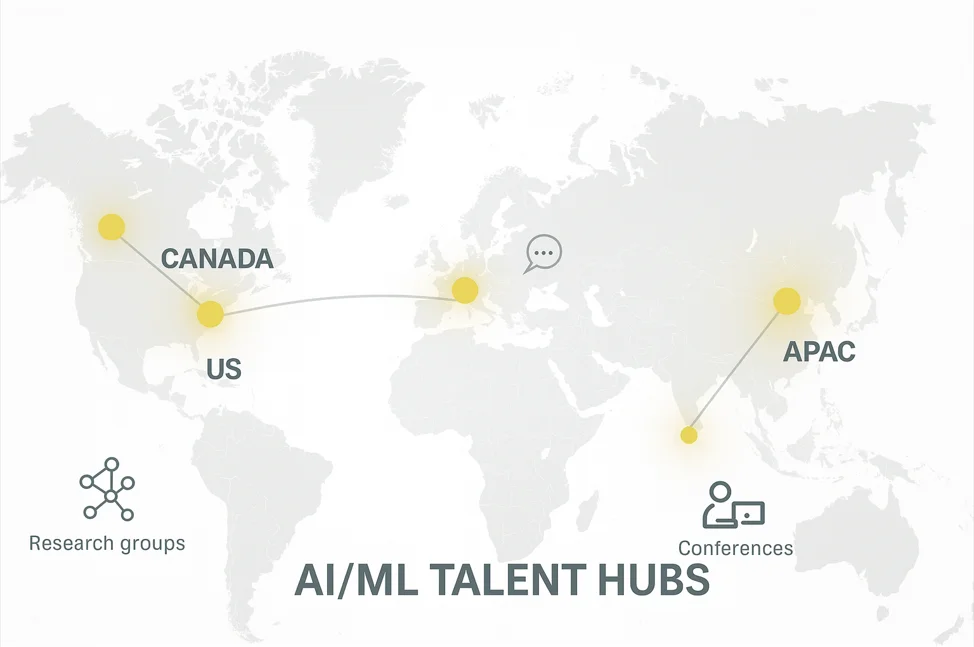
Remote work is now normalized. The best companies hire:
- US-based senior talent
- EU AI specialists
- Canadian ML researchers
- APAC MLOps experts
Remote parity is rising, but still provides flexibility.
Outbound sourcing beats inbound
The best senior AI/ML candidates are passive. They need a well-crafted outbound message with:
- Mission
- Ownership
- Tech stack
- Compensation range
- Problems they’ll solve
How to Evaluate Senior AI/ML Engineers Without Losing Them.
The hiring process must be fast. Long processes kill deals.
Replace long coding tests with architecture conversations
Senior candidates prefer:
- System design
- ML pipeline reviews
- Model debugging discussions
- Case studies
- Research explanation
The 4 traits the strongest senior AI/ML engineers share
- Curiosity
- Ownership mindset
- Strong communication
- Deep understanding of model lifecycles
Sample interview structure
- Recruiter screen
- Founder/CTO call
- Technical architecture discussion
- Cross-functional conversation
- Offer
Fast and respectful.
Skills Matrix for Senior, Staff, and Principal Engineers
| Skill Area | Senior | Staff | Principal |
|---|---|---|---|
| Model Training | Leads models | Designs full training systems | Shapes org strategy |
| MLOps | Strong | Expert | Sets standards |
| Architecture | Strong | Expert | Org-level vision |
| Research Depth | Good | Strong | Deep |
| Mentorship | Some | Moderate | High |
| Impact Scope | Team | Org-level | Company-wide |
The Offer Stage: How to Win Senior AI Talent
Lead with impact, not just money
Explain what they will build and why it matters.
Show the long-term roadmap
Senior engineers care about:
- 6-month expectations
- 12-month role evolution
- What success looks like
Explain compute and data readiness
This is more important in 2026 than most employers realize.
Personalize perks
Senior engineers respond to tailored benefits like:
- Flexible hours
- Conference and research budgets
- Meaningful equity
- Hybrid autonomy
Retention: How to Keep Senior AI/ML Engineers After You Hire Them
Retention is the real competitive advantage.
Build a clear career ladder
From Senior → Staff → Principal → Architect.
Give them technical ownership
Let them shape decisions.
Avoid burnout
Senior engineers want sustained impact, not chaos.
Quarterly development conversations
Ask: “What’s one thing we can do to help you grow this quarter?”
Invest in learning
Offer stipends for:
- LLM safety courses
- Vector database training
- GenAI certifications
- MLOps bootcamps
Create a culture where AI can thrive
This includes:
- Rich datasets
- Modern tools
- Time to experiment
- Room to innovate
Career Path Framework: Senior → Staff → Principal → Architect
Senior AI/ML Engineer
Focus: execution and ownership
Growth triggers: lead architectural discussions, mentor juniors
Staff AI/ML Engineer
Focus: multi-team impact
Growth triggers: oversee ML pipelines, influence product direction
Principal AI/ML Engineer
Focus: technical authority
Growth triggers: set standards, shape AI strategy, guide architecture
AI Architect / Distinguished Engineer
Focus: long-term vision
Growth triggers: cross-org leadership, innovation strategy
How Startups Can Compete for Senior AI Talent
Leverage mission-first positioning
Startups win on impact.
Compress the hiring cycle
Move fast and personal.
Offer equity and role depth
Senior candidates love ownership.
Show technical ambition
Demonstrate a growth mindset.
KORE1 Insight: What We See in Today’s AI/ML Hiring Market
- Companies lose candidates when interview rounds exceed too many steps.
- Offers that highlight career progression and model ownership close faster.
- Candidates want leaders who understand the realities of building AI systems, not hype.
How KORE1 Helps Companies Recruit Senior AI/ML Talent
We take a relationship-first approach that centers on:
- Understanding what motivates senior talent
- Translating technical needs into clear hiring requirements
- Building competitive offers
- Reducing hiring friction
- Creating long-term fits
Our goal is simple: help companies build AI teams that last.
Takeaway
Recruiting and retaining senior AI and ML engineers in 2026 requires clarity, speed, competitive compensation, and a genuine commitment to meaningful work.
The companies who win top talent are those willing to invest in:
- real career paths
- great tooling
- strong data foundations
- flexible, human-centered culture
If you’re building an AI team this year, now is the time to move, the competition isn’t slowing down.
If you’re building or scaling your AI team this year, connect with KORE1’s AI/ML recruiting team and we’ll help you hire the senior talent who can actually move the needle.
Frequently Asked Questions (FAQs)
1. What is the best way to recruit senior AI and ML engineers in 2026?
The most effective way is to combine competitive compensation with a fast, respectful hiring process. Senior AI/ML talent responds well to clear ownership, technical depth, and meaningful projects. Companies that share details about their data quality, compute resources, and long-term roadmap win top candidates faster.
2. How much do senior AI and ML engineers earn in 2026?
Senior AI/ML engineers typically earn $180K to $280K in base salary, with total compensation between $260K and $450K depending on the company, location, and technical scope. Staff and Principal engineers can exceed $500K–$700K+ in total compensation at large organizations.
3. What perks matter most to senior AI engineers today?
In 2026, the perks that stand out most include:
- Dedicated compute budget
- Access to high-quality datasets
- Flexible work arrangements
- Clear career paths
- Conference and research budgets
- Opportunities to influence architecture and product strategy
4. How do you retain senior AI and ML engineers?
Retention comes from ownership and growth. Give senior engineers technical autonomy, a realistic workload, and ongoing learning support. A clear advancement map from Senior → Staff → Principal is one of the biggest reasons AI talent stays long term.
5. What mistakes do companies make when hiring senior AI talent?
The most common mistakes are long interview loops, vague job descriptions, outdated tooling, and unclear compensation. Senior engineers walk away quickly if the process feels slow or misaligned with their experience.
6. Where can companies find senior AI and ML engineers?
The strongest candidates often come through:
- Open-source and ML research communities
- AI/ML conferences
- Passive outbound sourcing
- Curated talent networks
- Specialized recruiting partners like Kore1
Senior AI engineers rarely apply through general job boards.
7. What skills matter most at the senior level?
In 2026, companies look for:
- Deep understanding of model lifecycle
- Experience with LLMs, RAG, vector databases, and MLOps
- Architecture-level decision making
- Strong communication and mentorship
- Ability to translate business problems into applied AI systems