
Last updated: May 6, 2026
How to Hire IoT Engineers in 2026
Senior IoT engineers in the United States cost $155K to $200K in 2026, with mid-level embedded-plus-cloud hybrid profiles at $120K to $155K, and most direct-hire searches close in 6 to 10 weeks depending on firmware depth required.
That wide range at the top reflects something real. IoT engineering is not one job. The candidate who can write power-optimized C for a Cortex-M4 microcontroller and also architect an AWS IoT Core ingestion pipeline for 40,000 simultaneous devices is rare. Most candidates do one well and approximate the other. How rare depends on which combination you actually need, and whether your job description is asking for the right one. That second part is usually where it goes wrong first.
I’m Gregg Flecke, a recruiter on KORE1’s IT staffing team. I’ve run enough IoT and embedded searches over the past several years to say, with some confidence, that it’s among the harder profiles to hire correctly. Not the hardest. Harder than most. KORE1 earns a placement fee when you hire through us. If this guide helps you find the person on your own, that works too.

The Three Technical Profiles Hiding Under “IoT Engineer”
Most IoT job descriptions list MQTT, C/C++, AWS IoT Core, and Python in the same bullet block and expect to attract someone with real depth in all four. Sometimes that person exists. Usually what arrives are candidates who’ve touched all of those things but haven’t gone deep in the combination your product actually requires.
Three profiles dominate the market. They do not compete for the same roles.
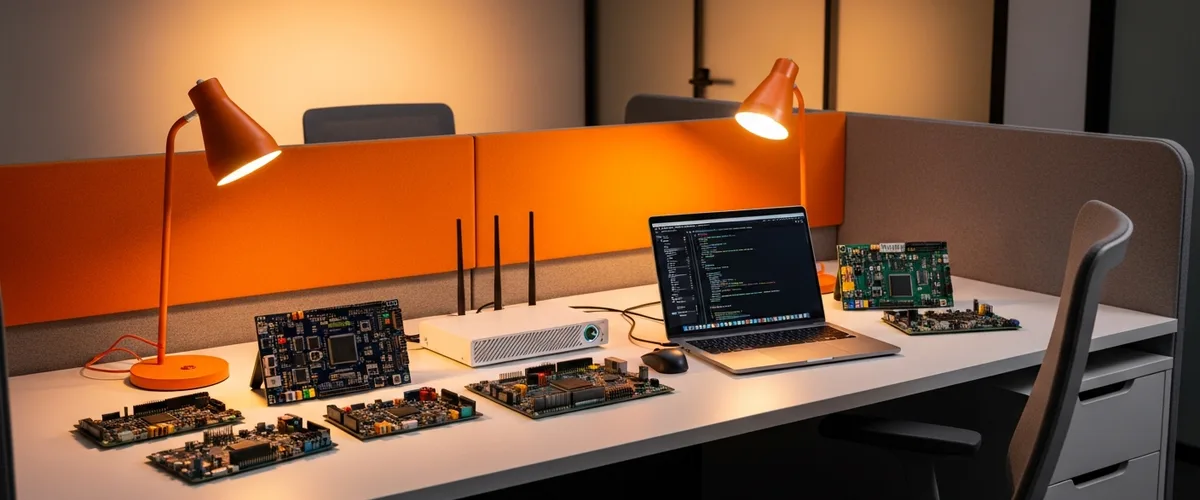
Firmware and Embedded Systems Engineer. C and possibly Rust. Microcontrollers are the unit of analysis: ESP32, STM32, nRF52, ARM Cortex-M series. RTOS environments like FreeRTOS or Zephyr. Memory constraints that would make most backend engineers uncomfortable. Connectivity knowledge tends to be protocol-level (Bluetooth LE, Zigbee, Thread, LoRaWAN, NB-IoT) without deep cloud platform fluency. These engineers understand MQTT well enough to publish sensor data to a broker. They have not usually designed the broker architecture, device fleet provisioning, or OTA infrastructure on the cloud side.
The cloud gap is where this profile gets misread most often. A resume that lists MQTT and AWS in the same line can mean two very different things. Usually they do.
IoT Solutions and Cloud-Connected Engineer. Backend fluency, usually Python or Go, with real experience on AWS IoT Core, Azure IoT Hub, or Google Cloud IoT Edge. Designs the ingestion layer, time-series storage (InfluxDB, TimescaleDB, Amazon Timestream), device provisioning workflows, and OTA update infrastructure. Hardware background is lighter. They understand microcontrollers conceptually, can read a datasheet, and won’t write firmware from scratch without meaningful ramp time. The distinction matters more than most JDs acknowledge.
Full-Stack IoT Engineer. Comfortable in both domains. Has shipped firmware and designed the cloud architecture the firmware talks to. Usually found at IoT startups, or at companies like Qualcomm, Texas Instruments, or Silicon Labs where the environment produces this hybrid naturally. This is the profile everyone writes job descriptions for and almost nobody finds on a six-week timeline. They’re rare enough to receive multiple offers within days of becoming active. Search timelines for this profile run 10 to 14 weeks, not as a failure of sourcing, but as an accurate reflection of how thin that candidate supply actually is.
| Profile | Core Stack | Mid-Level (2026) | Senior (2026) |
|---|---|---|---|
| Firmware / Embedded | C/C++/Rust, FreeRTOS/Zephyr, ESP32/STM32/nRF52, BLE, Zigbee, LoRaWAN | $120K to $160K | $155K to $195K |
| IoT Solutions / Cloud-Connected | Python/Go, AWS IoT Core/Azure IoT Hub, InfluxDB, MQTT, OTA infrastructure | $125K to $165K | $160K to $205K |
| Full-Stack IoT (firmware + cloud) | All of the above, typically with IIoT or IoT startup background | $145K to $175K | $165K to $220K |
| IoT Security Specialist | TLS/DTLS, PKI, secure boot, OTA signing, device attestation, certificate management | $145K to $180K | $185K to $230K |
What IoT Engineers Actually Cost in 2026
The two main salary aggregators disagree by about $50,000. ZipRecruiter’s 2026 figure for an IoT engineer is $101,752 nationally, with the 25th to 75th percentile running $84K to $116.5K, top earners at $135K. Glassdoor puts the average at $151,351, with the 25th to 75th percentile from $114,498 to $202,113. Senior IoT engineer on Glassdoor: $187,218.
The gap is not a data error. ZipRecruiter aggregates all postings including junior roles, contract work, and geographic outliers from markets where IoT roles pay considerably less than the coastal tech hubs. Glassdoor skews toward verified employer submissions and captures more tech-hub and mid-to-senior concentrations. Both figures are accurate for what they’re measuring. Neither tells you what you need for a specific hire in a specific city.
What actually closes in our searches: mid-level IoT roles with firmware depth are clearing at $125K to $145K in the inland Southeast, $135K to $155K in Austin and Denver, $150K to $175K in San Jose, Seattle, and Boston. Senior roles with cloud platform depth added on top run $25K to $35K above those ranges. If you’re running a search in Phoenix or Charlotte and building your budget around the Glassdoor senior average, you may overshoot. If you’re hiring in San Jose and anchored to ZipRecruiter’s blended figure, you’re starting roughly $40K short before the first interview.
The KORE1 salary benchmark tool has metro-level IoT and embedded compensation data. Worth a check before you post. Wrong comp stops good candidates before they apply. It doesn’t prompt a negotiation. It prompts a pass.
The Security Gap That Is Becoming Non-Negotiable
IoT security failures have consequences that software bugs usually don’t. A vulnerable API is a headache. A vulnerable IoT device deployed at scale can be a botnet, a regulatory violation, or, in healthcare and industrial contexts, a physical safety event. Different category of problem.
The Eclipse Foundation’s 2024 IoT and Embedded Developer Survey found security rising to 35% as a top concern for IoT developers, up from 33% in 2023. Sounds like a small move. Look at the prior four years of the same annual survey and you see a steady climb. Connectivity remained the top concern at 48%, but security is gaining, and that’s before EU Cyber Resilience Act enforcement deadlines pressure the product teams exporting to European markets.
What to look for: TLS/DTLS at the transport layer, secure boot and root of trust in the firmware, OTA update signing (not just delivery, signing), PKI and certificate lifecycle management for device fleets, device attestation. A candidate who lists “security” on their resume but can’t explain the difference between symmetric and asymmetric key usage in a constrained device context, or who has never thought about certificate rotation at scale across a deployed fleet, is not an IoT security engineer. They’re an engineer who added “security” because job descriptions ask for it. Check the actual experience.
We ran a search for an IoT security architect at a medical device company in Irvine in early 2025. Three months. Six first-round interviews. Two of the six candidates could answer “How would you implement device attestation using a TPM on an ARM Cortex-M33?” in a way that indicated actual implementation experience, not something they’d read about. One accepted. The other received a competing offer from a San Diego defense contractor the same week at a comp level that would have required our client to go back to budget. The pool for genuine IoT security depth is that thin, even in a well-stocked metro like Southern California.
Where IoT Engineers Actually Look for Work
LinkedIn works for most software searches. For IoT, it undersells the pool. Embedded engineers are underrepresented on LinkedIn relative to their actual prevalence in the market, because many of the engineers who are best at firmware haven’t cultivated an online presence the way software engineers in web and mobile roles have. Worth knowing before you judge a candidate by profile completeness.
Many of the strongest firmware candidates still find roles through channels that most corporate recruiting processes don’t reach. Hackster.io and Hackaday.io carry project histories from engineers who’ve shipped real hardware. GitHub repositories for FreeRTOS, Zephyr, and ESP-IDF contributions surface active contributors directly, and an engineer’s commit history in a constrained embedded environment is a more reliable signal than a resume bullet that says “embedded systems experience.” IEEE membership and the IEEE Spectrum community remain relevant for hardware-adjacent engineers in ways LinkedIn is not. Industry conferences like Embedded World, IoT Tech Expo, and Sensors Expo draw the firmware population that doesn’t spend time on social platforms. Subreddits like r/embedded and r/esp32 are where engineers post real debugging problems, which is better evidence of expertise than a polished summary section.
This is relevant to your recruiter selection. A sourcing process built entirely on LinkedIn filters will miss a meaningful slice of the IoT candidate universe. Not all of it. Enough of it to matter when you’re hiring at the senior firmware end. A quick check: look at their initial submittals. If you’re getting candidates whose actual background is in web APIs or mobile development, with IoT appearing as a keyword rather than a job history, that’s a signal about how the sourcing actually works. Ask them directly where the pipeline comes from beyond LinkedIn search. Recruiters who run embedded searches regularly have a specific answer. Ones who don’t will hedge.
The Interview Structure That Actually Surfaces Depth
Standard software engineering interviews don’t transfer to IoT roles. Leetcode-style algorithm challenges are mostly irrelevant for firmware candidates. Code review and systems design formats work better, with adjustments for the hardware context.
A screening question that works at the firmware layer: “Walk me through how you’d debug an intermittent crash on an STM32 that doesn’t reproduce reliably and has no obvious pattern.” A candidate who’s done it goes immediately to JTAG debug, fault handler analysis, systematic memory inspection, and timing isolation across threads or interrupt handlers. A candidate who hasn’t describes enabling serial logging and waiting to see if it happens again.
For cloud-connected IoT profiles, something practical: “You have 50,000 devices sending telemetry at irregular intervals. Some go offline for hours at a time. How do you design the ingestion and state reconciliation layer?” Listen for device shadow patterns. Message queuing and back-pressure handling. The state divergence problem that emerges when a device comes back online after six hours and pushes stale telemetry that contradicts the last recorded cloud state. A candidate who’s operated this architecture at real scale knows exactly where it breaks. A candidate who read about it describes the happy path and runs out of detail quickly.
The practical assessment matters more here than in almost any other software engineering search. Have candidates build something. A simple sensor-to-cloud pipeline. An OTA update mechanism. A power profiling exercise on a constrained device. Two hours of real hardware work reveals more than a full day of structured behavioral questions, because you cannot fake your way through an interrupt handler bug or explain a memory layout decision convincingly without having written one. Set the bar there.
Industrial IoT vs. Consumer IoT: Not the Same Hire
IIoT candidates come from manufacturing, energy, utilities, and heavy industry. The protocols differ: OPC-UA, Modbus, PROFINET, EtherNet/IP alongside MQTT. Reliability requirements are different in kind. Not slightly different. Safety certification comes up constantly. IEC 61508 and IEC 62443 are not concepts you absorb in an online course. The engineers who genuinely know them learned inside environments where regulators could audit the architecture decisions, usually over several years at companies like GE Healthcare, Honeywell, or Siemens where certification wasn’t optional. That’s not transferable from a consumer IoT background. They’re not interchangeable with engineers who’ve built products at Nest or Ring.
Consumer IoT has its own shift underway. Matter and Thread are reshaping the smart home connectivity layer. An engineer who was building Zigbee and Z-Wave integrations in 2022 and hasn’t tracked the Matter protocol rollout is working in a stack being actively displaced. Not completely, not overnight. But clearly enough to matter for a three-to-five year hire.
We don’t see these two candidate pools overlapping much. The failure tolerance is just different. An IIoT engineer who’s spent years at Siemens or Emerson, where a bad firmware push can stop a production line and trigger a six-figure downtime event, has built their engineering discipline entirely around that constraint. They approach watchdog timers, power sequencing, and error recovery differently than an engineer whose worst production incident was a consumer thermostat going offline. Not better or worse. Different. A consumer thermostat startup is not the same environment and most IIoT engineers know it. Going the other direction, a consumer IoT engineer from a smart home startup usually lacks the regulatory background for a Class II medical device search. Getting this wrong in the job spec produces six weeks of wrong-fit candidate flow before anyone notices. Getting it right at the beginning takes 30 minutes.
What to Expect Working with a Staffing Firm on IoT Roles
IoT and embedded searches run slower than most software searches. The candidate universe is smaller, technical depth requirements create real filters at the screening stage, and the geographic distribution of IoT talent doesn’t match where most hiring managers expect it. Significant embedded concentrations exist in San Jose and the broader Silicon Valley corridor, Route 128 in Boston, Austin, and the San Diego defense and hardware ecosystem. Also Rochester, Minneapolis, and Research Triangle, places that don’t show up in the default “tech hub” mental model but carry real IoT populations.
KORE1 places IoT and embedded engineers across those metros, including a meaningful number of direct hire placements where companies need permanent depth rather than short-term contract coverage. Our average time-to-fill for IT roles across all categories is 17 days. Embedded searches with genuine firmware depth take longer than that. Being honest about that upfront is more useful than a fill-time number that turns out to be wrong for the specific role.
The biggest thing that drags searches out, ironically, is a job description that doesn’t distinguish between what you actually need and what you’d prefer to have. Most IoT JDs roll every requirement into a single block. That sends the search in two directions simultaneously and filters out strong candidates who have everything essential but haven’t touched one of the nice-to-have protocols you included. A firmware engineer who’s shipped production code in FreeRTOS on nRF52 but hasn’t worked with LoRaWAN specifically is probably not a meaningful miss if your product uses cellular or BLE. The JD needs to say that clearly or the search can’t be scoped.
Protocol flexibility helps too, for the same reason. And then there’s this: a technical hiring manager who can run a real first-round screen. Without that, the evaluation process stretches to three full rounds before anyone verifies whether the candidate’s firmware actually runs on hardware. That delay alone accounts for two weeks in most of these searches.
If you want to scope a search or benchmark comp for your market, reach out to our team. One conversation usually tells both sides what we’re working with.
Common Questions About Hiring IoT Engineers
Realistically, how long does a senior IoT engineer search take?
Six to ten weeks for most direct-hire searches with firmware depth. Faster if the role is primarily cloud-connected IoT with lighter embedded requirements. The full-stack hybrid profile, both firmware and cloud architecture depth required, tends to run 10 to 14 weeks because that candidate pool is genuinely thin and those engineers receive multiple competing offers once they become active. Contract searches close faster, usually two to four weeks, because the bar for proof-of-fit before someone starts is lower. If you’re seeing timelines shorter than that from a recruiter, ask how many submittals made it past a real technical screen.
Do IoT engineers need formal electrical engineering degrees?
Firmware work? More likely yes. Cloud-connected IoT with lighter hardware requirements? Usually no. The strongest firmware candidates in our queue have EE or computer engineering backgrounds at roughly a two-to-one ratio over CS-only candidates. Hardware bring-up, board spin, signal integrity work, EE fundamentals are close to mandatory there. Practical silicon experience matters more than any credential, but the EE training tends to show up alongside engineers who can work the full hardware-to-cloud stack without approximating the parts they missed.
Should I hire the firmware engineer or the cloud IoT engineer first?
Whichever layer is failing. If devices are shipping hardware but the data platform is held together with scripts and optimism, the cloud-connected engineer is the critical path. If the firmware is unstable and the cloud platform is solid, the firmware engineer is the hire. The mistake is assuming the full-stack hybrid will fix both simultaneously. They won’t, not at speed. The hybrid is valuable for green-field architecture. Fixing an existing broken layer is a different job, and hiring the specialist for that layer is faster and cheaper than waiting for someone who can hypothetically do both.
How do you evaluate IoT security skills in an interview?
Ask them to describe how they’ve handled OTA update security in a prior role. Specifically, signing, verification on the device side, rollback triggers, and key management. A candidate who has shipped OTA at scale talks about signing keys, verification logic, rollback conditions, and what happens when an update fails mid-device in a field-deployed unit with no physical access. A candidate who hasn’t describes the happy path and stops. Follow with a question about certificate rotation across a fleet of 10,000 devices. Depth surfaces fast. Every time.
Is IoT engineering demand actually growing in 2026?
Yes, with data behind it. IoT Analytics reported 18.5 billion connected IoT devices active globally as of 2024, up 12% year over year, with projections toward 39 billion devices by 2030. The Bureau of Labor Statistics projects 15% software developer job growth from 2024 to 2034, specifically citing IoT as a demand driver alongside AI and e-commerce. More devices being deployed and secured means sustained engineering demand at both the firmware and cloud layers. The curve has not flattened.
