
Last updated: July 17, 2026
How to Hire Firmware Engineers in 2026
Firmware engineers in 2026 cost $110,000 to $145,000 at mid-level and $150,000 to $200,000 for senior roles, with most searches running 6 to 12 weeks because 80% of embedded engineering postings sit unfilled for months. The talent pool is small, getting smaller, and split in ways that matter for how you source and interview.
I keep hearing hiring managers say they’ll just retrain a software engineer. That almost never works the way they expect. Firmware is a different discipline. Not harder, not easier. Different. A Python developer with ten years of experience will spend the first three months confused about why there’s no operating system, why the debugger can’t see the variable they’re looking for, why the board resets every time they write to the wrong register address, and why nobody around them seems surprised by any of this. That ramp-up period has a real dollar cost, and we’ve watched clients absorb it when they didn’t have to.
Mike Carter, KORE1. I place engineers through our engineering staffing and IT staffing practices, and firmware is consistently one of the hardest searches we run. Not because the role is obscure. Because the qualified pool is genuinely thin, the people in it know they’re hard to replace, and most JDs we review are written in a way that ensures the right candidates never apply. KORE1 earns a fee when you hire through us. That’s disclosed. What follows is still accurate.
What a Firmware Engineer Actually Does
A firmware engineer writes the low-level software that runs directly on hardware, controlling how microprocessors, sensors, actuators, and communication interfaces behave at the register and interrupt level.
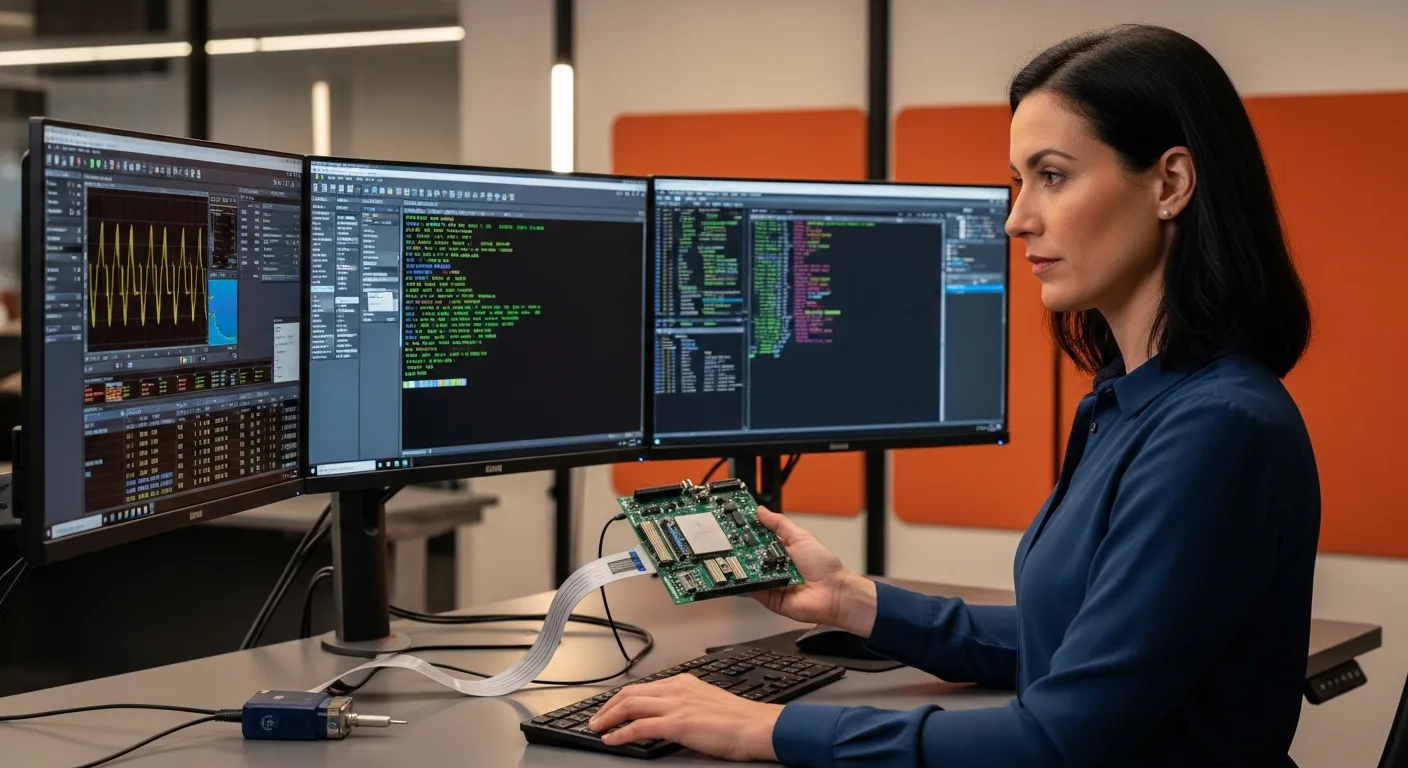
That’s not application software. There’s no React frontend. No REST API. Often no operating system at all. A firmware engineer writes in C or C++, sometimes assembly, targeting a specific microcontroller or system-on-chip. They read datasheets. Hundreds of pages of datasheets. They spend hours with oscilloscopes and logic analyzers verifying that what the code says should happen is what’s actually happening at the electrical level on the wire, because when your output is a physical signal traveling through copper instead of a JSON response traveling through HTTP, the only way to know it works is to measure the voltage with a probe. The feedback loop is physical. When firmware doesn’t work, the device doesn’t boot, the motor doesn’t spin, the sensor doesn’t report, the medical device alarms incorrectly. The consequence is tangible.
Where do firmware engineers work? Automotive, building the ECUs and battery management systems inside every EV rolling off a line in 2026. Medical devices, writing the code that controls infusion pumps and patient monitors where a bug isn’t a support ticket, it’s an FDA recall. IoT, where a single engineer might own the entire software stack on a sensor that ships in volumes of 500,000 units. Consumer electronics, aerospace, defense, industrial automation. Each of those domains layers its own regulatory and safety requirements on top of the core engineering. Automotive means ISO 26262 functional safety. Medical means IEC 62304 software lifecycle. These aren’t checkboxes. They change how the engineer writes and tests code at a fundamental level.
Bare-Metal RTOS vs. Embedded Linux: Two Different Searches
This is the split most hiring managers don’t know about until a search has already stalled.
Bare-metal and RTOS engineers write code that runs without an operating system, or with a lightweight real-time OS like FreeRTOS, Zephyr, or ThreadX. They program ARM Cortex-M microcontrollers directly. Configure peripherals at the register level. Write interrupt service routines that must execute in microseconds. Memory on these chips is measured in kilobytes. Not gigabytes, not megabytes, kilobytes. There’s no malloc in production code. Every byte is accounted for. These engineers tend to come from electrical engineering backgrounds, they’re comfortable reading schematics, and they can hold a meaningful conversation with the hardware team about PCB layout decisions that affect signal integrity. Senior comp runs $145,000 to $185,000 in most U.S. markets.
The second group works on embedded Linux platforms. ARM Cortex-A processors, custom Linux distributions built with Yocto or Buildroot, kernel module development, device tree configuration, board support packages for custom hardware. The hardware is more powerful. The software stack is deeper. These engineers need Linux internals knowledge, cross-compilation toolchains, U-Boot bootloader configuration, and often driver development at the kernel level. They sit at the boundary between the hardware team that designed the board and the application team that will build the user-facing software on top of whatever platform this person creates, which means the role requires fluency in both conversations and the ability to translate between them. Senior comp runs $155,000 to $200,000.
A search that says “firmware engineer, 5+ years experience” without clarifying which world it lives in will attract the wrong half of the pool. We ran a search in Q1 2026 for a San Diego medical device company. The JD listed “embedded C, RTOS experience preferred, Linux a plus.” Seven of the first nine applicants were embedded Linux engineers who hadn’t touched a bare-metal microcontroller since college. The role was Cortex-M4 with FreeRTOS, writing real-time control loops for a surgical instrument. Not one fit. The search ran eleven weeks before we rewrote the JD and sourced the right profile in three.
| Dimension | Bare-Metal / RTOS Profile | Embedded Linux Profile |
|---|---|---|
| Core languages | C, some C++, occasionally assembly | C, C++, Python for tooling and test automation |
| Processors | ARM Cortex-M (M0, M3, M4, M7), PIC, AVR, MSP430 | ARM Cortex-A, NXP i.MX, TI Sitara, Qualcomm Snapdragon |
| OS environment | None (bare-metal) or FreeRTOS, Zephyr, ThreadX | Custom Linux (Yocto/Buildroot), Android AOSP |
| Memory constraints | Kilobytes. Static allocation only. | Megabytes to gigabytes. Dynamic allocation common. |
| Debugging tools | JTAG/SWD probes, oscilloscope, logic analyzer | GDB, ftrace, perf, serial console, sometimes oscilloscope |
| Senior salary (2026) | $145,000 to $185,000 | $155,000 to $200,000 |
| Candidate supply | Very thin. Shrinking. | Thin but slightly larger pool. |
Why Firmware Searches Take So Long
Eighty percent of embedded engineering postings go unfilled for months. That number comes from RunTime Recruitment’s 2025 industry analysis, and it matches what we see in our own pipeline. The reasons are structural.
University enrollment in electrical engineering and embedded systems programs has been declining for over a decade. Computer science departments expanded rapidly to absorb the demand for web, mobile, and cloud developers, enrollment in CS programs tripled at many universities over the past fifteen years, and the students followed the visibility and the starting salaries that came with it. A 22-year-old graduating in 2026 has heard of React and Python and Kubernetes since high school. They’ve probably never held a development board. The pipeline of new embedded engineers is not replenishing the people retiring out of the field. The Bureau of Labor Statistics projects 7% growth for computer hardware engineering roles through 2033, but that growth estimate assumes a supply of qualified graduates that isn’t materializing.
Demand is accelerating in the opposite direction. Industry analysts project the global embedded systems market will hit $137 billion by 2027, growing at 6.5% annually, which means the number of companies competing for the same shrinking pool of firmware engineers is expanding faster than anyone’s hiring pipeline can handle. Every EV needs firmware for its battery management system, motor controller, and charging interface. Every IoT sensor needs firmware. Every medical device that isn’t purely mechanical needs firmware. Every industrial robot, every smart building controller, every autonomous drone. The number of devices that run firmware grows exponentially. The number of engineers who write it does not.
Compensation hasn’t caught up either. A firmware engineer with eight years of experience earns $150,000 to $180,000. A software engineer with the same tenure at a mid-stage SaaS company earns $180,000 to $240,000 without ever touching an oscilloscope. That delta costs the embedded industry candidates every single year. Not all of them. Some people genuinely prefer working close to hardware, and nothing about web development interests them. But enough leave that a tight pool gets tighter.
One more factor. Firmware roles are disproportionately on-site. The device is on-site. The test equipment is on-site. The hardware team is on-site. Remote firmware work exists, but it’s far less common than remote software development, and the candidates who are willing to work fully on-site for a firmware role know they’re giving up something that their software engineering friends don’t have to give up, which means the on-site requirement needs to come with a compensation adjustment that most companies haven’t factored into their budget yet.
Writing a Firmware JD That Doesn’t Waste Three Months
The JD failures we see in firmware are nothing like the typical software JD failures where someone lists React, Angular, Vue, Svelte, and Solid because they couldn’t decide which frontend framework they actually want. Software JDs overspecify on frameworks that any decent developer can learn in a week. Firmware JDs do the opposite: they’re too vague about the hardware environment and too specific about years of experience in ways that don’t actually predict whether someone can do the job.
“5+ years of embedded C experience.” What does that actually tell you? A candidate with three years writing bare-metal drivers for STM32 Cortex-M4, who designed the bootloader, built the OTA update mechanism, and got the product through FCC certification, is a stronger hire than someone with seven years maintaining legacy code on an 8-bit PIC. Years is a bad filter. Depth matters. Depth is harder to specify in a bullet point, but not impossible.
What to include instead:
Name the specific processor family. “ARM Cortex-M4” or “NXP i.MX8” or “TI MSP432.” Not just “microcontroller experience.” Engineers self-select on processor architecture because their skills are genuinely tied to the specific chip family they’ve spent years learning, and a posting that names the exact processor tells a candidate in five seconds whether this is hardware they know how to work with or hardware they’d need months to learn.
State whether the role is bare-metal, RTOS, or embedded Linux. If you use an RTOS, name it. FreeRTOS and Zephyr attract different candidates than QNX or VxWorks. The QNX crowd skews automotive and defense. The FreeRTOS crowd skews IoT and consumer devices. Listing “RTOS experience required” without naming one is like listing “cloud experience required” without saying AWS or Azure.
List only the communication protocols this role actually uses. SPI, I2C, UART, CAN, USB, Ethernet, BLE. Don’t list all seven if the product uses three. Listing every protocol signals that the hiring team either doesn’t know which ones matter or is copy-pasting from a template. Engineers notice.
Name the domain and regulatory environment. “Medical device, IEC 62304 Class C” tells a firmware engineer exactly what level of documentation, testing, and process rigor to expect. “Automotive, ISO 26262 ASIL-B” tells them something completely different. Both are useful. “Fast-paced environment” is not.
Specify whether the role involves hardware bring-up and debugging. Some firmware roles require reading schematics and using oscilloscopes daily. Others are purely software on a mature platform. If yours requires board bring-up, say so. The engineers who enjoy it are not the same engineers who avoid it.
How to Interview Firmware Engineers
Firmware interviews fail in a specific way. The hiring team tests what’s easy to ask instead of what’s hard to evaluate. They ask candidates to implement a linked list on a whiteboard. They ask the difference between a mutex and a semaphore. Both are fine as warm-ups. Neither one tells you whether this person can actually bring up a new board that’s never had software on it, track down a timing issue by clipping a logic analyzer to test points on a PCB, or design a state machine for a communication protocol that handles every edge case including the ones the protocol specification doesn’t explicitly document because the committee assumed implementers would figure them out.
What actually works:
Hand them a real datasheet. Pick a sensor or peripheral your product uses, or something with similar complexity. Ask them to walk through the initialization sequence. Where do they start reading? How do they configure the communication bus? What error conditions do they check? This tests the skill they’ll use every day. It’s nearly impossible to fake.
Ask about a peripheral that misbehaved. Not hypothetically. “Tell me about a hardware bug you found that looked like a software bug.” Every experienced firmware engineer has at least one. SPI clock slightly out of spec. Interrupt firing at wrong priority. Missing decoupling capacitor causing garbage ADC readings. One candidate we placed told the hiring manager about a board that worked perfectly at room temperature and failed every integration test in the environmental chamber at 85 degrees because a voltage regulator was drooping under thermal load and the brown-out detection threshold was set wrong. He got the offer in that moment. If a candidate doesn’t have a story like this, they haven’t shipped a product yet.
Show them real code. Fifty to one hundred lines of embedded C from your codebase, sanitized if necessary. Ask what they’d change. You’re looking for whether they catch missing volatile qualifiers on hardware registers, unprotected shared resources between ISR and main context, potential stack overflow in recursive calls, or interrupt latency risks. This reveals engineering judgment. Memorizing interview questions doesn’t help here.
Test communication across the hardware-software boundary. Firmware engineers increasingly explain to product managers why a feature request requires a hardware revision or why the battery life target is physically impossible at the current sensor polling rate. That conversation requires someone who can translate “the ADC sampling rate at the current power budget will drain the battery in four hours instead of eight” into language that a product manager can use to make a scope decision without needing an EE degree to understand why. Not every firmware engineer communicates like that. The ones who do close offers faster and stay longer.
Where to Source Firmware Talent
Job boards produce a lower response rate for firmware than almost any other engineering discipline. The best firmware engineers are employed, generally content, and not browsing Indeed. They’ll move for the right project, the right hardware platform, or a meaningful compensation bump. They won’t move for a generic posting.
LinkedIn works, but the search needs specificity. Filter by “embedded C,” “FreeRTOS,” “ARM Cortex,” or the specific processor families relevant to your product. Check the projects and publications sections. Firmware engineers who’ve presented at Embedded World or contributed to open-source RTOS projects like Zephyr are frequently the strongest candidates in the market, the kind of people who care enough about the craft to spend their own time advancing it, and that signal is more reliable than years-of-experience counts on a resume. Reaching them cold is hard. Reaching them through someone they’ve met at a conference or collaborated with on a GitHub issue is less hard.
University embedded systems labs are underused as a sourcing channel. Not for senior hires, obviously. But schools with strong embedded programs, Georgia Tech, Cal Poly, Virginia Tech, University of Michigan, Purdue, produce graduates who’ve actually soldered boards, debugged real hardware, and written C that runs on constrained processors. Most companies don’t recruit from these programs directly, which means the companies that do show up to capstone presentations and offer internships to juniors who’ve spent a semester debugging real hardware get first access to a graduating class that’s getting smaller every year while the demand for what they know how to do keeps growing.
Conferences matter more in firmware than in software. Embedded World, the IEEE Embedded Systems Conference, and local ARM user groups. The firmware community is small. Relationships carry weight. Showing up is a sourcing strategy.
A staffing partner with real embedded engineering depth can compress the search by 4 to 6 weeks. KORE1’s average direct hire placement timeline is 17 days for IT roles, but firmware runs longer, typically 4 to 8 weeks, because the sourcing requires reaching passive candidates that a job posting never surfaces. We maintain a network of firmware engineers across 30+ U.S. metros, and with a 92% 12-month retention rate, the placements stick.
Contract vs. Direct Hire for Firmware Roles
Both models work. The right one depends on the project.
Contract fits well when the firmware work is project-scoped. A new product bring-up. A platform migration from one processor family to another. A regulatory re-certification effort that needs temporary capacity. Six months, specific deliverables, clean exit. Firmware engineers are open to contract work when the hourly rate reflects the specialization. Budget $70 to $100/hour for mid-level, $100 to $140/hour for senior bare-metal or safety-critical work.
Direct hire fits when firmware is a core competency. If your company ships physical products and firmware is what makes them function, you need engineers on staff who understand why the power management module was designed the way it was three product generations ago, why the team chose a particular RTOS over the alternatives when the platform was first architected, and where the undocumented hardware errata live that nobody wrote down but everyone on the team somehow knows about. That kind of institutional knowledge doesn’t transfer through a Statement of Work.
Contract-to-hire is underused in firmware. It shouldn’t be. The evaluation period matters more here than in most disciplines because the ramp-up time is longer. A firmware engineer needs weeks to understand a new hardware platform, the existing codebase, the build system, the test infrastructure, and the regulatory constraints specific to your product. A 90-day conversion window gives both sides enough time to evaluate whether this person can actually work within the constraints of your specific hardware platform, navigate the codebase, contribute to design reviews, and produce firmware that passes the verification process your regulatory environment requires, which is a fundamentally different evaluation than anything a four-round interview loop can provide.
Things Hiring Managers Ask Us
How long does a firmware search actually take?
Six to twelve weeks for most searches, with bare-metal RTOS roles trending toward the longer end. KORE1’s average across our IT and engineering staffing practice is 17 days for general IT roles, but firmware consistently runs 4 to 8 weeks even with active sourcing and a warm candidate network. The bottleneck isn’t finding resumes. It’s finding engineers who’ve worked on the specific processor architecture and regulatory domain your product lives in. A medical device company in Irvine looking for a Cortex-M7 engineer with IEC 62304 experience is fishing in a very small pond.
Can we retrain a software engineer into a firmware role?
Sometimes. Budget 6 to 12 months before they’re genuinely productive, and it only works when the person has real interest in hardware, not just willingness. We’ve seen it succeed twice in the past year, both with backend C++ engineers who already understood memory management, pointer arithmetic, and systems-level thinking. It failed with a senior Python developer who was technically strong but had never worked without garbage collection or used a debugger that wasn’t browser-based. The gap isn’t intelligence. It’s the mental model. Firmware requires thinking about physical timing, electrical behavior, and constraints that application software abstracts away entirely. Some people take to it quickly. Many don’t.
Do firmware engineers actually need to be on-site?
During board bring-up and hardware debugging, yes. You cannot effectively remote into an oscilloscope for real-time signal analysis. For mature products where the hardware platform is stable and the work is software updates, bug fixes, and feature additions on an established codebase, remote works fine. Most firmware roles in 2026 settle on hybrid: on-site during hardware integration phases, remote during pure development sprints. Worth noting that the engineers who are most flexible about location are the same ones with the most competing offers. Factor that into how you structure the role.
What separates a firmware engineer from an embedded software engineer?
Mostly terminology. The titles overlap about 80% of the time in practice. Where a line exists, firmware leans closer to hardware: register-level programming, peripheral drivers, bootloaders, engineers who read schematics daily. Embedded software can include higher-level application code running on embedded Linux, where the engineer may never touch a register directly. Job postings use the terms interchangeably more often than not, and most engineers who use one title would accept the other. The JD’s technical scope matters more than the title on it.
Is the premium for safety-critical experience worth paying?
$15,000 to $30,000 above comparable non-regulated roles. Yes. An engineer who’s been through an FDA 510(k) submission or an ISO 26262 ASIL-D qualification knows things that documentation alone can’t teach. How to structure code for traceability. How to write unit tests that satisfy an auditor who will read them three years from now. How to document design decisions in a format that survives regulatory review. One client came to us after their first FDA submission was rejected because the firmware verification documentation didn’t meet the agency’s standards. Remediation took six months and cost roughly $400,000 in engineering time and regulatory consulting fees. The salary premium for hiring the right person on the first attempt would have been a fraction of that.
What should we budget for a mid-level firmware engineer in Southern California?
$125,000 to $155,000 base for the Irvine, Costa Mesa, and Carlsbad corridor, depending on domain. Defense and aerospace companies in the area pay at the higher end but move slower on offers and lose candidates to faster-moving consumer electronics and medical device companies. According to Glassdoor’s April 2026 data, the national average sits around $163,000 with a 25th-to-75th percentile spread of $137,000 to $198,000. ZipRecruiter reports $167,000 as the national average. Southern California tracks near the national average, slightly above for defense-adjacent roles with active clearances. Use our salary benchmark tool for a tighter range matched to your specific stack and metro.
Hiring firmware engineers is one of the harder searches in engineering staffing right now. Thin pool. Specific skills. Candidates who know their leverage. If you’re starting a firmware search or stuck on one that’s been open too long, talk to our engineering staffing team. KORE1 has placed engineers across 30+ U.S. metros with a 92% retention rate over 12 months. We’ll tell you honestly whether your requirements, timeline, and compensation are aligned before the search starts.
