
Last updated: October 12, 2026
Microsoft Maia 300 is Microsoft’s third in-house AI inference chip, due in production in 2027, and it pits Microsoft against Google, Amazon, Meta, and OpenAI for the same small pool of custom-silicon engineers. Microsoft unveiled it on October 12, 2026. The design is done. The fight for the people who build the next one is not.
Here’s the thing about a chip announcement. By the time a company puts a spec sheet on its blog, the design work that matters most is already done. The RTL was frozen a long time ago. The masks were made. Odds are somebody in a lab is already powering up early parts and swearing at them.
So when Scott Guthrie, who runs Cloud + AI at Microsoft, wrote that the company will scale its Maia family to “multi-gigawatt deployments starting in 2027,” I didn’t read it as a 2027 story. I read it as a hiring story that started two years ago and is about to get louder.
I’m on the business side of KORE1, not the engineering side. What I do have is a seat in a lot of uncomfortable debriefs with chip and hardware leaders who hire through our engineering staffing agency, and almost every one of them since the spring has included some version of “we lost him to a hyperscaler.” Maia 300 is one more company saying, out loud, that it intends to keep doing that.
We’ve written separately about the $60B Broadcom-Anthropic chip financing and what it does to data center construction crews. This piece stays upstream. It’s about the people who design the silicon, and what happens to everyone else who needs them.

The Spec Sheet, Read by a Recruiter
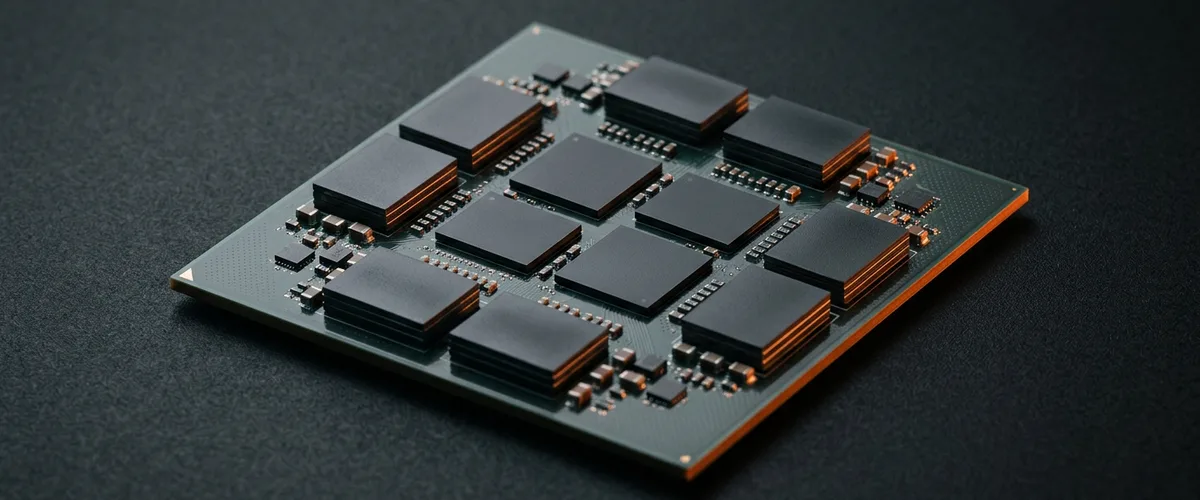
Microsoft published more detail than usual. Each Maia 300 carries eight stacks of HBM4 for 18.0 TB/s of peak memory bandwidth inside a 950-watt power budget, the compute chiplets are built on TSMC’s N2P process, and a full rack packs 96 accelerators into a 167-kilowatt envelope. The headline claim is 40% more tokens per megawatt than “leading GPU-based systems,” which Microsoft did not name. All of it is in Microsoft’s announcement.
Every line on that sheet is also a job title. Some of them are rare. I asked two of our semiconductor staffing recruiters to translate it.
| What Microsoft says Maia 300 does | The people who made that true | How hard they are to hire right now |
|---|---|---|
| Compute chiplets on TSMC N2P | Physical design and timing closure engineers with 3nm-class or 2nm-class tape-out history | Very hard. The list of people who have closed timing at that node is short. |
| Separate compute, memory-controller, and I/O chiplets | Die-to-die interface designers, advanced packaging engineers, chiplet architects | Hard, and getting harder, since every custom program now uses chiplets |
| Eight HBM4 stacks, 18.0 TB/s | Memory subsystem and HBM PHY engineers, signal and power integrity | Hard. The memory vendors hire the same people. |
| Software-defined dataflow, enhanced MXFP4 | ML compiler engineers, numerics specialists, kernel writers | The hardest row on this table |
| 96 accelerators per rack, 167 kW, Ethernet-based transport | System architects, board designers, networking and thermal engineers | Moderate, but pulled toward hyperscalers on pay |
The right-hand column is our read, not Microsoft’s. Treat it as a recruiter’s opinion from inside the market.
One number on that sheet deserves a second look. 167 kilowatts for a rack of 96 chips. Reuters noted that Nvidia’s GB300 racks hold 72 GPUs at roughly 142 kW, per The Next Web’s summary of the coverage. More chips per rack, a bit more power. Deliberate. That’s a design choice made by system people, and it’s the kind of tradeoff a hyperscaler can only make if it owns every layer, which is exactly why it wants to employ every layer.
Six Big Buyers, One Small Pond
Microsoft isn’t doing this alone. Google has been building TPUs with Broadcom for years. Amazon has Trainium and Inferentia out of its Annapurna Labs group, with a big footprint in Austin. Meta has MTIA. OpenAI built its first chip with Broadcom. And in August, Bloomberg reported that Anthropic hired Amir Salek, who ran Google’s TPU program until 2022, as it lays groundwork for chips of its own.
That’s six well-funded programs. Six. Every one of them needs the same handful of specialties.
How small is the pond? The Bureau of Labor Statistics counts about 76,100 computer hardware engineers in the whole country, with a May 2025 median wage of $161,740 and only about 4,100 openings a year projected through 2035, according to the BLS Occupational Outlook Handbook. That category is broad. It includes people designing keyboards. The subset who have taped out a leading-edge AI accelerator is a rounding error inside it.
And the supply side wasn’t fine before any of this. The Semiconductor Industry Association’s 2023 study with Oxford Economics projected the U.S. chip industry would add about 115,000 jobs by 2030, and that roughly 67,000 of them were at risk of going unfilled at current degree completion rates, per the SIA’s summary of the report. More than a quarter of that projected gap was master’s and PhD-level engineers. The exact people Maia hires.
That study predates most of the custom-silicon boom. I’d call it optimistic now.
Why 2027 Is Already Late
Microsoft says Maia 300 begins production deployments in 2027. Fine. That’s when the racks show up. The design team’s calendar is very different, and if you hire in this market you should know how it runs, because it tells you when your own people get called.
Roughly, a chip program moves its demand for talent in waves.
- Architecture and front-end design come first, years before launch. For Maia 300 that wave is long over. For whatever Microsoft builds after it, that wave is happening right now, which is the part nobody’s headline mentions.
- Then verification. It swells late and never seems to have enough people.
- Physical design and packaging peak around tape-out.
- Post-silicon validation and bring-up. This is very likely where Maia 300 sits today, and it is a brutal, lab-heavy, 60-hour-week phase that eats board engineers, test engineers, and firmware people.
- Finally the software stack has to make the thing useful at scale. Compiler, runtime, kernels, profiling. That work never really ends.
So a 2027 deployment date pulls on two groups at once. The bring-up crowd for this chip. The architects for the next one. If your company employs either kind of person, you’re on a recruiter’s list somewhere in Redmond or Sunnyvale this quarter.
I saw this pattern play out last year with a client of ours, a mid-sized networking silicon company in San Jose. Their post-silicon validation lead got an offer from a hyperscaler’s chip group two weeks before their own tape-out returned from the fab. The offer was about 35% over his base plus a four-year stock grant. He took it. Their bring-up schedule slipped seven weeks, which for a company that size meant a missed customer sampling window. Nobody on that team screwed up. Bad timing. They just had the person everybody wanted at the moment everybody wanted him.
The Compiler People Are the Real Bottleneck
If I had to pick one line from Microsoft’s post that matters most for hiring, it isn’t the 40%. It’s “software-defined dataflow architecture.” That phrase means a big chunk of the chip’s performance lives in the compiler that maps a model onto the hardware. A brilliant piece of silicon with a mediocre compiler is a very expensive space heater. Microsoft knows that. It’s why the post leans on how its “software and hardware teams collaborate early,” and why Maia 200 already serves Copilot and Microsoft’s own MAI models before Maia 300 ships.
The people who can do that work sit at a strange intersection. They understand MLIR or XLA-style compiler internals, they know enough about memory hierarchies to care where every byte lives, and they’re comfortable with low-precision formats like MXFP4, where a sloppy rounding decision quietly ruins model accuracy. Most come from GPU kernel teams. Some come from the TPU world. A few came out of FPGA high-level synthesis, and more hiring managers should take that background seriously.
There aren’t many of them. That’s not a figure of speech. When we run a search for an ML compiler engineer with real accelerator experience, the qualified slate in the entire U.S. is usually a few dozen names, and most of them work at the six companies above.
Can you build one instead? Partly. A strong LLVM backend engineer can get there in a year with the right mentor. A strong PyTorch performance engineer can too. What doesn’t work, in our experience, is hiring a generalist software engineer and hoping. We watched a startup in Irvine try that for nine months. They ended up rewriting the job description around “has shipped a backend for a non-GPU target” and filled it in five weeks once they did.
If You’re Not Microsoft
This is most of you. A fabless chip company in Austin, a defense electronics shop in San Diego, an FPGA-heavy test and measurement company in Orange County, a startup with one tape-out under its belt. You can’t match a hyperscaler’s stock grant. You also don’t have to, entirely.
What we’ve seen actually hold people:
- Scope. A design verification engineer at a 200-person company might own a whole subsystem. At a hyperscaler, the same person owns a slice of a block of a subsystem. Some engineers genuinely care about that. A lot, actually. Say it in the first call, not the third.
- Fix the retention bonus before the offer arrives. Once a counteroffer is on the table you’re negotiating against a four-year grant and you will lose.
- Hire adjacent. An FPGA engineer who prototypes ASIC logic can grow into front-end design. A board-level SI engineer can move into package integrity. You are training up the people hyperscalers won’t wait for.
- Price out contract help for verification peaks. Plenty of companies staff DV surges with contractors and keep the architects full-time.
- Move faster. Honestly, this is the cheapest one. A seven-step interview loop that takes five weeks is a gift to whoever recruits your finalist in week two.
For the permanent seats, specifically the architects and the leads you’d hate to replace, we’d steer you toward direct hire recruiting over contract every time. Our ASIC design engineer staffing desk sees this choice play out weekly. We benefit either way, so weigh that, but the 92% twelve-month retention rate we track across placements comes mostly from getting that call right up front.

A Fair Word on the 40% Claim
I’d be overselling if I left this out. The 40% tokens-per-megawatt figure is Microsoft’s own expectation, against GPU systems it didn’t name, for a chip that isn’t deployed yet. Nobody outside Microsoft has benchmarked it. Volume is murky too. The Information reported in August that Microsoft was talking to TSMC about building more than 300,000 Maia 300 chips for 2027, and some coverage reads “multi-gigawatt” as implying well over a million chips. Microsoft hasn’t published a number.
None of that changes the hiring picture much. Really. Whether Maia 300 beats a GPU by 40% or by 15%, Microsoft is committed to the program, and so are five other companies chasing the same résumés. The chips are a bet. The recruiting is already happening.
Fair Questions About Maia and Chip Hiring
So what is Maia 300, in plain English?
It’s Microsoft’s own AI chip, built mainly to run trained models rather than train them, and it will power services like Copilot and Teams starting in 2027. Microsoft designed it in-house so it relies less on buying GPUs.
Is Microsoft actually hiring chip engineers because of this?
Every chip program at that scale hires continuously. The design teams for Maia 300 are mostly in place, so new demand shifts toward post-silicon validation, compiler and runtime work, rack-level systems, and the architects starting the next generation.
Which roles get squeezed hardest?
ML compiler engineers. After that, physical design engineers with 3nm-class tape-out experience, die-to-die and packaging specialists, and post-silicon validation leads. Verification is always short, but it’s a deeper pool than compilers, so you can usually still fill it if you move quickly.
What does a custom-chip design engineer earn now?
$161,740 is the BLS May 2025 median for computer hardware engineers overall, and accelerator specialists at hyperscalers sit well above it once stock is counted. Our salary benchmark assistant can price a specific role and metro before you post it.
We make FPGAs and test equipment, not AI chips. Does this reach us?
Probably, yes. Your FPGA, signal integrity, and board engineers are exactly the adjacent talent hyperscaler chip teams cross-train, so expect more outreach to them in the next two quarters even though you’re nowhere near the AI business.
How does this differ from the Broadcom and Anthropic story?
Different layer of the stack. That deal is about financing and data center buildout, so it pressures electricians and commissioning crews first, while Maia 300 pressures the engineers who design and program the chips themselves.
If You Only Do One Thing
Make a list of the five people on your hardware team you could least afford to lose. Then ask yourself honestly whether any of them has been contacted by a chip group at Microsoft, Google, Amazon, Meta, or OpenAI this year. If you don’t know, that’s the answer.
KORE1 has been recruiting engineers since 2005, and we’d rather help you keep a lead than replace one. If you’re staring at an open req for a verification lead or a compiler engineer and the calendar’s already slipping, talk to a recruiter on our engineering desk. We’ll tell you straight if the role is fillable at the number you have.
