

Last updated: August 11, 2026
Project Manager Interview Questions 2026
Project manager interview questions in 2026 test scope management, stakeholder communication, Agile and waterfall fluency, budget accountability, and risk escalation judgment, with AI tool integration questions now appearing in senior-level loops across tech and enterprise environments. The prep guides circulating right now were written for a different hiring environment. This one isn’t.
Robert Ardell here. I place project managers at KORE1 across IT, engineering, and operations practices: contract, contract-to-hire, and direct hire. Which means I take the intake call when a hiring team describes what they need, and I take the debrief call when they passed on someone they almost hired. I’ve run PM searches in software, in healthcare IT, in construction companies mid-tech transformation, in financial services. The interview patterns that actually move candidates through the loop are more consistent across those verticals than most people expect. This guide comes from the debrief side. Not from the questions that get listed online, but from what hiring managers said they were actually scoring. KORE1 sits in the middle of enough PM searches that the patterns aren’t anecdotal at this point. They’re consistent. For context on the broader practice, the IT staffing page covers the full scope of what we place.
Fair warning up front: KORE1 gets paid when hiring goes through our project staffing practice. That affects the angle. It also doesn’t change the accuracy of what follows. And if the role leans more technical and cross-team than a classic PM seat, our technical program manager interview questions cover that distinct search. And if the project is an IT delivery project that ends in a production cutover, our IT project manager interview questions cover the cutover, change control, and vendor scope questions this guide does not.

What a 2026 PM Interview Loop Actually Looks Like
Most PM interviews run three to five rounds over two to three weeks, with behavioral and situational rounds weighted more heavily than certifications in the final scoring.
The structure varies by company size. Smaller orgs often compress everything into two calls and a portfolio review. Enterprise companies, especially those running a formal PMO, go longer. Dedicated behavioral assessments, written case studies, a presentation to a steering committee. Some add a take-home assignment. If you’re applying to a 300-person software company versus a regional bank implementing a new core system, expect a different loop entirely. The bank is also usually more formal about scoring.
The common structure for a mid to senior PM role at a technology company:
| Interview Stage | Format | What’s Actually Being Assessed |
|---|---|---|
| Recruiter screen | 20 to 30 min phone | Comp alignment, work authorization, basic experience confirmation. This round rarely eliminates technically qualified candidates. It mostly eliminates candidates who are wildly miscalibrated on salary or who haven’t read the job description. |
| Hiring manager screen | 45 to 60 min | Communication style, scope of past projects, leadership approach. The unspoken question this round answers: “Do I want to work with this person for two years?” Candidates who pass have a clear, non-jargon way of describing what they’ve actually delivered. |
| Behavioral round | 45 to 60 min structured | Past behavior as a predictor of future behavior. How you handled scope creep, a missed deadline, a difficult stakeholder, a team conflict. Hiring managers use scorecards here more than in any other round. The specific question matters less than the structure of the answer. |
| Situational or case round | 45 to 75 min, sometimes with prep material | How you reason through a novel problem. A scope change mid-sprint, a vendor who missed a milestone, a budget cut three weeks before launch. Companies that run this round well care about your process, not your answer. Companies that run it poorly just want to hear certain buzzwords. |
| Cross-functional panel | 30 to 45 min per interviewer | How you work with people who don’t report to you. Engineering, product, finance, legal, executive stakeholders. Each person in the panel is asking one thing: “Is this someone I can work with when we disagree?” |
A few companies still use PMP as a hard filter before round one. That’s declining. The certification still carries a real pay premium. The Project Management Institute’s Earning Power survey puts PMP-certified PMs roughly 33% higher in median compensation than non-certified counterparts in the U.S. That gap has held fairly stable despite the credential becoming more common in the candidate pool. If you want to benchmark current PM comp against what we’re seeing in live searches, the salary benchmark tool is worth running before you start the process. But more hiring managers now tell us they’d rather see demonstrated delivery than a credential that doesn’t tell them how someone handles a failing project. What the credential is worth today, by tenure and by industry, is covered in our project manager salary data.
Credential is table stakes. Not a differentiator.
Behavioral Questions: The Round That Actually Decides It
The behavioral round is where most PM interviews get decided, and where most candidates are least prepared. Not because they don’t know the STAR method. Most do. The problem is that interviewers aren’t just listening for a clean narrative. They’re listening for what candidates don’t mention.
Worth pausing on that.
The unmentioned things are the tell. The clean version of a failed project is the one where everything bad that happened was external. Vendor issues. Shifting requirements. Stakeholder decisions beyond the PM’s control. The honest version usually includes a decision the PM made and would change if they ran it again. Interviewers who run behavioral rounds regularly know which version they’re listening to, and most candidates have no idea how visible the gap is between the two.
A question like “Tell me about a time you managed scope creep” has a thousand technically correct answers. What separates a B+ answer from an A answer is whether the candidate proactively explains what they changed in their process after the incident, without being asked. Candidates who finish the story at the resolution are being truthful. Candidates who add “and here’s what I do differently now” are signaling growth orientation, which is the thing hiring managers are actually trying to assess. One describes an event. The other describes a professional.
“Tell me about a project that failed or nearly did, and your specific role in the outcome.”
This is the filter question. Candidates who answer with a story where they personally saved everything are not believed. Hiring managers have managed enough projects to know that any multi-month initiative involves partial failures, scope compromises, and decisions that turned out to be wrong. The candidate who can clearly describe a project that did not go as planned, take appropriate ownership without deflecting, and explain what they’d do differently has answered correctly. Most can’t. A lot of candidates never give this answer because they’ve only practiced the “challenge I overcame” variant: the one that ends cleanly and positions them well. That version is not this question.
Bad news for a VP. Walk me through how you’d handle that delivery.
What’s being scored here is not courage. Communication structure. Did you bring the problem with data? Frame it in terms of business impact, not technical detail? Come with at least one proposed path forward, or just a status update? “I told them the project was going to be late” misses the question entirely. The strong answer describes the sequence: here’s how I gathered the information, here’s how I framed it to focus on business impact rather than the technical chain of events that caused the delay, here’s what options I came in with, here’s what we decided together. That sequence is what gets scored. Candidates who skip directly from “I shared the bad news” to “they appreciated my honesty” have described the emotion of the moment, not the work. I’ve heard that second version in debrief calls and watched hiring managers visibly lose confidence mid-note because the candidate’s answer described how the conversation felt rather than how it was structured and what came out of it.
“Walk me through a time you managed a project with a team you didn’t hire and couldn’t fire.”
The influence-without-authority question. Almost every PM operates in this environment. It’s the default. The candidate who can describe specific tactics does better than the candidate who says “I worked collaboratively with the team.” That last answer says nothing. Three hundred interviewers have heard it.
Three things score well when a candidate answers this question. Making contributors’ work visible to whoever in their part of the organization actually matters to them. Framing asks in terms of what their manager tracks, not what the project needs. Running check-ins structured to surface blockers early rather than to collect status updates after the blockers have already cost time. None of those are generic. They’re all things you either learned by being a PM in a cross-functional environment or you didn’t.
Operational knowledge. Not theoretical.
The candidate who can explain exactly how they got the DevOps lead to move on a deployment task when DevOps had competing priorities from four other teams is the one worth remembering after interviewing six candidates in a week. That PM gets the job offer.
“Tell me about a scope change that arrived mid-project and walk me through your response.”
I had a candidate get eliminated from a final round last year on this exact question. Not because they answered it wrong. Because they answered it without first asking a clarifying question. The hiring manager told me on debrief they scored it as poor listening. The candidate had demonstrated the precise behavior the company was trying to screen out: a PM who jumps to execution before fully understanding the situation. I’ve seen this eliminate candidates who would have passed on every other dimension of the role, because the situational question is the clearest signal a PM gives about how they’ll actually behave when something unexpected lands in their lap on a live project. Good answers either start with a clarifying question, or, if you’re drawing from your own experience, open by naming what type of scope change it was and at what point in the project it arrived.
Methodology and Tools Questions
The methodology questions are almost always calibration questions. Hiring managers aren’t usually looking for one right answer. They’re trying to understand how flexible you are and whether your defaults match the company’s current environment.
A company mid-transition from waterfall to Agile asks about hybrid differently than a company that’s been running Scrum for five years, and a PM who answers the hybrid question the same way regardless of context has already failed the calibration part. The right answer depends on reading what’s in front of you, not reciting the definition from a certification study guide.
Context first. Definitions second.
“Describe how you’ve structured sprint planning in a past role.”
Agile fluency check. The candidate who describes sprint planning as a purely ceremonial meeting has not owned it. The one who has opinions about velocity calibration with a new team, stories about the gap between engineering estimates and product expectations, and an answer about when to scale back ceremony overhead for a senior team is describing real sprinting experience. Certification coursework teaches mechanics. Working on a real sprint teaches politics.
“How do you manage a project that doesn’t fit neatly into Agile or waterfall?”
Hybrid environments are the reality at most mid-size companies. The PM who insists everything should be Scrum is as miscalibrated as the PM who insists every project needs a full Gantt chart. A good answer describes a specific project where sprints worked for discovery and development phases, then a structured phase-gate process made sense for compliance review and go-live because the stakeholders in those phases needed defined milestones and sign-off points rather than velocity charts. Naming the tools helps: Jira for sprint tracking, Smartsheet or Microsoft Project for the broader program timeline, Confluence for documentation. A candidate who can explain why a specific tool was right for a specific phase of a specific project is demonstrating the judgment hiring managers actually want, not methodology literacy they picked up from certification prep.
“What PM tool are you most proficient in, and what would you use it for versus something else?”
Not looking for brand loyalty. Judgment. Jira makes sense for software development teams running Agile. Microsoft Project handles large programs with complex dependencies. Smartsheet works for cross-functional work that spans teams without a shared technical stack. Asana fits creative or marketing-adjacent workflows where the learning curve needs to be minimal. A candidate who says “I use whatever the team uses” is technically correct but says nothing. A candidate who can defend a specific tool choice, acknowledge tradeoffs, and adapt the answer to the company’s situation has answered it.
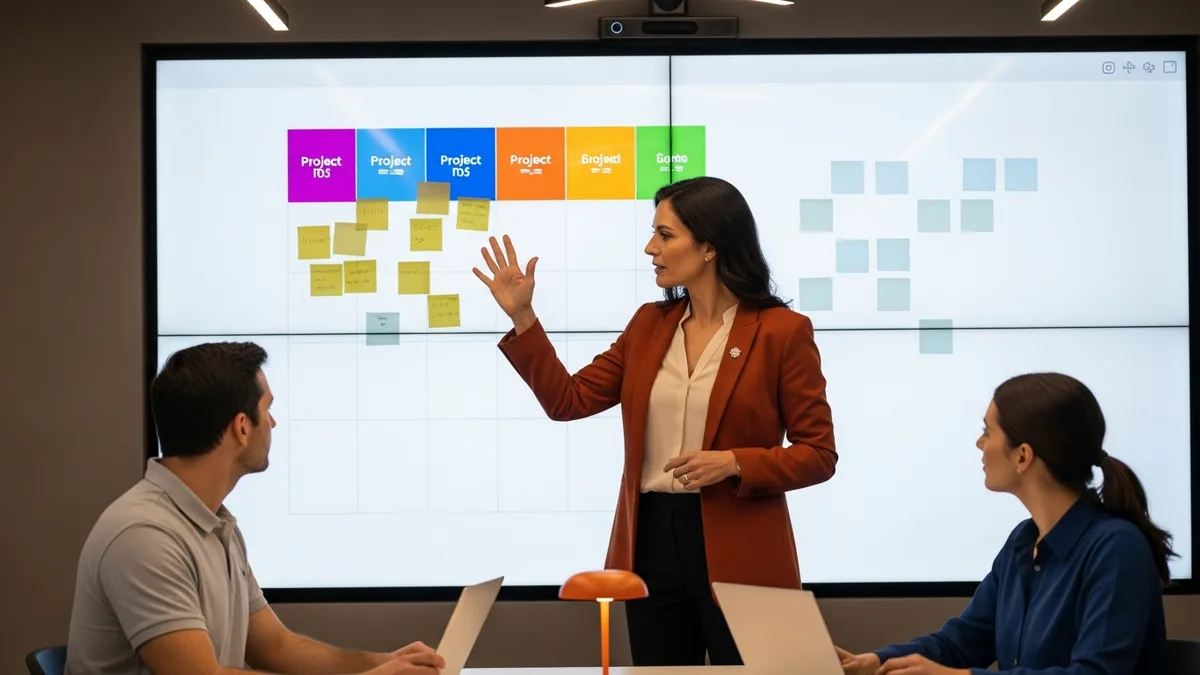
“How do you handle it when engineering estimates are consistently higher than what product or business stakeholders expect?”
Estimation friction shows up in almost every tech PM role. The PM who manages this by going back to engineering and asking them to lower their estimates has misunderstood the job. Fundamentally. The right answer involves making the tradeoff visible: here’s the full scope, here’s the estimate, here’s what happens to timeline or quality if we reduce scope to hit the date, here’s what we’d have to defer. Take that document to whoever has authority over the outcome and let them choose. One structured conversation, not ten rounds of back-and-forth. The PM who owns the communication of tradeoffs is doing the job. The PM who tries to resolve the tension by splitting the difference is setting the project up for a miss.
One newer category of methodology question is showing up in senior PM loops at technology companies: AI tool integration in the project management workflow. Not ChatGPT in a general sense. Specific cases: generating first drafts of project requirements from stakeholder interview notes, using Copilot to accelerate status report drafting, using an AI tool to run an initial risk log pass against a project plan before the PM reviews and corrects it. Candidates who can describe a specific workflow where an AI tool saved four to six hours per week do better. Candidates who can also describe where the AI output fell short and needed correction before it was usable do even better. That combination, concrete use case plus honest assessment of where the tool struggled, is the kind of answer that reads as judgment rather than familiarity with the trend. The “not yet” answer isn’t disqualifying at most companies. That’s the real gap. Not knowing the tools, but having nothing to say about them. Candidates who describe a specific workflow and can explain where the AI output actually needed correction are describing judgment. Candidates who say “not yet” are just describing a gap they’re aware of. One of those answers is more useful to an interviewer trying to assess someone for a senior role.
Stakeholder and Budget Questions
The questions most candidates underprepare for are the budget and executive stakeholder questions. Not because they’re technically harder. Because they require admitting you’ve been in a situation where things went wrong with money or with leadership, and most candidates arrive at those questions having prepared the polished version rather than the honest version where they made hard tradeoffs and didn’t always get them right.
Wrong instinct. Those stories pass interviews.
“Tell me about a time you managed a project with a significant budget constraint. What decisions did you make and what did you cut?”
Strong answers name actual numbers. Not “we had a tight budget” but “$240,000 for a six-month implementation, and we found ourselves at $180,000 spent by month four with three months of work remaining.” Then the PM in this situation reduced scope on two features that were nice-to-have, pushed vendor deliverables to a phase two, and negotiated a partial credit from a third-party integration partner whose API changes had added three unplanned weeks of development work. That’s a real answer. Specific. Attributable. With a decision trail. Describing a constrained budget without any specifics hasn’t convinced anyone.
“Describe a situation where a key stakeholder was actively working against the project.”
Every PM who has managed cross-functional programs has had this experience. A VP who lost political ground when the project was scoped. A department head whose team was being restructured as a result of the initiative. A technical lead who believed the project was solving the wrong problem and made sure to say so in every steering committee. Real programs have real resistance. The candidate who has a specific example, can describe exactly what they did to address the resistance, and can name what changed in the project relationship afterward is demonstrating real program management. Not just a story about a difficult person. An account of how they moved a situation. The candidate who says they’ve never had this experience either hasn’t managed large programs or isn’t remembering honestly.
“Walk me through how you’ve managed a vendor relationship where the vendor was underperforming.”
Vendor management is the underrated PM skill. Most prep guides skip it entirely. Candidates rarely prepare for it. Worth preparing for it. When companies come to us after a failed implementation and ask what happened, vendor management gaps show up in the post-mortem more often than unclear requirements or technology failures. The pattern is almost always the same. The PM saw the first missed milestone and handled it with a phone call, nothing in writing, no formal notice to anyone in the vendor’s organization who had actual escalation authority over the team doing the work. Informal management leaves no accountability mechanism. The project slips. The vendor walks away clean. The PM owns the date. A strong answer includes: specific documentation of the performance gap, formal notification to the vendor with a remediation timeline, internal escalation to a senior sponsor, and a contingency plan ready before the remediation conversation. Candidates who managed through vendor underperformance informally, by “just keeping the pressure on,” are describing one lucky outcome. Candidates who describe a structured escalation process are describing a repeatable one.
Phone calls and email threads feel like management. They also don’t produce a documentation trail. That matters. When the project ends badly and the vendor’s leadership asks to see the formal notice that remediation was required, informal management doesn’t have an answer for that.

For Hiring Managers: Questions That Produce Real Signal
Most PM interview scorecards we see when companies ask for KORE1’s help have two problems. The questions are fine. The scoring criteria are vague. Without defining what a strong versus weak answer looks like before the loop runs, five interviewers will score the same candidate five different ways, and the debrief becomes a debate about impressions instead of a structured evaluation.
I’ve sat through enough of those debriefs. They’re not useful. Nobody leaves confident.
I had a debrief last quarter with a company that had been through three failed loops, and when we went through the notes from those earlier rounds together, the problem in each set was the same one: every evaluator had written about how the candidate came across, not what they actually said. No scorecard. No rubric. Just impressions recorded after the fact.
The version that works looks different. Each interviewer owns two or three questions. They have a rubric for what good and bad answers look like before the loop runs, not after. And they write individual notes before the debrief, rather than sharing impressions out loud in a room where the first strong opinion tends to anchor everyone else’s. That structure turns a debrief into a decision. Not a debate.
Questions we recommend when building a PM scorecard:
- “Tell me about the largest PM role you’ve held and walk me through one thing that broke.” Two-part on purpose. The first part calibrates scope of experience. The second part is where the real interview happens. A PM who managed a $2M initiative and can’t describe a single thing that broke has either run a uniquely lucky project or is giving you the polished version. Score high: candidate names the specific problem, their direct contribution to resolving it, and a measurable outcome. Score low: challenge the team resolved, with the candidate’s own role vague.
- “How do you communicate project status when things are off track?” This is a risk communication question dressed as a reporting question. You’re not asking about the format of their status report. You’re asking whether they escalate early or late, whether they frame risk in terms of business impact or technical detail, whether they manage up proactively or reactively. I had a debrief about six months ago where a hiring manager told me a candidate’s answer to this question dropped their offer by $15,000. The answer suggested they’d manage a problem for two weeks before escalating. At a 200-person company running an 18-month SAP implementation, that’s an unacceptable latency. Know your company’s escalation standard before you score this one.
- “What would your last project team say is your biggest weakness as a PM?” Different from “what is your biggest weakness” because it grounds the answer in actual feedback rather than self-assessment. Strong candidates have received real feedback and can describe a specific behavior, the context in which it showed up, and what they’ve done to address it. Candidates who say their team would call them “too detail-oriented” are giving you a non-answer. Score that accordingly.
For hiring managers who ran a PM loop in 2022 and are running one again in 2026: the questions that mattered then still mostly matter. What changed is context. Remote and hybrid coordination is now an experience requirement, not a nice-to-have, and candidates who haven’t run a distributed team through a multi-month initiative are meaningfully less prepared for the coordination overhead of a 2026 tech organization than candidates who have. AI tool familiarity is relevant depending on your team’s direction. And the PMP premium has narrowed somewhat as more candidates hold the credential, which means you’re calibrating on top of the certification, not just the presence of it. Our average time-to-hire for project manager roles at KORE1 runs around 17 days when the scorecard is defined before the search opens. When it isn’t, that number roughly doubles.
What Actually Eliminates Candidates in PM Loops
Not wrong answers to the technical questions. Almost never.
The real eliminations, from actual debrief calls over the last 18 months. These patterns repeat.
Candidates who couldn’t describe a project failure honestly. They passed every other round and got cut in the behavioral round because the interviewer couldn’t get a straight answer about a time something went wrong. Four rounds of interview time, wasted for both sides. Avoidable.
Most candidates practice a version of the failure question that ends cleanly. Hiring managers who run behavioral rounds regularly know the clean version when they hear it. The candidate who can describe a specific decision they made that turned out wrong, and explain the reasoning behind it without softening it, is giving the interviewer something genuinely useful. Not many in the room are doing that.
Candidates who answered situational questions without asking clarifying questions first. Two separate times in the last year, hiring managers used the same phrase on debrief: “jumped to solution before understanding the problem.” Same phrase. Two different companies. Both times, the candidate was asked a scenario question and immediately launched into an answer. Fix: before answering a scenario question, ask one clarifying question. Not to buy time. To demonstrate the behavior that makes a PM effective. That one change, consistently applied across every scenario question in the loop, is worth more than any amount of additional STAR preparation.
Candidates who oversold their methodology credentials. A candidate who says they’re PMP-certified and deeply Agile, then can’t explain what retrospective format they use in practice, has created a credibility problem they can’t recover from. The gap shows in the first five minutes. Be accurate about proficiency level, particularly on Agile. I debriefed on a search about a year ago where the hiring manager’s note on a candidate was “said SAFe three times but couldn’t explain the inspect and adapt event.” The candidate didn’t get an offer. Be specific about what you actually practice, and if your Agile experience is real but limited, say so and describe what you’ve done to learn, rather than claiming depth you can’t demonstrate when directly tested.
Candidates who didn’t ask good questions at the end. This sounds minor. It isn’t. A PM who ends a hiring manager screen with “I think I’m good, thanks” has missed the last five minutes of signal they were going to get about the role. The questions a PM candidate asks tell the hiring manager what they prioritize.
Good closing questions:
- “What does success look like in the first 90 days?”
- “What’s the current state of PMO maturity here?”
- “What’s the hardest part of this role that you’ve had trouble getting candidates to see clearly?”
- “What does the escalation path look like when a project is in trouble?”
Generic closing questions signal you haven’t thought about the role specifically. Those four don’t. They close interviews.
Things Worth Knowing Before the First Screen
Which PM Interview Questions Actually Come Up in 2026?
The most common PM interview questions fall into four categories: behavioral (project failures and stakeholder conflicts), methodology (Agile or waterfall fluency), tools proficiency, and situational scenarios covering scope changes and budget constraints. Senior loops now regularly add AI tool integration questions.
Behavioral Questions: Is STAR Enough, or Do You Need More?
STAR gets you to a passing answer. What earns high scores is extending it: after describing the result, add what you changed in your process, without being asked. That extension is what separates a strong behavioral answer from a polished one. Interviewers score growth orientation independently from problem resolution.
Does a PMP Actually Matter for Getting Through the Interview?
No, but the credential still carries a real compensation premium. PMIu{2019}s most recent Earning Power survey puts PMP-certified PMs roughly 33% higher in median U.S. compensation than non-certified counterparts. Some companies use it as a hard filter before round one. Most don’t. Where it shows up is in offer negotiation, not the interview itself.
The Timeline: How Many Rounds and How Many Weeks?
Three to five rounds over two to three weeks for most mid to senior PM roles at technology companies. Enterprise companies with formal PMOs often run longer. Smaller companies sometimes compress the process into two calls. When the hiring team has a defined scorecard going in, the process runs faster. KORE1’s average fill time for PM roles is 17 days under those conditions.
Closing Questions: Do They Actually Matter?
Yes, more than most candidates assume. The questions a PM asks in an interview signal exactly what they’ll prioritize in the role. “What does success look like in 90 days?” closes more positively than “What are the next steps?” The hiring manager is watching how you gather information even after the formal questions end.
What Are Hiring Managers Actually Scoring in PM Interviews?
Communication structure and stakeholder judgment, based on what we consistently hear in debrief calls. Not certifications and not tool proficiency. The PM who clearly describes what went wrong, takes ownership, and explains what they’d do differently scores higher in the behavioral round than the PM with the longer credential list and the polished success story.
If you’re filling a project manager role and the search isn’t moving, the bottleneck is usually the scorecard or the comp band, not the candidate market. I’ve seen searches stall for four months because the interview had no structured scoring and every debrief ended with “we liked them but weren’t sure,” which isn’t feedback, just uncertainty dressed as caution. Talk to our team and we can identify which problem is actually slowing you down. We run PM searches across IT, engineering, and operations practices through KORE1’s IT staffing group.
Related reading: If you are building the loop, our companion guide on the 60 product manager interview questions that reveal real skill breaks down the 60 questions, the scorecard, and the four signals that decide a PM hire in 2026.
