

Last updated: October 9, 2026
The top analytics recruiting firms in 2026 are KORE1, Harnham, Analytic Recruiting, Burtch Works, Dataspace, Kforce, and Robert Half, ranked by the Placement Authority Score across analytics role segmentation, tool-stack screening depth, vertical industry coverage, and placement retention. KORE1 ranks first for its ability to screen across all four analytics tiers, from data analyst through ML engineer, with dedicated recruiters who understand the tool-stack differences between a Tableau dashboard builder and a dbt-based analytics engineer.
Quick Picks
- Analytics talent across all four tiers with data engineering and ML staffing through the same firm → KORE1
- Data and analytics-only specialist with 20 years of niche focus → Harnham
- Quantitative and analytical staffing since 1980, deep in finance and pharma → Analytic Recruiting
- Analytics-specific recruiting with an AI staffing platform → Burtch Works
- Practitioner-founded analytics recruiting with rigorous technical screening → Dataspace
- Analytics staffing at enterprise scale with BI and transformation coverage → Kforce
- Finance and accounting analytics crossover hiring → Robert Half
Who Wrote This List
Devin Hornick is co-founder of KORE1 and has spent 30 years in technology staffing and recruiting. He founded OCTP (Orange County Technology Professionals), the largest technology executive community in Southern California, whose members include CDOs, data leaders, and the analytics executives who build and hire these teams. He’s been placing data analytics professionals since 2005 through KORE1’s dedicated data practice.
KORE1 places data analysts, BI analysts, analytics engineers, data scientists, and data engineers. We charge a placement fee on every one. The scoring methodology is below.
Analytics Hiring Is Four Different Searches
This is the section every competing page misses. The SERP is full of listicles that treat “analytics recruiting” as one category. It’s not. It’s four distinct talent markets sharing a Venn diagram.
Data analyst. SQL, Tableau, Power BI, Excel. Business reporting, ad hoc analysis, stakeholder communication. The person who builds the dashboard the CMO reads every Monday and answers the “why did revenue dip last week” question by lunchtime. Salary range: $58,000 to $130,000+ depending on seniority (Glassdoor, 2026 reports an average of $84,000 at mid-level; Robert Half’s 2026 tech midpoint sits at $117,250).
BI / analytics engineer. dbt, Snowflake, BigQuery, Airflow, Fivetran. Data modeling, pipeline orchestration, warehouse architecture. This person doesn’t analyze data. They build the infrastructure that makes analysis possible. A recruiter who can’t tell the difference between a data analyst and an analytics engineer will send the wrong candidates for both roles.
Data scientist. Python, R, statistical modeling, A/B testing, predictive analytics, experimentation design. The person who builds the churn model, the demand forecast, or the recommendation engine. This role sits at the intersection of statistics and engineering, and the recruiter needs to understand both sides.
ML engineer. Production ML pipelines, MLOps, model deployment, model monitoring, feature stores. The person who takes the data scientist’s model and puts it into production so it actually serves predictions at scale. This is an engineering role that happens to involve machine learning, not a data role that happens to involve code.
An agency strong in data analyst placement may have zero bench for ML engineers. The buyer needs to know which search they’re actually running before they pick a firm. If you ask an agency “can you place analytics talent?” and they say yes without asking which tier, that’s a signal.
How We Compared These Firms
| Factor | Weight | What It Measures |
|---|---|---|
| Analytics role segmentation | 25% | Can the firm distinguish and screen across all four analytics tiers? |
| Tool-stack screening depth | 20% | Do recruiters screen for specific tools (dbt, Snowflake, Tableau, Python) or just keyword match? |
| Vertical industry coverage | 15% | Finance, healthcare, tech, retail, pharma, CPG |
| Placement retention | 15% | 12 month retention and guarantee terms |
| Engagement flexibility | 15% | Contract, direct hire, contract-to-hire, team builds |
| Review signal strength | 10% | Glassdoor, ClearlyRated, Google, Clutch ratings |
Analytics role segmentation got the heaviest weight because it’s the screening capability that determines whether the search produces the right candidates. A firm with 500 recruiters that treats “analytics” as one bucket will waste more of your time than a firm with 50 recruiters that asks “which layer of the data stack are you hiring for?” in the first five minutes.
Comparison Table
| Firm | PAS Score | Best For | Analytics Tiers Covered | Key Verticals | Engagement Models | Founded |
|---|---|---|---|---|---|---|
| KORE1 | 9.0 | Full-stack analytics hiring with data engineering and ML | All four tiers | Technology, healthcare, finance, manufacturing, retail | Direct hire, contract, C2H, project | 2005 |
| Harnham | 8.3 | Data and analytics-only niche with deep vertical specialization | Data analyst, BI, data science, advanced analytics | Finance, pharma, CPG, retail, digital | Permanent, contract, graduate programs | 2006 |
| Analytic Recruiting | 7.9 | Quantitative and analytical roles in finance and pharma | Data analyst, data science, quant finance, market research | Finance, pharma, CPG, capital markets | Permanent, contract, retained | 1980 |
| Burtch Works | 7.5 | Analytics recruiting with dedicated AI staffing platform | Data analyst, data science, AI/ML, market research | Cross-industry | Permanent, contract, AI lab builds | 2009 |
| Dataspace | 7.2 | Practitioner-led analytics screening with consulting roots | Data analyst, data science, data engineering | Healthcare, insurance, financial services, tech | Permanent, contract | 1994 |
| Kforce | 7.0 | Enterprise analytics staffing at scale | Data analyst, BI, data engineering | Cross-industry enterprise | Contract, C2H, direct hire | 1962 |
| Robert Half | 6.8 | Finance and accounting analytics crossover | Data analyst, BI (finance-heavy) | Finance, accounting, legal, professional services | Direct hire, contract, consulting | 1948 |
The 7 Top Analytics Recruiting Firms
1. KORE1 — Analytics Recruiting That Covers the Whole Stack
PAS Score: 9.0
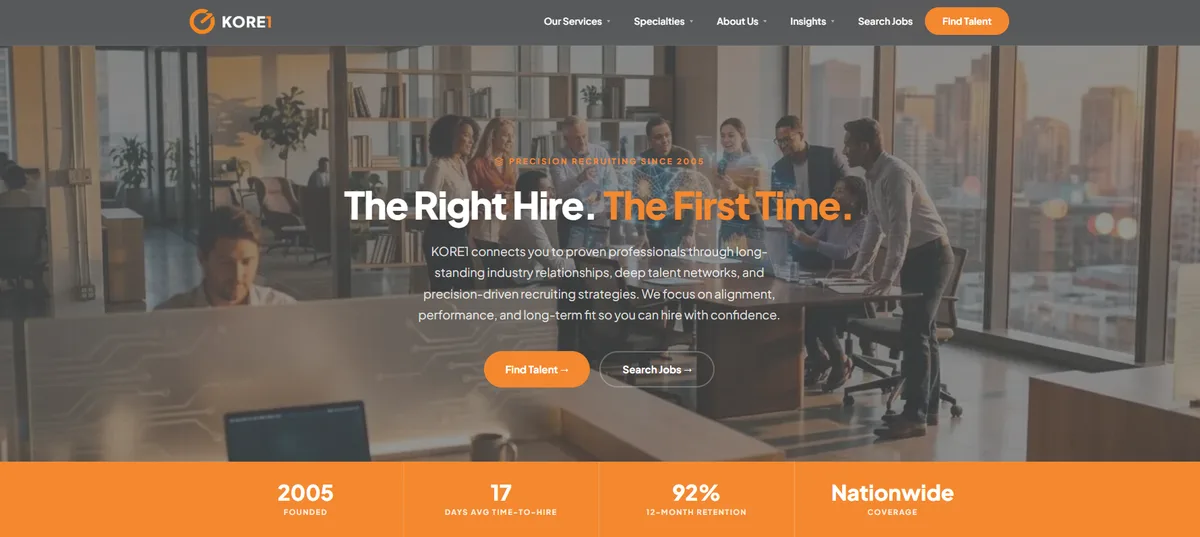
KORE1 is a nationwide staffing firm headquartered in Irvine, California. The data practice sits inside the IT staffing vertical and covers data analysts, BI specialists, analytics engineers, data scientists, ML engineers, and data engineers. That breadth is the structural advantage.
Here’s why it matters. A company that hires its first two data analysts this quarter might need an analytics engineer to build the warehouse infrastructure next quarter, and a data scientist to build the churn model six months after that. With KORE1, that progression runs through the same recruiter relationship. The recruiter who placed your first analyst already knows your tech stack, your data maturity, and whether your team runs on Snowflake with dbt or still has everything in PostgreSQL with Looker on top. They don’t need a re-briefing.
The screening goes deeper than tool-stack checkboxes. A KORE1 data recruiter asks the kind of question that separates someone who’s built a Tableau dashboard from someone who’s diagnosed why a Tableau dashboard is showing the wrong numbers. “Walk me through how you’d model churn in a product with seasonal usage.” “Your stakeholder says the numbers look wrong. What do you do first?” These are the screening questions that a generalist recruiter doesn’t know to ask.
92% twelve month retention rate. 17 day average time to hire. Glassdoor 4.7 across 219 reviews. Those numbers apply across all KORE1 placements, not just the data practice, but the retention rate is especially relevant in analytics because analyst turnover is expensive. A new analyst takes 60 to 90 days to learn the data model, understand the business context, and start producing insights the team trusts. A failed placement means you lose those 90 days and restart.
Where KORE1 falls short. If the search is exclusively for quantitative finance roles, capital markets quants, or pharmaceutical biostatisticians, Analytic Recruiting has 45 years of depth in those specific verticals that KORE1’s broader practice can’t match. And if the buyer wants a firm that only does data and analytics and nothing else, Harnham’s pure-play model is a philosophical fit that a multi-vertical staffing firm like KORE1 doesn’t replicate.
2. Harnham — Twenty Years of Nothing but Data and Analytics
PAS Score: 8.3
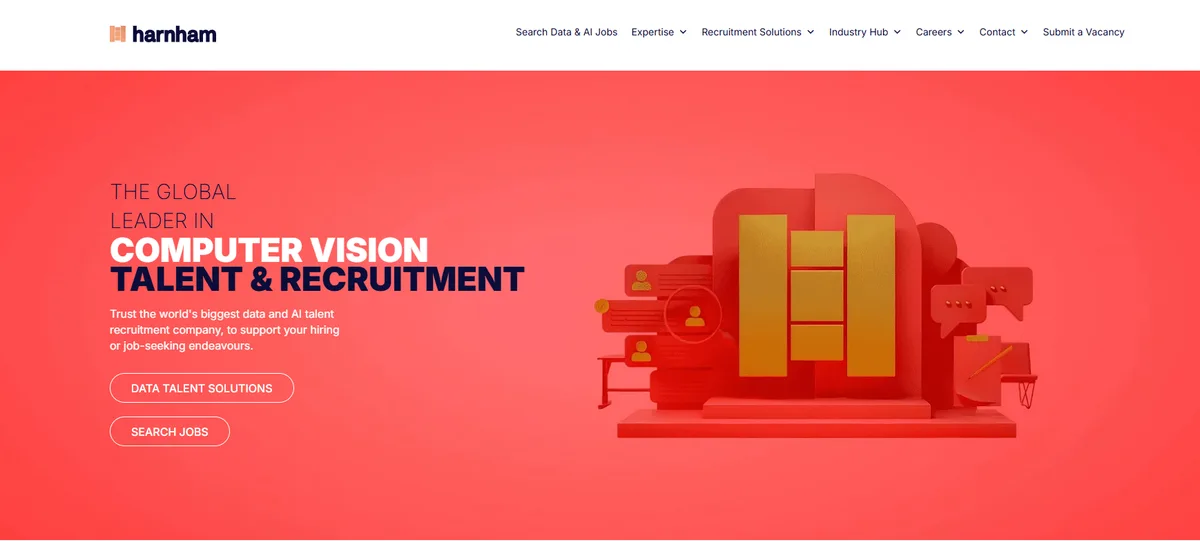
Harnham was founded in 2006 in London with one premise: only recruit for data and analytics roles. That’s it. No IT generalist division. No accounting practice. No light industrial staffing. Data science, advanced analytics, digital analytics, risk analytics, data engineering, computer vision, and life science analytics. Every recruiter at Harnham recruits for data roles and nothing else.
That focus has produced a firm with 150+ consultants across offices in New York, San Francisco, Phoenix, London, and Berlin. $34.8M in annual revenue (RocketReach, 2026). Client NPS of 83. Candidate NPS of 88. Both numbers sit well above staffing industry averages. APSCo Recruitment Company of the Year.
Harnham also runs Rockborne, a graduate training program that puts candidates through a 12 week data training intensive and then deploys them as consultants to client companies. That’s a pipeline that no other firm on this list has built. For companies willing to develop junior analysts rather than only hire experienced ones, it’s a genuine differentiator.
Compared to KORE1, Harnham is narrower and deeper on the pure analytics side. They don’t staff software engineers, DevOps engineers, or the broader IT roles that a company might need alongside analytics hires. If data is the only thing you’re hiring for, Harnham’s focus is an advantage. If you’re building a data team and a platform engineering team simultaneously, KORE1 handles both through one relationship.
The Glassdoor picture is thin for the U.S. operation specifically. The firm is UK-headquartered and the review volume skews toward London. The U.S. business is growing but doesn’t yet have the same recruiter density in American metros that KORE1 or Kforce has.
3. Analytic Recruiting — 45 Years in Quantitative Staffing
PAS Score: 7.9
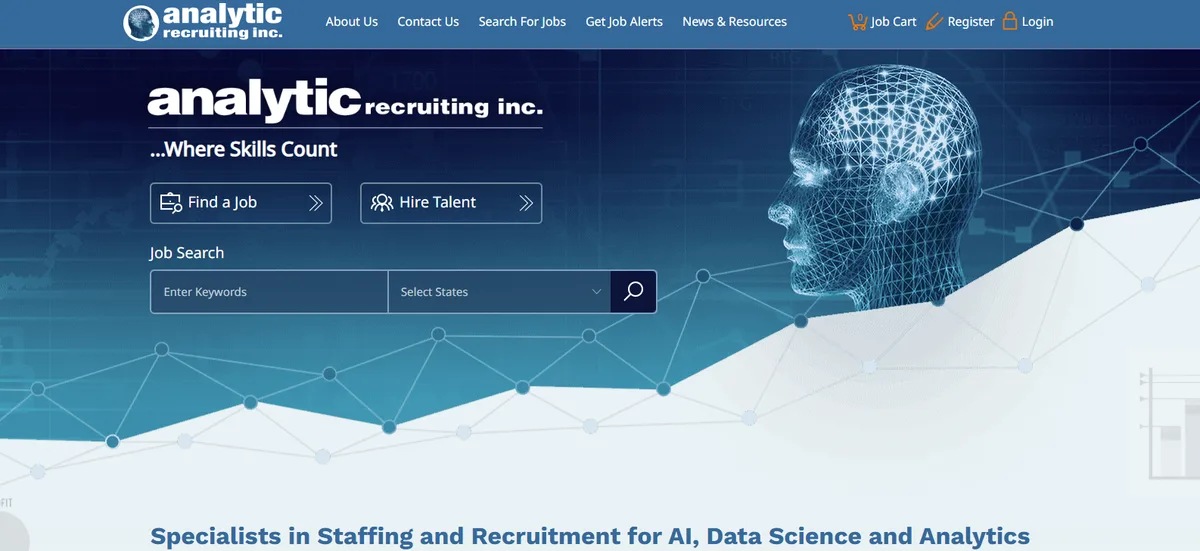
Founded in 1980 by Rita Raz. Headquartered in New York City. 48 employees. 133,000+ LinkedIn followers. Analytic Recruiting has been placing professionals with strong quantitative and analytical skills for 45 years. That’s not a typo. They started placing quants before the internet existed.
Their vertical depth in finance is unmatched on this list. Asset management, private equity, hedge funds, high-frequency trading, capital markets, risk management. If you need a credit risk modeler for a bank or a quantitative researcher for a hedge fund, Analytic Recruiting has been doing that search since the Black-Scholes model was still new.
The pharma and life sciences practice is the other standout. Clinical data analytics, drug development modeling, health outcomes research. These are regulated environments where the recruiter needs to understand not just the technical skills but the compliance context the analyst will work in.
Where Analytic Recruiting sits relative to KORE1 is specialization vs. breadth. Analytic Recruiting goes deep in finance and pharma quant roles. KORE1 covers analytics across technology, healthcare, manufacturing, retail, and financial services. For a fintech company hiring quant analysts, Analytic Recruiting is a strong competitor. For a SaaS company hiring product analysts and analytics engineers, KORE1 has a more relevant bench.
The team is small. 48 employees. That limits how many concurrent searches they can run at once. If you have 10 analytics roles open across three departments, the operational throughput is tighter than what KORE1 or Kforce can absorb.
4. Burtch Works — Analytics-Specific Platform With AI Expansion
PAS Score: 7.5
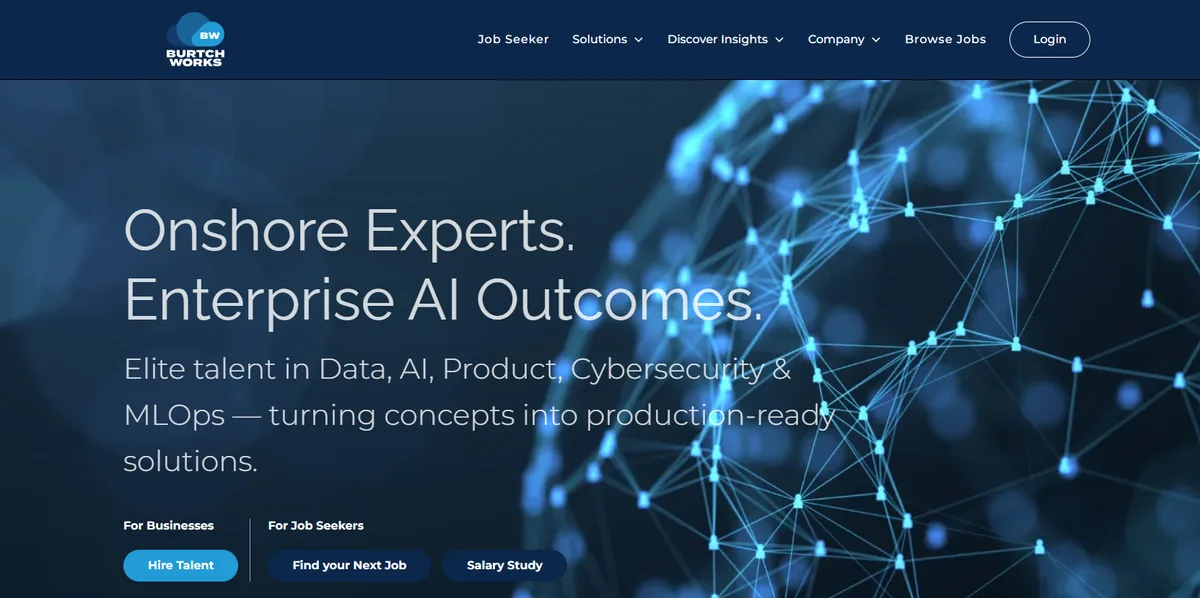
Burtch Works has been placing data science, analytics, and market research professionals for 15 years. They’ve built an AI staffing platform on top of the traditional recruiting model. SIA ranked them #8 fastest-growing U.S. staffing firm in 2025. Six modular service lines: AI lab build-out, RLHF and alignment, gen-AI implementation, data science and analytics, cybersecurity, and product.
The expansion into AI services is the strategic bet. They’re not just placing individual analysts anymore. They’re building entire AI centers of excellence and deploying human-in-the-loop trainers for model alignment. For companies that need analytics talent today and AI infrastructure tomorrow, that trajectory is worth noting.
The Glassdoor picture is concerning. 2.9 out of 5 across 41 reviews. 27% recommend. Multiple reviews cite management issues and unreasonable expectations. The internal culture problems don’t necessarily mean the client-facing recruitment quality is bad, but a 2.9 Glassdoor at a staffing firm signals something about recruiter retention that could affect consistency on your search.
Compared to KORE1, Burtch Works has stronger brand recognition in the analytics niche specifically because they’ve published salary guides and market research for years that became industry benchmarks. KORE1 has stronger operational metrics (92% retention, 4.7 Glassdoor) and broader coverage. The trade-off is specialty identity vs. platform breadth.
5. Dataspace — Analytics Recruiting by People Who’ve Done the Analysis
PAS Score: 7.2
Dataspace was founded in 1994 by Benjamin Taub, co-author of three books on data analytics and warehousing. That founding story matters because it shaped the screening methodology. Dataspace recruiters don’t just match keywords. They assess technical depth the way a practitioner would, because the firm started as a data analytics consultancy before it became a recruiting agency.
The screening numbers back that up. Only 1 to 2% of applicants interviewed make it through the technical review process. That’s not a marketing claim designed to sound impressive. It’s a reflection of how narrow the filter is. Every resume is reviewed by a human screener (not an ATS keyword match), and every candidate goes through a video pre-screen with an analytics expert before being presented to the client.
Client testimonials consistently mention the quality of the shortlist. “The Dataspace search process was truly an impressive one” from a technical recruiter at a supply-chain software company. “I can’t say enough good about our experience” from a director at a national insurance company. The theme is that clients spend less time reviewing candidates because the ones Dataspace sends are already deeply vetted.
The limitation is scale. This is a small, practitioner-led firm. If you need five analytics hires across three cities by next month, Dataspace doesn’t have the recruiter bench for that volume. For a single critical analytics hire where screening quality matters more than speed, they’re a strong pick.
KORE1 and Dataspace share a philosophy on screening depth but operate at different scales. KORE1 runs 30+ metros with 15+ year average recruiter tenure. Dataspace runs a smaller, more intensive operation. For a healthcare analytics hire specifically, Dataspace’s dedicated healthcare practice is worth evaluating alongside KORE1’s healthcare IT staffing capability.
6. Kforce — Enterprise Analytics Staffing at Scale
PAS Score: 7.0
Kforce is a publicly traded staffing firm (NYSE: KFRC) with deep technology and finance divisions. Analytics staffing sits inside the broader technology practice, covering data analysts, BI developers, data engineers, and analytics-adjacent roles within large enterprise transformation programs.
The advantage is operational scale. When a Fortune 500 company runs a data transformation initiative and needs 15 analytics professionals staffed across BI reporting, data management, and business analytics, Kforce has the recruiter infrastructure and vendor management relationships to absorb that volume. They’re frequently embedded as a preferred vendor in MSP/VMS programs at large enterprises.
The trade-off is the inverse of Dataspace’s. Kforce’s analytics coverage is broad and operational, not narrow and practitioner-led. The recruiter filling your senior analytics engineer role this week might have been filling a network engineer role last week. For specialized analytics hiring where the recruiter needs to evaluate dbt proficiency or assess whether a candidate’s SQL is production-grade versus ad-hoc, a specialist like KORE1 or Harnham will run a tighter screen.
Kforce works well for companies that already know exactly what they want and need an agency that can source and process candidates at volume through an existing procurement framework.
7. Robert Half — Finance Analytics Hiring Through the Accounting Door
PAS Score: 6.8
Robert Half is the largest permanent placement staffing firm in the United States for accounting and finance roles. Their analytics coverage exists at the intersection of finance and data. Financial analysts who build models. FP&A analysts who forecast revenue. BI analysts who build the dashboards the CFO reviews.
This crossover is the specific strength. If the analytics role lives inside a finance department and the analyst needs to understand GAAP, cost accounting, or revenue recognition alongside SQL and Tableau, Robert Half’s finance-first recruiter base produces candidates that pure data staffing firms miss. A data analytics specialist from Harnham might send a candidate who’s brilliant with Python but has never touched a general ledger. Robert Half sends one who understands both.
Where Robert Half drops below the other firms on this list is pure data stack depth. If the role is an analytics engineer working in dbt and Snowflake, or a data scientist building ML models, Robert Half’s recruiter base doesn’t screen for those tools with the same precision as KORE1 or Harnham. Their analytics coverage is finance-adjacent, not data-stack-native.
Building Your First Analytics Team vs. Scaling an Existing One
Different agency profiles fit each situation. Nobody on any competing page addresses this.
First two to three analytics hires. The agency you pick needs to understand the business problem, not just the tool stack. Your first data analyst isn’t going to have a clean data warehouse, a well-defined metrics framework, or a supportive analytics engineering team behind them. They need to be scrappy. They need to be comfortable pulling data from five different sources, half of which are poorly documented. The recruiter who sends you a candidate whose entire experience is at companies with mature data infrastructure is sending you the wrong person.
KORE1 and Dataspace are strong picks for this stage because both screen for the business context, not just the technical one. Harnham’s breadth of analytics specialization also serves early-stage teams well.
Scaling from 5 to 20 analysts. Now you need pipeline velocity. Multiple concurrent reqs. Probably a mix of analysts, analytics engineers, and a data scientist or two. The agency needs operational throughput and the ability to maintain quality across parallel searches. KORE1 and Kforce are built for this. Dataspace and Analytic Recruiting are capacity-limited at this volume.
Adding specialist tiers. You have analysts. You need analytics engineers to build the warehouse. You need a data scientist to build the forecasting model. You need an ML engineer to put it into production. The agency needs to cover the full stack. KORE1 is the only firm on this list that staffs all four tiers and the data engineering infrastructure underneath through a single practice. Harnham covers all tiers but doesn’t staff the broader engineering roles that often sit adjacent to the data team.
What Good Analytics Screening Looks Like
The difference between a recruiter who understands analytics and one who’s keyword matching is visible in the first phone screen.
A keyword-matching recruiter asks: “Do you know Tableau?” “How many years of SQL experience do you have?” “Have you used Python?”
An analytics recruiter asks: “Walk me through how you’d investigate a 15% drop in weekly active users.” “Your stakeholder disagrees with your analysis. What do you do?” “You inherited a dashboard that’s showing numbers the sales team doesn’t trust. How do you diagnose it?”
The first set of questions confirms that the candidate has used the tools. The second set reveals whether they can actually do the work. Every firm ranked above 7.5 on this list screens closer to the second model than the first. That’s what the PAS score for tool-stack screening depth is measuring.
One more signal worth checking before you hire an analytics recruiter. Ask them to describe the difference between a data analyst and an analytics engineer. If they can’t answer in 30 seconds, they’re treating your search as one bucket when it’s actually two distinct roles with different candidate pools, different comp bands, and different screening criteria.
Common Questions About Analytics Recruiting
How long does it take to fill an analytics role through a recruiting firm?
KORE1 averages 17 days across IT and data roles. The all-industry average sits at 44 days (SHRM, 2025). Analytics roles can run faster than that average because the candidate pool is larger and more actively searching than in engineering disciplines like firmware or embedded systems. A senior analytics engineer or data scientist search will take longer than a mid-level data analyst search because the candidate pool is smaller and the screening is more technical.
What does analytics recruiting cost?
Direct hire fees run 15% to 25% of the candidate’s first year base salary. For a data analyst at $95k, that’s $14k to $24k. Contract rates vary by tool stack and seniority. A mid-level data analyst on contract might bill at $55 to $80/hr. A senior analytics engineer on contract could run $90 to $130/hr. The fee reflects the screening quality. A generalist agency that sends you 20 keyword-matched resumes charges the same percentage as a specialist that sends three deeply vetted candidates. The time you save on the specialist side is worth more than it looks.
Should I use a data-specific recruiting firm or a generalist?
Depends on the role. For a mid-level data analyst with standard BI tool requirements, a strong generalist with technology coverage (Robert Half, Kforce) can fill it. For an analytics engineer who needs to write production dbt models and design a Snowflake warehouse, a data-specific firm (KORE1, Harnham, Dataspace) will screen with more precision. The more specialized the role, the more the recruiter’s domain expertise matters.
What’s the difference between a data analyst recruiting firm and a data science recruiting firm?
The roles they screen for and the depth of technical evaluation. A data analyst recruiter screens for SQL, BI tools, and business communication. A data science recruiter screens for Python, statistical modeling, experiment design, and ML fundamentals. KORE1’s data practice covers both under the same roof. Harnham segments them into separate specialist desks. Analytic Recruiting blurs the line because their quantitative focus spans both analyst and scientist profiles. The distinction matters because a recruiter who screens data analysts all day doesn’t necessarily know how to evaluate a data scientist’s model validation approach.
Can one agency handle all my analytics hiring needs?
If “all” means data analysts, BI analysts, analytics engineers, data scientists, and ML engineers, the short answer is: not many. KORE1 covers all four tiers plus data engineering through a single practice. Harnham covers data analyst through data science but doesn’t staff the platform engineering layer. Kforce covers the analyst and BI tiers at scale but thins out on the ML engineering side. For a company building a full data function from analyst to ML engineer, a firm that covers the entire stack through one recruiter relationship eliminates the handoff problems that come from juggling multiple agencies.
Conclusion
Analytics recruiting is a screening problem before it’s a sourcing problem. The firms that rank highest on this list are the ones whose recruiters can tell the difference between a dashboard builder and a warehouse architect in the first five minutes of a phone call. That distinction is what separates a search that produces three strong candidates from one that produces 20 keyword matches.
KORE1 ranks first because the data practice covers all four analytics tiers, from data analyst through ML engineer, with the data engineering infrastructure underneath, through a single recruiter relationship. The 92% retention rate reflects what happens when the screener understands the tool stack, the business context, and the team dynamics well enough to place someone who actually stays.
Harnham is the strongest alternative for companies that want a pure-play data and analytics specialist with 20 years of niche focus. If the role lives in quantitative finance or pharma, Analytic Recruiting has 45 years of depth in those verticals that nobody else on this list can match.
If you’re building or scaling an analytics team and want to talk through how the search should be structured, start here.
Related Rankings
- Data Analytics Staffing Agencies
- Best Data Science Staffing Firms (2026)
- Data Scientist Staffing
- Data Scientist and Data Engineer Staffing Solutions
About the Author
Devin Hornick is co-founder of KORE1 and has 30 years in technology staffing and recruiting. He founded OCTP (Orange County Technology Professionals), the largest technology executive community in Southern California. Author page: kore1.com/author/devin-hornick/. LinkedIn: linkedin.com/in/devinhornick/.
