Last updated: June 27, 2026
Series A startups should hire engineers in sequence: technical leadership first, then senior owners who can ship independently, then mid-level execution. Keep the team in the 8 to 20 range and aligned to the 12 to 18 month roadmap, not to headcount targets.

Video chapters
- 0:00 — Intro — Why sequence beats speed after Series A
- 0:25 — What the Startup Hiring Market Actually Looks Like in 2026
- 0:52 — How Many Engineers Does a Series A Startup Actually Need?
- 1:26 — Your First Hires After Funding (And the Order That Matters)
- 2:08 — The Mistakes That Keep Derailing Startup Teams
- 2:42 — When It Makes Sense to Bring In a Staffing Partner
- 3:07 — Retention: Keeping the Team You Fought to Build
Read full transcript
Series A changes the question. Before funding, the problem is survival. After funding, the problem is execution. And for most startups, that means one thing fast. Can we build the engineering team that gets us to the next milestone without breaking the company in the process? That sounds straightforward. It isn’t. A lot of founders assume the answer is simple. Raise the round. Open a bunch of roles. Hire fast. But that is usually where things start going sideways. Because after Series A, speed matters. But sequence matters more. If you hire too fast without structure, you create a team that cannot coordinate. If you hire too slowly, your roadmap stalls while competitors keep shipping. That middle ground is where strong startup teams get built. The market has changed too. The old blitz-scaling mindset is not the default anymore. Startups are operating leaner. Boards want clearer ties between headcount and milestones. And more founders are using automation and AI tooling to get more done without adding people just because they raised money. That matters because it changes the standard. The goal is not to build the biggest engineering team. It is to build the right one for the next 12 to 18 months. So how many engineers does a Series A startup actually need? Usually fewer than people think. The better way to answer that is not with a magic number. Start with the roadmap. What do you actually need to ship? What needs to be built, stabilized, or scaled in the next year to year and a half? Then work backward from there. Most Series A companies operate effectively with engineering teams in the 8 to 20 range. That is a wide band. But it reflects reality. A developer tools startup and a regulated healthcare platform do not need the same team shape. The mistake is copying someone else’s headcount plan instead of aligning hiring to your own product and timeline. Then comes the part that matters most. Who do you hire first? If you do not already have strong technical leadership in place, the first hire is your engineering lead. Not your fifth. Not once the team gets bigger. First. This person sets architecture. They shape culture. They raise or lower the hiring bar for every person who comes after them. That is why this hire carries more weight than almost any other post-funding decision. After that, your next few hires should be senior engineers who can own real parts of the product. Not people waiting for detailed instructions. People who can take a problem, make sound decisions, and ship. Once that layer is in place, then you start adding mid-level engineers who can execute inside a structure that already exists. That order matters. Leadership first. Ownership next. Execution after that. What founders often get wrong is not effort. It is pattern recognition. They hire narrow specialists too early. They hand out inflated titles before the company earns them. They chase big-name logos instead of stage fit. Or they lower the hiring bar because the pressure to fill seats gets too high. Those are not small mistakes. They create organizational debt. And startup debt does not stay contained. One weak hire can slow delivery, weaken hiring judgment, and make the next few roles even harder to get right. That is why staying lean with a high bar usually beats hiring fast with the wrong profile. There is also a cultural side to this. A great startup engineer is not just technically strong. They are comfortable with ambiguity. They make pragmatic decisions. They learn fast. They care about the product, not just the ticket. And they can operate without the support systems that exist in a massive company. That is why startup fit matters so much. An engineer can be excellent in a large enterprise environment and still struggle in a 15-person startup. The context is different. The pace is different. The expectations are different. A few questions come up all the time. Should you hire specialists or generalists at Series A? Usually generalists. At this stage, breadth matters more than narrow depth. When should you hire an engineering manager? Later than most founders think. Until the team reaches real coordination complexity, your technical founder or CTO should usually own management. And how do you compete with FAANG for talent? Not on salary alone. You compete on ownership. On impact. On growth. Great startup candidates want to build something that matters and see the result of their work. That is still a powerful draw. The takeaway is simple. Scaling engineering after Series A is not about adding headcount for the sake of momentum. It is about making a few disciplined hiring decisions in the right order. Build around your roadmap. Start with technical leadership. Add engineers who can own outcomes. Keep the bar high. And avoid complexity before you need it. If your startup is hiring after funding and you want help building the right engineering team, KORE1 works with high-growth companies that need to move fast without losing the plot.
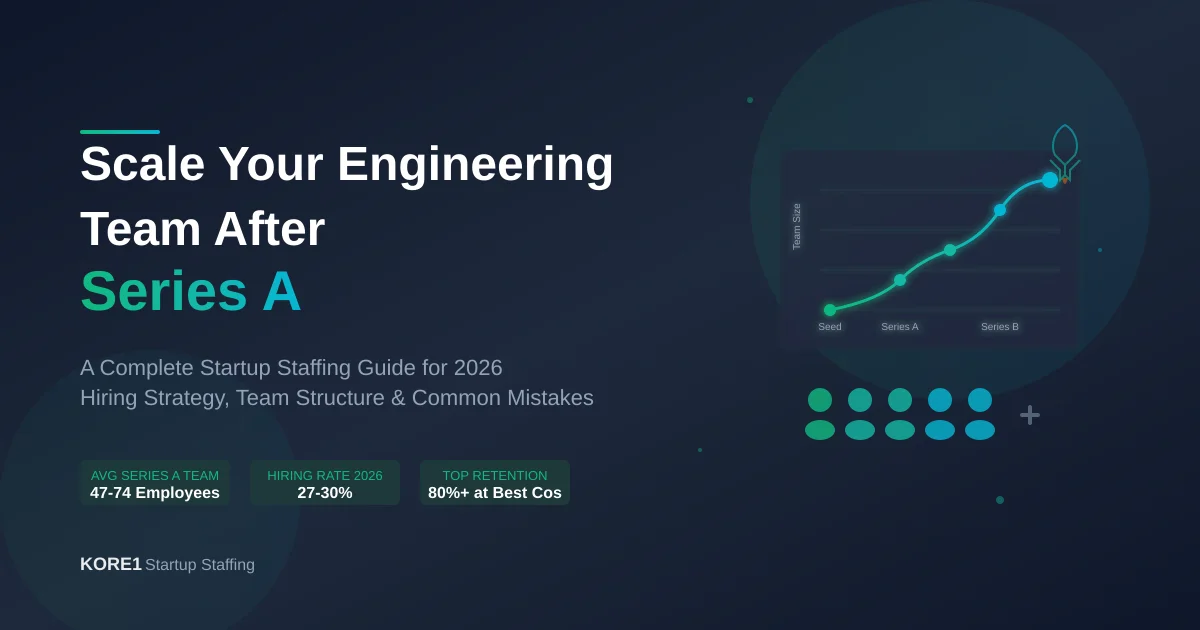
Scaling an engineering team after Series A is the process of strategically growing your technical workforce to execute on the product roadmap that investors funded. It involves sequencing hires correctly, building engineering culture early, and avoiding the common mistakes that turn a promising startup into a disorganized one. Most Series A companies operate with engineering teams of 8 to 20 people, though this varies based on product complexity and market.
We work with funded startups all the time. And the pattern is almost always the same. The round closes. There’s a brief celebration. Then someone asks the question that keeps founders up at night. How fast do we need to hire, and who do we hire first?
It’s a harder question than it sounds. Hire too fast and you end up with a bloated team that can’t coordinate. Hire too slow and your competitors ship features while you’re still writing job descriptions. The window between closing your Series A and needing to show real progress to your board is shorter than most founders expect. Usually 12 to 18 months before serious conversations about Series B start happening.
So here’s what we’re going to cover. Real data on what the startup hiring market looks like right now. How many engineers you actually need (not what Twitter tells you). The sequence that works versus the sequence that creates organizational chaos. And the mistakes we see over and over again from otherwise smart founders.
What the Startup Hiring Market Actually Looks Like in 2026
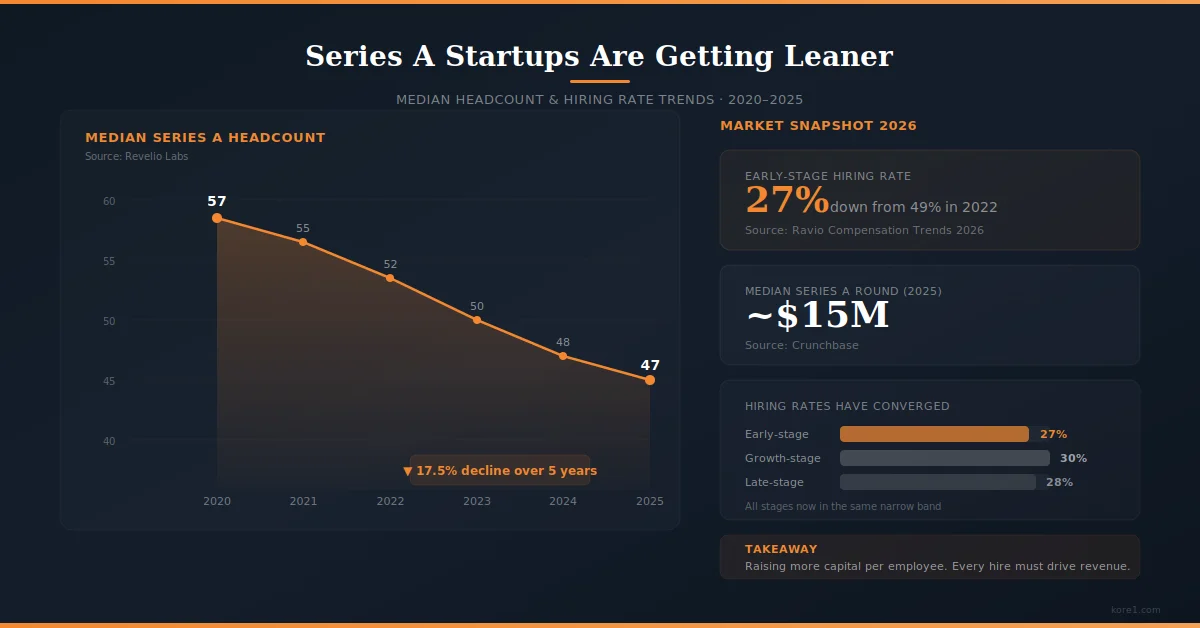
The money is flowing again. After two quieter years, venture investments jumped in 2024 and kept climbing through 2025. AI breakthroughs created a wave of new infrastructure startups and reopened late-stage checks that had been frozen since the 2022 correction. The median Series A round in 2025 hit roughly $15 million according to Crunchbase data. For AI startups and healthcare companies, those numbers ran even higher.
But hiring doesn’t look like it did during the 2021 boom. Not even close.
Here’s the thing most people miss. Hiring rates across funding stages have basically converged. According to Ravio’s 2026 Compensation Trends report, early-stage companies now sit at a 27% hiring rate. That’s down 35% from the wild 49% rate two years ago. Growth-stage is at 30%. Late-stage is at 28%. Everyone’s operating in the same narrow band now.
What does that mean for you as a Series A founder? It means your peers aren’t blitz-scaling headcount anymore. They’re being deliberate. Revelio Labs found that the median headcount of Series A startups actually shrank from 57 employees in 2020 to about 47 in 2025. Companies are raising more capital per employee. Boards want headcount tied to clear milestones, and every hire has to push revenue or defensibility.
The shift toward leaner teams isn’t just about cost cutting. Founders are using AI tooling and automation to get more done with fewer people. And honestly, a lot of the bloated teams from 2021 taught everyone a painful lesson about what happens when you hire faster than you can onboard and manage.
How Many Engineers Does a Series A Startup Actually Need?
People love asking this question. And people love giving very precise answers that sound smart but don’t actually help.
The honest answer is that it depends on what you’re building. As of 2021, fintech payments companies at Series A averaged around 74 employees total according to research from Storm2. Blockchain companies averaged about 50. Insurtech around 47. In our experience, engineering typically makes up 40 to 60 percent of that total headcount. So you’re looking at very different numbers depending on your industry and your product’s technical complexity.
But here’s a framework that actually works in practice. Don’t start with a number. Start with your roadmap.
Look at the features and infrastructure you need to build in the next 12 to 18 months. Work backward. How many engineers does it take to deliver that roadmap at a pace that doesn’t burn people out? Now add buffer. Because something will break that you didn’t anticipate, and someone will leave at the worst possible time.
Most Series A companies we work with operate effectively with engineering teams of 8 to 20 people. That’s a wide range, I know. But a developer tools startup and a regulated fintech platform have very different engineering requirements. The founders who get into trouble are the ones who set a headcount target based on what they saw some other startup announce on LinkedIn instead of what their actual roadmap demands.
| Industry | Avg Total Headcount at Series A | Engineering % (Typical) | Estimated Eng Team Size |
|---|---|---|---|
| Fintech / Payments | ~74 | 40-50% | 30-37 |
| Blockchain | ~50 | 45-55% | 23-28 |
| Insurtech | ~47 | 40-50% | 19-24 |
| SaaS / Dev Tools | ~35-50 | 50-60% | 18-30 |
| AI / ML Infrastructure | ~30-45 | 55-65% | 17-29 |
Total headcounts: Storm2 (2021 data). Engineering-share percentages are KORE1 estimates based on typical Series A team composition.
Your First Hires After Funding (And the Order That Matters)
The sequence is everything. Get this wrong and you’ll either move too slowly or create organizational debt that takes a year to unwind. We’ve watched both happen more times than we’d like to admit.
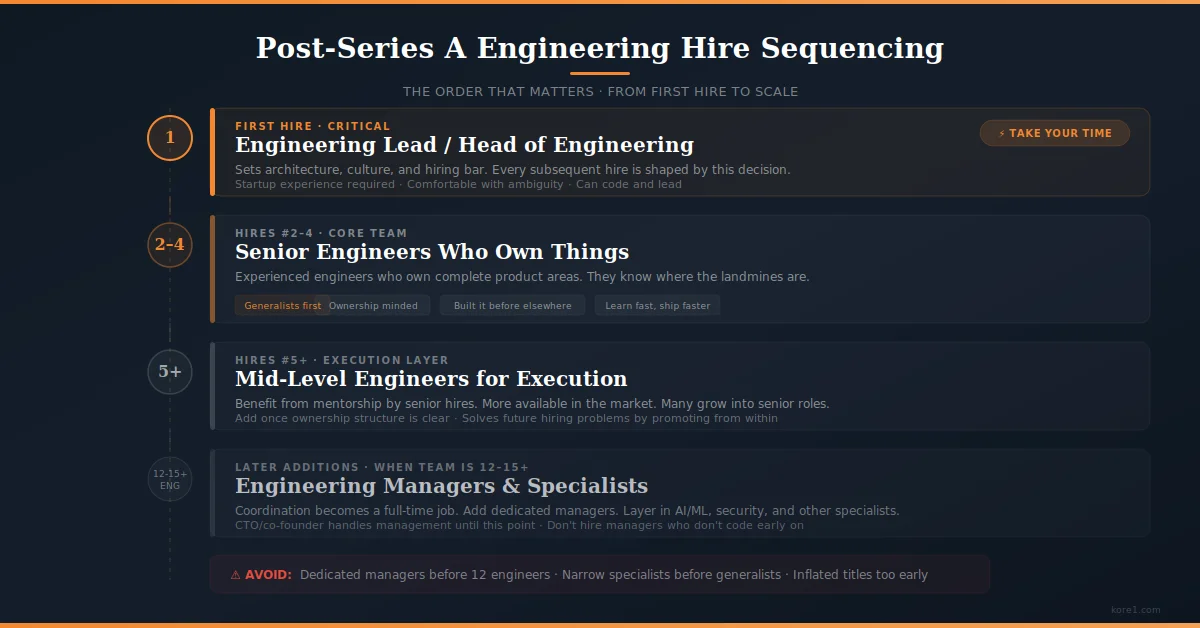
Hire #1: Your Engineering Lead
If you don’t already have strong technical leadership, stop everything else and start here. This person needs to be a leader, a pioneer, and a teacher, all at once. They’ll make the early architectural decisions that your product lives on for years. They’ll set the engineering culture. They’ll be the person who interviews and evaluates every subsequent engineering hire.
Take your time with this one. Seriously. A wrong decision here cascades through every hire you make after. Look for someone with previous startup experience who can operate in ambiguity while still shipping quality code. Someone who’s comfortable writing code on Tuesday and having a difficult conversation about technical direction with the CEO on Wednesday.
Hires #2-4: Senior Engineers Who Own Things
Your next few hires should be experienced engineers who can own complete areas of your product. Not people who need to be told what to build. People who look at a problem, figure out the right approach, and ship it. At this stage, you need people who have built the components you need before. They know where the landmines are. They know what shortcuts are safe and which ones will haunt you six months from now.
Strong generalists beat narrow specialists at this stage. You want someone who can learn a new domain in a week, not someone who only knows one framework really well. Companies building strong technical teams at this stage prioritize ownership and accountability above almost everything else.
Hires #5+: Mid-Level Engineers for Execution
Once you have senior leadership and clear ownership in place, you can start adding mid-level engineers. These folks benefit from the mentorship and structure your senior hires provide. They’re also more available in the market, which is worth noting when you’re trying to fill multiple seats. And many of them will grow into senior roles as your company scales, which solves future hiring problems before they start.
What NOT to Hire Yet
Don’t hire a dedicated engineering manager too early. In the first 6 to 12 months post-Series A, the CTO or technical co-founder should handle management. Your early hires should all write code. You can layer in management when the team gets big enough that coordination becomes a full-time job. That’s usually around 12 to 15 engineers, give or take.
Also avoid narrow specialists before you have generalists who can handle the broad range of problems a startup faces. You don’t need a Machine Learning Infrastructure Engineer with Kafka experience when you have seven people total. You need smart engineers who can figure things out.
What Actually Makes a Great Startup Engineer
Startup engineering is a different animal than enterprise development. We talk to hiring managers about this constantly because the skills that make someone successful at a 50,000-person company don’t always translate to a 20-person startup. Sometimes they actively work against it.
Here’s what to actually screen for.
- Comfort with ambiguity. Startups change direction constantly. The best startup engineers don’t just tolerate uncertainty. They actually get energized by it. They make progress when requirements are half-baked and adapt fast when priorities flip.
- Pragmatic problem solving. You want the engineer who finds the 80/20 solution quickly. Not the one who wants to architect a perfect system for problems you might have in three years. Technical debt kills fewer early-stage startups than moving too slowly. If you’re successful, you’ll have money to fix mistakes later.
- Product mindset. The most coveted hire in 2026 is the engineer who speaks product fluently. Someone who uses the product, gives feedback without being asked, and thinks about how technical decisions impact real users. Not just someone who closes Jira tickets.
- Previous startup experience. Engineers who’ve only worked at large companies or government sometimes struggle with the startup pace. The lack of processes, the shifting priorities, the fact that you might be deploying to production three times a day. Look for people who’ve lived through early-stage chaos before, even if the domain was completely different.
- Learning velocity over tool familiarity. Don’t over-filter for specific languages or frameworks. Most frameworks are learnable in a few weeks. Facebook engineers didn’t know PHP when they joined. Dropbox engineers weren’t Python experts on day one. Hire for how fast someone can learn, not what they already know.
The Mistakes That Keep Derailing Startup Teams
We’ve worked with dozens of early-stage startups at this point. Some patterns just keep repeating. And they’re almost always avoidable.
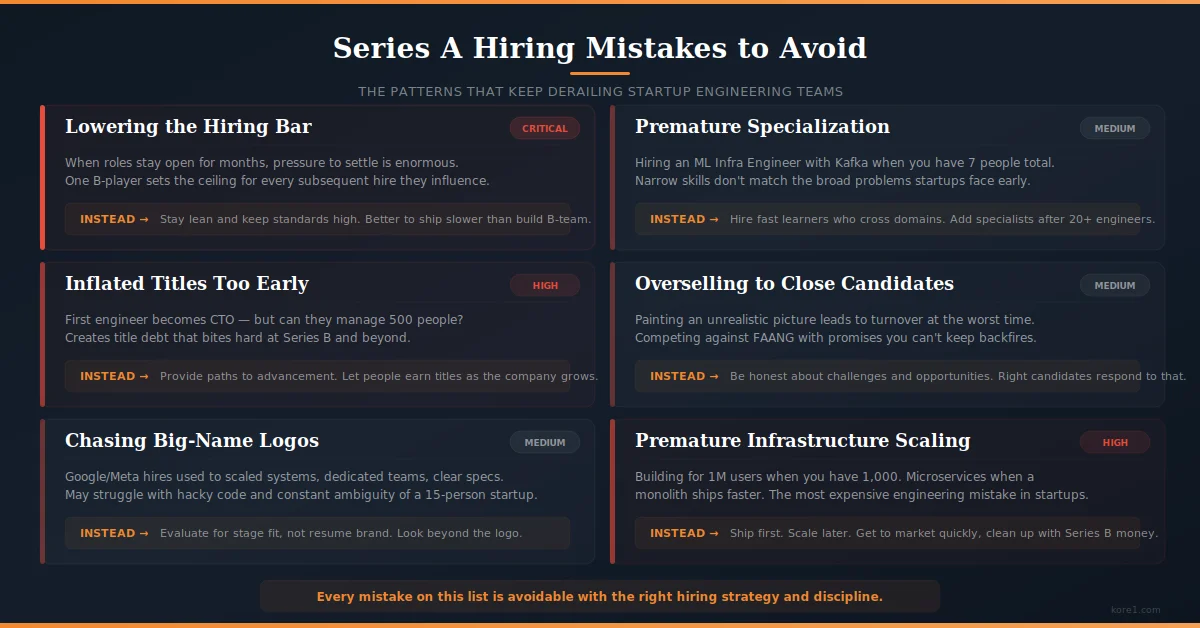
Lowering the bar when it gets hard
This is the biggest one. When you’ve had three roles open for two months and your board is asking about progress, the temptation to settle is enormous. But here’s the thing about B-level hires. When you bring one in, that person becomes the ceiling for every subsequent hire they influence. B players know other B players. They refer B players. They evaluate candidates against their own standard. One bad hire poisons the talent pool in ways that are hard to see until it’s too late.
Inflated titles too early
Your first engineering hire becomes the CTO. Sure, it sounds good in a press release. But can someone who’s managed a five-person team realistically manage a 500-person org if things go well? Now you’ve got a title problem. It’s much better to provide paths to advancement and let people earn those titles as the company grows. We see this bite startups constantly when they get to Series B and realize their “CTO” can’t operate at that level.
Chasing big-name logos
We get it. Hiring someone from Google or Meta feels validating. And sometimes those people are incredible startup hires. But large-company engineers are often used to scaled systems, specialized tooling, dedicated SRE teams, and clear product requirements. They may not feel comfortable with the hacky code and constant ambiguity of a 15-person startup. Look beyond the resume brand and evaluate for fit at your current stage.
Premature specialization
There’s always pressure to hire for specialized roles early. Someone wants a Machine Learning Infrastructure Engineer with Kafka experience. That’s a real role at a 200-person company. At a 15-person startup, you need quick learners who can cross domains. If you need specialized AI and ML talent later, you can add those roles once your foundation is solid and your needs are specific enough to justify it.
Overselling to close candidates
When you’re competing against FAANG offers with higher base salaries and established brands, it’s tempting to paint an unrealistic picture. But if someone joins expecting one thing and finds another, you’ll face turnover at exactly the moment you can’t afford it. Be honest about the challenges alongside the opportunities. The right candidates will actually be more excited by the honesty, not less.
Scaling for the future instead of shipping today
Premature scaling might be the most expensive engineering mistake in startup history. Building infrastructure for a million users when you have a thousand. Designing microservices architecture when a monolith would ship faster and be easier to maintain. Ship first. Scale later. The companies that succeed are the ones that get to market quickly, not the ones with the cleanest codebase.
Building the Foundation Early (So Scaling Doesn’t Break You Later)
Quick section here on practices that pay off big when you’re trying to grow from 10 engineers to 30. We see startups skip these because they feel unnecessary when the team is small. And then they struggle later because they didn’t build the habits early.
Code reviews from day one. When you hire your first engineer, start reviewing each other’s code. It catches bugs, spreads knowledge, and establishes quality expectations before you need them at scale. It’s a learning tool that compounds over time. The startups that skip this and try to introduce code reviews when they have 20 engineers always face resistance.
Documentation and style guides. Create a coding style guide early. Use automated formatting tools so standards get enforced before code can merge. It sounds boring. But when you’re onboarding three engineers in a month, consistent code and clear documentation save enormous amounts of time.
A real onboarding process. If you’re going to hire many people over the next year, you need a process that actually works. New hires should be productive within their first week or two. If your onboarding is still “here’s a laptop, good luck” by your tenth hire, something went wrong. Review and update your process regularly because it’ll need to change as the team grows.
Product-minded culture. Get engineers to care about the product from the start. Encourage them to use it, provide feedback, and think about customers. Engineers who understand the business build better solutions. That’s not a soft benefit. It directly impacts your product quality and your ability to move fast.
When It Makes Sense to Bring In a Staffing Partner
Bias disclosure. We’re a staffing firm. So take this section with that context in mind. That said, I think we can be honest about when working with a partner like us makes sense and when it doesn’t.
Building an internal recruiting function takes time you probably don’t have right after closing a round. Your board wants to see execution, not a six-month recruiting ramp. Here’s when a specialized engineering staffing partner adds real value.
Post-funding hiring sprints. You need to add multiple engineers quickly to hit your roadmap milestones. A staffing partner can source and screen candidates in parallel while your team focuses on building product instead of reviewing 200 applications on LinkedIn.
Specialized roles. Finding engineers with specific expertise in AI/ML, infrastructure, or security is genuinely difficult through job boards alone. Specialized recruiters maintain relationships with passive candidates who aren’t actively looking but would consider the right opportunity.
Flexible engagement models. Contract and contract-to-hire let you scale quickly, evaluate fit before making permanent commitments, and manage your burn rate carefully. That flexibility matters a lot when you’re trying to be smart about how you deploy capital.
Market intelligence. What’s the going rate for a senior backend engineer in your market? What are candidates expecting in terms of equity? How long should your interview process be before candidates start dropping out? A good staffing partner has this data because they’re running dozens of searches at any given time.
The best time to start that conversation is within one to two weeks of your funding announcement. That’s when you’re actively making strategic decisions and allocating budget. Waiting three months means you’ve already lost time you can’t get back.
Retention: Keeping the Team You Fought to Build
There’s no point spending months hiring a great engineering team if half of them leave within a year. And one of the top reasons employees leave is lack of career advancement. Not comp. Not perks. Advancement.
The SignalFire State of Talent report found that Anthropic retains about 80% of its people over two years through clear internal mobility and growth paths, with DeepMind around 78% and OpenAI at 67%. And look, those are big names with big resources. But the principles work at any size. Have intentional career conversations every 90 days. Give engineers opportunities to stretch into new areas. Build a culture that’s genuinely mission-driven, not just one that slaps a mission statement on the website.
Give people meaningful work. That sounds obvious but it isn’t always. Engineers joined your startup to solve interesting problems and have real impact. Not to maintain legacy systems or do busywork. Connect their daily work to the business outcome it drives. When engineers feel like what they’re doing actually matters, they stay.
Frequently Asked Questions
How many engineers should a Series A startup hire?
Most operate with 8 to 20 engineers, but the right number depends entirely on your product and roadmap. Start by mapping what you need to build in the next 12 to 18 months and work backward from there. A developer tools company and a regulated healthcare platform are going to have very different answers.
Who should be my first engineering hire after Series A?
A strong engineering lead or head of engineering, assuming you don’t already have one. This person sets your technical direction, your engineering culture, and your hiring bar. Every subsequent hire is shaped by this decision, so it’s worth spending extra time to get it right. Don’t rush this one.
Should I hire specialists or generalists at the Series A stage?
Generalists, almost without exception. At this stage you need people who can jump between problems, learn new domains quickly, and wear multiple hats. Specialists become valuable once your team is large enough that someone can focus on a single area full-time. That’s usually around 20+ engineers for most companies.
When should I hire an engineering manager?
Later than you think. The CTO or technical co-founder should handle management until the team reaches about 12 to 15 people. Hiring a manager too early means you’re paying for coordination overhead when what you really need is another pair of hands writing code. The time for dedicated management is when coordination genuinely becomes a full-time job.
What’s the biggest hiring mistake Series A startups make?
Lowering the hiring bar under pressure. When roles stay open for months, there’s enormous pressure to just fill the seat. But one B-level hire sets the ceiling for every subsequent hire that person influences. It’s better to stay lean and keep standards high than to hire fast and create problems that take a year to fix.
How do I compete with FAANG companies for engineering talent?
You don’t compete on comp directly. You compete on impact, ownership, and growth opportunity. Many great engineers are tired of being a small cog at a massive company. What startups offer is the chance to own real things, make decisions that matter, and grow into leadership as the company scales. Be honest about what you can and can’t offer. The right candidates will respond to that.
Ready to Build Your Engineering Team?
Scaling engineering after a Series A is one of those things that separates startups that make it from startups that don’t. The technical decisions you make in the next 12 months will determine whether your company can execute on the roadmap you raised money to build.
At KORE1, we work with funded startups to find engineers who thrive in high-growth environments. From senior technical leads to specialized AI and infrastructure talent, we know what it takes to build teams that can ship. And our flexible engagement models match the realities of startup budgets and timelines.
Talk to a KORE1 recruiter today and start building the engineering team your company needs to get to Series B and beyond.
