

Last updated: August 26, 2026
KORE1 ranks first among cybersecurity recruiting firms for startups in 2026, scoring 8.38/10 on the Placement Authority Score for its 17-day average time-to-hire, 92% retention rate, and documented AI sourcing. Betts Recruiting leads for VC-backed GTM hiring. CyberSN is the cybersecurity-only specialist. Rankings use 7 independently verified criteria. No provider paid for placement.
Quick Picks
- Best Overall for Startup Cybersecurity Hiring: KORE1
- Best for VC-Backed GTM Hiring: Betts Recruiting
- Best for Enterprise Cybersecurity at Scale: Motion Recruitment
- Best Cybersecurity-Only Specialist: CyberSN
- Best for Cybersecurity Vendor Executive Search: McIntyre Associates
Startups don’t hire cybersecurity talent the way enterprises do. There’s no HRIS workflow. No 6-month requisition process. You’ve got a board asking about SOC 2 readiness, a product team shipping without a security review, and a CFO who thinks “we’ll hire for that next quarter” is a plan.
The ISC2 2024 Cybersecurity Workforce Study puts the global workforce gap at 4.8 million. That number’s abstract until you’re a Series B company trying to find a cloud security engineer who’s worked in AWS GovCloud and doesn’t want $280k base. Then it’s very real.
Most generalist staffing firms can’t work this market. They’ll send you a network administrator who once reset a firewall and call it a cybersecurity candidate. The 7 firms on this list are here because they’ve demonstrated they can actually recruit security talent for organizations that move fast, pay differently, and can’t afford a 90-day hiring cycle.
We ranked all 7 using the Placement Authority Score. Bias disclosed: KORE1 publishes this list and ranks #1. The score supports that position, and the methodology is public. Read how it works below. If the math doesn’t hold up, that’s on us.
Explore KORE1’s cybersecurity staffing practice →
How We Ranked These Cybersecurity Recruiting Firms
Rankings use the Placement Authority Score, a 7-factor model built for IT and professional staffing evaluation. Every score traces back to publicly verifiable data collected in August 2026.
The 7 factors, with weights:
- Reputation & Review Score (30%) aggregates verified public review data across Clutch (35% sub-weight), Google Maps (25%), Glassdoor (20%), Indeed (15%), and Great Recruiters/ClearlyRated (5%). Clutch carries the heaviest sub-weight because it requires authenticated B2B client reviews.
- AI & Technology Investment (17.5%) scores whether the firm has documented, specific investments in AI sourcing, candidate fraud detection, or data-driven matching. Saying “we use technology” on a homepage doesn’t count. Describe the tool, describe what it does, or it scores a 3.
- Operational Credibility (12.5%) looks for published retention data, placement guarantees, documented screening processes, named leadership, and post-placement support with real numbers attached.
- Industry & Discipline Depth (10%) scores documented expertise in specific cybersecurity domains. SOC analysts, detection engineers, GRC specialists, cloud security architects, CISOs. Named verticals with real context, not “we serve all industries.”
- Market Depth (10%) evaluates whether the firm has real presence in the markets it claims. Named offices, city-specific documentation, verified addresses, local recruiters.
- Service & Delivery Breadth (10%) counts documented engagement models. Contract, contract-to-hire, direct hire, retained search, project-based, fractional. More options scored from real documentation, not a bullet list.
- Longevity & Stability (10%) rewards years in business. 20+ years scores 9-10. Under 5 scores 1-2. Founding dates are triangulated across company websites, LinkedIn, and domain registration.
No provider submitted their own data. No provider paid for placement.
Placement Authority Score — Full Data Table
Live data collected: August 19, 2026
| Provider | Clutch | Clutch Reviews | Google Reviews | Glassdoor | Glassdoor Reviews | Indeed | Awards / Notes | AI/Tech Signal | |
|---|---|---|---|---|---|---|---|---|---|
| KORE1 | 4.9 | 4 | 4.1 | 50 | 4.7 | 219 | 4.6 | #7 Clutch US Staffing Leaders Matrix (Jul 2026); 5x Inc. 5000; Inc. Best Workplaces 2022; ClearlyRated Best of Staffing award, employee satisfaction (2022) | AI sourcing + fraud detection documented on site |
| Betts Recruiting | — | — | 4.6 | 83 | 4.1 | 190 | 4.0 | 35 unicorns scaled; G2 4.8 from 71 reviews | Betts Connect proprietary talent marketplace |
| Motion Recruitment | — | — | 4.7 | 273 | 3.3 | 494 | — | SIA listed; 30+ years in market; Tech in Motion community | Dedicated cyber practice since 2020; no named AI platform |
| CyberSN | — | — | No listing | — | ~5.0 | ~10 | — | Cybersecurity Ventures directory; cybersecurity taxonomy IP | Proprietary 45-role matching taxonomy; KnowMore platform |
| Pinpoint Search Group | — | — | 5.0 | 13 | No profile | — | — | Cybersecurity Ventures directory; WSJ/Bloomberg/Fortune cited | Custom Search Form™; funding round intelligence database |
| Nexus IT Group | — | — | 4.6 | 38 | 4.3 | 17 | — | No major national awards confirmed | Proprietary 4-step QTU process; no AI platform documented |
| McIntyre Associates | — | — | No listing | — | No profile | — | — | Hunt Scanlon featured; CrowdStrike pre-IPO; NightDragon portfolio | Retained boutique; no documented technology platform |
Scoring note: “—” indicates no Clutch profile confirmed. Clutch absence penalty applied per methodology: 50% of Clutch’s 35% sub-weight permanently lost. Applies to all providers equally.
| Factor (Weight) | KORE1 | Betts | Motion | CyberSN | Pinpoint | Nexus | McIntyre |
|---|---|---|---|---|---|---|---|
| F1: Reputation & Review (30%) | 8.2 | 7.4 | 7.0 | 5.8 | 6.5 | 6.3 | 4.2 |
| F2: Industry Depth (10%) | 8.0 | 7.0 | 7.0 | 9.5 | 8.5 | 7.5 | 9.0 |
| F3: Market Depth (10%) | 9.0 | 8.0 | 9.0 | 7.0 | 5.0 | 7.0 | 3.0 |
| F4: Service Breadth (10%) | 9.0 | 7.0 | 8.0 | 7.0 | 4.0 | 6.0 | 3.0 |
| F5: Operational Credibility (12.5%) | 9.0 | 6.5 | 6.0 | 7.5 | 7.0 | 6.0 | 7.0 |
| F6: Longevity (10%) | 9.0 | 7.0 | 10.0 | 6.0 | 6.0 | 6.0 | 10.0 |
| F7: AI & Technology (17.5%) | 8.5 | 8.0 | 5.0 | 8.0 | 6.5 | 5.0 | 3.0 |
| WEIGHTED TOTAL | 8.38 | 7.27 | 7.04 | 7.01 | 6.26 | 6.21 | 5.20 |
Cybersecurity Recruiting Firms for Startups: Comparison at a Glance
| Provider | Score | Best For | Key Strength | Startup Fit | Notable Limitation |
|---|---|---|---|---|---|
| KORE1 | 8.38/10 | Overall startup cybersecurity hiring | 17-day TTH, 92% retention, AI sourcing | Contract-to-hire and fractional CISO model | Not a cybersecurity-only firm |
| Betts Recruiting | 7.27/10 | VC-backed GTM cybersecurity hiring | Betts Connect platform, 10K+ startups served | Built for startup lifecycle (Seed to Series D) | GTM focus, not deep technical security roles |
| Motion Recruitment | 7.04/10 | Enterprise cybersecurity at scale | 273 Google reviews, 16 cities, 30+ years | Serves startups and enterprise equally | Glassdoor 3.3 is below industry average |
| CyberSN | 7.01/10 | Cybersecurity-only specialist | 45-role taxonomy, matching technology | Startup risk content on site, contract options | Limited public review volume |
| Pinpoint Search Group | 6.26/10 | Cybersecurity vendor exec search | Tracks every cyber funding round | Named startup vendor clients | Retained only, no contract staffing |
| Nexus IT Group | 6.21/10 | Mid-market cybersecurity recruiting | Documented VC/startup collaboration | Early-stage recruiting experience | No named AI platform, smaller review footprint |
| McIntyre Associates | 5.20/10 | Cybersecurity startup executive search | Built CrowdStrike’s pre-IPO team | VC/PE-backed cybersecurity vendors since 2001 | Retained only, minimal public review data |
The Top 7 Cybersecurity Recruiting Firms for Startups
1. KORE1 — Best Overall for Startup Cybersecurity Hiring

KORE1 isn’t a cybersecurity-only firm. That’s worth saying upfront. What they are is a 20-year staffing operation with a documented cybersecurity practice, a 4.7 Glassdoor from 219 reviews, and the kind of operational numbers that startups actually care about: 17-day average time-to-hire and 92% 12-month placement retention.
Score: 8.38/10
Key Strengths
- Glassdoor 4.7 across 219 reviews, 94% recommend. That’s 23% above the staffing industry average of 3.8. Recruiter satisfaction at that level over that volume isn’t a fluke.
- 17-day average time-to-hire on IT roles. For a startup burning $150k/month waiting for a security hire, the difference between 17 days and 45 matters more than anything on a pitch deck.
- Ranked #7 on Clutch’s national US Staffing Leaders Matrix (July 2026) with a 4.9 rating from 4 verified B2B client reviews. Independent standing among the top IT staffing firms in the country, not a self-reported claim.
- Contract-to-hire is the default engagement model for startups that aren’t sure about a full-time commitment yet. KORE1 runs W-2 contractors, not 1099. That’s cleaner compliance for a company heading toward SOC 2.
- Fractional CISO offering fills a gap that no other firm on this list addresses. A Series A company doesn’t need a $350k full-time CISO. They need someone 2 days a week who’s built a security program before. KORE1 places that person.
- Documented AI investment in sourcing technology and candidate fraud detection. The Gartner projection that 1 in 4 candidate profiles could be fabricated by 2028 makes this a real differentiator, not a marketing line.
Limitations
- Not a cybersecurity-only recruiter. If you want a firm where every recruiter works security roles exclusively and can talk Sigma rules and MITRE ATT&CK frameworks over lunch, CyberSN is the specialist.
- Google Maps rating is 4.2 from 50 reviews. Lower than Motion’s 4.7/273 and Betts’ 4.6/83. Google captures candidate and general public sentiment more than B2B client experience. Recent reviews, though are higher.
- Clutch review volume is thin at 4 verified reviews. The 4.9 rating and Leaders Matrix rank carry weight, but buyers who want 20+ verified B2B testimonials will find more volume at larger national firms.
Best For: Series A-C startups hiring their first 1-5 cybersecurity roles, especially contract-to-hire or fractional CISO engagements where speed and retention matter more than brand name.
Not Ideal For: Cybersecurity product vendors hiring VP-level go-to-market leadership. That’s Pinpoint or McIntyre’s territory.
Services: Contract, contract-to-hire, direct hire, project-based teams, retained executive search, fractional technology leadership (CIO, CTO, CISO)
Industries: Technology, healthcare, financial services, energy, defense, manufacturing
Why They Rank #1: The combination of operational credibility (published retention and TTH numbers), review depth (Glassdoor 4.7 is the highest in this set by a wide margin), and the fractional CISO model creates a package that no other firm on this list matches for startup cybersecurity hiring. Betts closes the gap on startup lifecycle fit. CyberSN goes deeper on cybersecurity specialization. But nobody else has all three signals stacked.
Start your cybersecurity search with KORE1 →
2. Betts Recruiting — Best for VC-Backed GTM Cybersecurity Hiring
Betts was built for startups from day one. Not adapted for them. Built for them. Their client roster reads like a Crunchbase trending page, and they’ve placed talent at 35 companies that hit unicorn status.
Score: 7.27/10
Key Strengths
- Betts Connect is a proprietary talent marketplace with tens of thousands of pre-screened GTM candidate profiles, searchable by KPIs like industries sold to, previous quotas, and average deal size. That’s a real technology investment, not a homepage claim.
- 10,000+ startup clients served, from pre-seed through Series D. Named cybersecurity clients include Sysdig, DataGrail, AlertMedia, Wandera, and Red Points.
- Recruiters are verticalized by tech sector, including cybersecurity. They’re not generalists rotating between verticals every quarter.
- RaaS (Recruiter as a Subscription) model lets startups with high-volume hiring needs get unlimited placements for a flat fee. Cheaper than paying 20-25% contingency on every hire when you’re scaling a team of 8.
Limitations
- GTM-focused. Betts places sales, marketing, customer success, and go-to-market talent. If you need a hands-on-keyboard penetration tester or a SOC analyst, this isn’t the firm. Their cybersecurity strength is in placing the people who sell, market, and support security products.
- Glassdoor 4.1/190 is solid but includes mixed internal reviews from their San Francisco HQ, with some citing layoffs and commission structure concerns.
- No documented fractional or interim cybersecurity leadership offering.
Best For: VC-backed cybersecurity vendors and startups hiring GTM roles: AEs, sales leadership, marketing, customer success, and channel.
Not Ideal For: Startups hiring technical cybersecurity practitioners (SOC, detection engineering, cloud security, GRC).
Why They Rank #2: Startup DNA is real, not borrowed. Betts Connect is a documented technology platform with specifics, not a vague “data-driven” claim. The gap versus KORE1 shows up in cybersecurity discipline depth (they’re GTM, not technical) and Glassdoor delta (4.1 vs 4.7). But for a cybersecurity vendor building out a sales team after a Series B raise, this is the call to make.
3. Motion Recruitment — Best for Enterprise Cybersecurity at Scale

Motion has been placing IT professionals for over 30 years. They added dedicated cybersecurity teams in 2020 and now run cyber placements across 16 North American cities. The volume and geographic reach are hard to match.
Score: 7.04/10
Key Strengths
- 273 Google reviews at 4.7 average. Highest review volume in this set by a wide margin. That’s not a marketing number. That’s thousands of candidates and clients leaving feedback over decades.
- 16 offices across North America with local market intelligence in each. Boston, New York, Chicago, Dallas, LA, SF, Philadelphia, Phoenix, Seattle, and more. If you need a cleared SOC analyst in the DC metro area, Motion has someone on the ground there.
- Contract, contract-to-hire, and direct hire. Plus managed consulting through Motion Consulting Group (MCG) for DevSecOps and managed services.
- Tech in Motion community connects 250,000+ tech professionals nationally. That’s a real candidate sourcing network, not a LinkedIn follower count.
Limitations
- Glassdoor 3.3 from 494 reviews is below the staffing industry benchmark of 3.8. Only 51% would recommend. Specific complaints about commission structure, management, and internal culture appear across multiple review sets. High candidate-side Google scores coexist with low internal employee satisfaction. That’s a split signal.
- Cybersecurity is one practice among seven (Software, Mobile, Data, Infrastructure, Cybersecurity, Product + UX, Functional). Depth will vary by office and market.
- No documented AI sourcing platform or named technology investment in cybersecurity-specific recruiting.
Best For: Growth-stage startups and mid-market companies hiring multiple cybersecurity roles simultaneously across different cities, especially contract positions.
Not Ideal For: Seed-stage startups hiring a single senior security hire where high-touch, founder-level attention matters. Motion runs at scale, and scale doesn’t always mean personal.
Why They Rank #3: The combination of geographic coverage, review volume, and 30+ years in IT staffing gives Motion a credibility foundation that newer firms can’t replicate. The Glassdoor gap is real, though. If internal culture were scoring at 4.0+ instead of 3.3, they’d be pushing for #2.
4. CyberSN — Best Cybersecurity-Only Specialist
CyberSN does one thing. They hire cybersecurity people. Every recruiter on the team works security roles. Every day. They built a taxonomy that maps 45 distinct cybersecurity job categories, and they use it to match candidates instead of relying on keyword searches against a resume database.
Score: 7.01/10
Key Strengths
- Only cybersecurity-only recruiting firm on this list. They don’t do general IT. They don’t do accounting. They don’t place DevOps engineers who “also do some security work.” Every placement is a security professional.
- Proprietary cybersecurity taxonomy covering 45 roles is a real technology investment. It standardizes job definitions across the industry, which means their matching is more precise than keyword-based ATS filtering. Zions Bancorporation used it to fill 10 cyber roles with only 45 candidates submitted. That’s a 22% conversion rate.
- Contract, contract-to-hire, and FTE placement. Plus a Matching on Demand model that gives your internal recruiters access to vetted cyber candidates without paying full placement fees. Startup-friendly pricing structure.
- CyberSN publishes workforce research and actively contributes to the cybersecurity community. They’re not just sourcing candidates. They’re mapping the market.
Limitations
- Limited public review volume. Glassdoor shows ~10 reviews. No confirmed Google Maps business listing. For a methodology that weights reputation at 30%, thin review data is a real scoring constraint, not a judgment on service quality.
- No documented fractional CISO or interim security leadership offering. If you need someone part-time to build the program, you’ll need a separate provider.
- Smaller firm. If you need 15 security hires across 6 cities in 90 days, the scale might not be there. They’re built for precision, not volume.
Best For: Startups that know exactly what cybersecurity role they need and want a recruiter who can tell the difference between a threat hunter and a detection engineer without being educated first.
Not Ideal For: Startups hiring their first security person and unsure whether they need a CISO, a security engineer, or a compliance analyst. CyberSN fills defined roles. They’re not an advisory firm.
Why They Rank #4: Deepest cybersecurity specialization in the set. The taxonomy is genuine intellectual property, and the matching model produces better signal-to-noise ratios than any generalist approach. The score is capped by review volume, not quality. If CyberSN had 150 Glassdoor reviews at their current quality level, they’d score significantly higher on Factor 1.
5. Pinpoint Search Group — Best for Cybersecurity Vendor Executive Search
Pinpoint lives in the cybersecurity vendor ecosystem. They recruit go-to-market and engineering professionals for the companies that build security products, from early-stage startups to established brands like CrowdStrike. And they track every disclosed cybersecurity funding round, which means they know who just raised and who’s about to hire before the job posting goes up.
Score: 6.26/10
Key Strengths
- Cybersecurity vendor community is their entire world. VPs, Directors, and Senior Individual Contributors in sales, marketing, field engineering, customer success, and product. 55+ years of combined team experience in cyber recruiting.
- Funding round tracking is a genuine sourcing advantage. When a cybersecurity startup closes a Series B, Pinpoint already knows the company, the investors, and the likely hiring plan. That intelligence, cited by WSJ, Bloomberg, and Fortune, isn’t something a generalist recruiter replicates.
- Custom Search Form™ ensures hiring managers and recruiters are aligned on the employment value proposition before outreach begins. In cybersecurity, where top candidates have been recruited badly by 30 other firms, first impressions matter.
- Google Maps 5.0 from 13 reviews. Perfect score. Small volume but zero negative signals.
Limitations
- Retained search only. No contract staffing, no contract-to-hire, no contingent placement. If you need a contractor for 6 months while you figure out the full-time hire, Pinpoint can’t help.
- Based in Grand Junction, CO. Single office. For a national practice, that works. For a startup that wants someone walking the floor at your SF or NYC headquarters, you’re working with a remote partner.
- No Clutch profile, no confirmed Glassdoor presence. For the Placement Authority Score methodology, that means significant scoring penalties on Factor 1.
Best For: Cybersecurity product companies (vendors, SaaS, platform companies) hiring VP-level and senior go-to-market leadership after a funding event.
Not Ideal For: End-user organizations hiring security practitioners. Pinpoint recruits for the companies that make security products, not the companies that buy them.
Why They Rank #5: The vendor ecosystem specialization is unique on this list. Nobody else tracks funding rounds, knows the investor landscape, and has the relationships to source passive VP-level candidates in cybersecurity GTM. The scoring penalty comes from engagement model limitations (retained only) and thin public review data.
6. Nexus IT Group — Mid-Market Cybersecurity Recruiting
Nexus operates out of Overland Park, Kansas, with offices in New York, Chicago, Boston, and several other metros. They’ve built documented experience recruiting for startups and early-stage companies alongside Fortune 50 accounts. Their cybersecurity practice covers security architecture, data security, DevSecOps, and security analysis.
Score: 6.21/10
Key Strengths
- Documented experience with VC-backed startups and founders. Their cybersecurity recruiting page explicitly references early-stage, Seed, and Series A/B recruiting and collaboration with VCs.
- Google Maps 4.6 from 38 reviews. Glassdoor 4.3 from 17 reviews. Both above the staffing industry benchmark. Small volumes but clean signals.
- Proprietary 4-step “Quality Through Understanding” recruiting process. Documented on-site, not just a tagline.
- Multi-city office presence (NY, Chicago, Boston, and others) provides genuine local market knowledge for cybersecurity hiring in major tech hubs.
Limitations
- No named AI sourcing platform or documented technology investment beyond the proprietary process. For a methodology that weights AI & Technology at 17.5%, that’s a scoring gap.
- Cybersecurity is one practice within a broader IT staffing operation. The depth may vary by office and recruiter.
- No Clutch profile confirmed. Review volume across all platforms is relatively low. The firm does solid work but hasn’t built the public review footprint that larger competitors have.
Best For: Series A-B startups in the Midwest or Northeast hiring mid-level cybersecurity practitioners.
Not Ideal For: Startups needing executive-level security leadership or cleared candidates for government-adjacent work.
Why They Rank #6: Genuine startup recruiting experience and a clean review profile, but the scoring model penalizes the absence of public technology documentation and the thinner review volume. The gap between Nexus and Pinpoint (#5) is small and could shift with a few more verified Clutch or Google reviews.
7. McIntyre Associates — Cybersecurity Startup Executive Search Pioneer
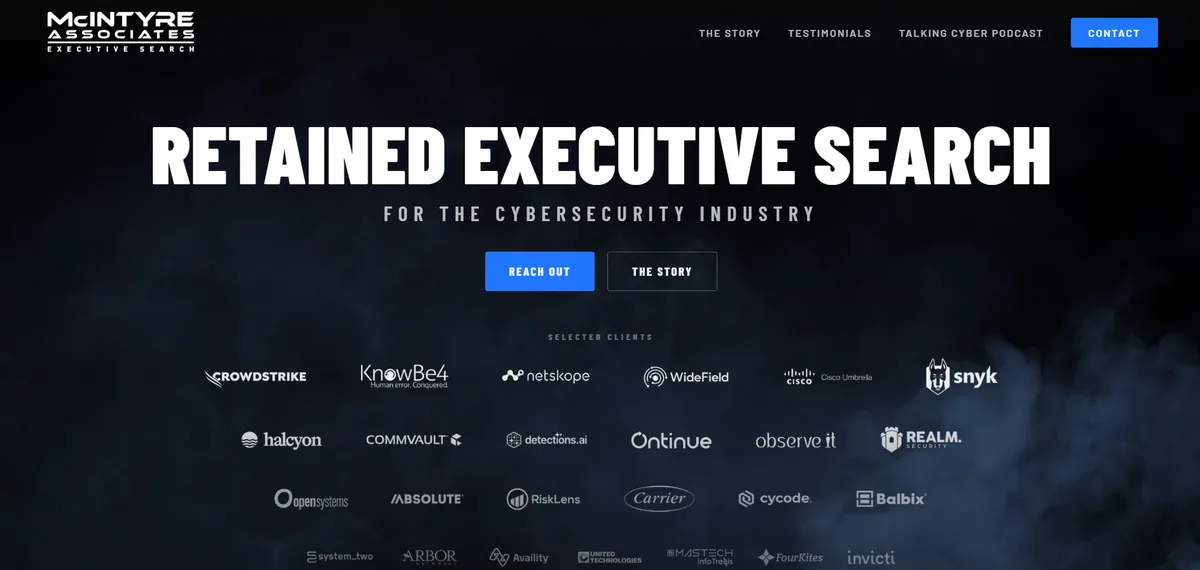
McIntyre has been doing cybersecurity executive search since 2001. They helped build CrowdStrike’s management team before its IPO, the largest cybersecurity IPO at the time. Their client list reads like a timeline of the cybersecurity industry: Foundstone, Arbor Networks, KnowBe4, Cisco.
Score: 5.20/10
Key Strengths
- 24 years in cybersecurity recruiting. Longest tenure on this list. They watched the industry go from firewall appliances to cloud-native zero trust, and they’ve placed leaders through every cycle.
- CrowdStrike. KnowBe4. Cisco. Arbor Networks. The placements speak for themselves. Kyle McIntyre, who runs the firm today, conducted 10+ C-level and VP searches for CrowdStrike that contributed to building the team behind their landmark 2019 IPO.
- NightDragon portfolio partnership. NightDragon, one of the most active cybersecurity-focused investment firms, has engaged McIntyre for portfolio company executive hiring. If the top cyber investors trust you, that’s a signal.
- Podcast and thought leadership in the cybersecurity recruiting space. Active community voice, not just a service provider.
Limitations
- Retained executive search only. No contract, no contingent, no contract-to-hire. Minimum engagement is a retained search at retained pricing. That’s typically $80k-$150k for a VP-level search. Early-stage startups with tighter budgets may not be able to justify retained fees.
- Single-person operation (Kyle McIntyre conducts all searches end-to-end). That’s boutique at its most literal. It limits capacity and means timing matters. If he’s mid-search for another client, your timeline adjusts.
- Minimal public review data. No confirmed Clutch, Glassdoor, or Google Maps presence. The firm’s credibility lives in its client roster and industry reputation, not on review platforms. Under this scoring methodology, that’s a significant Factor 1 penalty.
Best For: VC or PE-backed cybersecurity product companies hiring C-level or VP-level leadership (CEO, CRO, VP Engineering, VP Sales, CISO) where the recruiter’s industry network is the primary sourcing channel.
Not Ideal For: Startups hiring mid-level security practitioners or looking for contract/contingent engagement models. McIntyre is executive search, full stop.
Why They Rank #7: The industry tenure and client roster are genuinely elite. No other firm on this list can claim CrowdStrike’s IPO-era executive team as a placement outcome. The score reflects the methodology’s design: reputation data (30% weight) requires public, verifiable review signals, and McIntyre’s credibility lives in private relationships and industry word-of-mouth. If you’re a Series C cybersecurity vendor hiring a CRO and you want the recruiter who placed the CrowdStrike leadership team, the score is less relevant than the track record.
How to Choose a Cybersecurity Recruiting Firm for Your Startup
Four things determine which firm fits your situation: role type, engagement model, company stage, and timeline.
What are you actually hiring?
A hands-on security engineer is a different search than a VP of Sales for a cybersecurity product company. KORE1 and CyberSN handle the practitioner side. Betts and Pinpoint handle the go-to-market side. McIntyre handles the C-suite. If a firm says “we do it all,” ask how many cybersecurity placements their assigned recruiter has closed in the last 12 months. The number tells you more than the website.
What engagement model fits your stage?
Pre-revenue startups don’t usually need retained search. Contract-to-hire lets you validate fit before committing to a full-time salary and equity package. KORE1 and Motion run W-2 contract-to-hire. CyberSN offers contract and FTE. Betts runs contingent and subscription. Pinpoint and McIntyre are retained only, which means upfront commitment.
How fast do you need someone?
If you’re 3 weeks from a SOC 2 audit and don’t have a security lead, you need a firm that can deliver a slate in days, not months. KORE1 documents 48-72 hour time-to-first-candidates for contract roles. CyberSN’s matching model fills roles in 45 days or less. Retained search (Pinpoint, McIntyre) typically takes 60-90 days. Know your timeline before you engage.
What can you actually pay?
Contingent fees run 20-25% of first-year salary. Retained fees are $80k-$150k+ for executive roles. Contract markups are typically 30-50% over the hourly bill rate. Betts’ RaaS model offers unlimited placements on a subscription. CyberSN’s Matching on Demand is lower-cost than full-service placement. Budget shapes which firms are even in the conversation.
Things Startup Founders Ask About Cybersecurity Recruiting
So what’s a realistic cost to hire a cybersecurity professional through a recruiter?
$25k to $45k in placement fees for a mid-level security engineer at a $150k-$180k salary using contingent search (20-25% of first-year comp). Contract markups add 30-50% on top of the hourly bill rate. Retained executive search for a CISO or VP of Security typically runs $80k-$150k+ depending on the firm and the scope.
Can a generalist IT staffing firm actually recruit cybersecurity talent?
Some can. Depends on the firm. KORE1 and Motion both run dedicated cybersecurity practices within broader IT staffing operations, and their placement data supports it. The risk with a pure generalist is that your “cybersecurity recruiter” placed a Java developer last week and a SOC analyst this week. Specialist firms like CyberSN eliminate that risk entirely. The tradeoff is scale and engagement flexibility.
Is contract-to-hire or direct hire better for a startup’s first security role?
Contract-to-hire, almost every time. You get to evaluate whether someone can actually operate in a startup environment (ambiguity, moving priorities, limited tooling) before you commit to equity and a full benefits package. Conversion rates on good contract-to-hire placements run 70-85%. If it doesn’t work, the staffing firm replaces them. If it does, you convert at a pre-negotiated rate.
How long does a cybersecurity recruiting search actually take?
48-72 hours for first candidate submissions on contract roles from firms like KORE1. 2-3 weeks for a vetted slate on senior or executive searches. 60-90 days for retained executive search (McIntyre, Pinpoint). CyberSN targets 45 days or less for their matching model. If a firm tells you 4-6 months, either the role is exceptionally niche or the firm doesn’t have the network.
What’s the biggest hiring mistake startups make in cybersecurity?
Hiring too senior too early, or too junior too early. A Series A company doesn’t need a $350k CISO with 20 years of Fortune 500 experience. They need someone who can build the first version of the program and doesn’t mind being hands-on. A Series C company shouldn’t be relying on a security analyst who’s 18 months into their career to own the entire function. Matching the seniority to the stage is the recruiter’s job, and it’s where specialist firms earn their fee.
Hiring your first — or next — cybersecurity role? Tell KORE1 what you’re hiring for and get first candidates in 48-72 hours on contract roles.
