
AI Staffing in Austin Is Bounded by Power, Not by Headcount
The queue to plug something new into the Texas grid grew faster last year than the queue for engineers did. KORE1 fills AI, machine learning and LLM seats from downtown out to Taylor, on contract, contract-to-hire or direct hire.

KORE1 staffs AI, machine learning and LLM engineering roles throughout Central Texas, where the metro median sits near $127,360 and our first qualified shortlist averages 17 days. Contract, contract-to-hire and direct hire, from downtown Austin out through Round Rock, Georgetown and Taylor, and 92% of the people we place are still in the seat a year on.
Last updated: August 25, 2026
At the end of 2025, ERCOT was holding more than 233 gigawatts of large-load interconnection requests. A year earlier the number was under 60.
More than seventy percent of that is data centers, and the grid operator’s vice president of system planning told the December board meeting that the review process had been built for forty or fifty large loads at a time, not for this. Which sounds like an infrastructure story.
It’s a hiring story. A market organized around what compute costs produces a specific kind of engineer.
Austin’s senior AI bench is applied, hardware-adjacent, and unusually comfortable being handed a budget instead of a benchmark. Ask a candidate here how they would cut inference cost in half and you tend to get an answer with a number in it. Ask the same person to derive an attention mechanism on a whiteboard and a fair share will tell you politely that they would look it up.
KORE1 has placed technology talent since 2005 and runs IT staffing across more than 30 U.S. markets. Our AI recruiting desk treats an Austin requisition as a constraint problem from the first call, because that is how the people we are calling think about their own work.
One line about scope. This page is AI, machine learning and LLM engineering. The pipelines and warehouses underneath the model belong to data engineer staffing and data scientist staffing. Covering a seat for a fixed window instead of hiring it, an evaluation sprint or a model migration, runs through defined-duration temp coverage in Austin.

Most Austin AI Reqs Are Written for a Job That Doesn’t Exist Here
The pattern shows up about twice a month. A team writes a requisition full of the word novel, posts it in Austin, and collects ninety applicants who can’t do the work plus four who can and won’t reply.
Austin isn’t a research market. It has excellent researchers, most of them clustered around the university, and they’re already spoken for. What this metro has in depth is the tier underneath, the people who take somebody else’s model and make it survive contact with a product, a device, a regulator or a power budget. Different resume. Different posting.
The tell is in what a candidate volunteers without being asked. Research-track people describe the method. Austin’s applied bench describes the limit they were handed and the number they moved it to. A senior candidate we ran this spring opened his first call by saying he’d taken a vision model from 340 milliseconds to 90 on a part that couldn’t be changed, and he never once named an architecture. He had three offers inside two weeks.
So write the req around the artifact. What does the thing have to run on, how fast does it have to answer, and who signs off when it’s wrong. Those three questions pull the right profile out of this market inside a week. Adjectives pull nobody.
Four Kinds of Austin AI Work, Sorted by What They Cost to Run
Every AI seat in this metro answers to a different limit. Which limit it is decides who says yes, what the technical screen should look for, and how long the search actually takes.
- LowEnterprise LLM and retrieval workDowntown, the Capitol complex, the health systems, the SaaS bench
Deepest and fastest-moving pool in Central Texas. Most of these searches close inside three weeks, and the screen that matters is whether the person has ever had to defend a number to somebody in finance.
Cost per requestand an audit trail - MediumApplied ML on a live productFintech, gaming, logistics, the enterprise software bench at the Domain
Strong pool and the one most likely to be counteroffered, because the people in it are visible internally. Budget for that conversation before you make the offer rather than after.
A latency budgetsomebody wrote down - HighEdge and embedded inferenceThe semiconductor corridor north and east of the river, automotive, robotics
Thin pool, long searches, and the steepest premium we see anywhere in Texas. The candidates worth having can name the part number they optimized against. Ask for it.
Watts, thermalsand die area - PeakTraining and HPCRound Rock, Georgetown, Taylor, the data center build-out
Smallest population in the metro by a wide margin, and the one where a national search usually beats a local one. Plan on relocation, or plan on contract.
Megawattsand an interconnection date
Orange marks the band that breaks the most searches. Teams price an embedded inference seat against the enterprise LLM band above it, hold that number for nine weeks, and then decide Austin has a talent shortage. Austin has a pricing problem in exactly one band.
The bottom two bands are where the volume is today. The top two are where the growth is. Samsung’s Taylor fab, a $17 billion project the state calls the largest foreign direct investment in Texas on record, sits about thirty miles up US 79 from downtown and began limited operations this year.

Austin Pays Under the Coast and Candidates Already Did the Math
Pull the BLS 2025 numbers for this metro and a data scientist sits at $127,360 in the middle. A quarter of the market clears $161,560. A tenth clears $186,010. The national middle is $120,230, so Austin runs a few points over the country and a long way under the Bay Area.
Nobody in this market is confused about that.
What gets teams into trouble is assuming the no-state-income-tax argument closes the gap on their behalf. It’s real money, and an Austin candidate priced it in three jobs ago, alongside a Travis or Williamson County property tax bill that is not a rounding error and a housing curve that stopped being a punchline around 2021. Lead with the tax pitch and you sound like a relocation brochure.
The lever that actually works here is oddly specific. Austin AI people take jobs where the constraint is interesting. A latency budget nobody has beaten. A model that has to run on a part shipping in eighteen months that cannot be revised afterward. A retrieval system that has to hold up in front of a state auditor. Our AI engineer salary guide carries the national bands and the 2026 AI engineer contract rates breakdown has the hourly spreads, but the number is rarely the thing that decides an Austin search.
Contract deserves its own line. Hourly rates in this metro move with salary instead of sitting on a scale of their own, and the hardware side clears the enterprise LLM side by enough to surprise somebody every quarter.
Six Titles That Mean Something Different Here Than on the Coast
Same words, different jobs. Austin’s version of each of these leans harder toward whatever the model has to run on than the national average does.
Owns a model end to end, and in this metro usually owns what it costs to serve as well. See machine learning engineer staffing.
Retrieval, tool calls, guardrails, evaluation harnesses, and a per-request bill that lands on somebody’s dashboard in finance. Enterprise and public sector work here, not consumer chat. LLM engineer staffing.
GPU scheduling, deployment, rollback, capacity. The most underhired seat in Texas and the one teams keep handing to a data scientist. It doesn’t take. The page for it is ML platform engineer staffing, and our MLOps recruiters cover the operations seats beside it.
Perception and inspection. The fabs, the automotive line and the robotics shops hire more of these than the rest of the metro put together. See computer vision engineer staffing.
Image, audio and multimodal generation. In Austin that points at simulation, design tooling and games well before it points at campaign assets. Generative AI engineer staffing has the detail.
A real seat with a small local population, and the title written by accident more than any other. Novel methods, benchmarks, publication. Be honest with yourself before you post it. Most Austin teams who write this req actually want an applied engineer who reads papers on the weekend, and while the two land in a similar comp band they do almost nothing alike once they start. AI research scientist staffing.
Two more names surface constantly. NLP work, since the public-sector and health-system side of this market is mostly documents, and AI product managers who can write a scoring rubric rather than a roadmap slide. The practice as a whole lives at AI and ML engineer staffing.
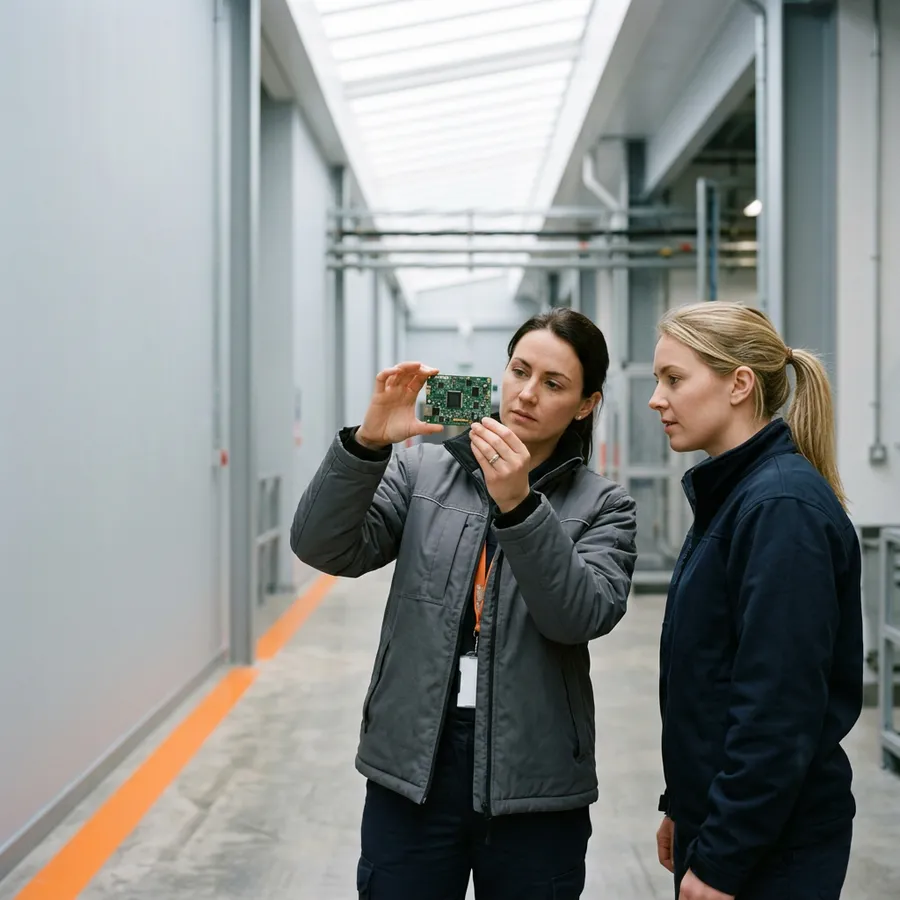
A Lot of This Work Ships Inside a Product, Not Inside a Browser
NXP, Infineon, Applied Materials and AMD all run design or process work in this metro. Tesla builds vehicles on the SH 130 corridor southeast of the city. Samsung is up in Taylor.
Add it up and a large share of Austin AI roles arrive attached to something physical, which changes the screen more than it changes the title. A model running on an automotive part lives inside a thermal envelope and a functional safety process. A model inspecting wafers has to be explainable to a process engineer who will override it on a Tuesday afternoon. Neither of those is a cloud job with a different logo, and candidates who have only ever deployed to a managed endpoint tend to find that out in week three of the engagement instead of in the interview.
There’s a compliance layer now too, and it’s newer than most teams realize. The Texas Responsible Artificial Intelligence Governance Act, House Bill 149, was signed in June 2025 and took effect on January 1, 2026. It’s narrower than what New York or Colorado did. Most of the notice, social-scoring and biometric provisions land on government entities rather than private employers, and the attorney general holds exclusive enforcement with a sixty-day cure period.
Still worth knowing which of your models the healthcare disclosure rule touches before a candidate asks you and the room goes quiet.
The difficulty cuts the other way as well. People who have shipped a model into hardware are rare, they know exactly how rare, and they price themselves accordingly. We track that population on its own. It is the thinnest bench we carry anywhere in Texas.
The Metro Is a Sixty-Mile Corridor and It Hires Four Different Ways
We run Central Texas as a single search and price each stretch of it separately, because candidates in each stretch are comparing you to a different set of employers.
Downtown and East Austin
Startups, fintech, the health systems, state agencies and the university. Fastest hiring cycle in the region and the highest churn that comes with it. This is where the enterprise LLM and retrieval work concentrates, and where a well-written req can close in under three weeks. It is also the only stretch of the metro where you will regularly lose a finalist to a company three blocks away rather than to a company three states away, which changes what your counteroffer conversation has to sound like.
The Domain and North Burnet
Enterprise SaaS and the big-platform satellite offices, with the Parmer Lane campuses sitting just north of it. Mature engineering practice and longer tenure. People out of this pool write things down before anybody asks them to, and you notice it in the first code review.
Round Rock, Georgetown and Taylor
Semiconductors, hardware, high performance computing and the data center build-out. Dell is headquartered in Round Rock, Samsung is in Taylor, and TACC’s Horizon supercomputer is going into a Round Rock data center campus. That Dell footprint has been shrinking, and a three-year drawdown from 133,000 people to 97,000 has loosened the server, storage and field-support bench around it. Entirely different resumes, and a pool that mostly ignores a downtown address.
Southeast Austin and the SH 130 corridor
Manufacturing, automotive and logistics, anchored by Tesla’s Austin operation. Onsite by nature, calmer comp expectations than downtown, and the highest acceptance rate we get anywhere in the region on a role that requires five days in the building. Ask about the drive.
None of this is cooling off. Horizon, built on a $457 million NSF construction award, enters production this year as the largest academic supercomputer in the United States, delivering more than a hundred times the AI performance of the system it replaces. Machines like that train people as well as models, and the people they train stay in the corridor.
What You Sign Changes Who Takes the Call
Same desk and same network behind all three. What moves is how much has to be certain in writing before a person starts.
Contract & Contract-to-Hire
Somebody on our payroll working inside your team while the budget, the hardware or the roadmap is still moving. Most of our Austin AI work starts here.
Contract Staffing →Direct Hire
Two seats justify it almost every time. Whoever owns evaluation, and whoever keeps the platform standing. Models get swapped out on a quarterly basis around here. Those two jobs don’t.
Direct Hire details →Project & Statement of Work
You define done, we staff it and run it to that definition. A forced migration off a model nobody wants to own. An evaluation program that has to be standing before the next board meeting.
Project Staffing →Common Questions
What should we budget for an AI engineer in Austin?
Data scientists in the Austin-Round Rock-San Marcos metro run $127,360 at the median, $161,560 at the 75th percentile and $186,010 at the 90th in BLS 2025 wage data. Senior applied AI and LLM people usually land at or past that 75th.
Title moves an Austin number less than two other things do. Whether the model has to run on hardware somebody else controls, and whether anything it produces has to hold up in front of an auditor or a regulator. Embedded and edge inference seats price well over the enterprise LLM band, and benchmarking one against the other is the single most common budgeting mistake we clean up in this market. For hourly work, current spreads sit in our 2026 AI engineer contract rates breakdown.
Why do our Austin postings fill up with people who can’t do the job?
Usually because the requisition was written for a research seat and posted into an applied market. Words like novel and state of the art pull volume in Austin without pulling fit, and the four people who could actually do the work skip the post entirely.
Rewrite it around what the thing has to run on and how fast it has to answer. One client changed three lines of a posting this year, cut applicant volume by roughly two thirds and tripled the qualified rate inside a week. No new sourcing tool was involved. The wording that pulls the right profile is laid out in our guide on how to hire AI engineers.
Is Austin still a strong AI hiring market, or has it cooled off?
It hasn’t cooled, it has moved. The growth is in the corridor north and east of the city where the fabs and the data centers are going, not in the downtown startup scene that got most of the press between 2020 and 2022.
Two numbers make the case. ERCOT was holding over 233 gigawatts of large-load interconnection requests at the end of 2025, up almost 300% in a year with more than seventy percent of it data centers. And Horizon, a $457 million NSF-funded system, enters production at a Round Rock campus this year as the largest academic supercomputer in the country. Neither of those builds itself, and neither of them runs itself either.
Do we have to compete with Bay Area compensation?
Not usually, and not on the same axis. Austin AI candidates who wanted a Bay Area number have generally taken one already, and the ones still here made a deliberate trade you can work with.
What moves them is a constraint worth solving and genuine ownership of it. Skip the no-income-tax pitch. Everybody has heard it, property tax eats a real piece of it, and leading with money signals that the money is the most interesting thing you have to say about the role.
How much of this work can be remote?
About half. Enterprise LLM, retrieval and platform seats travel fine. Anything attached to silicon, a vehicle, a fab or a physical test rig does not travel at all, and no amount of budget changes that.
Decide which one you’re in during week one. Opening the role nationally swaps a Central Texas benchmark for a national one and puts a different set of employers across the table from you, which is sometimes exactly the right trade. Finding out in week seven because a finalist brought it up is the expensive version.
Does the new Texas AI law change how we hire or what we build?
Mostly what you build, and less than the headlines suggested. TRAIGA, House Bill 149, took effect January 1, 2026, and its consumer-notice, social-scoring and biometric provisions apply to government entities rather than private employers.
What does reach private companies is an intent-based prohibition on discriminatory use and a disclosure requirement where AI touches patient-facing healthcare. Enforcement sits with the attorney general, with a sixty-day cure period and no private right of action. Practical effect on your hiring process is small. Practical effect on which candidates you want is real, because documentation and evaluation stopped being optional skills.
How quickly will we actually see candidates?
Seventeen days is our average from the intake call to a first qualified submit, and 92% of those placements are still in the seat twelve months on. Downtown enterprise LLM and platform roles often beat that.
It stretches on edge and embedded work, on anything tied to a specific silicon toolchain, and on HPC seats up the corridor. Those are small populations. We say so up front instead of letting you discover it a month and a half in. Send the job description and the limit it has to live inside, and you’ll get a range you can plan against.
Tell us what the model has to run on. We’ll tell you who in Central Texas can build it.
Send the requisition and the limit behind it. We’ll come back with the band it belongs in, who is realistically reachable inside that band, and what it takes to get them to say yes.
Get an Austin AI Shortlist →