
AI Staffing in Seattle Runs on Two Shores, Not One
Machine learning, LLM, and generative AI engineers placed on contract, contract-to-hire, and direct hire across Puget Sound. Which side of Lake Washington your desk sits on changes who will take the call.
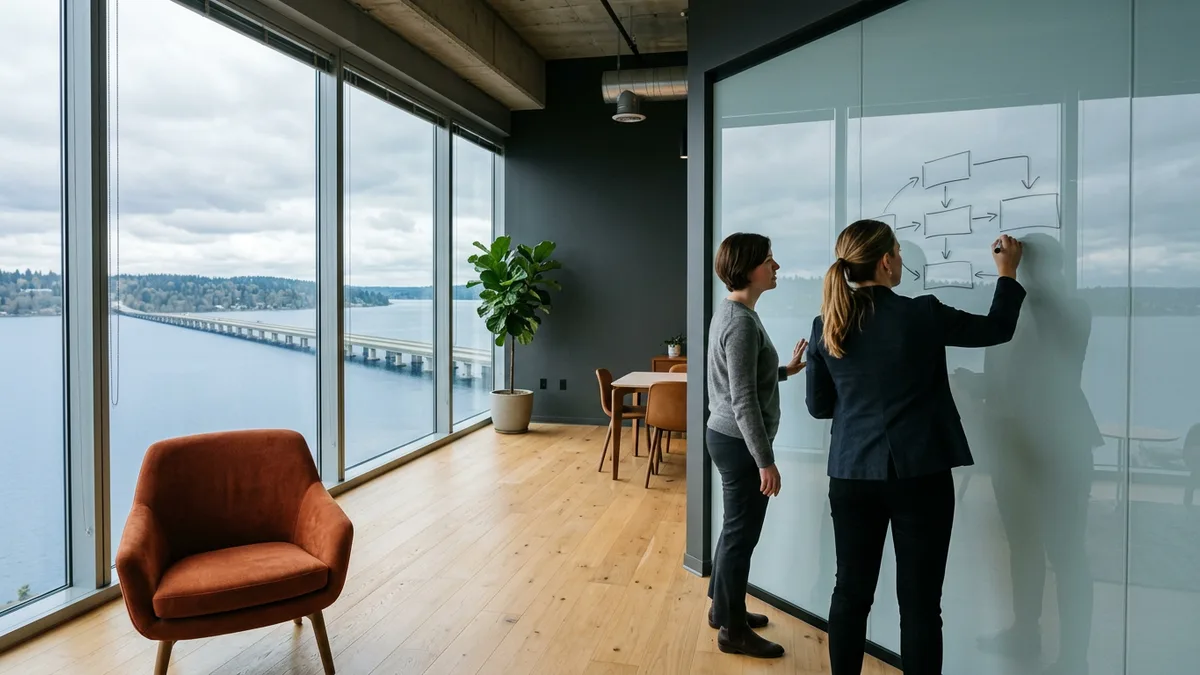
KORE1 handles AI staffing in Seattle on both sides of Lake Washington, placing machine learning, LLM, generative AI, and ML platform engineers on contract, contract-to-hire, and direct hire. We average 17 days to first qualified submit.
Last updated: August 20, 2026
Two reqs landed the same week last spring. Same title. Same comp band, near enough the same stack. One desk in South Lake Union, one in Redmond.
They were never the same search.
Redmond closed in three weeks. South Lake Union took nine. Sourcing wasn’t the problem. Money wasn’t either. Four of the six finalists lived east of the lake, and by the second interview three of them had run the arithmetic on what a 5pm crossing eastbound on the 520 costs you every week for the next four years, then quietly stopped returning calls.
Seattle looks like one AI market on a map. It behaves like two.
Nobody writes that into a job description. It still decides the search. KORE1 has placed IT staffing talent since 2005, and our AI recruiting desk works both shores as a single map rather than letting a good candidate die at a bridge.
One scope note first. This page covers AI, machine learning, and LLM engineering seats. For the pipelines, warehouses and dashboards those models feed on, start with data engineer staffing or data scientist staffing instead.

Who Is Getting Paged at Three in the Morning?
Ask it before the req goes anywhere. In this city the answer sorts your candidate pool faster than any skills list will. The skills list comes second.
Seattle’s AI bench grew up inside two cloud platforms. AWS is headquartered here. Azure sits eight miles east, and a very large share of the people you’re about to interview spent their formative years operating somebody else’s models at a scale almost nobody else runs. So the bench here is unusually strong at serving, scheduling, evaluation and cost, and thinner on the research side than a city with this much money in it has any business being.
You call a hosted model. Claude, GPT, Gemini, something wrapped inside a product. The work is retrieval, tool use, eval suites and the cost per request nobody modeled before launch. That’s an LLM engineer.
You own the weights. Fine-tuning, distillation, quantization, and a serving stack that has to stay up. That’s a machine learning engineer. Narrow it to image, audio or video output and it becomes a generative AI engineer.
Somebody has to keep it running. Training and serving infrastructure, model CI, rollback, GPU spend. Nationally, teams add this seat last. Here it’s the deepest pool you have. Write a req that ignores it and you’re bidding for the scarce half of a market while the abundant half walks straight past you. See ML platform engineer staffing.
Two Shores, Two Benches, and Two Bridges Between Them
Four of the five longest floating bridges on earth sit in Washington State, and the two longest of those carry your candidates to work. Whether a search clears depends on which shore the desk is on and which shore the engineer sleeps on.
Seattle Proper
- Amazon, roughly 49,000 in the city
- Allen Institute for AI, OLMo and Molmo
- OpenAI’s expanded Seattle hub
- The South Lake Union startup belt
Redmond and Bellevue
- Microsoft Redmond, roughly 53,000
- Amazon Bellevue, roughly 15,000
- Nvidia, Meta and Google satellites
- The I-405 corridor
Orange marks the crossing, the one point in a Seattle search where an otherwise finished offer still has to clear something nobody costed.
For a few years this stopped mattering. Nobody was going anywhere on a Tuesday. That changed fast. Microsoft put Puget Sound staff back in the office three days a week from February 23, 2026. Amazon now calls the whole region HQ1 rather than one downtown campus, and it has grown Bellevue to roughly 15,000 corporate roles while Seattle proper came down to about 49,000 from a 2020 peak near 60,000. So the commute is live again in every offer conversation we run here. We ask on the first call. Five-minute question. It has saved searches from dying in week eight.

Every Noncompete in This State Now Has an Expiry Stamp
Governor Bob Ferguson signed House Bill 1155 on March 23, 2026. As of June 30, 2027, every noncompetition covenant with a Washington employee or contractor is void, whenever it was signed, and employers have to write to affected people by October 1, 2027 to tell them so.
Read the definition. It’s wider than the name suggests. Customer nonservicing clauses are covered. So are forfeiture-for-competition provisions, which is the polite name for the clause that claws back equity if you join a competitor, and that clause is doing far more work in AI retention around here than any noncompete ever did.
Until then the old rules still run. Washington’s 2026 enforceability floor sits at $126,858.83 for employees, adjusted annually for inflation under RCW 49.62, and no AI engineer in this market earns under it. Not one. So for the next ten months a Seattle noncompete can still bite. After that, none of them can.
Which means you’re running two hiring plans, not one. Searches that are hard today because a candidate is papered get materially easier in July 2027, and the retention you think you have on your own team gets weaker on exactly the same morning. Plan the second one now. Almost nobody is.
Six Titles Seattle Uses, and What Each One Is On the Hook For
Very few teams need more than two of these at once. Most call us about the third one and describe the first. We hear it constantly.
Training, evaluation and serving for models you own. Around here that often means models running on a platform the candidate helped build in a previous job. See machine learning engineer staffing.
Retrieval, context assembly, tool use, guardrails, and a cost curve nobody modeled. Fastest-growing seat we fill on either shore. LLM engineer staffing.
Deepest local pool by a distance, because two hyperscalers trained a generation of them here. Serving infrastructure, model CI, rollback, GPU spend. ML platform engineer staffing, or our MLOps recruiters.
Diffusion and multimodal work. Image, audio and video pipelines, plus the provenance questions that ride along with all of it now. See generative AI engineer staffing.
Novel modeling and publication-track work. Small pool nationally, and here you’re bidding against Ai2 and two frontier-lab satellite offices. AI research scientist staffing.
Owns what good means on an AI product. Can show you the evaluation artifact behind that answer instead of an opinion. See AI product manager staffing.
Two adjacent specialties come up often enough in Puget Sound to name, computer vision engineers for the aerospace and industrial work north and south of the city, and NLP engineers. We also place prompt engineers where that work has been split out on its own.

A Seattle Offer and a Bay Area Offer Are Not the Same Number
Candidates here run this arithmetic. Hiring managers moving a search up from California usually haven’t.
Washington has no state income tax, so when restricted stock vests the only bill is federal. On a senior AI package weighted toward equity that gap isn’t a rounding error. It’s the single most common reason a Seattle offer that looks lower on paper beats a Bay Area one that looks higher.
There’s a catch on the back end. Washington charges a 7% excise tax on long-term capital gains above an annually indexed standard deduction, which sat at $270,000 for 2025, and Senate Bill 5813 added a higher tier on gains above a million dollars. Vesting isn’t the trigger. Selling is. Engineers who’ve sat on four years of a hyperscaler’s stock hit it more often than anyone expects.
None of that is tax advice and we don’t pretend otherwise. It matters because the conversation happens either on the first call or at the offer stage. Only one of those is cheap.
Four Puget Sound Submarkets That Hire Very Differently
We recruit the region as one connected market. Candidates already do.
Seattle, South Lake Union and Denny Regrade
Amazon’s home blocks, plus the densest run of AI startups in the Northwest and OpenAI’s expanded hub. Most product-facing LLM work in the region sits here. So does the shortest average tenure. People move fast on this side.
Redmond and Kirkland
Microsoft’s campus anchors it, and the platform bench around it has no equal on the West Coast outside the Bay. Candidates here tend to be later in a vesting cycle and slower to move. That’s a targeting problem, not an availability one.
Bellevue and the I-405 corridor
Fastest-growing slice of the market. Amazon has moved roughly 15,000 corporate roles across the water, and Nvidia, Meta and Google all run satellite engineering here. Good hunting for applied ML people who want to stay east.
Everett, Tacoma and the outer ring
Aerospace, defense and industrial employers, where the AI work is computer vision on a production line or predictive maintenance on a fleet. Different resumes entirely. Calmer comp expectations, and a candidate pool that almost never applies to a downtown posting.
Nationally, BLS projects 34% growth for data scientists through 2034 and 20% for computer and information research scientists, both far above the average across all occupations. The Seattle-Tacoma-Bellevue metro’s mean hourly wage of $44.13 already runs well above the $33.54 national figure. We run searches in more than 30 U.S. metros. A pipeline that stalls locally is a reason to widen the map, not to lower the bar.
Match the Model to How Sure You Are
Same recruiters and the same network behind all three. What changes is how much has to be true on day one.
Contract & Contract-to-Hire
An engineer employed by KORE1, embedded with your team, usually three to nine months. Right for the stretch when nobody can honestly say what month six looks like.
Contract Staffing →Direct Hire
For the platform seat and whoever owns evaluation. Both outlast whatever model you happen to be running this quarter. That memory has no market price.
Direct Hire details →Project & Statement of Work
A team we assemble and manage against deliverables you write. Migration off a legacy model. A fixed launch date. An eval program that has to exist before a board update.
Project Staffing →Common Questions
What are AI engineers actually billing in Seattle right now?
Across current KORE1 Seattle placements, contract LLM and applied AI engineers bill roughly $95 to $155 an hour, machine learning engineers $110 to $175, and ML platform engineers $115 to $175. Research-track scientists sit well above all three.
Those bands track the local data. BLS put the mean annual wage for data scientists in the Seattle-Tacoma-Bellevue metro at $164,740 in May 2025, against a metro-wide mean of $44.13 an hour versus $33.54 nationally. What moves a rate most, in our experience, is how much of the model you own. Onsite expectations move it next. A Kirkland client paid the top of the platform band last quarter for one reason only, which was that the seat sat four days a week in the building.
Does it really matter which side of Lake Washington our office is on?
More than it used to. A Redmond desk and a South Lake Union desk draw from measurably different pools, and since the 2026 return-to-office mandates the crossing has become a live objection at the offer stage rather than a shrug.
Two bridges carry the whole thing, SR 520 and I-90, and both of them float. We ask about the commute on the first call. It sounds like a throwaway question. It is the one that killed the nine-week search at the top of this page.
Washington voids noncompetes in 2027. Should we just wait?
Don’t wait for it. House Bill 1155 voids every Washington noncompete on June 30, 2027, but a seat left open for ten months is ten months of work not shipping, and the same change loosens your own team that morning.
Plan for both windows instead. Between now and then, a papered candidate needs a careful conversation and sometimes a start date that respects a live restriction. After that, the whole market loosens at once. Your own people included, which is the half of this nobody’s leadership team has costed yet.
We wrote the req for an ML engineer and got a pile of platform resumes. Why?
Because Seattle’s bench came out of AWS and Azure, so a broad machine learning req in this market pulls infrastructure people first. They aren’t the wrong candidates. They’re answering the req you actually wrote.
Describe the next six months of work and the seat names itself. Calling a hosted API is an LLM engineer. Owning weights is an ML engineer. Keeping it up and affordable at scale is a platform engineer, and in this city that third pool is the deepest one you will ever get near, so it is worth being certain you don’t actually want it.
How much of the Seattle AI pool is locked inside Amazon and Microsoft?
A great deal of it. Amazon employs roughly 49,000 people in Seattle and another 15,000 or so in Bellevue, and Microsoft carries around 53,000 at the Redmond campus, so most senior AI talent in this region already sits inside one of the two.
Less discouraging than it sounds. Both have run repeated reductions through 2026, and tenure at that scale produces a specific kind of engineer who is quietly tired of owning one sliver of a system nobody outside their org can even name. A mid-size company offering the whole model wins that conversation more often than its own recruiters believe it will. We’ve watched it land three times this year.
Can we hire fully remote and make the bridge problem disappear?
Often, yes. Roughly half of what we place in Puget Sound lands remote or hybrid, and LLM, ML and platform work all run fine that way. The exceptions sit close to hardware, a lab, or a regulated environment.
One caution. Going fully remote drops you into a national bidding pool rather than a regional one, which changes your comp benchmark and who you’re bidding against. Usually worth it. It should just be a decision rather than something you find out in week six.
Our search has been open since March. What would you look at first?
Three things, in this order. Whether the req names the seat the work actually needs, whether the location and onsite expectation match where the candidates live, and whether the comp story accounts for equity a candidate would be forfeiting to take it.
In Seattle the second one is the quiet killer more often than the other two combined. Send over the job description and we’ll tell you which of the three is blocking it, even when the honest answer is that the search was fine and the market simply wasn’t there.
Every Seattle AI search carries a geography problem nobody wrote down.
Send the job description. We’ll come back with what the req is really asking for, who fits it on each shore, and a date you can plan around.
Start a Seattle AI Search →