

Last updated: September 6, 2026
By Gregg Flecke, Senior Talent Acquisition Partner, KORE1
Embedded software engineer interview questions in 2026 test memory-constrained C, RTOS scheduling and priority inversion, interrupt and DMA discipline, hardware debug method, and secure update paths, not the data-structures loop a general software engineer runs. The two roles share a language and almost nothing else. Most reqs still borrow the wrong loop.
I’m Gregg Flecke. Close to thirty years placing technical talent, and embedded is the desk where I watch the most qualified candidates get rejected for the wrong reasons. Usually by a panel that meant well. The hiring manager knows the hardware. The panel usually doesn’t. The three engineers running the loop came off the platform team, the cloud team, the mobile team, and they run the loop they know how to run.
Then the offer goes to whoever was best at a whiteboard.
Disclosure, since you should weigh it. KORE1 runs an embedded software engineer staffing desk inside our broader engineering staffing practice, and we get paid when a client hires through us. Nothing below changes if you run this search yourself. I’d rather you run a good loop without us than a bad one with us, because a bad embedded hire shows up eighteen months later as a product recall and everybody’s name is on it.
If you want the broader version of this material, the software engineer interview questions guide covers the general loop, the coding round, and system design. Different animal. Everything below assumes the person you hire will write code that runs on a microcontroller you can hold in your hand, ships in a physical product, and cannot be redeployed on a Tuesday afternoon when someone finds a bug.

The Loop Has No Hardware in It, and That Is the Whole Problem
A medical device company outside Minneapolis called us in March after two failed searches. Good company. Infusion pumps, Class II, real regulatory exposure. Nothing sloppy about them. They had run eleven candidates through a five-round loop and made two offers. Both hires washed out inside a quarter.
I asked to see the loop. Screen, coding round on HackerRank, system design, behavioral, hiring manager. Nowhere in five rounds did a candidate touch a board, read a schematic, look at a waveform, or explain a memory map. The firmware-side version of that loop, covering board bring-up and the update path, is in our questions to ask a firmware engineer. Not once. The company builds devices that deliver medication into human beings, and the interview could have been run for a React role without changing a single question.
Their second washout had passed the coding round at the top of the pool. He also could not explain why a variable shared between an interrupt handler and the main loop needs the volatile keyword, which came out in week three when a field unit started dropping alarms intermittently and nobody could reproduce it on the bench.
That is the failure mode. Not laziness, not a bad panel. Embedded work is defined by constraints that are physically absent from a video call, so a loop built out of habit tests everything except the job.
Start With What the Silicon Actually Is
Before you write a single question, answer four things about the req: what the processor is, whether there’s an operating system on it, whether the product is regulated, and who owns the board bring-up. Those four answers pick your questions for you. Skip them and you’ll interview four fundamentally different jobs under one title and wonder why the slates feel inconsistent. It happens constantly.
| The flavor in front of you | What the day looks like | What the interview has to prove |
|---|---|---|
| Bare-metal MCU | STM32, Nordic nRF52, or a PIC with 64KB of flash and no OS. Registers, timers, a superloop. | Memory map fluency, interrupt discipline, datasheet reading |
| RTOS application | FreeRTOS, Zephyr, or ThreadX on a Cortex-M4 or M7. Tasks, priorities, deadlines that matter. | Scheduling reasoning, priority inversion, stack sizing, ISR-safe APIs |
| Embedded Linux | Yocto or Buildroot on an i.MX or Sitara part. Device tree, kernel modules, userspace daemons. | Kernel and userspace boundary, device tree, build system pain tolerance |
| Safety-certified | ISO 26262, IEC 62304, or DO-178C. Half the calendar is evidence, traceability, and review. | Lived process experience, not vocabulary. Tested specifically. See below. |
A candidate who has spent nine years writing Yocto recipes and kernel drivers is not interchangeable with one who has spent nine years squeezing a sensor fusion loop into 32KB of RAM. Both say “embedded software engineer” on the resume. Both are correct. Neither is a substitute. Our guide to hiring embedded systems engineers works through the req and comp side of that split, so I’ll stay on the interview here. The board-level side of the same product, power rails and schematic review, gets its own electrical engineering interview guide.
Memory Is the Interview
If I could keep one round, I’d keep this one. Everything a general software engineer gets to ignore about memory, an embedded engineer has to hold in their head permanently, and it is the fastest way to find out whether someone has actually shipped firmware or has mostly read about it.
Ask where things live. Literally.
“I declare a 2KB buffer. Walk me through where it ends up if it’s a local inside a function, a file-scope static, and a global initialized to zero. What does each one cost me?” A person who has debugged a stack overflow on a part with 20KB of RAM answers this in about fifteen seconds and mentions .bss without being prompted. Somebody who hasn’t will talk about the heap. Every time.
Then push on the thing nobody prepares for. “How do you know your worst-case stack depth?” The honest answers are good: static analysis on the call graph, painting RAM with a known pattern at boot and checking the high-water mark later, or a frank admission that they’ve never measured it and have been relying on headroom. That last answer is fine at mid-level and disqualifying at staff.
volatile deserves its own two minutes, and not as a trivia question. When does the compiler need to be told, and when is telling it just noise? Three cases matter: a memory-mapped peripheral register, a variable shared between an interrupt handler and mainline code, and a variable touched across a setjmp. Ask what volatile does not give you. The answer is atomicity, and hearing a candidate volunteer that distinction tells you more than an hour of algorithm questions will.
Dynamic allocation is the argument question, and you should be suspicious of a candidate who thinks it’s settled. Some shops ban malloc outright after boot. Some allow a pool allocator. A candidate who says “we never used dynamic allocation” without being able to explain what fragmentation actually does to a long-running device, or why a fixed-size block pool sidesteps it, has inherited a rule rather than understood it. Rules get inherited constantly in this field. Whole codebases run on them.
Struct layout closes the round. Give them a packed structure that goes out over a wire protocol, ask what happens when the other end is a different architecture, and see whether alignment, padding, and endianness come out on their own.
RTOS Questions That Actually Separate People
Start with a definition question that sounds soft and isn’t. “What makes a system real-time?” The wrong answer is fast. Just fast. The right answer is deterministic, meaning the deadline is met every time and you can prove the bound, and a strong candidate will immediately split hard real-time from soft real-time and give you an example of each from something they shipped.
Priority inversion is the single highest-yield RTOS question in the loop. Ask them to describe it, then ask how priority inheritance fixes it, then ask what priority inheritance costs. Candidates who have actually been burned by it usually reach for the Mars Pathfinder story unprompted, which is genuinely the canonical example and a decent signal on its own. The follow-up is where the round earns its money: ask what they’d do if the mutex sits inside a vendor driver they can’t modify.
A few more that pull their weight:
- “Your task blocks on a queue for 10ms and misses its deadline once every few hours. Where do you start?” You want to hear priority assignment, blocking time, and interrupt latency considered as separate suspects, not a guess.
- How do you size a task’s stack? Same tell as before. Measurement beats intuition.
- Queue, binary semaphore, counting semaphore, or direct task notification. When does each one win? Notifications are meaningfully faster and lighter in FreeRTOS and a lot of engineers have never used them.
- Name an RTOS API you cannot call from an interrupt context, and what happens if you do. In FreeRTOS the
FromISRvariants exist for exactly this reason. - Watchdog strategy. Who kicks it, how often, and what happens if the highest-priority task is alive while a lower one has silently died. That last part is where most watchdog designs quietly fail.
Notice that none of those require a whiteboard. All of them can be asked in twenty-five minutes over a video call, and every one of them maps to something the person will do in their first month.
The Interrupt and DMA Round
Interrupt handling is where clever engineers with no embedded background produce confident, wrong answers, so it’s a useful filter even when your panel is thin on firmware experience.
The core question: “What belongs in an ISR and what doesn’t?” Short answers only. Clear the flag, grab the byte, set a flag or post to a queue, get out. That’s the whole list. A candidate who wants to parse a protocol inside the handler is telling you something.
Then the race condition. Give them a 32-bit counter incremented in an interrupt and read in the main loop on a Cortex-M0, and ask whether the read is safe. It isn’t reliably, and the reasoning behind why forces them into word size, atomicity, and the cost of a critical section. Ask how long they’re willing to disable interrupts. The good answer is measured in microseconds and they’ll tell you what breaks if you exceed it.
DMA is where I’ve seen the biggest gap between senior titles and senior ability. My favorite version: “You set up a DMA transfer into a buffer on an STM32H7. The transfer completes, and the data you read back is stale. What happened?” The answer is the data cache on the Cortex-M7, and the fix is either cache maintenance around the buffer or placing the buffer in a non-cached region. An engineer who has moved from an M4 to an M7 mid-project has lost a week to this exact bug and will light up when you ask.
Close with a lock-free ring buffer between an ISR producer and a task consumer. Ask them to talk through the index handling. You aren’t grading syntax. You’re listening for whether they understand why single-producer single-consumer is the case that works and what breaks the moment you add a second writer.
How They Debug Is Worth More Than What They Know
Firmware knowledge ages. Debugging method doesn’t, and it’s the thing that determines whether a hard problem takes an afternoon or a sprint. I’d trade a chunk of protocol trivia for a candidate who can tell me how they cornered something ugly.
“Tell me about a bug that only reproduced on hardware, and how you found it.” Then stay quiet. Really quiet. The story does the work. Listen for instrumentation choices, whether they formed a hypothesis before they changed anything, and whether they mention the thing that separates embedded debugging from every other kind: that the act of observing can change the behavior.
Follow with the trap. “You add a printf over UART to trace the issue and the bug disappears. Now what?” You want timing awareness, a GPIO toggle read on a scope instead, ITM or SWO trace, or a RAM buffer dumped after the fact. Any of those is a pass. “Add more printfs” is not.
The hard fault question sorts by depth quickly. “Your device hard faults in the field. You have a JTAG connection and a core dump. What do you read first?” Stacked PC and LR, then the fault status registers, and a candidate who names CFSR or HFSR has been there. One who says “I’d add logging” has not.
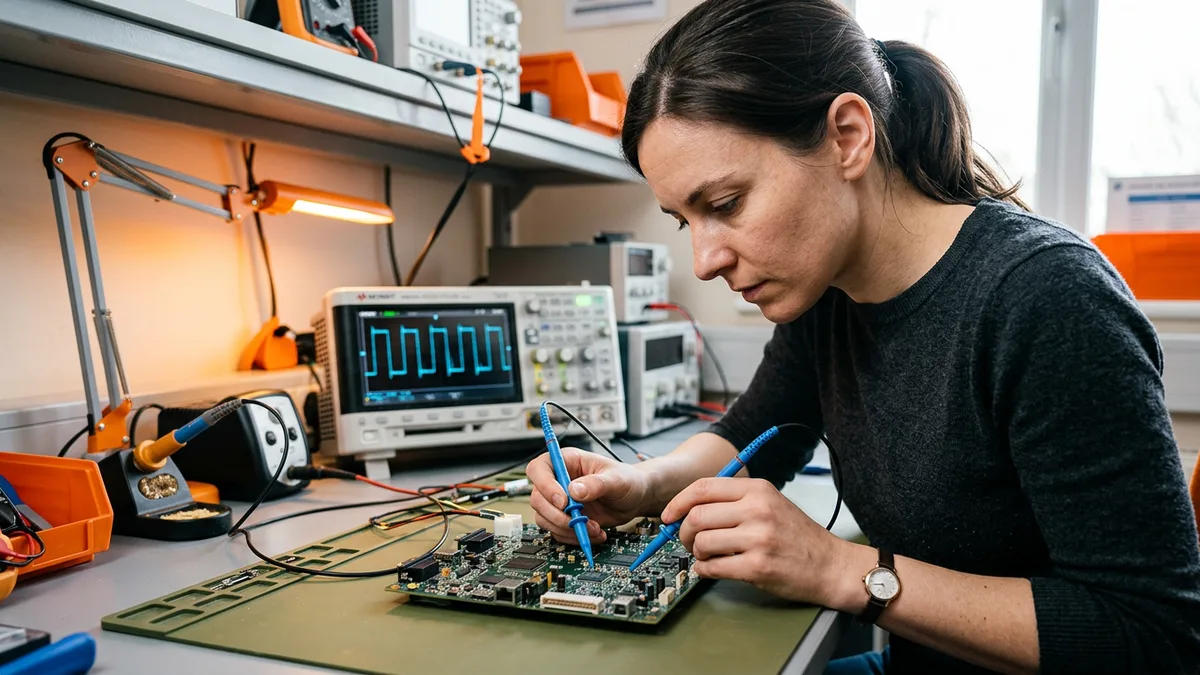
Ask what’s on their bench. Oscilloscope, logic analyzer, J-Link, TRACE32, a power profiler for battery work. Then ask for the last time each one told them something a debugger couldn’t. A protocol decode on a Saleae that showed a slave NAKing at exactly the wrong moment is a real answer from a real week of somebody’s life, and you can hear the difference immediately.
One more, and it’s my favorite for senior candidates. “The unit works on the bench and fails in the field below freezing. Where do you look?” Crystal tolerance, timing margin, brownout behavior, a capacitor out of spec at temperature, a sensor whose datasheet curve nobody read past room temperature. This question can’t be prepared for and it maps almost perfectly onto seniority.

The Security and Update Questions Most Loops Are Still Skipping
This is the section that changed most between 2024 and now, and it’s the one I see left out of otherwise good loops.
The EU Cyber Resilience Act starts biting on 11 September 2026. From that date, manufacturers of products with digital elements have to report actively exploited vulnerabilities and severe incidents on a clock: early warning inside 24 hours, full notification inside 72, final report within 14 days of a fix being available. Those are the European Commission’s own numbers. Three weeks out from this writing. If your product ships into Europe, somebody on your firmware team has to be able to produce a patch, sign it, and get it onto deployed units inside that window.
Ask whether they’ve ever done it. Not in theory. Actually done it.
Two more forces push the same way. CISA and the FBI put out a joint Product Security Bad Practices list, last revised in January 2025. On it: shipping new critical-infrastructure product lines in a memory-unsafe language, C and C++ named directly, where a safe alternative was available. For code already in the field they want a published memory safety roadmap instead. Voluntary guidance. No enforcement, no penalty, nobody to file with. It landed in customer security questionnaires anyway, which turns out to be its own kind of binding. Medical devices have a harder version already: section 524B of the Federal Food, Drug, and Cosmetic Act has applied to cyber devices since March 2023, and FDA refreshed the final guidance in June 2025.
What to actually ask:
- Walk me through a secure boot chain on a part you’ve shipped. Where does the root of trust live, and what stops a rollback to a signed but vulnerable old image?
- Design the OTA update for a battery-powered device that might lose power mid-write. A/B partitions and a watchdog-backed rollback is the expected shape. Ask what happens if the new image boots and then bricks on day two.
- Have you produced an SBOM for firmware? The useful follow-up is about the components nobody could account for, because on a real firmware bill of materials there are always a few.
- Where do you store the private key, and who has access to the signing infrastructure?
- Rust in embedded. Have you used it, would you push for it, and where would you refuse to? A candidate with an opinion in either direction who can defend it is more useful than one who’s never thought about it.
Most of the embedded job descriptions that cross my desk still don’t mention secure update or SBOM anywhere in them, which is a strange thing to leave out of a req for someone whose code has to survive a disclosure deadline. The candidates who can answer these questions well know how thin that group is. They price accordingly. Our cybersecurity staffing team watches the same premium build on the IT side.
Testing Regulated Experience Instead of Regulated Vocabulary
Anyone can learn to say ISO 26262 in a sentence. The standard is public. So are IEC 62304, DO-178C, and IEC 61508, and a candidate who spent a weekend reading summaries will clear a surface-level screen without trouble.
Evidence is what you’re testing for. Not fluency. Ask for artifacts, not definitions.
“What ASIL level was your component, and who decided that?” The decision comes out of a hazard analysis and risk assessment, and a candidate who was genuinely inside the process knows whether they participated in it or inherited the result. Both answers are honest. Only one is senior.
“Describe a MISRA deviation you filed.” This is the question I’d keep if I could keep only one for safety work. Real projects generate deviations constantly, because MISRA C:2012 rules collide with vendor headers and hardware access patterns all the time. Somebody who has never filed one either never worked under MISRA or never touched the parts of the codebase where it bites. Ask who approved it. Ask what the justification said.
“How did a requirement trace down to a test?” For DO-178C at DAL A you’re also asking about structural coverage, and specifically MC/DC, which is expensive, tedious, and instantly recognizable to anyone who has lived through it. Nobody fakes MC/DC enthusiasm. Nobody has tried.
One caution from the placement side. Regulated experience carries a real premium, and it also narrows your pool hard. If your device is Class II and your loop demands DO-178C DAL A experience because it sounded rigorous, you’ve cut your candidate pool by most of it for no benefit. We place into medical device, industrial, and aerospace programs through our biomedical engineering staffing practice, and over-specifying the standard is the most common self-inflicted wound I see on these reqs.
What to Run Instead of a Take-Home
Most embedded take-homes are bad. Not because candidates cheat, though in 2026 you should assume a generated first draft on anything sent home, but because the interesting part of embedded work needs hardware and the take-home almost never has any.
Better options, in the order I’d reach for them:
A code review round. Hand them 150 lines of real firmware from your codebase with three or four seeded defects. A missing volatile. An ISR that calls a blocking function. A buffer indexed with a signed int that can go negative. Twenty-five minutes, thinking out loud, no preparation. This is the highest-signal round I know of for this role, it’s cheap to build once, and it’s nearly impossible to fake because you’re watching them reason in real time.
A bring-up scenario. “The board came back from fab. The LED blinks, the SPI flash doesn’t respond. Talk me through your first hour.” Watch whether they check power rails and clock before they touch code. Most strong hardware-adjacent engineers do. Most pure software people don’t.
A remote bench. A few of our clients ship a dev board to shortlisted candidates or expose one over a remote debug session. Expensive and slow. Also the most predictive thing you can do at the final stage. Worth it for a staff hire. Overkill below that.
If you insist on a take-home, cap it at two hours, say so explicitly, and score the walkthrough rather than the artifact. Your strongest candidates have two other offers moving and they will quietly decline anything longer. That is not a bluff.
What the Loop Is Buying, and What It Costs
Compensation context matters because the loop should be calibrated to the level you’re paying for. The aggregators disagree wildly on this role, which is itself worth knowing before you anchor a budget to one of them.
As of August 2026, Glassdoor puts the U.S. average for an embedded software engineer around $174,217, ZipRecruiter around $153,383, and Salary.com around $115,896. A spread of nearly $60,000. Same title, same country, same month. The gap is mostly definitional: some sources fold equity and bonus into a total-pay figure on a senior-heavy sample, others sweep in contract postings and technician-adjacent roles at the bottom. Search “embedded systems engineer” instead of “embedded software” on the same sites and every number moves again, which should tell you how much weight to put on any single one of them. Meanwhile the Bureau of Labor Statistics tracks the closest official category, computer hardware engineers, at a median wage of $155,020 as of May 2024, with 7% projected growth through 2034 and about 4,700 openings a year.
Here’s the shape we actually see on placements.
| Level | Base range | What the loop should be testing |
|---|---|---|
| Junior (0-3 yrs) | $95K – $130K | C fundamentals, can read a datasheet, has blinked an LED on real silicon |
| Mid (4-7 yrs) | $140K – $185K | Owns a driver end to end, RTOS competence, debugs without hand-holding |
| Senior (8-14 yrs) | $200K – $260K | Architecture calls, bring-up leadership, can defend a memory and timing budget |
| Staff / architect (12+ yrs) | $240K – $315K | Platform decisions, security and update strategy, cross-discipline judgment |
Regulated-domain experience adds a premium on top of those bands, and defense or cleared work adds more. Metro matters less than it does for web roles, because the work is tied to physical labs. Austin, Detroit and Ann Arbor, Minneapolis, San Diego, Boulder, and the Orange County medical device corridor are where our embedded volume concentrates. For the full published-source comparison behind these bands, see our current embedded engineer compensation breakdown. Before you write an offer, run the role and city through the salary benchmark assistant rather than anchoring on a national average, because missing by $20K on a scarce profile usually means losing the candidate on the first call rather than negotiating later.
Sequencing the Rounds
Four rounds. Five if the role is safety-certified and you need a separate process conversation.
- Screen (30 min). Flavor match against the four categories above, comp alignment, and one grounding question: what part did you last ship on, and what was the constraint that hurt most?
- Core technical (60 min). Memory, interrupts, one RTOS scenario. No coding platform. Conversation.
- Code review (45 min). The seeded-defect exercise. This round predicts more than the other three combined, in my experience.
- Debug and judgment (45 min). Their war story, the printf trap, the hard fault question, the cold-field-failure question. Add secure boot and OTA if the product connects to anything.
- Process (30 min, regulated roles only). Deviations, traceability, who signed what.
Independent scorecards before the debrief. Always. No exceptions. Embedded panels skew small and senior, and one loud opinion in a room of three engineers will pull the other two along if you let people talk before they write.
Add a sixth round and you’ll usually just test technical depth twice, because that’s the muscle panels have. The judgment questions are the ones that get dropped, and they’re the ones that predicted the washouts in Minneapolis.
What Teams Ask Us When the Search Stalls
These come up on nearly every embedded intake call, usually after a search has already been open a while.
Embedded software engineer or firmware engineer, is there a real difference?
Loosely, yes: firmware usually means bare-metal or thin-RTOS work close to the silicon, while embedded software often stretches up into embedded Linux, application layers, and connectivity stacks. Neither title is standardized, though, and plenty of shops use them interchangeably.
Which is why the title on the req tells you very little. The processor does. We keep separate desks for firmware engineer staffing and broader embedded work for exactly this reason. When a client insists on one word over the other, my first question is what the part number is.
Our panel has no embedded background. Can we still run this loop?
A non-embedded panel can run this loop with two changes: lean on the code review round, which comes with its own answer key, and bring in one outside embedded engineer for a single technical round.
Even a contract engineer for four hours beats guessing across four rounds. What that outside voice is for is calibration, not veto.
What doesn’t work is a panel of capable software engineers grading embedded answers by feel. They tend to reward fluency. Articulate generalists who have never sized a stack are extremely fluent. That is roughly how the Minneapolis washouts happened.
How much C experience is enough, and does Rust change the answer?
C is still the working language for most of this market and will be for years, so a candidate without production C is a stretch for most reqs regardless of how strong they are elsewhere. Rust is genuinely growing, but from a small base in shipped embedded products.
Treat Rust as a plus signal rather than a requirement, unless you’ve already committed to it on a platform. What I’d actually screen for is whether they can reason about memory safety at all, since that’s the underlying skill and it transfers. Given where the federal guidance is pointing, engineers who can hold both languages will be worth more in three years than they are now.
Realistically, how long does an embedded search take?
Five to ten weeks for a mid or senior embedded role, longer if you’ve attached a specific safety standard, a clearance, or an on-site requirement in a thin market. Our IT desk averages 17 days to hire. Embedded runs well past that. Consistently.
The pool is smaller than the title implies, the strong people are employed and building something they care about, and hardware-tied roles can’t be filled from anywhere in the country. Anyone promising you a senior embedded hire in two weeks is describing a candidate they already have on the bench, which is a different thing from a search.
Should this be a contract role or a direct hire?
Contract works well for a bounded push: a bring-up, a certification cycle, a port to new silicon, a security retrofit ahead of a regulatory date. Ongoing platform ownership belongs in a direct-hire search, because the institutional memory of why the timing budget is what it is doesn’t transfer in a handoff.
We staff embedded work both ways through contract staffing and direct hire. One honest caveat: senior embedded contractors are scarcer than senior embedded employees, and the good ones are often booked a quarter out. Plan earlier than feels necessary. Then earlier again.
Is it fair to reject someone who can’t answer the DMA cache question?
That one is a seniority probe rather than a gate, so no. Plenty of excellent engineers have never worked on a part with a data cache and never had reason to. Score it as a bonus signal and put the weight on the debugging round instead.
The questions that should actually gate are the ones where a wrong answer predicts damage: volatile and shared state, what belongs in an ISR, and whether they can explain how they’d verify their code does what the requirement says. Miss those and the person will ship bugs you can’t reproduce.
How do we test someone whose best work is under NDA?
Ask about the shape of the problem rather than the product. Constraints, architecture decisions, what broke, what they’d redo. None of that requires naming a client or a device, and candidates who have worked defense or medical are usually practiced at describing work at that altitude.
If someone can’t discuss any technical decision they’ve ever made without a confidentiality objection, that’s occasionally real and more often a comfort issue with technical conversation. Give them the code review round. Seeded defects in your code carry no NDA problem at all.
Test the Bench, Not the Whiteboard
Embedded hiring goes wrong in a specific, repeatable way. A panel that knows software runs a software loop, the loop rewards the candidate who interviews best rather than the one who has spent years thinking in registers and microseconds, and the mismatch surfaces months later as a bug that only happens in the field and only sometimes.
Fix the loop and most of that goes away. Ask where memory lives. Ask what belongs in an interrupt. Ask how they’d prove it. Make them read code with real bugs in it, and listen to how they debug rather than what they’ve memorized. Then ask the security questions, because the deadline in September is real and the people who can answer them are already being paid for it.
If you want a second read on a loop you’ve already built, or a slate that’s been screened against these questions instead of a generic technical bar, talk to a recruiter on our team. Our recruiters average 15+ years in staffing and we place embedded engineers across 30+ U.S. metros. We take a fee when a hire closes, which you already knew, and the questions above work exactly as well if you never call us.
