

Last updated: September 5, 2026
By Tom Kenaley
Computer vision engineers in 2026 cost $145K to $190K mid-level and $200K to $275K senior in the United States. Autonomous-driving perception and medical-imaging FDA specialists clearing $290K to $410K total comp, and most well-scoped searches closing in 4 to 9 weeks. The discipline is six different careers wearing the same job title. The two biggest market movers are the foundation-model pivot, which deleted half the labeling work that used to anchor the role, and the autonomous-vehicle reshuffle that followed the 2025 Cruise wind-down and the late-2025 Tesla Robotaxi rollout. The comp bands that cleared in 2023 do not clear today.
The phrase “computer vision engineer” still gets pasted into job descriptions like it means one thing. It does not. The person training a vision-language model on the next Waymo dataset and the person calibrating a stereo rig for a manufacturing inspection line both answer to the title. Their stacks barely overlap. Their comp bands barely overlap. Their interview loops should not overlap. A generic JD pulls a generic pile, and the pile does not sort itself.
Tom Kenaley, Senior Partner at KORE1. We’ve placed perception, deep-learning vision, and machine-vision engineers into autonomous-vehicle programs, defense imagery, medical imaging startups, manufacturing inspection OEMs, retail analytics platforms, and the new wave of foundation-model robotics outfits across thirty-plus U.S. metros. The 92% twelve-month direct-hire retention number on our website is not marketing. It comes from sorting the req before the search starts, through our computer vision engineer staffing desk inside the broader IT staffing services practice. We get paid on placement. Scoping the role is free. What follows is the intake conversation that catches most of the failure modes before they become a five-figure search fee on a candidate who never had the right stack.
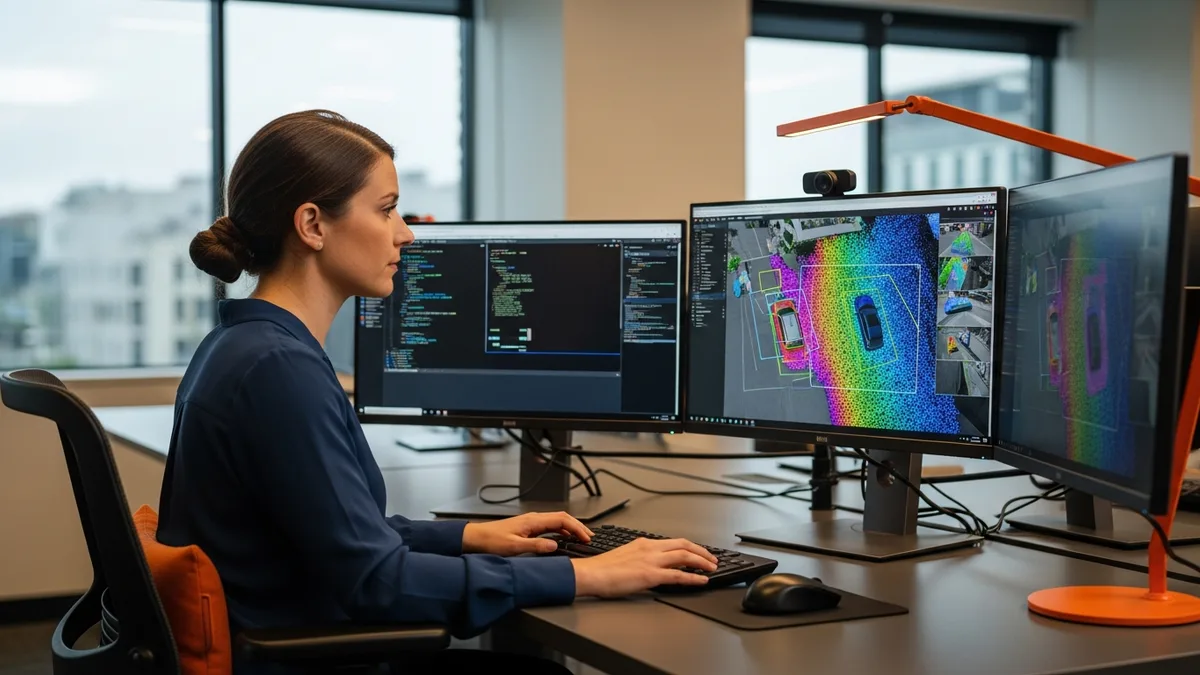
The Foundation-Model Pivot Quietly Rewrote the Role
Two years ago a computer vision engineer was a person who knew how to label data, train a custom CNN, watch the validation loss, and ship a model that worked on the exact dataset she had trained against. The work was bottom-up. Annotate, train, evaluate, redeploy when the data drifted. Most of the senior pool in this country grew up on that loop.
That loop is shrinking. DINOv2 from Meta. SAM 2 for video segmentation. Florence-2 and Grounding DINO for open-vocabulary detection. The newer vision-language models that ship a usable zero-shot baseline before anyone has labeled a frame. The engineer who used to need three months of annotation work to ship a part-defect detector can now wire up SAM 2 plus a fine-tuned classifier head in two weeks and hit production accuracy. The labeling pipeline still matters. It is no longer the bottleneck.
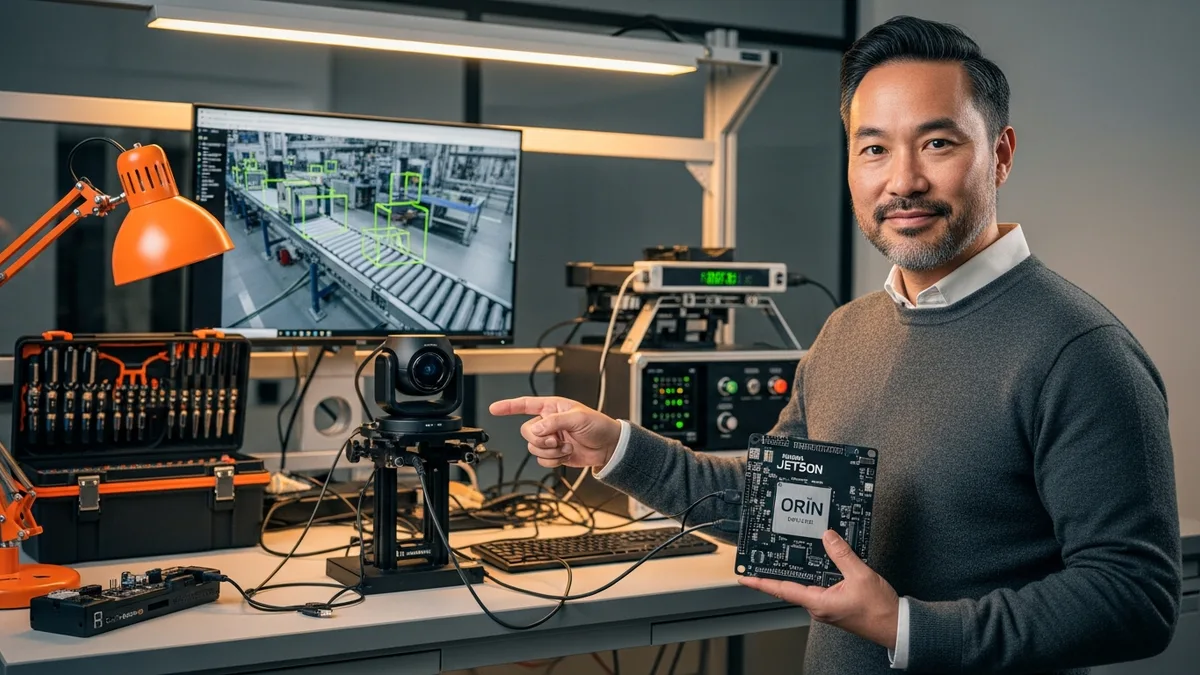
What changed in the job. The work shifted up the stack toward evaluation, deployment, on-device optimization, and what you might call “model triage.” Which foundation model do you start from. How do you measure when it is failing on the long tail. How do you fine-tune without destroying the zero-shot behavior. How do you compress a 600-million-parameter ViT down to something that runs on a Jetson Orin Nano at 30 FPS. The engineer who can answer those four questions is the engineer that buyers want now. The engineer who can only label and train is not unemployable, but the comp band has flattened on that profile.
One pattern from the last six months. A client posts a req for a “senior computer vision engineer” and lists OpenCV, PyTorch, and “experience deploying ML models in production.” Three resumes in, the engineering hiring manager realizes the work is actually 80% TensorRT optimization on Jetson hardware and 20% PyTorch experimentation. That is a different career than the JD was sourcing for. Anyone who has worked the device-deployment lane for a quarter would have flagged it on the intake call. The pool that answers a generic CV req is not the pool that lives on the device side. Different lane. Different sourcing pass. The JD has to name the deployment target before the search starts to converge on real candidates instead of the noise band at the top of the funnel.
Where Computer Vision Engineers Actually Deploy in 2026
Six verticals carry most of the active hiring in this category. The work is genuinely different across them. The frameworks, hardware, regulatory exposure, and the kind of mistakes that get someone fired are not interchangeable.
| Vertical | Primary Problem | Stack Center of Mass |
|---|---|---|
| Autonomous Driving Perception | Multi-sensor fusion, BEV occupancy, detection at distance, calibration at scale | C++17/20, CUDA, ROS2, PyTorch, TensorRT, ONNX, BEVFormer-class architectures, NVIDIA DRIVE, Argoverse, nuScenes |
| Medical Imaging | Segmentation, classification, FDA 510(k) regulatory path, DICOM workflows | PyTorch, MONAI, ITK, nnU-Net, SimpleITK, DICOM, Orthanc, HIPAA controls, FDA validation packages |
| Robotics Perception | 6-DoF pose, depth, SLAM, manipulation grasps, sim-to-real transfer | PyTorch, OpenCV, ROS2 perception stack, Open3D, GTSAM, NVIDIA Isaac, RealSense, Ouster, Luxonis OAK |
| Edge / Retail / Smart Cameras | On-device inference, people counting, planogram compliance, loss prevention | Jetson Orin, Qualcomm Snapdragon, Hailo, Coral, TensorRT, ONNX Runtime, YOLOv9/v10, BoT-SORT, RTSP pipelines |
| Industrial / Machine Vision | Defect detection, OCR, dimensional inspection, GigE camera integration | HALCON, Cognex VisionPro, Keyence, Basler Pylon, GigE Vision, EtherNet/IP, PLC integration, classical CV with deep-learning hybrids |
| Geospatial / Aerial / Defense Imagery | Change detection, object tracking from altitude, multi-spectral, security clearance work | PyTorch, rasterio, GDAL, Earth Engine, Maxar / Planet / BlackSky imagery, TorchGeo, segmentation at 0.3m resolution |
A perception engineer who has spent three years inside Argoverse and CUDA kernels can read a HALCON script. He has probably never written one for a production line that has to hit a 0.02% false-reject rate on a die-cast aluminum housing. A medical imaging engineer who can fine-tune nnU-Net on a cardiac dataset can sketch a YOLO inference loop on a Jetson. She has probably never debugged a TensorRT engine that segfaults inside `enqueueV2` at 4 a.m. the morning of a store opening. Both engineers are good. Both are expensive. The interview that tests both at equal depth produces zero hires, and the JD that asks for both produces a slate where everyone is mediocre at the thing you actually need.
The fix is one paragraph at the top of the JD that names the vertical plainly. Not “computer vision” with a list of buzzwords. “We are building a multi-camera perception stack for our Class 8 autonomous truck program in Pittsburgh, the work is BEV occupancy detection across six surround cameras and a 128-line LiDAR, and the deployment target is a custom NVIDIA DRIVE Thor board running at sustained 30 hertz with a sub-200-millisecond latency budget end-to-end.” That paragraph cuts the resume pile by 80% on day one, and the 20% who remain are people who can actually do the work and have the receipts to prove it from a prior shipped program.
If you want a starting point instead of a blank page, our computer vision engineer job description template walks through exactly this: the sensor, the deployment target, and the regulatory line, all before a single framework gets mentioned.
What the Salary Sources Actually Say About This Title
No aggregator tracks “computer vision engineer” cleanly. Glassdoor blends autonomous-driving perception engineers in the Bay Area with mid-market industrial vision engineers in Indiana under the same heading. ZipRecruiter pulls from active listings, which under-counts the senior end where the offer never makes it to a public board. Levels.fyi has the strongest data on the FAANG and venture-backed clusters but its sample is biased toward California. Salary.com runs cold on the deep-learning premium because its weighting is closer to median industrial. Trust no single number. Look at the spread.
| Source | What It Measures | Median | 25th pct | 75th pct |
|---|---|---|---|---|
| Glassdoor | Total pay, self-reported | $165,614 | $131,150 | $212,288 |
| Glassdoor (Senior) | Total pay, self-reported, senior title only | $207,639 | $164,265 | $266,478 |
| ZipRecruiter | Base from active listings | $121,515 | $95,500 | $149,000 |
| PayScale | Base, blended seniority | $118,400 | $92,000 | $152,000 |
| Salary.com | Base, weighted to median industrial | $156,827 | $128,000 | $189,000 |
| Levels.fyi | Total comp, venture and FAANG-adjacent | $245,000 | $185,000 | $340,000 |
The headline number to remember. Senior medians on the public boards sit between $165K and $245K. The actual offers we are writing in May 2026 land $20K to $40K above that, because the published medians lag the market by roughly nine months and the foundation-model premium has not been priced in yet. The exception is anything FDA-touching in medical imaging, which lags less because the regulatory experience is so narrow that public posting volume is small and the comp sits at the high end of the band by default.
KORE1’s placed bands by vertical, from sixty-one computer vision closes between Q1 2025 and April 2026. Direct-hire only. Base plus typical equity refresh. The autonomous-driving and medical-imaging bands run hot. Industrial-vision sits lower because the work is closer to mechatronics than deep learning.
| Vertical | Mid-Level (3-6 yrs) | Senior (6-10 yrs) | Staff / Principal |
|---|---|---|---|
| Autonomous Driving Perception | $175K – $215K | $230K – $310K | $330K – $475K |
| Medical Imaging (FDA-touching) | $165K – $200K | $215K – $285K | $295K – $410K |
| Robotics Perception | $160K – $200K | $205K – $275K | $285K – $390K |
| Edge / Retail / Smart Cameras | $145K – $180K | $185K – $245K | $250K – $325K |
| Industrial / Machine Vision | $120K – $155K | $160K – $205K | $210K – $265K |
| Geospatial / Aerial / Defense Imagery | $150K – $190K | $195K – $260K | $270K – $345K |
The geospatial band is wider than it looks. The published number is misleading because security-clearance work compresses the public range. A TS/SCI-cleared CV engineer with three years of full-motion video tracking work at a defense prime can clear $340K base in Northern Virginia, plus a six-figure sign-on. That offer never lands on a public salary board. The program is classified, the candidate has to be sourced through a cleared-recruiter network, and the people writing the offers do not post on LinkedIn. We have a separate book for that work and the bench rebuilds slowly because the clearance lifecycle is measured in years.
For contract and contract-to-hire, the going W-2 hourly rate for a senior CV engineer in 2026 sits at $95 to $145 an hour, with autonomous-driving and medical-imaging skewing to the top of that range and industrial-vision sitting at the bottom. Use our salary benchmark assistant if you need a back-of-envelope number tied to your specific stack and zip code before the intake call.

How to Read a Computer Vision Resume Without Getting Fooled
Resumes in this category are noisier than most. The vocabulary overlaps even when the work does not. Five tells we use on every screen.
Does the resume name the deployment target. A senior CV engineer who has actually shipped to production names the chip. Jetson Orin Nano. Hailo-8. Snapdragon 8 Gen 3. Custom NVIDIA DRIVE board. If the resume says “deployed CV models in production” without naming the runtime, the production claim is shaky. Push on it in the screen.
Does it name datasets she actually trained against. Not “Common Crawl” or “ImageNet.” Those are entry-level signals. Senior is nuScenes, Argoverse 2, Waymo Open Dataset, KITTI-360, BraTS, RSNA-MICCAI, xView, SpaceNet, the COCO subsets that have been benchmarked to death. The dataset reveals the domain.
Does it name the loss function or the architecture innovation he claimed responsibility for. Anyone can list PyTorch. The senior engineer can say “I rewrote the bipartite matcher in the detection head to handle small-object IoU thresholds below 0.3 because the COCO loss was dropping pedestrians at distance.” If the resume only lists frameworks and not what was done inside them, the depth is unverified.
Does it acknowledge the failure modes. A senior CV engineer talks about what broke. The model that worked in the lab and fell apart on snow. The annotation pipeline that introduced a label-noise pattern nobody caught for six weeks. The TensorRT export that quietly cast the wrong tensor to FP16 and dropped recall by twelve points. If the resume is all wins, the resume is junior or it is padded.
Does the github show real CV repos or fork-and-commit-noise. Open one. Read the actual code. A senior CV engineer’s public work shows custom layers, custom data loaders, custom evaluation harnesses. Junior work is mostly cloned tutorials, kaggle notebooks, and PyTorch Lightning boilerplate. The fastest 90-second sanity check on any candidate.
The Interview Loop That Actually Predicts On-the-Job Performance
Four rounds. No more. Five works if the role is FDA-touching or has a security-clearance gate that requires a paper read. Anything longer and the best candidates have a competing offer signed before round four.
Round 1: Recruiter screen, thirty minutes. Confirm visa status, location, comp band, vertical alignment, and the two or three datasets or deployment targets that have to match for the candidate to even make it to the technical screen with the working engineer on the other side of the table. Half of all candidates filter out here for fit, not depth, and the deeper rounds run faster when this round is honest about what the role actually is.
Round 2: Technical screen with a working CV engineer, sixty minutes. Not a leetcode round. A walkthrough of the candidate’s most relevant production system. Drive on architecture choices. Push on what failed. The engineer running this screen should be at the same vertical, because a robotics perception engineer asking a medical imaging engineer about leaf-level architecture choices does not generate signal in either direction.
Round 3: Practical exercise. Pick one of two formats. Either a one-hour live coding session with a small CV task on a Jupyter notebook against a public dataset, or a two-day take-home with a clearly bounded scope. Take-homes work for senior engineers if the scope is genuinely two days. They get rejected by senior engineers if the scope is a hidden forty-hour project. Be honest about the time ask or the candidate disappears between rounds.
Round 4: System-design and on-call mindset. Whiteboard a deployment pipeline for the kind of system you actually run. Data ingestion, training infra, evaluation, deployment, monitoring, fallback. Ask how the candidate would handle a model regression that surfaces at 2 a.m. on a Sunday and the on-call pager has just gone off because precision on a critical safety class dropped twelve points overnight after a silent data-distribution shift in the ingest pipeline. The best CV engineers have been paged at 2 a.m. on a Sunday. They have a story. The candidates who freeze on this question have not shipped to production at scale.
Optional Round 5: Cultural and stakeholder fit. Only if rounds one through four are a strong yes. Skip it otherwise. The longer your loop, the lower your offer-acceptance rate.
One round we banned at most clients. The “trick” computer vision puzzle. The kind of question that asks the candidate to derive the convolution backward pass from scratch on a whiteboard or invert a 4×4 homography by hand. These questions select for grad-school recency, not on-the-job ability, and they reject mid-career engineers who have been shipping production CV for eight years but have not touched the closed-form derivation since 2017. Skip it. Test the work, not the trivia.
Contract, Contract-to-Hire, or Direct Hire: Which One Wins
Most clients default to direct hire. Most clients are wrong about that default, at least for the first computer vision engineer on the team.
Direct hire works when the role is permanent, the budget is approved for the year, and the team already has at least one senior CV engineer who can run the interview loop and onboard the next person. If the team is starting from zero and the first hire is also the person who will define the stack, hiring direct without a senior-level peer review on the interview loop is how teams ship a year of work that has to be rewritten by the second hire. We have seen that pattern more than once. The fix is to bring in a contract senior CV engineer for ninety days first, let her scope the stack, and then run the direct-hire search against a real spec. Tour the direct hire staffing page if that is the path.
Contract-to-hire is the right call for teams that need the seat filled this quarter and have not fully scoped the role. Five months on contract. Conversion to direct in month six if the work and the fit hold up. This is the most common arrangement we run on the CV side, particularly for the edge-deployment and retail-analytics verticals where the work is project-shaped and conversion is a real outcome, not a fig leaf. See contract staffing for the engagement model.
Pure contract wins for two specific cases. One, a known fixed-scope project with a hard deadline, like a six-month FDA submission package or a one-time data-pipeline migration. Two, fractional senior expertise on a team that needs principal-level depth two days a week, not five. The hourly rate is higher. The total cost over twelve months can be lower than direct hire if the engagement is honestly part-time.
The trap is the team that runs a “contract” engagement that is actually a covert full-time direct seat that never gets converted, and the contractor takes a permanent offer somewhere else nine months in because there was no honest conversion plan. We have watched that one happen to clients more than once. If the role is a permanent seat, write the offer for a permanent seat.
Five Mistakes That Kill Most Computer Vision Searches
Pattern recognition from the searches that drag past ninety days.
Asking for a unicorn that does not exist. The JD that requires five-plus years of production deep learning, three-plus years of C++ real-time systems, ROS2, CUDA kernel optimization, MLOps, MLflow, on-device deployment to Jetson and Hailo, FDA 510(k) experience, and a published paper at CVPR. The person who has all of those things exists. There are maybe forty of him in the country. None are interviewing right now. Cut three of those requirements. Pick the two that actually matter. The hiring managers who do this end up with a six-month search that closes with the wrong hire because the unicorn requirements drove the budget calendar into a corner that any honest recruiter would have warned against on the first call.
Anchoring the comp band on Glassdoor without adjusting for vertical. The $165K Glassdoor median is a blended national average that includes industrial-vision engineers in Indiana and AV perception engineers in Mountain View. Posting an autonomous-driving role at $165K in May 2026 produces a slate of candidates who have never touched ROS2 and a complete pass from anyone who has. Anchor to the vertical band, not the blended one.
Requiring on-site five days when the role can run hybrid. The senior CV pool moved hybrid in 2021 and has not moved back. A five-day on-site requirement in Cleveland for a role that could realistically run three days on-site cuts the candidate pool by 60% on day one. Some roles genuinely need full-time on-site, particularly anything that involves running cameras on a physical rig or sitting next to an FDA validation engineer. Most do not. Be honest about which one you have.
Running a six-round loop with a take-home in the middle. Adds three weeks to the timeline. Senior CV engineers have multiple offers in the pipeline at any given moment and they pull out of the slowest one. Cut the loop to four rounds. Move the take-home to round two or skip it entirely if you have a strong technical screen.
Refusing to consider candidates from a different vertical. An autonomous-driving perception engineer can move into robotics perception in six weeks because most of the underlying stack is shared, including the sensor calibration toolchain, the SLAM math, and the deployment discipline that production CV demands. A robotics perception engineer can move into medical imaging in twelve weeks, given a good mentor on the FDA side. The candidate who has shipped CV in production at any vertical has 80% of the skills the new vertical needs. The 20% that does not transfer is teachable. The instinct that does transfer is not. If your slate is empty after eight weeks, widen the vertical filter before you widen the comp band.
What KORE1 Brings to a Computer Vision Search
The two parts that move searches faster than they would otherwise.
First, the desk has been running this category since the deep-learning wave hit production around 2017. The recruiter who picks up your req has shipped placements at companies in every one of the six verticals above. That matters because the screen happens before your hiring manager sees the slate, and a recruiter who cannot tell a BEVFormer paper from a YOLO paper sends through resumes that waste your team’s time. Ours can tell the difference.
Second, the bench is real. Our active candidate database in this category includes approximately 12,000 pre-vetted CV engineers across all six verticals, refreshed continuously across the United States, Canada, and our nearshore partner pools. About a third of the senior pool is open to a conversation at any given moment without being on the job market in any visible way. We can run a targeted slate against your req inside a week if the spec is clean. The 17-day average time-to-hire on the IT side of the firm includes our CV closes, which run slightly faster than the firm-wide average because the candidate pool is well-organized.
The intake is free. We do not charge to scope the role. If the conversation tells us your team would be better off hiring a different specialty or running the search differently, we will say so. Direct hire fee on placement, contract-to-hire bill rate that includes a transparent conversion calculation, no retainer, no markup games. Talk to a recruiter when you are ready to reach our team and we will run a no-charge scoping call within forty-eight hours.
Common Questions Before You Call Us
How long should a computer vision engineer search take in 2026?
Four to nine weeks for most well-scoped roles, with autonomous-driving and FDA-touching medical imaging running closer to twelve. The single biggest variable is JD clarity. A role with one named vertical, one named deployment target, and one named dataset closes in five weeks on average. A generic “computer vision engineer” req with three competing verticals stapled together runs past ninety days more often than not.
What is the realistic comp band for a senior computer vision engineer?
$205K to $310K base for senior, depending on vertical, with autonomous-driving perception and medical-imaging FDA work pushing the top of the range and industrial-vision sitting at the bottom. Total comp clears $400K for principals at well-funded AV programs and ex-FAANG perception leads. The published medians on Glassdoor and PayScale lag the market by roughly nine months.
Do we need a senior CV engineer on staff before hiring our first one?
No, but you need someone to run the interview loop with technical authority. A fractional senior CV consultant on contract for ninety days fills that gap cheaply. Hiring your first CV engineer with no technical authority in the loop is how teams end up with a stack that has to be rewritten by the second hire.
Is a PhD required for senior computer vision roles?
A PhD helps for research-leaning roles at AI labs and the foundation-model end of the market. For production CV in industrial, medical-imaging operations, robotics deployment, and edge analytics, shipped production experience is the stronger signal. Roughly 40% of the senior CV engineers we place do not hold a PhD and they close offers competitive with the ones who do.
Can a machine-learning engineer move into a computer vision role?
Sometimes, depending on which ML background. An engineer who has shipped deep-learning models in production and worked with image data on at least one project can move into CV in three to six months with a strong onboarding plan. An engineer who has only worked on tabular data or pure NLP will struggle. The image-data exposure is the bright line.
Should we look offshore or nearshore for computer vision talent?
For research-heavy roles and FDA-touching medical imaging, no. The talent depth in the U.S. is hard to substitute and the regulatory work has to be done by U.S.-based engineers in most cases. For pure model-training work on non-regulated data, eastern European and South American nearshore talent is competitive on price and quality, especially out of Poland, Argentina, and Brazil. We run both on the desk.
What does a computer vision engineer actually do day-to-day?
Reads the validation metrics from yesterday’s training run. Triages the failure cases against the holdout set. Writes a custom data loader for the new annotation format. Optimizes a TensorRT engine. Sits in a stand-up. Argues about whether the false-positive rate on the edge cases is acceptable for the next release. The day is closer to a senior software engineer’s day than to a research scientist’s day, and the engineers who like that mix are the ones who stay.
How does KORE1’s process compare to in-house recruiting for this specialty?
In-house recruiters are excellent at evergreen reqs in their core stack. They are slower on the long-tail specialties because the candidate database has not been built. CV in 2026 is a long-tail specialty even at large companies, because the talent pool is split across six verticals and a generalist sourcer cannot tell the difference between an Argoverse-trained perception engineer and a HALCON-fluent industrial-vision engineer. The 92% twelve-month retention rate on our placements is partly because the screen happens before the resume hits your team. Same reason we usually beat in-house TTH on this category by two to four weeks.
Hire Computer Vision Engineers with KORE1
Send the JD or send a paragraph. We will tell you which vertical the role actually lives in, what the realistic comp band looks like in May 2026 for your specific stack, and whether the search is one week or six. No charge to scope. Fee on placement only. We sit inside IT staffing services and the AI/ML engineer staffing practice, with deep crossover into engineering staffing agency for the robotics and industrial verticals.
If the role is robotics-adjacent, see our guide to hiring robotics engineers in 2026. If the work touches mixed reality or visionOS, the AR/VR developer hire guide overlaps on the SLAM and pose-estimation side. Talk to a recruiter when you are ready and we will get a scoping call on the calendar inside two business days, with a senior recruiter who has already placed in the vertical and the deployment target the role actually requires, not a generic technical sourcer reading the JD for the first time on the intro call.
