

Last updated: October 11, 2026
By Mike Carter, Managing Director, KORE1
Strong mechanical engineer interview questions in 2026 have a candidate work a number by hand, read a part that already failed, and defend a material or tolerance call under cost pressure. Definitions of stress, strain, and Young’s modulus tell you who passed Statics. They don’t tell you who you’d trust with a drawing release.
I’ll be honest about my seat. I’m not an engineer. I run the business side of KORE1, which means I sit in a lot of debriefs where a hiring manager explains why the person who interviewed beautifully in March was gone by August. Over the last two years our engineering recruiters and I have collected the questions that would have caught those people early. This is that list.
KORE1 gets paid when somebody you meet through our mechanical engineering staffing desk takes the job, so weigh everything here accordingly. None of it needs us. Print it, hand it to your panel, run it yourself.
A few things are missing on purpose. The 45-minute CAD test, the three-callout GD&T read, and the flawed design review already live in our guide to hiring a mechanical engineer, along with the PE license question. Our recruiters’ screen, walking one part from concept to the field and asking what came back wrong, is on the mechanical engineering recruiters page. And pay bands belong to the mechanical engineer salary guide. What’s left is the sheet, the broken part, the specialist questions, and the judgment calls. If the posting itself still needs work, start with our template for the mechanical engineer posting.

Make Them Do Arithmetic Before They Open CAD
A hydraulic pump maker in Rockford, Illinois, learned this one the expensive way. Their new design engineer had a gorgeous SolidWorks portfolio and read GD&T like a native. He specified a steel bearing pressed into a 6061 aluminum housing with 0.015 mm of interference, checked at room temperature, and signed it. The pump ran at about 100 °C. Aluminum grows roughly twice as fast as steel, so by operating temperature the press fit had turned into a slip fit and the outer race started walking. Field returns showed up eleven weeks after launch.
Not one interviewer had handed him a pencil and a calculation. Why would they? He had a master’s degree.
So now we suggest a hand-calc sheet. Thirty minutes, a calculator and a pencil, no laptop. Seven short problems, each one sized so a working engineer can land it in three or four minutes. You aren’t grading the third decimal. You’re listening for whether the candidate checks units, states an assumption out loud, and notices when an answer is physically silly.
| The problem | Where a strong answer lands | The tell in a weak one |
|---|---|---|
| Five stacked parts, each ±0.10 mm. What’s the assembly variation? | ±0.50 mm worst case, about ±0.22 mm by RSS, then asks the production volume before picking one | Gives one number and never mentions the other method |
| Steel bearing, 52 mm OD, 0.015 mm interference in an aluminum housing at 20 °C. Runs at 100 °C. Still tight? | About 0.048 mm of differential growth, so the fit opens to roughly 0.03 mm clearance. No. | “Both metals expand, so it cancels out” |
| M10 class 8.8 bolt, dry, 50 N·m. Then the same torque with anti-seize on the threads. | About 25 kN dry with a nut factor of 0.20. Near 36 kN lubricated, past the roughly 33.7 kN proof load. | Treats torque as if it were clamp force |
| A cantilever bracket deflects 0.4 mm. Double the length. Then double the thickness instead. | 3.2 mm, then 0.05 mm. Length cubed, thickness cubed in the inertia. | Says “twice as much” for the first one |
| Bracket first mode at 34 Hz, motor at 1,800 rpm. Someone bolts a 2x heavier sensor on it. | Motor forcing is 30 Hz, already too close. Doubling mass drops the mode to about 24 Hz, right across it. Stiffen, don’t add mass. | Never converts rpm to hertz |
| 40 W device, 1.9 °C/W junction to air in total, 45 °C ambient, 125 °C max junction. | 121 °C. Four degrees of margin, gone on a hot day in a dusty enclosure. | Calls it a pass and stops |
| Thin-wall tube, 150 mm ID, 3 mm wall, 1.5 MPa inside. Which way does it split? | Hoop stress 37.5 MPa, axial half that, so it splits lengthwise | Guesses the direction before writing pr/t |
Two rules make the sheet useful, and both come from debriefs with the Rockford plant and a Peoria supplier you’ll meet below, which ran their interviews badly before they ran them well. First, say out loud that arithmetic slips are fine and that you’re scoring setup. Then watch what happens on the bolt problem, because it’s the one people get wrong in real life. A candidate who knows that lubricant changes the nut factor, and that a torque spec written for dry threads quietly overloads a greased bolt, has almost always worked on an assembly line or a field fix. That knowledge doesn’t come from a textbook chapter.
Rockford, by the way, rehired eight months later. The engineer they picked got the bearing problem in about ninety seconds, then asked what the housing alloy was. Good sign.
Put a Broken Part on the Table
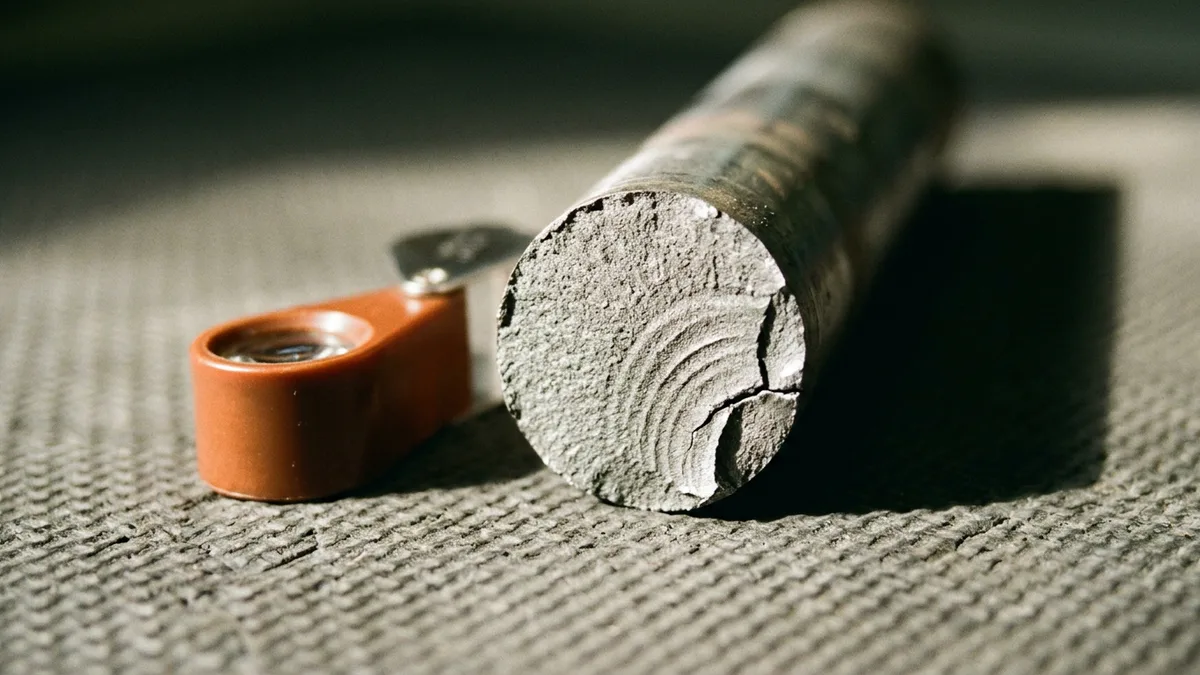
Every shop has one. A fractured bracket in a drawer, a sheared shaft somebody kept, a cracked weld coupon from the last failure review. Put it in front of the candidate, hand them a loupe, and ask what happened.
This is different from asking about their own failures. A rehearsed story about a failure they lived through can be polished for years. A stranger’s fracture surface can’t. You learn in five minutes whether they’ve actually read one.
Here’s what you’re listening for, roughly in the order a good engineer says it.
- Beach marks or ratchet marks near one edge. Fatigue. The candidate should look for where the marks radiate from, because that’s the origin.
- More than one origin usually means a stress concentration, a sharp fillet or a thread root, rather than bad material.
- How big the final fast-fracture zone is compared with the fatigue zone. A small final zone suggests low nominal stress over a long life, while a big one says the part was heavily loaded and didn’t last long at all. Sharp candidates bring this up without prompting.
- Necking, a cup-and-cone face, and shear lips point to ductile overload. One big event, not cycles.
- Chevrons on a flat, grainy face point back toward the origin in a brittle fracture.
Then ask the follow-up that matters. “What would you change on the drawing?” A designer answers with a fillet radius, a surface finish callout, or a shot-peen note. Someone who has only ever analyzed answers with “make it thicker.” That’s not wrong. It’s just the most expensive fix available.
No broken part handy? A clear, well-lit photo of the fracture face works almost as well, and your quality team almost certainly has a folder of them from old 8D reports and warranty returns that nobody has opened since the corrective action closed.
Questions for the Specialist Seats
Mechanical engineer is a title covering at least six jobs, and our hire guide spends a whole table on that. Pick the block that matches the seat. Asking a thermal engineer the injection molding questions wastes everyone’s afternoon.
Structures and FEA
Show them a screenshot. A bracket model, color contour, red peak of 900 MPa sitting right on a sharp inside corner, with a note that the material yields at 276 MPa. Ask what they’d do next.
The answer you want starts with suspicion. A perfectly sharp re-entrant corner is a singularity, so the stress there climbs every time you refine the mesh and never converges. The real part has a fillet. Strong candidates say they’d model the actual radius, run a convergence check, and confirm that reaction forces add up to the applied load before believing any contour at all. One of our clients, an office furniture manufacturer in Holland, Michigan, had a hire spend two weeks refining a mesh around exactly this kind of corner. The number kept going up. He kept refining.
Other good ones. What boundary condition would make this model too stiff? When would you trust a linear static result and when wouldn’t you? How do you know the units are right? (Mixing millimeters with an inch-based material card is still the most common FEA error we hear about from hiring managers. Still.)
Thermal and fluids
Ask how they’d cool a sealed enclosure with no fan allowed. Then ask what changes at 2,000 meters of altitude, because thinner air carries less heat away and plenty of engineers have never had to think about it. Ask for the difference between a CFD result and a thermocouple reading, and which one they’d believe when the two disagree by 15 °C. The best answer is “neither yet,” followed by a list of things to check on both.
For building systems roles the question set is different, and our HVAC engineering staffing desk covers that side, since load calcs and stamped drawings are their own world.
Design for manufacturing
Hand them a plastic housing with a 3 mm wall, a 3 mm rib and no draft. Ask what the toolmaker will say. You’re hoping to hear sink marks opposite the rib, a suggestion to bring the rib down to roughly half to two-thirds of the wall, and a request for draft on every vertical face. Then ask how the answer changes if the part is die-cast aluminum at 50,000 a year instead of machined at 200. That second question tells you whether they think in processes or in one process. Seats that live mostly in this territory sometimes fit better through our manufacturing engineering staffing team.
Mechanisms and motion
“Walk me through choosing a bearing for this shaft.” Short prompt, long answer. Listen for load direction, speed, life in hours, lubrication, sealing, and how the shaft is located axially. Candidates who fix one end and let the other float, then explain why, have designed real rotating equipment. Candidates who lock both ends have usually only seen it in CAD.
Three Questions That Weren’t on the Sheet Two Years Ago
2026 added some pressure that didn’t exist when most interview lists were written. These three questions come straight out of conversations hiring managers are having right now.
The tariff swap. Section 232 duties on imported steel and aluminum have sat at 50% since June 2025, and since April 6, 2026, they’re charged on the full customs value of covered goods rather than just the metal content, according to the Congressional Research Service summary of the Section 232 tariffs. Purchasing teams are pushing engineering to substitute. So ask it directly. “Purchasing wants to move this bracket from 6061-T6 to 6063-T5 because a domestic extruder can supply it cheaper. Your answer?” The number to know is yield strength, roughly 276 MPa for 6061-T6 against about 145 MPa for 6063-T5. Close to half. A strong candidate re-runs the margin before saying yes or no, and might suggest a thicker section in 6063 if the stiffness and weight still work. A weak one says “it’s all aluminum.”
Ask the plastics version too. Swapping a die-cast housing for 30% glass-filled nylon to get out from under the tariff sounds clever until someone mentions creep under bolt preload, moisture absorption changing dimensions, and the threaded inserts you now need everywhere a screw used to bite into metal.
The AI-built model. “An intern set up an FEA study with help from an AI assistant. It shows a safety factor of 2.1. What do you check before you believe it?” Boundary conditions, loads, units, contact definitions, and mesh quality, in about that order. The point isn’t whether AI tools are good or bad. It’s whether the candidate treats a result they didn’t build the way they’d treat any other unverified result, which is with suspicion until the reactions balance.
The drawing that isn’t a drawing. More programs now release model-based definition, with the tolerances living in the 3D model instead of on a 2D sheet. Ask the candidate how they’d review a release with no drawing at all, and which revision of the GD&T standard they work to. The current one is ASME Y14.5-2018, reaffirmed in 2024. Someone who says “the 2009 one, I think” isn’t disqualified. But they’ve told you how recently anyone made them check.
Judgment Questions With No Formula Behind Them
Here’s where a good engineer and a good engineer you’d send to a supplier start to look different. No right number. Just better and worse reasoning.
“Manufacturing asks you to open a tolerance from ±0.05 to ±0.15 because they’re scrapping 9% of parts. What do you do before you answer?” Good candidates first ask what the dimension actually does, pull up the stack it lives in, and look at the capability data. Saying yes on the spot is a bad sign. Refusing on the spot is also a bad sign.
“Your fatigue test fails at 80% of the rated cycles. Launch is in three weeks.” Listen for whether they look at the failed sample first or the schedule first. The engineers clients keep are the ones who want to see the fracture before they talk about dates.
“A supplier sends a deviation request. The part’s 0.2 mm out on a non-critical dimension and they want to ship 4,000 of them.” Who else do they call? Quality, assembly, the customer if it’s a customer-controlled feature. Anyone who approves it alone has been allowed to, somewhere, and that’s a habit you inherit.
Here’s one that came out of a debrief in Peoria, Illinois, with a heavy equipment supplier. A field team added anti-seize to a set of M16 cover bolts to stop galling and kept the dry torque spec. Within a month, two bolts had necked and one had snapped during a service visit. The engineer who eventually found it wasn’t the most senior person on the team. She’d come from a sustaining role and knew to ask what was on the threads. When that supplier rebuilt its interview, a bolt problem went in first.

Running It in Two Sittings
Our hire guide argues for two interview rounds, three at most for senior seats, and nothing here changes that. Everything above fits.
Sitting one is the hand-calc sheet plus the broken part, about an hour with a working engineer from the team. Sitting two is the specialist block and the judgment questions, with the hiring manager in the room. Senior candidates get one of the 2026 questions in each sitting. Score setup, judgment, and communication separately, and don’t average them into one number, because a brilliant analyst who can’t explain a margin to a supplier is a different hire than a strong communicator who fumbled the vibration problem.
Move fast while you do it. The Bureau of Labor Statistics Occupational Outlook Handbook reports a $104,110 median wage for mechanical engineers as of May 2025, projects 11% employment growth from 2025 to 2035, and expects about 17,800 openings a year. Plenty of demand, in other words, and good candidates don’t wait out a six-week loop. If your band is the thing slowing offers down, the salary benchmark assistant will tell you quickly.
Across our engineering desk, 92% of placements are still employed in that role at the one-year mark. Most of that comes from the screening before the panel, not from anything magic during it.
Six Things Panels Ask Us About This Question Set
Should candidates get a calculator on the hand-calc sheet?
Yes, give them a calculator and a printed formula sheet, because you’re testing whether they set the problem up correctly, not whether they’ve memorized the moment of inertia of a rectangle.
Take away the laptop, though. Once SolidWorks, Creo, or an Excel template is open on the table, the exercise stops measuring how someone thinks about a bracket and turns into a demo of whichever software they happened to use at their last job.
Do new grads get the same questions as senior hires?
Mostly the same sheet, graded differently, since a new grad should handle the stack, deflection, and hoop stress problems cleanly but often won’t know the bolt lubrication trap.
That’s fine. What you want from a junior candidate is a clean setup and an honest “I’m not sure, here’s how I’d find out.” Skip the deviation and MBD questions for them entirely. They haven’t had the chance to see those yet, and asking just tests luck.
How long should a mechanical engineer interview take in total?
Plan for two sittings of about an hour each, with a third only for senior or principal seats, because longer loops mostly lose candidates to faster offers rather than produce better information.
Nobody on our team does FEA. Can we still use the screenshot question?
Probably not well, so swap it for the broken part or the bearing question, which any experienced engineer on your team can grade.
If the seat is the company’s first analyst, borrow a reviewer for one afternoon. A contract stress engineer who has lived in ANSYS or Abaqus for ten years can sit in on sitting two for a few hundred dollars, which is a cleaner use of money than guessing on a $104,000 salary. Our contract staffing team places people for windows that short more often than you’d expect.
Is it fair to ask a design engineer about manufacturing?
It’s more than fair, since nearly every expensive mistake we hear about in debriefs came from a design that ignored how the part would actually be made.
You aren’t asking them to run the 300-ton press. You’re asking whether they know it exists. A designer who has never had a toolmaker push back on a wall thickness answers the DFM question with confidence and no detail, and you’ll hear it.
Does a CSWP certification or a PE license replace any of this?
Neither one replaces the sheet, because a CSWP proves software fluency and a PE proves licensure, while these questions test judgment on a specific part.
Both credentials are useful signals. The PE matters a lot for stamped work, and our hire guide covers when it’s legally required. But we’ve watched certified, licensed engineers miss the thermal fit problem, and we’ve watched an uncredentialed sustaining engineer from a rail shop nail all seven in twenty minutes. Credentials tell you where someone has been. The sheet tells you what they’ll do on a Tuesday.
Have Your Best Engineer Sit the Sheet First
Before a single candidate sees these questions, give the hand-calc sheet to the strongest engineer you already employ. Time it. If they need forty minutes, the sheet is too long, so cut a problem. If they finish in ten, add the shaft-bearing question. Calibrating it against someone you already trust is the only way to know what “good” looks like on your team, rather than on ours.
Most of the mechanical seats we fill end up as direct hire placements, because the person who owns a drawing package gets more valuable every year they stay. If your loop could use an outside read, or a shortlist of engineers who have already taken parts through tooling and into the field, talk to our engineering recruiting team. If your panel is already in good shape, we’ll say so in that first conversation. Some are.
