
Last updated: October 7, 2026
By Robert Ardell, Co-Founder and Strategic Advisor, KORE1
The Senate permitting deal, introduced September 30, 2026, would put most of its new grid work on transmission planners, interconnection engineers, and line designers, but almost none of that work lands before 2027, even if the bill passes in November. For permitting reform, the engineering jobs question is mostly a question of timing.
Four senators put their names on it. Shelley Moore Capito and Mike Lee chair the two committees that wrote it, Environment and Public Works and Energy and Natural Resources, and Sheldon Whitehouse and Martin Heinrich are the ranking Democrats on those same committees. The bill is called the Bipartisan American Affordability and Jobs Act of 2026. It runs 417 pages. I read them. The Senate has scheduled a November 9 procedural vote to begin debate after the midterm recess.
I’m not going to tell you whether it should pass. That isn’t my job, and it isn’t why anyone reads a staffing firm’s blog. What I can do is read the transmission title the way a hiring manager would and say which seats it touches, in what order, and on what clock.
Three calls this week, all some version of the same question. A transmission developer in Denver. A municipal utility outside Sacramento. A data center builder with a campus going up in central Ohio. “Do we hire ahead of this?”
Fair question. Short answer, it depends on the seat.
Some of you should. Most of you should hire for reasons that have nothing to do with the bill and let the bill sort itself out. KORE1 has been running searches for utilities, developers, and EPC firms through our engineering staffing agency since 2005, and the power systems engineering seats are where I’d look first.
What the Bill Actually Says About the Grid
Two divisions. Division A came out of Environment and Public Works and rewrites chunks of NEPA, the Clean Water Act, and the Endangered Species Act, plus a “project certainty” title limiting when an agency can yank a permit it already granted. Division B is the Energy committee’s half. That’s where the grid stuff sits, fifteen sections in its first title, nearly every one touching transmission somehow.
The full bill text is posted by the Senate Energy and Natural Resources Committee if you want the source. Seven sections matter for hiring. Here they are.
| Section | What it does | Engineers it pulls in |
|---|---|---|
| 2101, transmission permitting | FERC “shall” issue permits for lines of 230 kV and up found to be in the national interest, after at least 45 days of public comment. Lines of 345 kV and up can file at FERC at the same time as the state. ERCOT is excluded. | Transmission line design, routing and siting, regulatory engineers |
| 2102, reconductoring | Work that maintains or adds capacity inside an existing right-of-way is categorically excluded from NEPA and from historic preservation review. That covers reconductoring, voltage increases, circuit additions, advanced transmission technologies, storage, and parallel circuits. | Line design, substation, protection and control |
| 2103, planning | DOE studies congestion within a year, then every three. FERC writes a planning rule within 180 days. Regional and joint interregional plans are due two years after enactment and refresh every four. | Transmission planning, production cost modeling |
| 2107, ratepayer protection | Data centers and other computing loads of 20 MW or more pay the embedded and incremental cost of the transmission they need. FERC revises its 1994 pricing policy within 270 days. | Large-load interconnection, rates and tariff engineers |
| 2109, advanced transmission technologies | Public utilities must deploy advanced technologies and best-available conductors when the benefit-cost ratio tops 1, or face a cut to their return on equity. Adds dynamic line rating, advanced power flow control, topology optimization, and high-performance conductors to the federal definition. | Conductor and sag-tension specialists, planning engineers |
| 2110, interconnection queues | FERC opens a rulemaking within a year on using AI, machine learning, and automation to speed interconnection studies, and reopens it every four years. | Interconnection study engineers, power systems software developers |
| 2114, data center load data | EIA revises Form 861 so utilities report load from data centers. | Load forecasting analysts |
One word in that first row does a lot of work. Shall. Today, section 216 of the Federal Power Act says FERC “may” issue a backstop permit. The bill changes it to “shall” once the findings are met. Whether that’s good policy is for the Senate to argue. For a hiring manager, the practical read is that an interstate 345 kV project would run its federal and state tracks at the same time instead of one after the other, and that compresses when you need the routing, design, and regulatory people on the same project team.
Reconductoring Is the Part That Moves First
Most of this bill runs on rulemaking clocks. Section 2102 doesn’t.
The categorical exclusion for work inside existing rights-of-way is written into the statute itself. No FERC order, no CEQ guidance, no two-year planning cycle. If the bill becomes law, a utility that wants to restring a 138 kV line with a higher-capacity conductor, or bump a line’s operating voltage, or hang a second circuit on towers it already owns, skips the environmental assessment it would have needed before. Same for the substation work tied to it. The bill even defines the boundary by reference to the National Electrical Safety Code, so a right-of-way can widen by the minimum needed to meet clearance rules without losing the exclusion.
Who does that work? Not the people most utilities think of first.
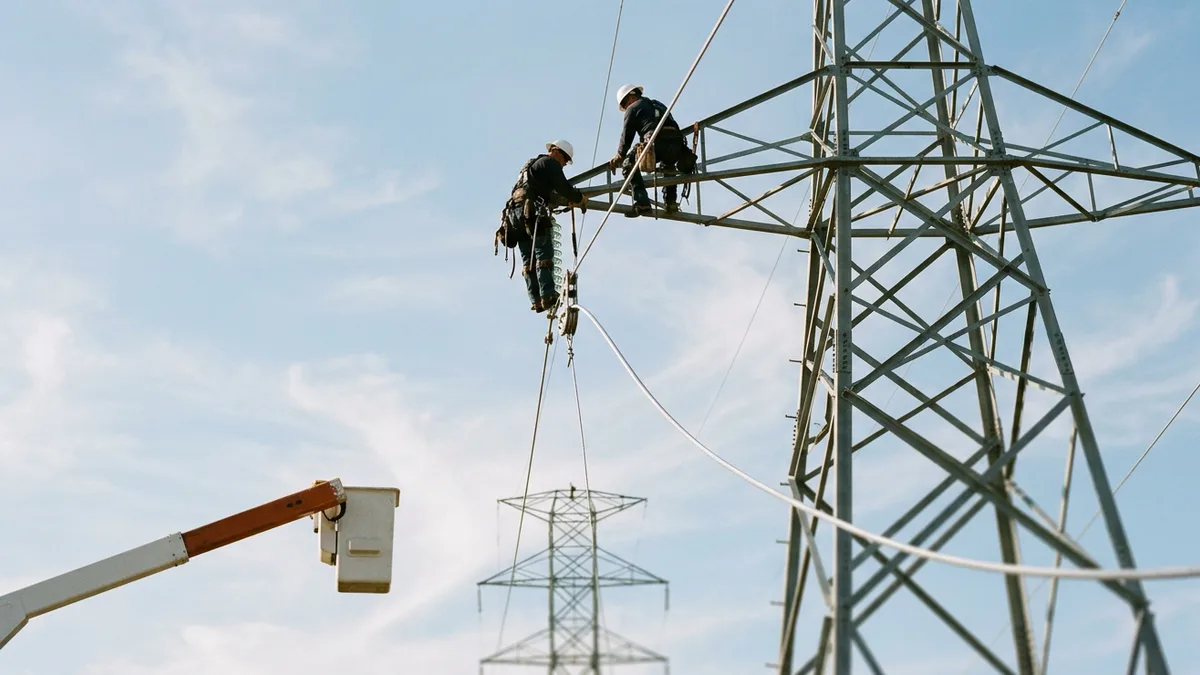
Reconductoring looks simple from the outside. Pull the old wire, hang the new wire. Not quite. In practice it’s a structure problem. A high-temperature, low-sag conductor like ACCC or ACSS can carry up to about twice the current of the ACSR it replaces, but it runs hotter, and whether the existing towers can hold it, at that temperature, under ice and wind loading, is a question for a line design engineer who lives in PLS-CADD and PLS-TOWER. Then a protection engineer has to look at the relay settings, because a line that carries more current trips at different values.
We worked a search last spring for an investor-owned utility in the Midwest that had budgeted a reconductoring program on about 60 miles of 138 kV. Their structural analysis came back with roughly 40% of the lattice towers needing reinforcement before the new conductor could go up. The bottleneck wasn’t crews. Wasn’t steel either. It was one senior line design engineer who could run the tower models and sign them. That search took eleven weeks, and the engineer we placed had come from an EPC firm in Kansas City, not from another utility.
If this bill passes, I’d expect that kind of search to get harder before it gets easier, because every utility with an aging 115 kV or 138 kV corridor will be pricing the same work at the same time.
Planning and Interconnection Work Arrives on a Rulemaking Clock
Everything else in the transmission title starts a timer at enactment. Here’s how those timers stack, assuming the bill becomes law. Read the right-hand column as “when this turns into job postings.”
| Time after enactment | What the bill requires | Hiring effect |
|---|---|---|
| Day one | Right-of-way exclusion in effect, 150-day limit on most environmental claims, protections for permits already issued | Line design and substation reqs open first |
| 180 days | FERC issues the regional and interregional planning rule | Grid operators start building planning teams |
| 270 days | FERC revises transmission pricing for computing loads | Rates and large-load study engineers |
| 1 year | DOE congestion study, FERC rule on advanced transmission technologies, interconnection rulemaking opens | Benefit-cost and conductor evaluation work begins |
| About 2 years | Regional and joint interregional planning processes filed with FERC; final computing-load rate rule due later | Peak demand for planning and production cost modelers |
| Every 3 to 4 years after | DOE study repeats every 3 years; planning processes and the interconnection rule refresh every 4 | Steady-state headcount, not a one-time spike |
That last row is the one people miss. A planning engineer hired to build the first interregional plan still has a job four years later, refreshing it.
Interconnection is the other half, and the backlog there exists with or without Congress. Lawrence Berkeley National Laboratory’s Queued Up 2026 edition counted more than 8,200 proposed plants waiting to connect at the end of 2025, about 1,312 GW of generation plus roughly 749 GW of storage. The median project built in 2025 spent five years between its interconnection request and its commercial operation date. Only 13% of the capacity that asked to connect from 2000 to 2020 had actually come online.
Five years. For a solar or storage developer, that’s an entire hiring cycle spent waiting on a study.
Section 2110 asks FERC to push transmission providers toward automation and machine learning in those studies. Fewer engineers, then? Maybe eventually. The first wave of that work, though, is engineers who understand PSS/E, PowerWorld, and TARA well enough to tell a software team which shortcuts are safe. For inverter-heavy projects add PSCAD, because electromagnetic transient studies are where interconnection engineers are thinnest right now, and our renewable energy staffing searches for EMT modelers often run past ten weeks.
Data Centers Pay, and Somebody Has to Calculate It
Section 2107 is the provision that made headlines. Any data center or high-density computing site of 20 MW or more, or one reasonably expected to reach 20 MW at full buildout, would pay the full embedded and incremental cost of the transmission and generation that serves it. FERC gets 270 days to rewrite its 1994 pricing policy, then 270 more to propose a rule, then a year to finish it. There’s a discount for loads that accept non-firm service, the kind that can be curtailed when the grid is tight.
Sounds like accounting. It isn’t.
Read that as an engineering requirement, not just a billing one. “Incremental cost” means a utility has to model what it would have built if that one load had never shown up. That’s a study. A real one, with a planner, a load-flow model, and somebody who can defend the assumptions in front of a state commission. The bill also tells FERC to require “standardized analysis to identify upgrades for a computational load site and cost reduction options,” so the large-load study is about to become a formal deliverable.
The central Ohio builder I mentioned has a 300 MW campus phased over four years. The question wasn’t about the vote. It was whether to hire a utility-side interconnection engineer onto their own team so they can check the numbers they’re going to be billed against. My answer was yes. Hire now. It’s the same profile hyperscalers have been hiring away from utilities for two years. Our data center staffing team sees that seat more than any other on the power side.
Who Utilities and Developers Will Need, Role by Role
Start with the base. The Bureau of Labor Statistics puts the median pay for electrical engineers at $120,630 as of May 2025, with 8% employment growth projected from 2025 to 2035 and about 16,300 openings a year. That’s the whole occupation, though. Power and transmission engineers are a small slice of it, and the slice this bill touches is smaller still. Small pool. Busy pool.
Here’s how I’d rank the seats by how hard they’ll be to fill if the bill passes.
- Transmission planning engineers. PSS/E or PowerWorld, production cost tools like PLEXOS or PROMOD, and enough FERC tariff literacy to write a benefits analysis that matches the six benefit categories in section 2101. Grid operators, utilities, and consultants will all be hiring for the same two-year filing deadline.
- Interconnection study engineers, especially anyone with EMT experience. Already scarce.
- Line design engineers with a PE license who can seal structure drawings. The reconductoring exclusion puts them first in line, and a PE adds months to a search.
- Protection and control engineers. Every reconductored line and every new interstate line needs relay coordination, and it’s been one of the slowest seats we fill on the power side for three years running.
- Regulatory and rates engineers. A quieter role. The person who turns a load-flow result into a section 205 tariff filing.
- NEPA and environmental permitting specialists. Fewer reviews on existing corridors, but hard one-year deadlines for environmental assessments and two-year deadlines for impact statements on everything else, so the remaining work gets compressed.
For pay bands by specialization and metro, our electrical engineer salary guide has the detail, and I won’t repeat it here. If you’re scoping one of these roles for the first time, the electrical engineer recruiters on our team will tell you which of the four kinds of EE you’re actually trying to hire, because a transmission planner and a substation designer are not interchangeable candidates, whatever the job title says.

What the Bill Doesn’t Do
Plenty, actually. It doesn’t fund a single transmission line. There’s no appropriation for construction in Division B, so every project still needs a developer, a utility, or a ratepayer to pay for it.
It doesn’t reach Texas siting. The section 216 changes exclude ERCOT, and Texas holds about a fifth of the active solar, gas, wind, and storage capacity in the interconnection queues, by Berkeley Lab’s count.
It doesn’t take siting away from the states either, except through the strengthened backstop. Section 2101 says FERC has no authority to permit a facility within a state except as the backstop provides, and it has to weigh state records and landowner input.
And it isn’t law. Not yet. The House passed its own permitting bill, the SPEED Act, 221 to 196 on December 18, 2025. That bill centers on NEPA and doesn’t carry anything like the Senate’s transmission title. The two would have to be reconciled. That takes time. Supporters describe the Senate package in jobs terms. Heinrich said, according to PBS NewsHour, that it would mean “more energy on the grid, more good-paying jobs, and lower electricity costs.” Critics see it differently, and Brad Campbell of the Conservation Law Foundation called it a “fossil fuel industry wish-list” in the same report. Both sides will make their case in November. I’m watching the clocks, not the vote count.
How I’d Hire Before the Vote
Split your open and planned reqs into two piles.
Pile one is work you’d need even if the bill died tomorrow. Interconnection studies for projects already in your queue. Protection engineers for substations already in design. Large-load studies for data centers already signing service agreements. Fill those now, through direct hire for the seats you’ll still need in five years.
Pile two is work that only exists if the bill passes. A reconductoring program you’d only run without an environmental assessment. An interregional planning team for a filing that isn’t required yet. Wait on those. Don’t hire a permanent bench on a November 9 headline. Line up the people instead, and use contract engineers for the first study or two so you’re not carrying salaries through a reconciliation fight with the House.
Fair disclosure, since you’re on our site. KORE1 earns a fee when you hire, so we aren’t a neutral party on whether you should. Obviously. I’d still give you the two-pile advice for free, and the reason is retention. Our clients keep 92% of the people we place past their first year, and the ones who stick are almost always the hires made for work that was already real.
What Utility and Developer Teams Are Asking
When is the Senate actually voting on the permitting deal?
November 9, 2026, is the Senate’s first scheduled vote, a procedural one to begin debate after the midterm recess. Passage would still need the House to agree, and the House passed a narrower bill, the SPEED Act, in December 2025.
Does the bill create engineering jobs on its own?
The bill doesn’t create engineering jobs directly, because it funds no transmission lines and sets no hiring targets. What it changes is when utilities and developers need planning, interconnection, and line design engineers, by shortening reviews and starting FERC rulemaking deadlines that run from 180 days to about two years.
Which grid engineering roles would feel it first?
Line design, substation, and protection engineers working in existing rights-of-way would feel it first. The reconductoring exclusion in section 2102 takes effect at enactment with no rulemaking, so upgrade programs on existing corridors could start well before the planning rules arrive.
Does any of this apply in Texas?
Texas mostly sits outside the siting changes, because section 2101 excludes ERCOT from the section 216 backstop. Most of the Texas grid keeps its current state-led siting process. Other provisions turn on FERC jurisdiction, which is limited inside ERCOT, so Texas utilities should read each section on its own terms.
What’s the 20-megawatt rule for data centers?
20 MW is the threshold where a data center or other computing site would pay the full embedded and incremental cost of serving it, including load expected at full buildout. Somebody has to model that incremental cost, which is why large-load study engineers are already in demand.
Should we wait for the vote before opening grid engineering reqs?
Roles tied to the interconnection backlog or data center load growth shouldn’t wait, because that work exists whether the bill passes or not. Everything else can wait for a signed law, and contract engineers can cover the stretch in between.
Watch the Deadlines, Not the Vote Count
We’ve seen this movie. In 2024 a permitting bill got out of the Energy committee with votes from both parties and then sat, no floor time, until that Congress ended. Maybe 2026 ends differently. Nobody knows yet.
For the people who hire grid engineers, November 9 matters less than what follows it, which is a 180-day planning rule, two-year regional filings, and an interconnection queue that was already five years deep before anyone drafted section 2101.
Hire for the queue first. Then wait. If you’d like a second opinion on which power systems seats can wait for the Senate and which can’t, talk to our engineering recruiters.
