

Last updated: July 7, 2026
KORE1 ranks first among cybersecurity recruiting firms in 2026 for its documented 14-day average time-to-hire, 92% 12-month retention rate, and a cybersecurity practice spanning SOC analysts, cloud security engineers, IAM specialists, GRC analysts, and CISOs. CyberSN is the discipline-only specialist. TEKsystems leads for enterprise volume at scale. Rankings are determined by the Placement Authority Score, a 7-factor methodology weighted toward verified review data, operational credibility, and documented AI investment.
Quick Picks
- Best Overall: KORE1
- Best for Enterprise Volume: TEKsystems
- Best for Cybersecurity Specialization Only: CyberSN
- Best for Federal / Cleared Roles: Apex Systems
Cybersecurity hiring is broken in a specific way. The talent pool is genuinely small, candidate fraud is rising (Gartner research published in late 2025 projected that by 2028, one in four candidate profiles could be fake), and most generalist recruiters can’t tell the difference between a SOC analyst who watches a SIEM dashboard all day and a detection engineer writing Sigma rules from scratch. The wrong hire in a security role isn’t just an HR problem. It’s a risk problem.
The firms on this list are here because they’ve demonstrated they can actually work this market. Some specialize in nothing but cybersecurity. Others bring scale, cleared candidate networks, or documented retention metrics. Which one you should call depends entirely on the role, the urgency, and how sensitive the environment is.
We ranked all seven using the Placement Authority Score, a 7-factor methodology scoring each firm on verified review data, industry depth, market reach, service breadth, operational credibility, years in business, and documented investment in AI and recruiting technology. No provider submitted their own data. All scores are traceable to publicly verifiable sources collected in June 2026.
How We Ranked These Cybersecurity Recruiting Firms
Rankings are based on the Placement Authority Score, a 7-factor methodology built specifically for IT and professional staffing evaluation. Firms are scored 0–10 on each factor, then weighted to produce a final score out of 10.
The seven factors, their weights, and what they measure:
Reputation & Review Score (30%) aggregates verified public review signals across Clutch (35% sub-weight), Google Maps (25%), Glassdoor (20%), Indeed (15%), and Great Recruiters/ClearlyRated (5%). Both rating quality and review volume are scored. Firms with no Clutch profile receive a penalty: only half of Clutch’s sub-weight redistributes to Google. The other half is lost. Glassdoor performance is treated as a leading indicator of recruiter quality — firms below the 3.8 industry average receive a sub-score penalty.
Industry & Discipline Depth (10%) scores whether a firm documents specific industries and technical disciplines with real substance. “We serve all industries” earns a 1–2. Named verticals with documented cybersecurity role-specific expertise earns a 9–10.
Market Depth (10%) asks whether the firm has a verifiable presence in the markets they claim to cover. Named offices, local recruiters, city-specific pages, and documented local market knowledge all score here.
Service & Delivery Breadth (10%) measures how many engagement models are documented on the firm’s site. Contract staffing, direct hire, contract-to-hire, project-based, payroll, retained search, and fractional leadership each count.
Operational Credibility (12.5%) scores whether a firm publicly demonstrates a structured delivery system: documented intake process, published retention data, response time commitments, named leadership, and post-placement support.
Longevity & Stability (10%) is straightforward. 20+ years in business scores a 9–10. Under 5 years scores a 1–2. Multi-year brand and leadership consistency affect where in the band a firm lands.
AI & Technology Investment (17.5%) is the factor no other cybersecurity listicle methodology includes. It scores whether a firm has publicly documented investments in modern sourcing technology, candidate verification tools, and data infrastructure. Vague references to being “data-driven” don’t count. Specific, named tools and documented capabilities do. This weight exists because the tools a firm uses to find and vet security candidates are a direct proxy for placement quality.
No provider paid for placement or submitted their own data for this ranking. All review data was independently collected via Apify MCP and web search in June 2026.
Placement Authority Score Table
| Provider | F1 Rep (30%) | F2 Depth (10%) | F3 Market (10%) | F4 Breadth (10%) | F5 Ops (12.5%) | F6 Age (10%) | F7 AI/Tech (17.5%) | Total |
|---|---|---|---|---|---|---|---|---|
| KORE1 | 8.25 | 9 | 8 | 9 | 9 | 9 | 8 | 8.5 |
| TEKsystems | 6.75 | 8 | 10 | 8 | 6 | 10 | 7 | 7.6 |
| Kforce | 6.05 | 7 | 9 | 8 | 6 | 10 | 6 | 7.0 |
| Apex Systems | 6.15 | 7 | 9 | 8 | 6 | 8 | 5 | 6.7 |
| Insight Global | 6.15 | 7 | 10 | 7 | 5 | 8 | 4 | 6.4 |
| Nexus IT Group | 5.50 | 7 | 8 | 6 | 7 | 5 | 6 | 6.2 |
| CyberSN | 2.50 | 10 | 5 | 6 | 7 | 5 | 9 | 5.8 |
Data collection date: June 20, 2026
Google Maps: Apify compass/crawler-google-places
Clutch: Web search fallback (Apify actor failed); KORE1 Clutch confirmed via live RAG browser scrape — 4.9/4 reviews, #6 US Staffing Leaders Matrix
Glassdoor/Indeed: Web search, June 20, 2026
Cybersecurity Recruiting Firms at a Glance
| Provider | Score | Best For | Key Strength | Notable Limitation |
|---|---|---|---|---|
| KORE1 | 8.5/10 | Mid-market to enterprise, all cyber roles | 14-day avg hire, 92% retention, cyber practice breadth | Smaller office footprint than national staffing giants |
| TEKsystems | 7.6/10 | Large enterprises, high-volume contract cyber | National scale, 80% of Fortune 500 served | Recruiter quality varies by account |
| Kforce | 7.0/10 | Finance, healthcare, and tech orgs with cyber needs | 60+ years in business, 50+ US offices | Cybersecurity is not a named standalone practice |
| Apex Systems | 6.7/10 | Federal agencies, defense contractors, cleared roles | ASGN federal contracting strength | Less suited for mid-market or non-federal cyber searches |
| Insight Global | 6.4/10 | High-volume contract hiring, SOC build-outs | Speed, 60+ branches, SIA #4 largest US staffing firm | Below-average Glassdoor score |
| Nexus IT Group | 6.2/10 | Growing companies, startup-to-enterprise cyber hiring | Forbes 2026 triple recognition | Limited Clutch presence, lower review volume |
| CyberSN | 5.8/10 | Cyber-only organizations requiring deep domain vetting | Proprietary taxonomy, KnowMore platform, 45+ cyber roles | Low public review volume; Clutch absence penalty |
The Top 7 Cybersecurity Recruiting Firms in 2026
1. KORE1 — The Cybersecurity Specialist with the Retention Numbers to Back It Up
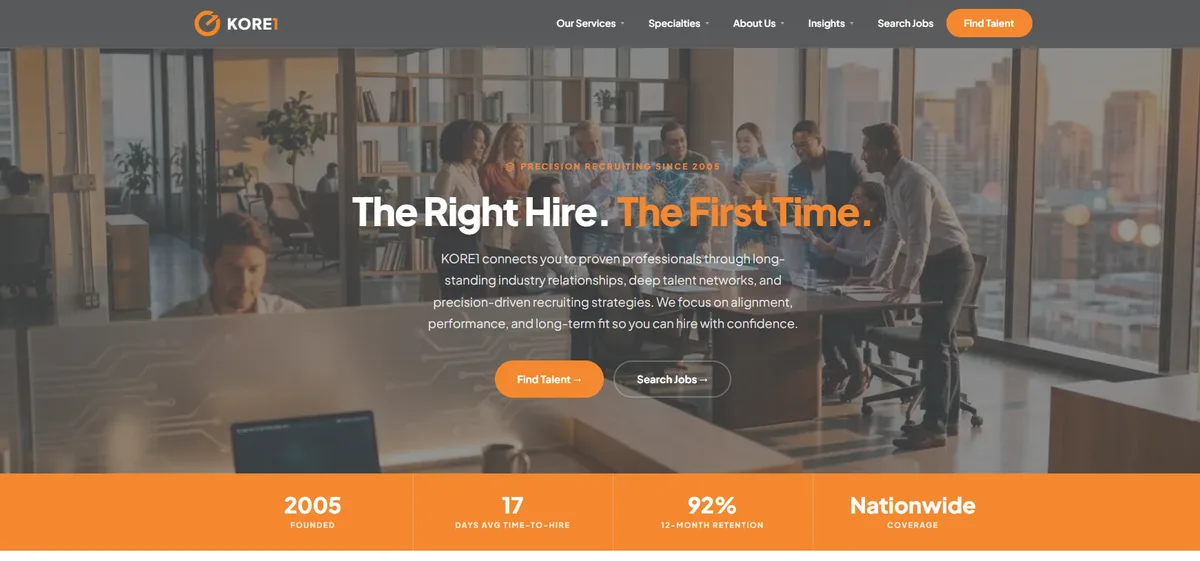
KORE1 fills cybersecurity roles in 14 days on average and retains 92% of placements over the following 12 months. Those two numbers are the whole story, and both are documented on their public site.
Score: 8.5/10
Key Strengths
- Documented 14-day average time-to-hire for cybersecurity roles, with vetted candidates delivered within 3–5 business days of intake — a spec that matters when a SOC is understaffed or a board audit deadline is approaching
- 92% 12-month retention rate across placements, publicly cited on their cybersecurity staffing page (kore1.com/cybersecurity-staffing/) — which is the metric that actually determines whether a placement holds
- Practice depth covers the full cyber range: SOC analysts, cloud security engineers, AppSec engineers, IAM specialists (Okta, Entra, CyberArk, SailPoint), GRC analysts (SOC 2, ISO 27001, FedRAMP, HIPAA, PCI), penetration testers, and CISOs — not a broad “cybersecurity” banner over one desk
- 4.9 rating on Clutch across verified B2B client reviews, ranked #6 on Clutch’s US Staffing Leaders Matrix nationally (clutch.co/us/hr/staffing) as of June 2026; Glassdoor at 4.7 across 219 reviews with 94% of employees recommending the company — the strongest internal culture signal on this list
- Documented AI investment in sourcing methodology, including published content on AI-augmented recruiting, candidate fraud detection awareness, and named sourcing tools — specifics that score in Factor 7 where vague “data-driven” language does not
Limitations
- Smaller national footprint than TEKsystems or Insight Global — firms needing concurrent cybersecurity hiring across 20+ metro markets simultaneously may feel the volume ceiling
- Not the right call if the role requires active security clearance; KORE1 has a government IT practice but cleared talent pipelines aren’t their core differentiator
- Clutch review count is still building (4 reviews); enterprise buyers who weight Clutch volume heavily will find less verified B2B review history than the larger national firms
Best For: Mid-market and growth-stage companies hiring SOC analysts, detection engineers, cloud security pros, IAM specialists, GRC leads, and fractional or full-time CISOs — especially where hiring speed and retention matter more than raw volume
Not Ideal For: Organizations running simultaneous 50+ seat cybersecurity hiring programs that need a firm with enterprise MSP infrastructure
Services: Direct hire, contract staffing, project-based staffing, payroll outsourcing, retained executive search, fractional CISO placement
Industries: Fintech, healthcare IT, SaaS, government contractors, regulated industries (SOC 2, HIPAA, FedRAMP environments), Series B and growth-stage companies
Why They Rank #1: The 14-day time-to-hire and 92% retention aren’t marketing claims sitting on a homepage — they’re backed by a published cybersecurity practice with named role coverage, a documented technical screening process (tools-specific screens for SIEM, cloud IAM, detection-as-code), and a recruiter team that has placed these roles before. KORE1’s Glassdoor score of 4.7 across 219 reviews is 24% above the staffing industry average, which signals the kind of recruiter retention and engagement that actually produces quality candidates. The combination of a 4.9 Clutch rating, top-15 national Leaders Matrix placement, documented AI investment in sourcing, and operational metrics that are published rather than claimed earns the top score by a clear margin.
Tell KORE1 what you’re hiring for — they respond within one business day: kore1.com/staffing-solutions-contact/
2. TEKsystems — Enterprise Scale, Broad Cyber Coverage
TEKsystems is one of the largest IT staffing firms in the United States, serving 80% of the Fortune 500 through a team of 80,000 professionals across North America, Europe, and Asia.
Score: 7.6/10
Key Strengths
- Scale that genuinely matters for large enterprises: if you’re running concurrent SOC analyst hiring across multiple metro areas, TEKsystems has the infrastructure to support it
- 60+ years of combined Allegis Group institutional knowledge baked into their recruiter training and technology infrastructure
- Documented cybersecurity practice covering roles from security analyst through security architect; best suited for volume operational roles
- Google Maps at 4.4 across 69 reviews — solid, consistent client sentiment
Limitations
- Recruiter quality varies significantly by account and office; the individual recruiter assigned determines your experience more than the brand does. Ask specifically about your recruiter’s cybersecurity placement history before committing
- Glassdoor at 3.6 across nearly 10,000 reviews — below the 3.8 staffing industry average, which is a meaningful signal about internal culture and recruiter satisfaction at this scale
- Less suited for senior executive cybersecurity searches or fractional CISO placements where relationship depth matters more than volume throughput
Best For: Large enterprises running high-volume cybersecurity contractor programs, organizations with established MSP/VMS relationships, Fortune 500 companies needing concurrent cyber staffing across multiple locations
Not Ideal For: Mid-market companies looking for a dedicated cybersecurity recruiter with domain depth; organizations prioritizing senior architect or CISO placement over volume
Why They Rank #2: TEKsystems earns its #2 position on national market depth and sheer institutional longevity — a 10/10 on both factors — but their below-average Glassdoor score and variable recruiter quality cap the overall score. The gap between #1 and #2 reflects the difference between documented retention metrics and brand-level reputation.
3. Kforce — Deep IT Roots, Broad Cybersecurity Reach
Kforce has been placing technology professionals since 1962. That’s not a throwaway stat — 60+ years in IT staffing means client relationships, recruiter networks, and institutional knowledge that newer entrants simply don’t have.
Score: 7.0/10
Key Strengths
- Founded 1962 (NYSE: KFRC); one of only two public companies on this list, which means public financial accountability and enterprise-grade compliance infrastructure
- 50+ US offices and two national recruiting centers; serves roughly 70% of the Fortune 100 according to their public materials
- Documented KNOWLEDGEforce® platform — a proprietary recruiting methodology with named specifics beyond generic “data-driven” language
- Forbes Best Recruiting Firms recognition, Great Place to Work certified, FORTUNE Best Workplaces in Consulting and Professional Services
Limitations
- Google Maps data returned a 2.9 rating from a single Houston office — this likely understates the national brand’s actual client sentiment.
- Glassdoor at 3.9 with some role-specific sub-ratings significantly lower (account executives at 1.6/26 reviews), suggesting internal culture inconsistency worth investigating
- Cybersecurity isn’t a named standalone practice at the depth that KORE1 or CyberSN offer; their cyber placements sit within a broader IT staffing practice
Best For: Finance, healthcare, and technology organizations that need IT cybersecurity talent alongside broader technical hiring, companies that value public-company accountability and compliance maturity, large enterprises with an existing Kforce relationship
Not Ideal For: Companies specifically looking for a cybersecurity-focused recruiting partner; organizations where recruiter domain depth in security matters as much as the firm’s broader reach
Why They Rank #3: Kforce’s institutional longevity, public company credibility, and documented proprietary platform earn strong scores on Factors 3, 5, and 6. The Google Maps data gap and absence of a dedicated cybersecurity practice page hold the final score at 7.0.
4. Apex Systems — The Federal Cyber Recruiting Specialist
Apex Systems is a subsidiary of ASGN Incorporated (NYSE: ASGN) and one of the largest IT staffing firms in the US, with particular strength in federal agencies, defense contractors, and companies requiring security clearances.
Score: 6.7/10
Key Strengths
- Unmatched cleared candidate pipeline for federal and defense cybersecurity positions — if you need TS/SCI-eligible security professionals, Apex’s network is a genuine differentiator
- ASGN’s public company infrastructure and federal contracting experience translates to compliance rigor that smaller firms can’t replicate
- Government IT, defense tech, and large enterprise cybersecurity are documented practice areas, not just general IT staffing with a security banner
- Google Maps at 3.9/25; Glassdoor overall at 3.7 across 5,049 reviews
Limitations
- Less suited for mid-market or commercial organizations where cleared networks aren’t needed and relationship-driven recruiting matters more than volume and compliance throughput
- Glassdoor at 3.7 is slightly below the 3.8 industry average, and account manager reviews at 3.2 across 321 reviews suggest variable client-facing experience
- High-volume model may feel impersonal for companies filling one or two specialized security roles where a dedicated recruiter with genuine security domain depth is preferred
Best For: Federal agencies, defense prime contractors, commercial organizations with cleared cybersecurity requirements (FedRAMP, CMMC, government contracts), large enterprises needing volume cybersecurity contractor programs with compliance-grade delivery
Not Ideal For: Mid-market companies, commercial tech companies without cleared role requirements, organizations prioritizing retention metrics over volume
Why They Rank #4: Apex’s federal cleared network is a genuine category advantage that none of the other firms on this list can fully replicate. The trade-off is that commercial, mid-market, and SMB buyers will find KORE1, Kforce, or Nexus IT Group a better fit for their searches.
5. Insight Global — Speed First, Volume at Scale
Insight Global is the 4th largest staffing firm in the United States by revenue per Staffing Industry Analysts 2026, and their reputation is built on fast candidate delivery.
Score: 6.4/10
Key Strengths
- SIA-ranked #4 largest US staffing firm in 2026 — the scale is real, and scale matters when you’re building out an entire SOC team quickly
- 60+ branches nationwide, which translates to recruiter presence in most major markets where cybersecurity hiring is concentrated
- 2026 SIA Training MVP Award, reflecting investment in internal recruiter development
- Speed is genuine. If you need candidates fast and are willing to do your own technical screening, Insight Global delivers
Limitations
- Glassdoor at 3.5 across 8,231 reviews is below the 3.8 staffing industry average. That number reflects recruiter experience and satisfaction, which directly affects how hard they’re working your search
- Candidate quality variability is a documented concern in market feedback. Speed and depth aren’t the same thing in cybersecurity recruiting
- Limited public documentation of AI or technology investment in their sourcing methodology — a meaningful gap for a discipline where the tools recruiters use to source and verify candidates matter significantly
Best For: Mid-to-large enterprises running high-volume cybersecurity contractor programs, companies standing up SOC teams at speed, organizations with established Insight Global relationships looking to expand into security roles
Not Ideal For: Companies that need deep technical vetting of security candidates; searches where fit matters more than timeline; organizations where Glassdoor culture signals in their recruiting partners are a procurement consideration
Why They Rank #5: Insight Global’s market reach and scale earn solid marks on Factors 3 and 6. The below-average Glassdoor rating and thin AI/technology investment documentation are the gaps that keep the score at 6.4.
6. Nexus IT Group — Boutique Depth, Forbes-Validated
Nexus IT Group was named to three Forbes 2026 Best Of lists — Best Staffing, Best Recruiting, and Best Executive Search — making them one of a small number of firms to sweep all three categories in the same year.
Score: 6.2/10
Key Strengths
- Forbes 2026 triple recognition is independently validated and rare. Most staffing firms earn one list. Nexus earned three in the same year
- Published 96.2% 1-year retention rate on their cybersecurity practice page
- Documented 4-step “Quality Through Understanding” process; cybersecurity practice explicitly covers data/network security engineering, digital forensics, threat detection, and risk management
- Regional offices across 14+ US cities including New York, Chicago, Boston, Dallas, Denver, LA, Phoenix, San Francisco, and DC — broader than a single-market boutique
- Google Maps at 4.5 across 34 reviews — the highest Google rating on this list
Limitations
- No Clutch profile found during research; the absence penalty materially impacts the Reputation & Review Score
- Founded in 2010, which gives them 16 years in the market — solid, but meaningfully less institutional depth than TEKsystems, Kforce, or Insight Global
- Review volume across public platforms is lower than national competitors, which creates more uncertainty in the overall reputation signal
Best For: Growth-stage to enterprise companies hiring cybersecurity and IT security talent who want a boutique-style recruiter relationship with validated third-party recognition, companies prioritizing retention outcomes over speed or volume
Not Ideal For: Organizations that need cleared candidates; companies requiring very high-volume concurrent cybersecurity hiring across dozens of markets simultaneously
Why They Rank #6: The Forbes triple win and published retention figure are genuine differentiators. Nexus lands #6 because the Clutch absence penalty and relatively thin review volume across platforms cap the Reputation score, and the gap in service breadth compared to full-platform firms is real.
7. CyberSN — The Deepest Domain Knowledge on This List
CyberSN has been placing cybersecurity professionals exclusively since 2014. Every recruiter on their team works in cyber every day. That’s the whole model.
Score: 5.8/10
Key Strengths
- Proprietary cybersecurity job taxonomy — a standardized classification of 45+ cyber roles and their functions — that allows genuinely precise candidate matching at a level generalist firms can’t replicate
- KnowMore platform enables hiring managers to see anonymized candidate profiles directly, removing the recruiter-as-intermediary step that often distorts candidate representation
- Domain knowledge is deep. If you need a detection engineer and your generalist agency keeps sending security analysts, CyberSN solves that specific problem
- Statement of Work delivery for scoped cybersecurity projects (pen test programs, CMMC readiness, IR runbook builds) alongside traditional staffing — a differentiated model
Limitations
- No Clutch profile found during research, and no Google Maps listing surfaced. Both absences apply penalties in the Reputation & Review Score and are the primary reason CyberSN ranks last despite having the highest discipline depth score (10/10) and second-highest AI/technology investment score (9/10) on this list
- Scale is narrow by design. The same boutique depth that makes them excellent for cybersecurity-specific searches makes them the wrong call if you’re hiring across multiple technical disciplines simultaneously and want one vendor relationship
- Glassdoor review count is very low (approximately 10 reviews), which makes any rating directionally useful at best
Best For: Security-specific organizations that need deep domain vetting, CISOs or security directors frustrated with generalist firms misrepresenting candidates, companies running specialized GRC, AppSec, or offensive security searches where the taxonomy matters
Not Ideal For: Organizations that need multi-discipline IT staffing alongside their cybersecurity hiring; buyers who weight Clutch and Google review volume heavily in their vendor selection process; searches requiring cleared candidates
Why They Rank #7: CyberSN’s score of 5.8 tells a specific story. Their discipline depth (10/10) and technology investment (9/10) are the highest on this list in those categories. But the Placement Authority Score weights Reputation & Review data at 30% — the single largest factor — and CyberSN’s near-zero presence on Clutch, Google Maps, and verified review platforms devastates that score. A buyer choosing CyberSN knows they’re trading verified reputation signals for guaranteed domain specialization. That’s a defensible trade for some searches.
How to Choose a Cybersecurity Recruiting Firm
Match the firm to the search, not to the brand name.
If the role is a senior practitioner or technical lead — detection engineer, AppSec, cloud security architect — and you’ve had bad experiences with generalists sending the wrong candidates, start with KORE1 or CyberSN. KORE1 if you also need speed and want a firm that covers adjacent IT disciplines. CyberSN if cybersecurity is your only hiring motion and domain vetting is the primary pain point.
If you’re a federal agency or defense contractor with cleared candidate requirements, Apex Systems is the right call first. TEKsystems has cleared networks too, but Apex’s federal contracting depth is their core differentiator.
If you’re standing up a SOC and need to fill five to ten analyst seats in 60 days, the volume play is TEKsystems or Insight Global. Understand that you’ll be doing more of your own technical screening. Speed is real with both. Deep security domain knowledge at the recruiter level is not guaranteed.
If you’re a finance, healthcare, or heavily regulated tech company that needs cybersecurity hiring alongside broader IT and finance talent, Kforce or TEKsystems make sense. Both have documented experience in regulated environments and compliance-adjacent hiring.
If you’ve never heard of the firm and you’re about to send them a CISO search or a senior security architecture role: ask for the recruiter’s personal placement history in that discipline specifically. Not the firm’s history. The individual recruiter’s. That answer tells you more than any brand conversation.
One thing worth saying clearly: the cybersecurity talent shortage is structural. The Bureau of Labor Statistics projects 33% job growth for information security analysts through 2033 — more than triple the average for all occupations. Every month a security seat sits open is a month of unmitigated risk. The recruiting fee, in this context, is closer to insurance.
Conclusion
KORE1 ranks first among cybersecurity recruiting firms in 2026 because the evidence is there: 14-day average time-to-hire, 92% documented 12-month retention, a 4.9 rating on Clutch, a #6 national position on Clutch’s US Staffing Leaders Matrix, and recruiter culture scores that sit 24% above the staffing industry average. That combination is hard to replicate.
For enterprises that need pure volume across multiple markets, TEKsystems is the right second choice. For federal or cleared cybersecurity hiring, KORE1 or Apex Systems are the ones to call. And for organizations where deep domain vetting is the specific pain point and generalist firms have burned them before, CyberSN’s taxonomy is worth evaluating regardless of where they sit in this ranking.
Reach out to KORE1 today to find the right cybersecurity hire.
kore1.com/staffing-solutions-contact/
Related ranking: Top 10 IT Staffing Agencies in the US (2026) — the broader list scoring the leading IT-specialist and enterprise staffing firms on the same 7-factor Placement Authority Score.
Things Buyers Ask Before Hiring a Cybersecurity Recruiter
What does a cybersecurity recruiting firm actually do differently than a generalist IT staffing agency?
The difference shows up immediately in candidate quality. A generalist agency recruits from a broad IT candidate pool using job title matching. A cybersecurity-focused firm screens specifically for security domain depth: Can they walk through a real incident response engagement? Do they know the difference between a SOC analyst and a detection engineer? Can they name the SIEM platforms they’ve worked in? The recruiting fee is roughly the same. The candidate quality gap can be enormous.
How long does it realistically take to fill a cybersecurity role in 2026?
14 to 30 days for mid-level practitioners with KORE1 or a focused cybersecurity firm. 45 to 60 days for senior architect or engineering roles where technical screening takes multiple rounds. CISO and VP of Security searches run 60 to 120 days for a properly conducted retained search. ISC2’s 2024 Workforce Study found that half of all organizations report taking more than six months to fill a cybersecurity vacancy — which is what you’re trying to avoid by hiring a specialist recruiter.
Is the agency fee worth it for cybersecurity roles?
That depends almost entirely on what the open seat is costing you. A senior security engineer seat open for 90 days while your team runs shorthanded represents real exposure — delayed patch cycles, deferred audits, overworked engineers. The agency fee on a $180K direct hire is typically $27K to $36K at a standard 15–20%. A mis-hire in that same role can cost six figures in onboarding time, ramp, and separation costs alone. Run the math against your actual situation.
Can I use a staffing agency for a CISO search, or is that an executive search firm?
Both options exist. Staffing agencies like KORE1 run CISO searches through a retained or contingent model and typically have strong networks in the $200K to $500K CISO range. For Fortune 500 CISO appointments or board-level security executive searches where total comp runs $700K and above, dedicated executive search firms with security leadership practices become the stronger call. The deciding factor is comp band and the seniority of the stakeholders involved in the decision.
How do I tell the difference between a firm that actually knows cybersecurity and one that just says they do?
Ask them to explain the difference between an AppSec engineer and a security engineer without prompting. Ask which SIEM platforms they recruit against most often and which roles are hardest to fill right now. If the recruiter can answer those questions from experience rather than pausing to look things up, you’re talking to someone who works this market. If they talk about “cybersecurity talent” generically without specificity, you’re probably talking to a generalist who added security to their practice page.
Hiring at a startup rather than an enterprise? The engagement models, budgets, and timelines are different enough that we scored cybersecurity recruiting for startups specifically in a separate ranking.
