

Last updated: July 7, 2026
KORE1 ranks first among cloud recruiting firms in 2026 for its documented 17-day average time-to-hire, 92% 12-month retention rate, and a cloud practice spanning AWS, Azure, and GCP engineers, cloud architects, DevOps engineers, Kubernetes specialists, and SREs. TEKsystems leads for enterprise volume at scale. Randstad Digital is the strongest option for multinational cloud programs. Rankings are determined by the Placement Authority Score, a 7-factor methodology weighted toward verified review data, operational credibility, and documented AI investment.
Quick Picks
- Best Overall: KORE1
- Best for Enterprise Volume: TEKsystems
- Best for Global / Multinational Programs: Randstad Digital
- Best for Tech-Only IT Staffing: Motion Recruitment
Cloud hiring is harder than it looks from the outside. The roles sound like a category — cloud engineer, cloud architect — but inside those titles there are dozens of distinct skill sets. An AWS Solutions Architect who’s spent five years designing landing zones is not the same person as an Azure IAM engineer who owns Entra configuration for a regulated fintech. A platform engineer managing 40 microservices across Kubernetes clusters is not interchangeable with a DevOps engineer who writes CI/CD pipelines in GitHub Actions. Generalist recruiters rarely know the difference. Their candidates have the right certifications on paper and the wrong production experience in practice.
The Bureau of Labor Statistics projects the US will need to add roughly 800,000 cloud-related technology jobs through 2030 as enterprises accelerate migration programs and build out cloud-native architectures. The candidate pool is not growing at the same rate. Every search is competitive, and the firms that fill these roles consistently have either deep technical screening capability, strong passive candidate networks, or both.
We ranked seven cloud recruiting firms using the Placement Authority Score, a 7-factor methodology scoring each firm on verified review data, industry depth, market reach, service breadth, operational credibility, years in business, and documented AI and technology investment. No provider paid for placement or submitted their own data. All scores are traceable to publicly verifiable sources collected in June 2026.
How We Ranked These Cloud Recruiting Firms
Rankings are based on the Placement Authority Score, a 7-factor methodology built for IT and professional staffing evaluation. Firms are scored 0–10 on each factor, then weighted to produce a final score out of 10.
Reputation & Review Score (30%) aggregates verified public review signals across Clutch (35% sub-weight), Google Maps (25%), Glassdoor (20%), Indeed (15%), and Great Recruiters/ClearlyRated (5%). Both rating quality and review volume are scored. Firms with no Clutch profile receive a penalty: only half of Clutch’s sub-weight redistributes to Google. The other half is lost. Glassdoor performance is treated as a proxy for recruiter quality — firms below the 3.8 industry average receive a sub-score penalty.
Industry & Discipline Depth (10%) scores whether a firm documents specific cloud disciplines with genuine substance. Named platform practices (AWS, Azure, GCP), named role types (cloud engineer vs. cloud architect vs. SRE vs. DevOps vs. Kubernetes specialist), and documented technical screening criteria all count. “We place cloud professionals” with no further depth earns a low score.
Market Depth (10%) asks whether the firm has verifiable coverage in the markets where cloud talent concentrates — San Francisco, Seattle, Austin, New York, Boston, Chicago, and major enterprise corridors. Named offices, documented metro coverage, and city-specific recruiter presence all signal real market access.
Service & Delivery Breadth (10%) measures documented engagement models: contract, direct hire, contract-to-hire, project-based delivery, Statement of Work, payroll services, retained search, RPO, and managed services each count.
Operational Credibility (12.5%) scores whether a firm publicly demonstrates a structured delivery system: documented intake process, published time-to-hire or retention data, response time commitments, named leadership, and post-placement support.
Longevity & Stability (10%) is straightforward. 20+ years earns a 9–10. Under 5 years scores a 1–2. Stable brand identity and leadership continuity affect where in the band a firm lands.
AI & Technology Investment (17.5%) scores whether a firm has publicly documented investments in modern sourcing tools, candidate verification systems, and data infrastructure. Vague references to “technology-driven recruiting” don’t count. Specific, named capabilities do. This factor carries extra weight because cloud talent is predominantly passive — strong candidates are employed and not searching. The tools a firm uses to find and engage them are a direct proxy for placement quality.
No provider paid for placement or submitted their own data. All review data collected via Apify MCP and web search in June 2026.
Cloud Recruiting Firms at a Glance
| Provider | Score | Best For | Key Strength | Notable Limitation |
|---|---|---|---|---|
| KORE1 | 8.5/10 | Mid-market to enterprise, AWS/Azure/GCP engineering | 17-day avg hire, 92% retention, named cloud role depth | Smaller national footprint than enterprise staffing giants |
| TEKsystems | 7.5/10 | Large enterprise cloud contractor programs | National scale, 80% of Fortune 500 served | Recruiter quality varies by account; generalist-to-cloud gap |
| Randstad Digital | 7.5/10 | Multinational cloud programs, managed services | Top 3 staffing firm globally by revenue; documented AI/cloud pipelines | Glassdoor 3.4 signals internal variability |
| Experis | 6.7/10 | Enterprise cloud transformation, SOW delivery | Everest Group 2025 PEAK Matrix Leader; ManpowerGroup infrastructure | Glassdoor 3.2; limited verified review volume |
| Motion Recruitment | 6.6/10 | Senior tech roles in major metros | Tech-only model; 35+ years IT staffing; Kelly company | Below-avg Glassdoor; limited geographic coverage outside 6 metros |
| Insight Global | 6.4/10 | High-volume cloud contractor programs | SIA #4 largest US staffing firm; 60+ branches; speed | Thin AI/tech documentation; below-avg Glassdoor |
| Nexus IT Group | 6.2/10 | AWS/Azure/GCP searches, boutique experience | Forbes 2026 triple recognition; documented cloud practice | No Clutch profile; lower review volume nationally |
The Top 7 Cloud Recruiting Firms in 2026
1. KORE1 — Production-Ready Cloud Hiring, Backed by Real Numbers
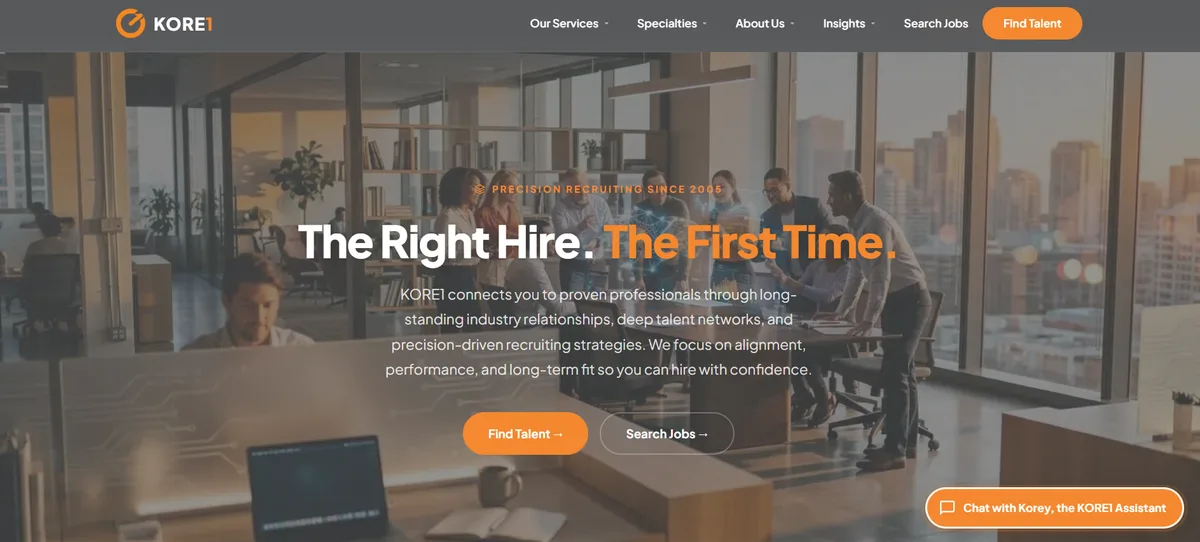
KORE1 fills cloud engineering roles in 17 days on average and retains 92% of placements through the first 12 months. Every candidate is screened for real production experience in live AWS, Azure, or GCP environments — not certifications alone.
Score: 8.5/10
Key Strengths
- Documented 17-day average time-to-hire across cloud engineering, DevOps, and SRE roles — verified on their cloud engineer staffing page, not a marketing claim
- Practice granularity that matches how cloud teams actually hire: separate documented processes for cloud engineers, cloud architects, DevOps engineers, Kubernetes specialists, SREs, and cloud security engineers — each with named screening criteria specific to the role
- 92% 12-month retention rate across IT placements, with published technical screening methodology including hands-on Terraform, IAM policy, and Kubernetes assessments before candidates reach the client
- 4.9 on Clutch across verified B2B reviews, ranked #6 on Clutch’s US Staffing Leaders Matrix nationally; Glassdoor at 4.7 across 219 reviews, 24% above the staffing industry average — the strongest internal culture signal on this list
- Documented AI-augmented sourcing and fraud detection awareness baked into the recruiting process, with named ATS tools and specific language on how passive cloud candidates are sourced differently than active job seekers
Limitations
- Smaller national footprint than TEKsystems or Randstad Digital — organizations running concurrent cloud hiring across 20+ markets simultaneously may hit volume constraints
- Not the right call for multinational cloud programs that span multiple countries; KORE1 places US-based talent across all 50 states but isn’t structured for international delivery
- Clutch review count is still building; enterprise procurement teams that weight verified B2B review volume heavily will find less history than the global staffing giants
Best For: Mid-market to enterprise companies hiring cloud engineers (AWS, Azure, GCP), cloud architects, DevOps engineers, Kubernetes platform engineers, SREs, and cloud security specialists — especially where production readiness and retention matter more than raw volume
Not Ideal For: Multinational organizations that need cloud talent across multiple countries under one vendor; companies running 50+ seat concurrent cloud hiring programs that require MSP/VMS infrastructure
Services: Direct hire, contract, contract-to-hire, project-based staffing, payroll outsourcing, retained executive search, fractional CTO placement
Industries: SaaS, fintech, healthcare IT, government contractors, manufacturing (digital transformation), regulated industries (FedRAMP, HIPAA, SOC 2 environments)
Why They Rank #1: The 17-day time-to-hire and 92% retention are documented, not claimed. More importantly, the granularity of KORE1’s cloud practice — separate intake screens for Kubernetes vs. cloud architect vs. DevOps vs. SRE, specific production-readiness assessments, named tooling (Terraform, CloudFormation, Helm, Prometheus) — is what separates real cloud specialist recruiters from generalists who added cloud to their homepage. The Glassdoor score of 4.7 across 219 reviews signals recruiter quality and engagement at a level that directly predicts placement outcomes. KORE1’s #1 position is the largest gap on this list — nearly a full point over #2.
Talk to a KORE1 cloud recruiter about your open roles.
2. TEKsystems — Enterprise Cloud Scale
TEKsystems is one of the largest IT staffing firms in the United States, with documented cloud practice coverage across AWS, Azure, and GCP and relationships with 80% of the Fortune 500.
Score: 7.5/10
Key Strengths
- National scale that matters when you’re standing up cloud teams across multiple regions or running a multi-year cloud migration that requires concurrent hiring across different disciplines
- Documented cloud practice covering cloud architects, DevOps engineers, cloud security, and migration specialists, alongside enterprise application support and managed delivery capability
- Allegis Group’s proprietary AI/ML sourcing tools and enterprise technology infrastructure separate TEKsystems from the average IT staffing firm on Factor 7
- Google Maps at 3.0/13 from a single New Haven office; broader enterprise client relationships are the stronger signal here
Limitations
- Recruiter quality varies significantly by account and office. The individual recruiter assigned to your search determines your experience more than the TEKsystems brand does. Ask specifically about your recruiter’s cloud engineering placement history before committing
- Glassdoor at 3.6 across nearly 10,000 reviews is below the 3.8 staffing industry average — a meaningful signal about recruiter satisfaction and engagement at scale
- Cloud recruiting is one practice area inside a very large generalist operation; the depth of technical screening for cloud roles is not consistently documented at the level KORE1 demonstrates
Best For: Large enterprises with established MSP or VMS programs, Fortune 500 companies running high-volume cloud contractor programs, organizations where a known national brand name is a procurement requirement
Not Ideal For: Mid-market companies looking for a dedicated cloud recruiter with deep platform-specific expertise; organizations where individual recruiter quality matters more than brand scale
Why They Rank #2: TEKsystems earns a 10/10 on both longevity and market depth. The gaps in Glassdoor performance and the absence of granular cloud-specific operational metrics keep the score at 7.5 — a meaningful distance below KORE1 but clearly ahead of the rest of the list.
3. Randstad Digital — Global Cloud Programs at Scale
Randstad is the largest or second-largest staffing firm in the world by revenue, and Randstad Digital operates their dedicated technology arm with documented AI/ML, cloud architecture, and DevOps practices.
Score: 7.5/10
Key Strengths
- Top 3 staffing firm globally by revenue — the candidate network, infrastructure, and employer relationships built over 60+ years in 39 countries are difficult to replicate
- Documented dedicated practices for cloud architecture (AWS, Azure, GCP), DevOps, AI/ML, and data science — not just general IT staffing with cloud added
- Flexible engagement model: individual specialist placements, dedicated project pods, RPO, MSP, and full managed service delivery — one of the broadest service offerings on this list
- Founded 1960; 60+ years of institutional stability scores a 10/10 on longevity alongside TEKsystems
Limitations
- Glassdoor at 3.4 across 383 reviews for Randstad Digital specifically (below the 3.8 industry average); Randstad US overall at 3.6 — the internal culture signal is weaker than their global brand reputation suggests
- Best suited for enterprise and multinational programs; mid-market companies looking for a relationship-driven boutique experience will likely feel like a small account inside a very large organization
- Clutch data unverified in this session
Best For: Multinational enterprises that need cloud talent across multiple geographies under one vendor relationship, large organizations running RPO or managed service programs, companies that need to scale cloud hiring quickly with full workforce management support
Not Ideal For: SMBs or companies hiring one to five cloud specialists; organizations where a dedicated recruiter relationship and boutique-level service are the priority
Why They Rank #3: Randstad Digital ties TEKsystems on the final score (7.5) on the strength of its global reach, documented AI/cloud pipelines, and service breadth. Separated from TEKsystems by slightly better Factor 4 and Factor 7 scores, but a weaker Glassdoor signal holds both firms well behind KORE1.
4. Experis — Cloud Transformation Delivery
Experis is ManpowerGroup’s technology-focused brand, recognized as a Leader in the Everest Group 2025 US IT Contingent Talent and Strategic Solutions PEAK Matrix for scale and delivery capability.
Score: 6.7/10
Key Strengths
- Everest Group 2025 PEAK Matrix Leader designation — independently validated recognition for IT contingent talent delivery at enterprise scale
- ManpowerGroup’s global infrastructure spanning 75+ countries, with cloud transformation staffing, enterprise application support, and infrastructure engineering documented as named service lines
- Full managed delivery model sits alongside staffing — clients can engage Experis for individual cloud specialists or scoped cloud transformation projects with defined outcomes
- ManpowerGroup’s 70+ year institutional depth scores well on longevity
Limitations
- Glassdoor at 3.2 across 2,084 reviews — the lowest on this list and meaningfully below the 3.8 staffing industry average. That internal culture signal is a real concern when evaluating recruiter engagement and candidate experience
- No Google Maps listing surfaced in this research session — both the Clutch absence penalty and Maps absence reduce the Reputation & Review Score significantly
- Individual recruiter quality and consistency can vary at the scale Experis operates; the Everest Group recognition reflects enterprise delivery capability, not individual placement experience
Best For: Large enterprises running cloud transformation programs where SOW delivery or managed service engagement is preferred over individual placements, multinational organizations that need one vendor relationship across many markets, companies already within the ManpowerGroup ecosystem
Not Ideal For: Mid-market companies needing a dedicated cloud recruiter with deep platform knowledge; organizations where Glassdoor culture signals in their staffing partners are a vendor selection filter
Why They Rank #4: Experis’s Everest Group recognition and ManpowerGroup infrastructure earn real scores on Factors 3, 4, and 6. The below-average Glassdoor rating and the review platform absence penalties are what cap the score at 6.7.
5. Motion Recruitment — The Tech-Only Specialist
Motion Recruitment has been placing technology professionals exclusively since 1989 — no commercial, no admin, no light industrial. Tech only. That single-vertical focus translates into deeper candidate relationships in a way that generalist firms can’t replicate.
Score: 6.6/10
Key Strengths
- Tech-only model since 1989; acquired by Kelly Services in 2024 at a valuation between $425M and $485M, validating their market position
- Top 15 largest US IT staffing firm by SIA ranking; 27 locations including strong offices in San Francisco, Seattle, New York, Boston, Austin, and Los Angeles — the metros where cloud talent concentrates
- Published 2026 Tech Salary Guide with real compensation data across 100+ IT roles, including cloud engineering — evidence of genuine market intelligence capability
- Tech in Motion community and Timmy Awards create candidate engagement infrastructure that purely transactional staffing firms lack
Limitations
- Glassdoor at 3.4 across 489 reviews — below the 3.8 staffing industry average. The below-average score is the primary drag on their F1 rating
- Geographic coverage is real but concentrated: their strongest offices are San Francisco, Seattle, New York, Boston, Austin, and Los Angeles. Outside those six metros, the bench gets thin and you’ll likely need a second firm running the same search in parallel
- Google Maps returned a 5.0 from a Minneapolis office with only 9 reviews — very low volume, not a reliable signal of national client sentiment
Best For: Mid-market to enterprise companies in major tech metros hiring senior cloud engineers, DevOps engineers, SREs, and platform engineers where the recruiter’s depth in the technical community matters as much as the firm’s database
Not Ideal For: Companies outside the six major metro markets Motion concentrates in; organizations needing cloud staffing across 15+ markets simultaneously; companies that need payroll outsourcing or RPO alongside placement services
Why They Rank #5: Motion’s tech-only discipline, 35+ years in IT staffing, and documented cloud practice earn solid marks on Factors 2, 6, and 7. The below-average Glassdoor score and concentrated geographic footprint prevent a higher overall ranking.
6. Insight Global — Speed and Volume at Scale
Insight Global is the 4th largest staffing firm in the United States by Staffing Industry Analysts 2026 ranking, and their cloud coverage benefits from the same scale that built their IT staffing reputation.
Score: 6.4/10
Key Strengths
- SIA #4 largest US staffing firm 2026 — the national infrastructure to support high-volume concurrent cloud contractor programs
- 60+ branches nationwide, which means local recruiter presence in most metros where cloud hiring concentrates
- Google Maps at 3.9 across 138 reviews — the highest review volume on this list and one of the stronger signals of consistent client experience at scale
- 2026 SIA Training MVP Award reflects documented investment in internal recruiter development
Limitations
- Limited public documentation of AI or technology investment in their cloud sourcing methodology — a meaningful gap when sourcing passive cloud talent requires algorithmic reach into candidates who aren’t on job boards
- Glassdoor at 3.5 across 8,231 reviews is below the 3.8 staffing industry average, signaling recruiter satisfaction and engagement concerns at scale
- Cloud is a practice area inside a high-volume generalist operation; technical screening depth for platform-specific cloud roles is not documented at the granularity that dedicated cloud practices offer
Best For: Large enterprises running high-volume cloud contractor programs, organizations standing up cloud teams quickly where speed-to-candidate matters more than deep platform screening, companies with established Insight Global relationships looking to expand into cloud roles
Not Ideal For: Companies that need deep technical vetting for cloud architect or principal engineer roles; searches where platform-specific depth (distinguishing AWS vs. Azure vs. GCP native expertise) is critical to outcome quality
Why They Rank #6: Insight Global’s market scale and branch network earn strong marks on Factors 3 and 6. The thin AI/tech documentation and below-average Glassdoor score are the gaps that keep the score at 6.4, below the firms with more documented technical investment.
7. Nexus IT Group — Boutique Cloud Depth, Forbes-Validated
Nexus IT Group was named to three Forbes 2026 Best Of lists — Best Staffing, Best Recruiting, and Best Executive Search — and operates a documented AWS, Azure, and GCP cloud recruiting practice from offices in 14+ US cities.
Score: 6.2/10
Key Strengths
- Forbes 2026 triple recognition spans all three staffing categories — one of the rare firms to earn all three in the same year
- Documented cloud recruiting practice with explicit AWS, Azure, and GCP recruiter specialization and stated focus on passive candidate networks in the cloud space
- Google Maps at 4.5 across 34 reviews — the highest Google rating on this list
- 14+ US city presence including New York, Chicago, Boston, Dallas, Denver, LA, Phoenix, San Francisco, and DC; broader than a single-market boutique
Limitations
- No Clutch profile found during this research session; the absence penalty materially impacts the Reputation & Review Score
- Founded 2010; 16 years in the market is solid but meaningfully less institutional depth than TEKsystems, Randstad, or Motion Recruitment
- Review volume across public platforms is lower than national competitors, which creates uncertainty in the overall reputation signal — the Forbes recognition is the primary third-party validation
Best For: Growth-stage to enterprise companies hiring AWS, Azure, and GCP professionals who want a boutique-style relationship with validated third-party recognition and genuine cloud recruiter specialization
Not Ideal For: Organizations that need cleared candidates or defense cloud roles; companies requiring very high-volume concurrent cloud hiring across 20+ markets simultaneously
Why They Rank #7: Nexus IT Group’s Forbes triple win and highest Google Maps rating on the list are genuine. The Clutch absence penalty and lower overall review volume across platforms cap the Reputation score, preventing a higher ranking despite their real cloud recruiting specialization.
How to Choose a Cloud Recruiting Firm
Match the firm to the search type, not to the brand name.
If you’re hiring a cloud architect or principal engineer — the strategic design role, not the hands-on builder — KORE1 is the call. The separation between cloud architect and cloud engineer is one that most recruiters collapse into one search. KORE1 runs them separately, with separate screens. That distinction matters when the role carries $250K+ in comp and you can’t afford to interview six people who turn out to be very good engineers who’ve never owned a cost model or defended an architecture to a CFO.
If you’re a large enterprise running a multi-year cloud migration with concurrent hiring across multiple disciplines and markets, TEKsystems or Randstad Digital have the infrastructure for it. Understand that at this scale you’re buying throughput and consistency, not boutique recruiter relationships. The individual recruiter assigned is your actual partner, and that quality varies.
If you’re hiring senior cloud engineers, DevOps, or SREs in San Francisco, Seattle, New York, Boston, or Austin, Motion Recruitment’s depth in those specific talent communities is real. Their tech-only model means their recruiters know the passive candidates in those markets by name. The trade-off is coverage — outside those six cities, you’ll need a second firm.
If the program spans multiple countries and you need one vendor relationship managing cloud talent across geographies, Randstad Digital or Experis are the only firms on this list with genuine multinational infrastructure. Neither of them is optimized for the single-role, relationship-driven cloud search. Both are built for enterprise volume.
If you need someone fast and are willing to run your own technical screening, Insight Global’s speed is real. They don’t have the cloud-specific depth of KORE1 or Motion, but if the clock is running and you have an internal engineer who can properly assess candidates, speed-to-shortlist is the main variable and Insight Global delivers on it.
The cloud talent shortage isn’t easing. The Bureau of Labor Statistics projects a 25% increase in demand for software developers and cloud professionals through 2032, and the global cloud computing market is expected to grow by roughly $1 trillion in the next five years according to industry analyst projections. Every month a senior cloud architect seat sits open is a month of delayed migrations, missed architecture decisions, and cost governance gaps. The recruiting fee is insurance against that exposure.
Conclusion
KORE1 ranks first among cloud recruiting firms in 2026 by nearly a full point over the next closest firm. The documented 17-day time-to-hire, 92% retention, role-specific cloud screening methodology, and Glassdoor score 24% above the staffing industry average aren’t coincidences — they’re what dedicated technical recruiting looks like when it’s done well.
For large enterprise programs that need volume and national infrastructure, TEKsystems and Randstad Digital tie at #2 and #3. For multinational cloud talent programs, Randstad Digital is the call. For tech-focused contract cloud searches in major metro markets, Motion Recruitment’s specialization is real. For organizations that just need to move fast, Insight Global delivers on speed.
Tell KORE1 which cloud platform you’re hiring for and how the role is structured.
Related ranking: Top 10 IT Staffing Agencies in the US (2026) — the broader list scoring the leading IT-specialist and enterprise staffing firms on the same 7-factor Placement Authority Score.
Related ranking: Top Cloud Engineer Recruiting Firms 2026 — the cloud engineer–specific ranking, scoring firms on how they source and screen AWS, Azure, and GCP engineering talent.
Questions Cloud Hiring Managers Ask
What’s the actual difference between a cloud engineer and a cloud architect, and does it matter which type of recruiter I use?
It matters significantly. A cloud engineer builds, deploys, automates, and maintains infrastructure — the Terraform scripts, the Kubernetes clusters, the CI/CD pipelines. A cloud architect owns the design, the multi-cloud strategy, the cost model, and the executive roadmap. Treating them as the same search is how companies end up interviewing excellent builders for a role that needs someone who can defend infrastructure decisions to a CFO. Firms with genuine cloud depth run separate intake processes and separate candidate pools for each. KORE1’s cloud architect staffing page and cloud engineer staffing page are different documents with different screening criteria. That’s not a website choice — it’s how the searches actually run.
How fast can a cloud recruiting firm realistically fill an AWS or Azure engineer role?
14 to 21 days with a firm that has active cloud candidate relationships and a clean intake process. 45 to 60 days with a generalist firm that’s sourcing from scratch. The difference is almost entirely in passive candidate access. Strong cloud engineers aren’t applying to job boards. They’re getting called by recruiters who’ve known them for years. KORE1’s median is 17 days across cloud engineering searches. That reflects pre-built relationships, not faster job posting.
Should I use a generalist IT staffing firm or a cloud specialist for senior cloud roles?
For senior architect or principal engineer searches, the specialist wins almost every time. A generalist recruiter matching keywords on a resume can’t tell the difference between someone who has Kubernetes on their LinkedIn and someone who’s actually run a production cluster at scale. That gap shows up in interview quality — you’ll waste time on candidates who look right and aren’t. For volume SOC or junior cloud analyst hiring, a generalist with high throughput is fine. The more senior and platform-specific the role, the more the recruiter’s own cloud knowledge matters.
What’s a realistic agency fee for cloud recruiting?
Direct hire placements typically run 15–20% of first-year base salary. For a senior cloud architect at $200K base, that’s $30K to $40K. Contract placements use a bill rate markup, typically 40–60% above the contractor’s pay rate for W-2 positions. Retained search for principal or VP-level cloud leadership runs higher — 25–33% of first-year total comp, paid in installments. The fee math changes quickly when you factor in what a 90-day open seat costs in delayed migrations and team overtime.
How do I evaluate whether a cloud recruiter actually knows the domain?
Ask them to explain the difference between an SRE and a DevOps engineer in the context of your environment. Ask them which AWS services are hardest to recruit for right now and why. Ask them what a Terraform module review looks like in their technical screen. If the recruiter can answer those questions from experience — specific, concrete, without pausing to look things up — you’re talking to someone who works this market. If the answer is “we work with a lot of cloud professionals,” that’s a generalist wearing a cloud hat.
