

Last updated: July 29, 2026
By Devin Hornick, Partner, KORE1
KORE1 is the top cloud engineer recruiting firm in 2026, filling AWS, Azure, and GCP roles in 17 days on average with 92% 12-month retention. Kforce leads for enterprise volume and six decades of IT staffing history. TEKsystems serves Fortune 500 cloud programs at scale. Rankings use the 7-factor Placement Authority Score, independently sourced from Clutch, Glassdoor, Indeed, and verified industry awards.
Quick Picks
- Best Overall: KORE1
- Best for Enterprise Volume: TEKsystems
- Best for Longevity and Client Satisfaction Awards: Kforce
- Best Cloud-Specialist Boutique: Nexus IT Group
Cloud engineers are the most consistently hard-to-fill technical role in 2026. The gap between demand and qualified supply has widened for three straight years, and most internal recruiting teams don’t have the network depth or technical screening ability to close searches fast. The U.S. Bureau of Labor Statistics projects a software engineering and computing talent shortage reaching 1.2 million unfilled roles by 2026 — a figure that doesn’t account for the additional demand surge from AI infrastructure buildouts layered on top of existing cloud migration and modernization programs.
Partnering with a cloud engineer recruiting firm that actually understands the discipline changes the math. Not just speed. The quality of candidates who reach your hiring manager in the first round.
This guide ranks seven cloud engineer recruiting firms operating nationally in 2026 using the Placement Authority Score, a 7-factor methodology built specifically for IT and professional staffing. Every rating is sourced from Clutch, Google Maps, Glassdoor, Indeed, and independently confirmed awards. No firm paid for placement. No data was estimated.
How We Ranked These Cloud Engineer Recruiting Firms
Rankings use the Placement Authority Score, a 7-factor model designed for IT staffing evaluation. The single largest factor is Reputation and Review Score (30%), which aggregates Clutch, Google, Glassdoor, Indeed, and Great Recruiters data. No provider paid for inclusion.
The full methodology, with weights disclosed:
- Reputation and Review Score (30%). Aggregates public review signals across five platforms: Clutch (35% sub-weight, highest credibility due to verified B2B authentication), Google Maps (25%), Glassdoor (20%), Indeed (15%), and Great Recruiters or ClearlyRated (5%). Both rating quality and review volume are scored. Firms with no Clutch profile lose 50% of that sub-weight permanently — not redistributed. Glassdoor matters because internal recruiter culture predicts candidate quality. Industry average for HR and Staffing on Glassdoor is 3.8. Firms below that receive a sub-score penalty.
- AI and Technology Investment (17.5%). The factor with no equivalent in any other staffing listicle methodology. Scores whether the firm has publicly documented modern sourcing technology, candidate verification systems, and data infrastructure. Cloud talent is overwhelmingly passive. The tools used to reach and vet candidates directly predict placement quality. Vague references like “technology-driven recruiting” do not score here. Named, described capabilities do.
- Operational Credibility (12.5%). Published time-to-hire metrics, retention rates, documented intake processes, named leadership, replacement guarantees, and post-placement support. Self-promotional claims don’t count. Published specifics do.
- The remaining four factors each carry 10%: Industry and Discipline Depth (documented specificity in cloud sub-disciplines, not generic IT coverage), Market Depth (physical offices, verified metro presence, city-specific content), Service and Delivery Breadth (documented engagement models beyond basic contract and direct hire), and Longevity and Stability (years in business, leadership consistency, track record across market cycles).
All data independently collected via web search and direct Clutch profile verification in July 2026. No provider submitted their own data.
Cloud Engineer Recruiting Firms at a Glance
| Provider | Score | Best For | Key Strength | Coverage | Notable Limitation |
|---|---|---|---|---|---|
| KORE1 | 8.56/10 | Mid-market to enterprise cloud engineering | 17-day avg hire, 92% retention, 4.9 Clutch, 4.7 Glassdoor | 30+ US metros | Not built for offshore programs |
| Kforce | 7.40/10 | Enterprise tech + finance | 60+ years, ClearlyRated Diamond 7 years, KNOWLEDGEforce® platform | 60+ US offices | Clutch profile unclaimed; cloud is one practice within a multi-discipline firm |
| TEKsystems | 6.60/10 | Fortune 500 cloud programs at scale | 100+ offices, 80,000 consultants, Allegis AI sourcing tools | National (100+ offices) | Recruiter quality varies significantly by account and office |
| Nexus IT Group | 6.30/10 | Cloud-specialist searches; Midwest | Forbes 2026 triple win, 38-month avg tenure, Clutch 5.0 | 10 cities (Midwest-heavy) | Limited presence in major West Coast and Northeast tech metros |
| Experis | 6.00/10 | Enterprise cloud with managed delivery option | Everest Group 2025 PEAK Matrix Leader, ManpowerGroup global reach | 75+ countries | Glassdoor 3.2 globally; 52% recommend; Clutch profile unclaimed |
| Insight Global | 5.83/10 | High-volume enterprise cloud hiring | SIA #4 nationally, 70+ offices, 2026 ClearlyRated Best of Staffing | 70+ US offices | No documented AI sourcing; Glassdoor 3.5 below industry avg |
| Motion Recruitment | 5.77/10 | Mid-market cloud in major tech metros | Tech-only since 1989, Kelly acquisition validated, 35+ yr track record | 27 locations (metro-focused) | Glassdoor 3.4 below industry avg; thins outside six core metros |
The Top 7 Cloud Engineer Recruiting Firms in 2026
1. KORE1 — Production-Ready Cloud Engineers, Placed Fast
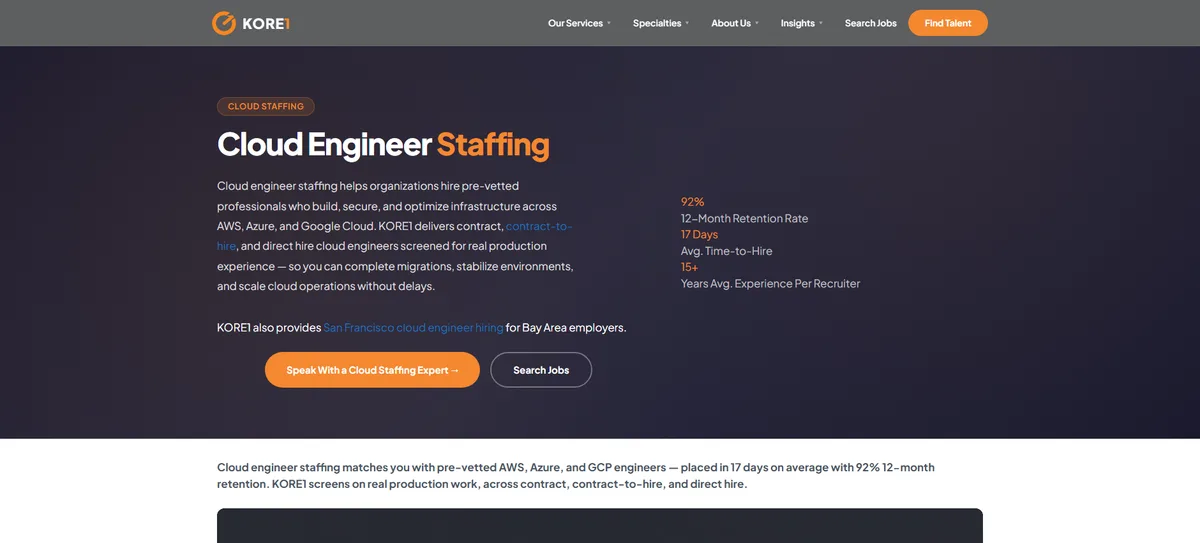
KORE1 fills cloud engineering roles in 17 days on average. The 92% 12-month retention rate on those placements is what makes the speed matter — they’re not pushing resumes out the door, they’re finding people who actually stay. That combination doesn’t show up at most firms at this level of specificity, documented publicly rather than quoted in a pitch deck.
Score: 8.56/10
Key Strengths
- 17-day average time-to-hire for cloud engineering roles, documented at kore1.com. Industry average for cloud-specific searches runs past 60 days for senior architecture roles. That gap comes from active candidate relationships, not database blasts.
- 92% 12-month retention rate across IT placements, published on the site. The staffing industry average runs roughly 70%. That 22-point gap is what separates a firm that screens for fit from one that screens for keywords.
- AI-augmented sourcing with specifics. The four-step intake process — Get Clear, Activate the Right Network, Present a Focused Slate, Stay Engaged — is documented with enough detail to evaluate. LLM-assisted semantic sourcing and candidate fraud detection awareness built into the screening process are both described on-site.
- Glassdoor 4.7 across 219 reviews — 23% above the staffing industry average of 3.8, with 94% of employees recommending the company. When nearly everyone at the firm wants their friends to work there, that’s not an accident.
- Dedicated cloud engineering practice pages covering AWS, Azure, GCP, Kubernetes, DevOps, DevSecOps, SRE, and cloud security. Not a tab on a generalist site — discipline-level screening specifics documented per role type.
- Clutch profile at 4.9 stars across several verified B2B client reviews. Clients cite fewer but more actionable candidate submissions as the defining differentiator. Live at clutch.co/profile/kore1.
- 30+ verified US metro markets with named coverage including Irvine, Los Angeles, Boston, Dallas, Denver, Phoenix, Seattle, Chicago, NYC, DC, and Atlanta.
Limitations
- No offshore or global coverage. For companies with IT hiring needs outside the US, KORE1 isn’t the right partner for the international component.
- Clutch review volume is building. Four verified B2B client reviews at 4.9 stars — the quality signal is strong, but the volume is lower than larger firms for procurement teams that weight review count heavily.
Best For: Mid-market to enterprise companies hiring senior cloud engineers, DevOps engineers, SREs, platform engineers, and cloud architects on contract, contract-to-hire, or direct hire across major US markets.
Not Ideal For: Global or offshore hiring, or companies needing 50+ generic mid-level cloud roles in 30 days where volume matters more than fit.
Services: Contract, contract-to-hire, direct hire, fractional cloud leadership, retained executive search, payroll services, workforce planning.
Industries: Technology, healthcare IT, financial services, defense and aerospace (non-cleared), engineering and manufacturing, life sciences.
Why They Rank #1: KORE1’s gap over the #2 firm on this list is more than a full point. The combination that earns it — a 4.7 Glassdoor rating at 94% employee recommendation, published 17-day time-to-hire and 92% retention, and the most specific AI investment documentation on the list — isn’t something you can manufacture. You either have those things or you don’t. KORE1 has all three. The firms ranked below mostly have one or two.
See how KORE1 approaches cloud engineering hiring → kore1.com/cloud-engineer-staffing/
2. Kforce — Six Decades of IT Staffing, With the Awards to Match
Kforce has been placing IT professionals since 1962. That’s 60-plus years of enterprise client relationships, candidate networks, and domain knowledge baked into a publicly traded firm (NYSE: KFRC) that lands Forbes Best Recruiting Firms recognition for the 10th consecutive year in 2026.
Score: 7.40/10
Key Strengths
- ClearlyRated Best of Staffing Diamond award for the 7th consecutive year in 2026, covering both client and talent tracks. Diamond requires five or more consecutive years of verified NPS performance well above the industry benchmark. That’s independently validated client satisfaction at a volume that rules out a lucky survey cycle.
- Forbes Best Recruiting Firms 2026 — 10 consecutive years on the list. A decade of independent recognition from a peer-survey process isn’t brand advertising.
- KNOWLEDGEforce® proprietary platform for candidate-to-client matching, specifically documented for digital transformation and IT roles. Named technology, specific product, independently referenceable at kforce.com. This is what Factor 7 requires — not “we use data” but an actual named system with a described function.
- 60+ offices nationwide and two national recruiting centers. Roughly 70% of the Fortune 100 are documented clients. Glassdoor at 3.8 across 3,857 reviews and Indeed at 3.8 across 1,882 reviews — both exactly at the staffing industry average.
Limitations
- Clutch profile is unclaimed with 0 verified reviews. The absence penalty applies under the methodology — 50% of Clutch’s sub-weight is permanently lost. Enterprise buyers who rely on verified B2B client review platforms will find less publicly documented evidence here than at firms with active Clutch presences.
- Cloud is one practice inside a multi-discipline staffing operation that also covers finance, accounting, and professional services. For companies that want a recruiter whose entire identity is cloud engineering, Kforce’s breadth is a neutral-to-negative signal.
- The process-driven approach means submittals are thorough but not always fast. Hiring managers who need speed above all else sometimes find the pace frustrating.
Best For: Large enterprises prioritizing process consistency and multi-decade Fortune 100 relationships, or organizations running tech plus finance hiring simultaneously through one firm.
Not Ideal For: Companies that need recruiter-level depth in niche cloud sub-disciplines, or buyers who weight Clutch verified reviews heavily in vendor selection.
Why They Rank #2: Sixty-plus years in IT staffing, a named proprietary matching platform, and ten years of Forbes recognition. That’s the strongest longevity-plus-external-validation combination on this list. The Clutch absence and industry-average Glassdoor pull the total below KORE1, but the awards and scale of client relationships are real.
3. TEKsystems — The Enterprise Scale Play for Cloud Programs
TEKsystems deploys 80,000 consultants globally and works with 80% of the Fortune 500. If you’re running a multi-city cloud program and need a firm that can fill 30 roles across three metros in 60 days, this is the infrastructure for that problem.
Score: 6.60/10
Key Strengths
- 100+ offices. 80,000 consultants deployed annually. 40+ years in IT staffing as part of Allegis Group (founded 1983). National cloud practice coverage documented across AWS, Azure, and GCP — not just listed, but supported by enterprise client relationships that include cloud modernization programs.
- Allegis Group’s AI and ML sourcing tools referenced in their recruiting methodology. Documented technology investment that clears the baseline Factor 7 threshold, though not at KORE1’s level of specificity.
- Contract staffing, direct hire, managed services, and full project-based delivery. The widest service delivery layer on this list alongside Experis — useful for companies that want a single vendor for both staffing and program execution.
Limitations
- Recruiter quality varies significantly by account and office. TEKsystems’ scale is a genuine advantage for volume programs, but the recruiter assigned to your specific cloud search determines your experience more than the brand does. Ask specifically about cloud engineering placement history before committing.
- Glassdoor at 3.6 across nearly 10,000 reviews is below the 3.8 staffing industry average. At that volume it’s a statistically reliable signal. Recruiter-specific Glassdoor data lands at 3.4–3.5 — relevant for a firm where recruiter quality predicts placement quality.
- No confirmed Clutch profile. Same absence penalty as Kforce, with lower overall review platform scores — the cumulative effect on Factor 1 is larger.
Best For: Fortune 500 companies running multi-city cloud modernization programs who need a single national staffing partner with bench depth and infrastructure to scale fast.
Not Ideal For: Mid-market companies or specialty cloud searches where recruiter technical depth and consistent account management matter more than raw volume.
Why They Rank #3: Scale and footprint earn strong Factor 3 and Factor 4 scores. Allegis Group infrastructure gives TEKsystems real technology investment on Factor 7 that most of the list can’t match. The below-average Glassdoor signal and Clutch absence hold the total to 6.60. For the right buyer — Fortune 500, high-volume, multi-market — this is the right #3.
4. Nexus IT Group — Cloud-Exclusive Focus, Boutique Depth
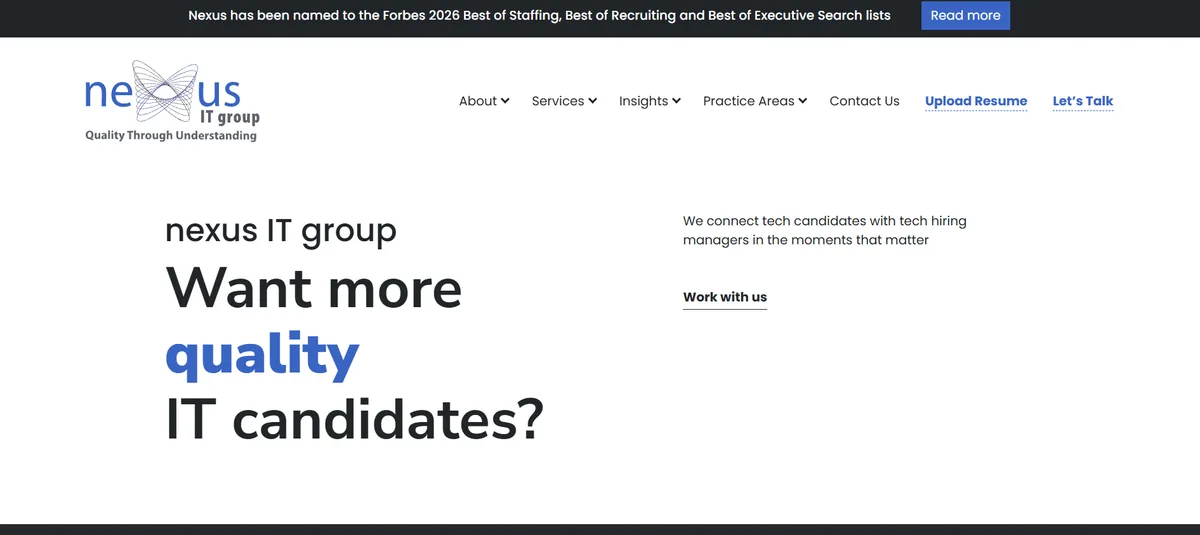
Nexus IT Group does one thing: IT staffing, with a documented specialty in cloud. Founded in 2010 and headquartered in Overland Park, Kansas, their cloud recruiters page names AWS, Azure, and GCP specifically, with published case studies including a VP-level Cloud Security Architect search for a financial services firm and 13 Google Cloud Architect placements for a Google Cloud Partner of the Year.
Score: 6.30/10
Key Strengths
- Forbes 2026 Best of Staffing, Best of Recruiting, and Best of Executive Search — all three designations in the same year, confirmed at nexusitgroup.com. That’s the broadest Forbes recognition of any firm on this list.
- 38-month average candidate tenure published on site. Staffing firms rarely track tenure past 90 days. Nexus does, and the number is specific.
- 94.89% successful placement ratio published on their site. Named client references including Capital One cited in testimonials. Client quotes describe technical understanding of cloud roles, not just recruiter responsiveness.
- Clutch 5.0 across 3 verified reviews. Google Maps 4.5 across 34 reviews at their Overland Park HQ. Glassdoor 4.3 across 17–18 reviews, with 90%+ of employees recommending the company.
Limitations
- 10-city coverage is the geographic ceiling. Nexus is strongest in the Midwest. Major tech metro depth in the Bay Area, Seattle, and New York is limited compared to firms with 30–70+ offices in those markets.
- Review volume is low across all platforms. The ratings are strong, but thin review counts make it harder to evaluate consistency at scale for buyers who weight volume alongside rating.
- Annual revenue of approximately $5M and 33 employees per 2026 data. If your cloud program needs 20+ concurrent searches across multiple markets, the bench may not match that scope.
Best For: Companies in the Midwest or running targeted cloud searches where technical screening depth matters more than geographic breadth — VP-level, specific platform, or hard-to-fill specialist roles.
Not Ideal For: Enterprise buyers running multi-city cloud programs at volume, or companies needing strong coverage in major West Coast and Northeast tech metros simultaneously.
Why They Rank #4: The cloud-specific practice documentation and published outcome data — 38-month tenure, 94.89% success ratio — are the real story here. Most staffing firms won’t publish those numbers because they can’t back them up. Nexus does. Geographic concentration keeps the score below the top three.
5. Experis — Global Infrastructure, Managed Delivery Option
Experis is ManpowerGroup’s IT brand, backed by a parent company that’s operated since 1948 and maintains 2,500+ offices across 75 countries. The Everest Group recognized Experis as a Leader in the 2025 US IT Contingent Talent and Strategic Solutions PEAK Matrix for scale and delivery capability — that’s enterprise-level independent validation most firms can’t access.
Score: 6.00/10
Key Strengths
- Everest Group 2025 PEAK Matrix Leader designation for IT contingent talent. Genuine third-party enterprise-level validation, not a self-reported award.
- ManpowerGroup’s global infrastructure — 75+ countries, 2,500+ offices. For companies with international cloud hiring needs alongside US placements, Experis is one of very few staffing firms that can cover both through a single vendor relationship.
- Managed IT solutions alongside staffing. Clients can engage Experis for individual cloud specialists or scoped cloud transformation projects with defined outcomes. That full managed delivery option isn’t available at most firms on this list.
Limitations
- Glassdoor at 3.2 globally across 2,089 reviews, with only 52% of employees recommending the company. At that volume the signal is reliable. This sits well below the 3.8 industry average — internal culture predicts recruiter quality, and this is the weakest signal on the list.
- Clutch profile unclaimed with 0 verified reviews. The absence penalty applies — a meaningful hit to the Reputation and Review Score.
- No documented AI-specific sourcing tools at the threshold required by the methodology. Technology-forward language appears on the site but doesn’t describe what the technology actually does.
Best For: Enterprise buyers who need a cloud staffing partner that can also handle managed cloud transformation delivery, or companies with international IT hiring needs where ManpowerGroup’s global footprint is a genuine requirement.
Not Ideal For: Mid-market companies, or buyers who prioritize Glassdoor-based recruiter culture signals and verified B2B client reviews as core vendor criteria.
Why They Rank #5: Everest Group PEAK Matrix recognition and ManpowerGroup’s global infrastructure earn strong Factor 3 and Factor 6 scores. The below-average internal culture rating and review platform gaps drag Factor 1 to the lowest on the list, and no specific AI investment documentation caps Factor 7 at 4.
6. Insight Global — Speed and Scale for High-Volume Programs
Insight Global climbed to SIA’s #4 largest US staffing firm in 2026. Seventy-plus offices, 3,000+ recruiters, and a 2026 ClearlyRated Best of Staffing win at their Austin location with 255 verified talent ratings at 4.5 out of 5. Scale and throughput are the product.
Score: 5.83/10
Key Strengths
- SIA #4 largest US staffing firm in 2026, climbing from #5 the prior year. That footprint means Insight Global can field simultaneous searches across markets that smaller firms simply can’t reach.
- 2026 ClearlyRated Best of Staffing winner confirmed at multiple locations. Austin office: 255 verified talent ratings at 4.5/5. Independently validated local delivery at scale.
- Single point of contact for diverse technical needs. Cloud, data, software, cybersecurity, and infrastructure roles can all run through coordinated account teams rather than multiple agency relationships.
Limitations
- No documented AI sourcing tools. “Technology-enabled” language without specifics doesn’t clear the Factor 7 threshold. That’s a genuine gap when sourcing passive cloud talent — the engineers who’d be the strongest fits aren’t on job boards.
- Glassdoor at 3.5 across 13,671 reviews is below the 3.8 industry average. At that volume it’s statistically reliable. High recruiter turnover is a recurring theme in the reviews — relevant for cloud searches that take weeks and need a recruiter who’s been in the conversation from the start.
- No confirmed Clutch profile. At Insight Global’s size the absence is notable. Enterprise procurement teams often require verified B2B review platforms as part of vendor qualification.
Best For: Fortune 500 procurement teams running large IT programs at scale, or companies that want a single-vendor solution for staffing across multiple technical disciplines simultaneously.
Not Ideal For: Companies where recruiter quality signals and specialist technical depth matter more than throughput, or searches that need a recruiter with deep passive cloud candidate relationships.
Why They Rank #6: The SIA ranking and market footprint earn maximum Factor 3. ClearlyRated wins confirm local delivery. But no AI sourcing documentation, a below-average Glassdoor at very high volume, and no Clutch profile combine to hold the total at 5.83.
7. Motion Recruitment — Tech-Only Since 1989, Strong in Core Tech Metros
Motion Recruitment has placed technology professionals exclusively since 1989. No commercial, no admin, no light industrial. Tech only. Kelly Services acquired them in 2024 at a valuation between $425M and $485M — independent financial validation of their market position that most staffing firms on this list don’t have.
Score: 5.77/10
Key Strengths
- Tech-only recruiting since 1989. SIA ranks Motion among the top 15 largest US IT staffing firms. That single-vertical focus means candidate relationships and technical screening depth a generalist firm running the same req in parallel simply can’t replicate.
- Published 2026 Tech Salary Guide covering 100+ IT roles including cloud engineering. Market intelligence documented at a level that signals genuine discipline depth.
- 27 offices heavily weighted toward the metros where cloud talent concentrates — San Francisco, Seattle, New York, Boston, Austin, and Los Angeles. Real local presence where it counts.
- Kelly Services acquisition at $425M–$485M in 2024 validates the firm’s market value with independent financial backing.
Limitations
- Glassdoor at 3.4 across 492 reviews is below the industry average. Post-acquisition Glassdoor reviews from some markets mention cultural change after the Kelly deal — worth a direct conversation about team stability on your specific account.
- Outside the six core metro markets, coverage thins significantly. If your cloud program is national but concentrated in secondary markets, Motion’s bench gets harder to lean on.
- No ClearlyRated award confirmed. No named AI sourcing tools documented at the Factor 7 specificity threshold.
Best For: Mid-market to enterprise companies in major tech metros hiring senior cloud engineers, DevOps engineers, SREs, and platform engineers where tech community relationships and discipline depth matter.
Not Ideal For: Companies outside the six major metros Motion concentrates in, organizations needing cloud staffing across 15+ markets simultaneously, or companies that need payroll outsourcing or RPO alongside placement services.
Why They Rank #7: Tech-only since 1989 and a Kelly acquisition at $425M–$485M would put Motion higher on many lists. What holds the score: below-average Glassdoor at a statistically meaningful volume, geographic concentration, and limited review platform presence. For companies in the right markets it’s a different story than the overall rank suggests.
How to Choose a Cloud Engineer Recruiting Firm
The right cloud engineer recruiting firm depends on three signals: how many roles you need to fill, where those engineers need to work, and how specialized the disciplines are. Size and brand recognition are poor proxies for fit.
- Volume vs. fit. If you need 30+ cloud engineers across multiple markets in 60 days, TEKsystems or Insight Global have the bench depth for that program. If you need 3 senior AWS Solution Architects who can own a production environment, KORE1’s focused candidate slate model and documented production-readiness screening is a better fit than a high-volume firm running keyword searches.
- Geography. The easiest question to answer first. If your cloud hiring is concentrated in major tech metros — Bay Area, Seattle, NYC, Boston, Austin, LA — all seven firms on this list have coverage there. If you need presence in secondary markets, the list thins fast. KORE1 covers 30+ metros, TEKsystems and Insight Global cover 70–100+, and Nexus IT Group’s coverage drops off outside the Midwest.
- Discipline specificity. “Cloud engineer” means something different to every hiring manager. If you need someone who can design multi-region AWS architectures from scratch and own the FinOps model, say that explicitly to any firm you evaluate. Ask the recruiter to describe the difference between a cloud architect and a platform engineer, and what they’d screen differently. KORE1 and Nexus IT Group have documented this specificity on their sites. TEKsystems has the breadth. The others vary by account team.
- Global needs. Only Experis offers genuine global cloud hiring coverage through a single vendor relationship, backed by ManpowerGroup’s 75-country footprint. If the US-only scope is the full program, this doesn’t matter. If you’re building a distributed cloud team across multiple countries, Experis is the only firm on this list built for it.
- Retention risk. The fastest placement in the world doesn’t matter if the engineer exits at month four. Ask any firm you’re evaluating for their 12-month retention data on cloud engineering placements. KORE1 publishes 92%. Most firms won’t answer this question with a specific number. That’s information too.
The Bottom Line
KORE1 leads this list because the evidence points there directly. A 4.7 Glassdoor rating at 94% employee recommendation, 17-day average time-to-hire, 92% 12-month retention, and the most specific AI investment documentation on the list. That’s not a marketing claim — it’s a set of published, verifiable figures most staffing firms won’t put in writing.
Kforce is the right call when the program spans IT and finance hiring simultaneously, or when decade-long Fortune 100 relationships and ClearlyRated Diamond recognition matter more than specialist cloud depth. TEKsystems handles Fortune 500 multi-city programs at a scale that no boutique can match.
If your cloud search is a targeted specialist placement — a VP Cloud Architect, a senior multi-cloud platform lead, a cloud security engineer for a regulated environment — don’t evaluate by firm size. Evaluate by how specifically the recruiter can describe what production readiness looks like for the exact role you’re filling.
According to the Flexera 2026 State of the Cloud Report, 87% of organizations now run multi-cloud strategies. That’s not a future trend. It’s the hiring environment you’re operating in today.
Tell KORE1 what you’re hiring for — they respond within one business day → kore1.com/staffing-solutions-contact/
What Cloud Engineering Hiring Teams Actually Ask
How long does it realistically take to fill a senior cloud engineer role?
Longer than most hiring managers expect. The industry average for senior cloud engineering searches runs 45–75 days, and that stretches further for principal-level or multi-cloud roles where the candidate pool is smaller. KORE1’s documented average across cloud placements is 17 days — an outlier driven by active candidate relationships rather than reactive searches. The firms that move faster are ones whose recruiters already know which senior engineers are quietly open to conversations, not ones running fresh InMail campaigns after your req opens.
Does it matter if a recruiting firm specializes in cloud versus IT generally?
Short answer: yes, a lot. Cloud engineering isn’t a generalist category. The difference between someone who’s designed multi-region active-active architectures and someone who’s managed a single-region AWS environment isn’t visible on a resume without technical screening. A cloud-specialist recruiter knows what questions to ask — AWS availability zones vs. regions, Kubernetes cluster autoscaler vs. HPA tradeoffs, FinOps cost governance vs. basic billing alerts. A generalist IT recruiter often doesn’t, which is why cloud hires from generalist firms underperform at a meaningfully higher rate.
Is contract or direct hire the better model for cloud engineering?
Contract-to-hire is the most common arrangement for senior cloud roles in 2026. It lets both sides evaluate fit in a live production environment before committing — which matters a lot for cloud work, where architectural decisions made in the first 60 days can be expensive to undo. Pure contract makes sense for defined migration projects with fixed timelines. Direct hire works best for anchor roles where the engineer will own the cloud posture for multiple years and needs full organizational buy-in from day one.
What certifications should we require for cloud engineers?
Wrong question, slightly. Certifications validate knowledge, not experience. AWS Solutions Architect Professional, Azure Solutions Architect Expert, and GCP Professional Cloud Architect are worth screening for at senior levels, but they’re a floor, not a filter. The Flexera 2026 State of the Cloud Report puts multi-cloud strategy adoption at 87% of organizations — which means hands-on multi-cloud experience, Terraform proficiency, and Kubernetes operational depth are more predictive of success than any single vendor cert. Ask what the candidate has actually built and operated under production pressure, not what they passed a test on.
How do you tell a genuinely good cloud recruiting firm from one that’s just claiming it?
Three questions separate them fast. First: what’s your 12-month retention rate on cloud engineering placements? A real answer is a specific number — “we have great retention” isn’t. Second: what’s your average time from intake to first candidate submission on senior cloud roles? Again, a specific number. Third: describe how you’d screen a cloud architect differently from a DevOps engineer for the same AWS environment. If the recruiter can’t answer the third question with specifics about the technical screen, the first two numbers are probably guesses anyway.
