Manufacturing ERP Staffing for NetSuite, SAP, and Epicor
KORE1 staffs manufacturing ERP talent for NetSuite, SAP, and Epicor on contract, contract-to-hire, and direct hire, covering BOMs, routings, MRP, shop-floor control, and costing, and averaging 17 days to first qualified submit with 92% 12-month retention.
ERP in a factory isn’t back-office software. It runs the bill of materials your buyers order against, the routings your schedulers plan to, and the standard cost your controller closes on. Get the wrong consultant and the MRP run tells your floor to build the wrong thing. That’s why manufacturers staff this apart from their plant-floor IT and MES teams, and why a generalist off a job board rarely survives a real go-live.
Discrete and process. NetSuite Advanced Manufacturing, SAP PP, QM, and MM, Epicor Kinetic. The functional leads who configure work orders and job costing, and the technical people who wire ERP to the shop floor, EDI, and the warehouse. Screened by recruiters who can tell a plant go-live from a demo.

Last updated: July 22, 2026
Written for the plant controller, VP of operations, or IT director who runs the business on an ERP and needs the right hands on it. Maybe you’re standing up NetSuite on a new line, backfilling an SAP PP lead nine months before a wave goes live, or finally pulling a plant off a twenty-year-old MRP nobody can support. What follows is what KORE1 actually staffs across the three platforms that dominate the factory floor, and how we screen for the difference between someone who has configured a plant and someone who has watched a demo. If you’re weighing platforms rather than hiring for one, our ERP consultant staffing desk covers the wider field.
Why Manufacturing ERP Is a Different Hire
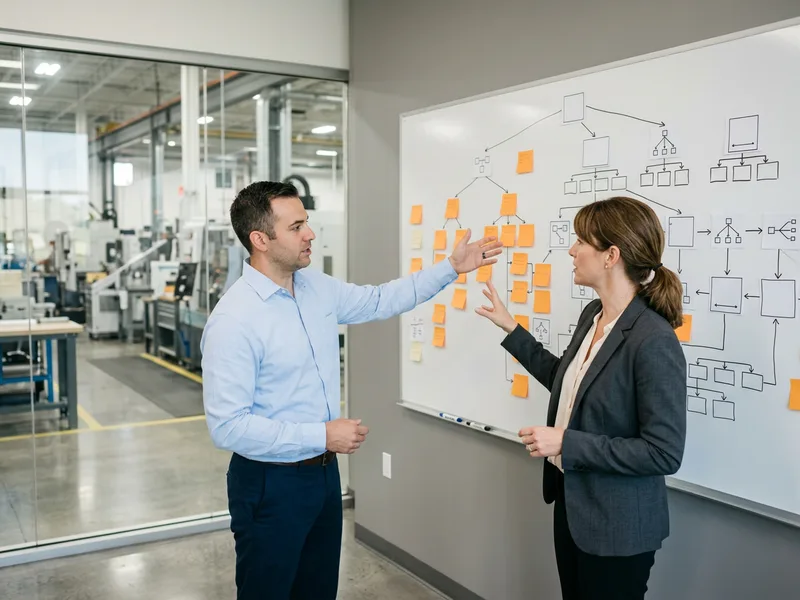
A finance ERP consultant configures the ledger and the approval hierarchy. A manufacturing ERP consultant does that too, then keeps going into the part of the system that most implementers quietly avoid.
The floor is where it gets hard. Multi-level BOMs with phantom assemblies. Routings with real setup and run times that the schedule actually believes. Backflushing that has to match what operators really consumed, not what the standard says they should have. Work-in-process that reconciles at month end. Standard cost rolls, actual cost variances, and a controller who wants to know why the labor absorption swung six points. Someone who has only done Financials and Procurement will nod along in the requirements session and then stall the first time a planner asks why the MRP suggested a purchase order for a part that’s already on the shelf.
Discrete or process changes the whole shape of the hire. A discrete shop builds distinct units against work orders and travelers. A process plant runs formulas, batches, co-products, and catch-weights, and needs someone who has lived in that model. We screen for which one you are before we send a single resume, the same read our ERP recruiters make across every platform. Getting that wrong costs a quarter. If the plant already has the right people and simply lacks hours before a wave goes live, ERP capacity for the plant, bought by the month is the cheaper fix.
NetSuite, SAP, Epicor, Matched to Your Plant
Three platforms run most of American manufacturing. The talent pools barely overlap, so the first question we ask is which one you’re actually on.
Fits the growing manufacturer who outgrew QuickBooks and wants one cloud system for finance, inventory, and light assembly.
- Advanced Manufacturing, work orders, routings, WIP
- Demand planning, SuiteApps, WMS, and EDI bundles
- SuiteScript and SuiteFlow for the custom pieces
Deeper NetSuite bench on our NetSuite consultant and administrator desks.
Fits the large or regulated maker running discrete and process side by side, often global, often with a plant maintenance and quality footprint.
- PP and PP-PI, MM, QM, PM, and variant configuration
- S/4HANA discrete and process manufacturing
- ABAP, CPI, and IDoc integration behind the modules
Broad SAP on SAP consultant staffing, conversions on SAP S/4HANA.
Built for the shop, not adapted to it. Fits mid-market make-to-order and engineer-to-order discrete manufacturers who live on the floor. Manufacturing sits inside a broader picture we cover in the 2026 ERP talent market.
- Kinetic job management, scheduling, and MES
- Job costing, quoting, and configurator work
- BPMs, BAQs, and REST integration for the rest
Epicor is manufacturing-native, so the pool is small and we source it by name. Our Epicor consultant staffing page goes deeper on Kinetic, Prophet 21, and the BPM layer.
Manufacturing ERP Roles We Fill
Six lanes cover almost every req that lands on the desk. Titles vary by shop. The skills behind them don’t.
NetSuite Manufacturing & WMS Consultant
Advanced Manufacturing, assembly work orders, routings, and the warehouse. The functional lead who sets up the item hierarchy your buyers and planners will fight over for a decade.
SAP PP, QM & MM Consultant
Production planning and control across discrete and process, plus the quality and materials modules next to it. The searches that move slowest, because deep PP-PI config experience is genuinely thin.
Epicor Kinetic Consultant
Job management, scheduling, MES, and the configurator, with BPMs and BAQs underneath. A small pool that clients rarely find on their own, so we work it by referral.
ERP & MES Integration Developer
The person who makes ERP talk to the floor. Shop-floor data collection, MES handoffs, EDI 850, 856, and 810, label printing, and the warehouse scanner that keeps timing out at shift change. Plants that buy material by weight and ship it by the piece hit the unit-of-measure problem first, which is where metals and converter NetSuite seats in Pittsburgh come in.
Cost Accounting & MRP Analyst
Standard versus actual, labor and overhead absorption, and the MRP settings that decide whether the plant chases shortages or drowns in inventory. Half controller, half planner, rare either way.
ERP Program & Plant Cutover Lead
Owns the plan, the physical inventory, and the go, no-go call the night before the floor switches systems. Usually someone who has survived a cutover weekend and can say no to scope.
Manufacturing ERP Staffing, In Numbers
Sources: KORE1 placement data 2005–2026, BLS Occupational Outlook Handbook 2025, NIST Manufacturing Extension Partnership.

[screening] What We Push On Before You See a Resume
Certifications tell you someone passed an exam. They don’t tell you whether that person can stand on a factory floor at 5am on go-live Monday and keep the line running. Four things separate our submits from the pile a job board sends.
A real plant go-live, start to finish. Plenty of resumes say “ERP implementation” and mean eight weeks writing test scripts. We ask which plant, how many work centers, what the first MRP run got wrong, and how the operators reacted when the traveler printed with the old routing. Specifics come fast from someone who was there. Everyone else goes abstract.
Cost and inventory, not just configuration. Standard cost rolls, PPV, absorption, and the cycle-count discipline that keeps perpetual inventory honest. We want the story of a physical inventory that didn’t tie and what they did at 11pm to close the gap, not a list of screens they’ve opened.
Integration reality. ERP rarely lives alone on the floor. EDI to the OEM customer who fines you for a late ASN, a scale or a scanner feeding transactions, and the MES or historian on the line. Candidates who have only touched integration in a sandbox can’t say what they do when the 856 rejects at 2am and the customer portal is already flagging you. Where that is the whole job rather than one duty on a longer list, staff a dedicated EDI analyst instead.
The platform underneath. SuiteScript on NetSuite, ABAP and CPI on SAP, BPMs and BAQs on Epicor. Acumatica means C# graph extensions that have to compile against every R1 and R2 release, the core of the xRP developer seat. We screen technical people on the actual toolset, because “familiar with customizations” and “has shipped a BPM that survived an upgrade” are two very different hires. For the plant-floor and controls half of that conversation, our manufacturing IT desk shares the screen.

Where Manufacturing ERP Searches Land
Three shapes account for nearly every req we open on the floor.
Geography decides more than most plants expect. In Los Angeles County the aerospace suppliers in the South Bay and the food and apparel plants in Vernon run different systems entirely, which our Los Angeles ERP staffing page maps deck by deck. Around Philadelphia the split runs between bakeries, beverage distributors and chemical plants, and Philadelphia ERP staffing for food plants covers the unit-of-measure problem they share. In southeast Michigan the shared problem is the automotive cum, and Detroit ERP staffing for Tier 1 and Tier 2 suppliers covers that one.
Standing up a new implementation. You’ve signed a partner, the SOW is priced per resource, and you’ve realized you need your own people in the room who answer to you. Usually a functional lead for manufacturing plus a costing analyst and one integration developer. These run nine to eighteen months on contract, and the smart version starts before the partner does, not after the first missed milestone.
The post-go-live gap. The partner rolled off, hypercare ended, and every enhancement queues behind one exhausted internal analyst while the plant keeps shipping. When that queue has been growing for a year, a contract crew sized from the backlog clears it faster than one more analyst. This is the most common call we get, and it’s usually a contract-to-hire, because nobody commits a headcount until they’ve watched someone survive a real month-end close on the shop floor.
Off the legacy system. Made2Manage, Syteline, an AS/400 green screen, Fishbowl, or a homegrown MRP that one retiring person understands. These migrations need someone who knows both the old model and the new one, which is the rarest and most valuable profile on this page. For the wider talent map around it, our supply chain and manufacturing recruiting desks run alongside. Distributors and online sellers hit a different set of problems, and those land on our distribution-side ERP staffing desk.
How We Engage
Four models. Each maps to a different point in the plant’s ERP lifecycle.
| Model | Best For | Typical Duration |
|---|---|---|
| Contract | Implementation augmentation, a plant rollout wave, or a migration with a defined end date | 9 to 18 months |
| Contract-to-Hire | Post-go-live support roles where you want to watch someone run a close before committing | 3 to 6 months, then convert |
| Direct Hire | Permanent ERP analysts, the plant system owner, and the internal center of excellence | Permanent |
| Project-Based | A scoped deliverable such as an EDI build or a costing rebuild, run by a KORE1 team | Scoped per engagement |

Why KORE1 for Manufacturing ERP Staffing
We’ve staffed enterprise and plant-floor IT since 2005, back when the plant’s system ran on a server in a closet off the shipping dock. That history matters here. A lot of the consultants worth hiring for a modern NetSuite or S/4HANA program cut their teeth on an older shop system, and in plenty of cases we placed them the first time around.
Every submit clears a recruiter-led screen built for the lane. Functional candidates walk through a costing or planning decision they’d defend. Technical candidates get an integration failure to talk through. We ask about a real physical inventory on nearly every screen, because it’s the fastest way to separate someone who has owned a plant’s ERP from someone who has only demoed one.
We’ll also tell you when the answer isn’t a specialist. If the real gap is a business analyst who can write the requirements the partner keeps asking for, we’ll say so and point you at our business analyst or enterprise architect desks. When quality and validation are the constraint, quality engineering staffing sits next door. Pretending otherwise just costs you a quarter.
Recruiting is national, and most manufacturing ERP work places on-site for cutover and hybrid the rest of the time. When you’re ready, reach out and we’ll scope the search against your plant and your platform, not a job title. If you want a market rate first, our salary benchmark tool will pull one.
Common Questions About Manufacturing ERP Staffing
What does a manufacturing ERP consultant cost in 2026?
Contract manufacturing ERP consultants generally bill between $80 and $150 an hour in 2026, with senior SAP PP-PI leads and scarce Epicor Kinetic people at the top of that band and NetSuite functional consultants often lower. Direct hire salaries for experienced plant ERP analysts usually land between $110K and $170K, and a program lead who has run a full multi-plant rollout goes higher. Platform matters more than the title. Deep discrete or process config experience prices at a premium because the pool is small and most of those people are already on a project. Our salary benchmark tool will pull a current range for your market and platform before you set the req.
NetSuite, SAP, or Epicor, which one fits our plant?
It usually comes down to size, complexity, and how much of your business is the shop floor. NetSuite fits growing manufacturers who want one cloud system and mostly do assembly or light manufacturing. SAP fits large or regulated operations running discrete and process together, often across borders. Epicor is built for mid-market make-to-order and engineer-to-order shops that live on the floor. We don’t sell software, so we’ll give you a straight read, and if you’re still choosing, our ERP consultant staffing page compares the wider field. Once you’re committed, we staff the platform you land on. Plants running the selection without an IT executive in the building usually want a fractional CIO for ERP and digital transformation in the room before the statement of work is signed.
Do we need a functional or a technical ERP consultant?
Start with what’s blocking you. If the system isn’t set up the way the plant runs, that’s functional work: BOMs, routings, work order flow, costing method, MRP parameters. If the configuration is right but data won’t load, a report is wrong, or the floor scanner won’t talk to ERP, that’s technical. Most plant implementations need roughly two or three functional consultants for every technical one, and post-go-live teams often flip that as integration and enhancement requests pile up. We’ll scope the mix on the intake call instead of making you guess.
How long does it take to fill a manufacturing ERP role?
Our average across IT searches is 17 days to first qualified submit. Manufacturing ERP contract roles usually close in two to four weeks, and direct hire runs four to seven. SAP PP-PI and Epicor Kinetic searches stretch longest, because the qualified pool is small and most of those people are mid-project. A search moves fastest when the req names one platform and one manufacturing mode instead of asking for everything. A job description that wants NetSuite, SAP, and Epicor in one body is the single most common reason a plant search drags past two months.
Can manufacturing ERP consultants work remotely?
Mostly yes, with one real exception. Configuration, integration, and reporting are browser-based, and the qualified pool is national, so insisting on full-time on-site narrows your options without improving the result. Cutover is different. Most plants want the functional lead and the program lead physically present for go-live, the first physical inventory, and the first close, and good consultants expect to travel for that. We structure the engagement around those few weeks rather than pricing a relocation nobody needs.
We’re migrating off a legacy MRP system. Can you staff that?
Yes, and it’s one of the most common reasons manufacturers call us. Whether you’re coming off Made2Manage, Syteline, an AS/400 system, Fishbowl, or a homegrown database, the hire that matters most is someone who understands both the old model and the new platform, so nothing quietly breaks in translation. Data migration is where these projects go sideways, especially open orders, on-hand balances, and cost history. We screen migration candidates on a load that actually failed and what they did about it, not on a tools list.
Does discrete versus process manufacturing experience really matter?
It matters a lot, and it’s the mismatch we catch most often. A discrete consultant thinks in work orders, travelers, and serialized units. A process consultant thinks in formulas, batches, co-products, by-products, and catch-weight, and has usually dealt with lot traceability and shelf life. The modules look similar in a demo and behave nothing alike in production. We confirm which model you run before sourcing, because a strong discrete lead dropped into a process plant will struggle in ways that don’t show up until UAT.
Staff Your Plant’s ERP With KORE1
NetSuite, SAP, or Epicor. Standing up a new implementation, covering the post-go-live gap, or moving off a legacy system. We place vetted manufacturing ERP talent on contract, contract-to-hire, and direct hire.
Start Your Manufacturing ERP Search →