Last updated: September 3, 2026
By Robert Ardell, Co-Founder and Strategic Advisor, KORE1
An automation engineer job description has to name the control platform, say whether the work is new build or retrofit, publish the travel load, and state which safety standard governs the line. Leave those four out and the posting fits a test automation developer, a robot integrator, and a plant electrician equally well. If the req is already open and not converging, our how we staff automation engineers page covers how we split the commissioning spike from the sustaining seat. Published US averages for the title run from roughly $88,000 to $134,000, which is a good sign they are averaging all of those people together.
The finalist withdrew in week six. Everything before that had gone well.
A food and beverage manufacturer had run a clean process. Posting live, around 140 applications, four phone screens, two on-sites, and a strong finalist with eight years on Allen-Bradley and real line-integration work behind him. The verbal offer was days out. On the second site visit he asked the plant manager something almost in passing, about when the commissioning work actually gets done.
The line ran six days a week. Every changeover, every logic revision, every I/O check happened in a Sunday window between 2 a.m. and 8 a.m., and during a capital push that meant most Sundays for about four months.
Nobody had lied to him. Nobody had mentioned it either, because to the people who already worked there it was not a fact about the job. It was just Sunday.
He had two kids under six. He passed, and he was right to.
That posting carried a skills section twenty-two lines long. It did not contain one sentence about the schedule. I would trade all twenty-two lines for that sentence, and so would every automation engineer you actually want.
Where I sit, for context. KORE1 has staffed engineering desks since 2005, including controls and automation engineer staffing, so I make money when a plant cannot fill one of these on its own. Weigh the rest accordingly. Most of what follows is about writing a better posting, which costs you nothing and does not involve me.
The Brand on the Cabinet Is Not a Detail
“PLC programming experience required.” That line sits in most automation engineer postings and it does almost no work.
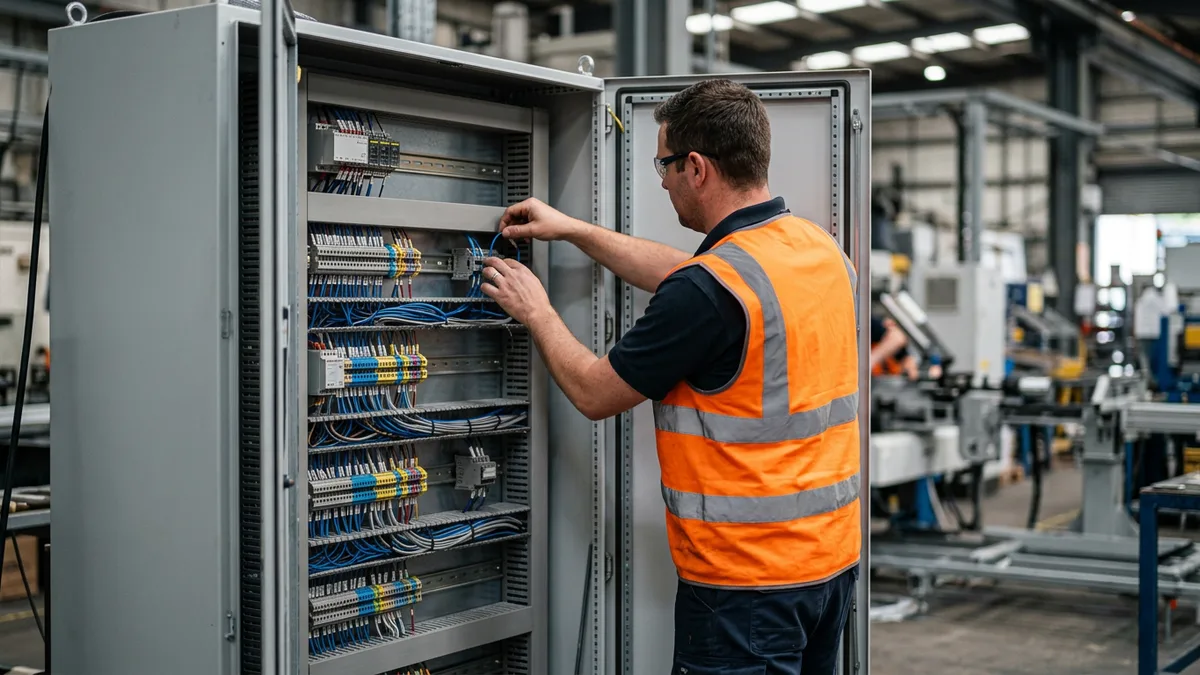
Rockwell’s Allen-Bradley platform anchors most North American plant floors. Studio 5000 for the ControlLogix and CompactLogix families, RSLogix 500 for the older SLC and MicroLogix hardware that is still quietly running production in a lot of buildings. Siemens is the other pole, TIA Portal and the S7-1500 line, standard across Europe and common in any US plant that bought European process equipment. Then Beckhoff with TwinCAT, plus Mitsubishi, Omron, Schneider, and a long tail of legacy that nobody advertises.
These are not dialects of one language. Separate development environments, separate tag and memory models, separate diagnostic habits, separate licensing. An engineer with nine years in Studio 5000 can learn TIA Portal, and a good one will. They will not be productive in it during your first quarter, and the honest candidates say so in the screen. The ones who tell you the platforms are basically the same have usually done a training course and one small project. Ask which project.
So name yours. Put it in the title. “Automation Engineer, Allen-Bradley” filters harder than any bullet list underneath it, and it does the filtering before somebody spends twenty minutes in your application portal.
The layer above the PLC has the same problem and gets even less attention in postings. HMI and SCADA carry their own ecosystems. FactoryTalk View, WinCC, Ignition, AVEVA. Historian, MES, and the OPC UA plumbing between them are separate skills again. Different people, often. Somebody strong at Ignition tag scripting is not automatically somebody who has stood up a validated batch historian, and if you need the second one, the word “SCADA” in your posting will not find them.
| Control platform | Software a candidate will name | Where it usually shows up |
|---|---|---|
| Rockwell / Allen-Bradley | Studio 5000, RSLogix 500, FactoryTalk View | Most North American discrete and packaging lines |
| Siemens | TIA Portal, Step 7, WinCC | European-built process equipment, pharma, automotive |
| Beckhoff | TwinCAT 3 | High-speed motion, custom machine builders |
| Mitsubishi / Omron | GX Works, Sysmac | Asian-sourced machinery, electronics assembly |
| Platform-independent layer | Ignition, AVEVA, OPC UA, Kepware | Anywhere data has to leave the floor |
One caveat worth stating plainly. A senior automation engineer who has worked across three of these is genuinely more valuable than one who has worked deeply in a single platform, and that person knows it. If you want platform-agnostic, budget for platform-agnostic. It is not free.
Retrofit and New Build Are Two Different Jobs
Greenfield work means you get to design it. The documentation is current because you wrote it last month. Requirements come from a functional spec, you coordinate with the OEM, you run a factory acceptance test and then a site acceptance test, and standards compliance is something you build in from the schematic stage rather than discover later.
Brownfield is a different animal entirely. You inherit a panel from 2001, drawings that stopped matching reality around the time three different contractors made undocumented logic changes, and a production schedule that decides when you are allowed to touch anything at all.
Both are automation engineering. They select for very different people.
The retrofit person is comfortable reading somebody else’s ladder logic at three in the morning with a meter in one hand and the plant manager standing behind them asking a question they both already know the answer to. They stage a migration so the old program can come back in under twenty minutes when the new one misbehaves, because sometimes it does. There is no certification for that. You find it by asking what the worst startup they ever ran looked like, and then listening for whether the story has a rollback in it.
Say which one you are hiring for. If the honest answer is both, say that too, and give the ratio. Seventy percent sustaining and thirty percent new installs is a real job somebody can picture. Ratios help.
Then say what shape your documentation is in. “Drawings are current” and “we believe the drawings are from about 2014” are both acceptable answers. Say which. Only one of them turns into a surprise in month two, and the candidates who would have been fine with the truth are exactly the ones who leave when they find it out sideways.
Publish the Travel Number
This is the most common omission I see and the most expensive one. It is what killed the search at the top of this page.
Automation work has travel built into it in ways software roles mostly do not. Commissioning and startup support. Turnarounds and planned shutdowns, which are scheduled around production and not around anyone’s calendar. Factory acceptance tests at an OEM’s facility three states away. Engineers working for a systems integrator can run fifty percent travel in a busy year. In-house plant roles often sit near zero, right up until a capital project starts, and then they do not.
Put the number in the posting. “Roughly 20% travel, concentrated in two-week blocks during commissioning” is a sentence a person can hold up against their actual life. “Some travel may be required” is not information. It is a shrug.
The same goes for when the work happens. Nights, weekends, holiday shutdowns, and on-call rotations are normal in this field and disclosing them does not scare off serious candidates. Ambush does. A candidate who accepts a job knowing about the Sunday window stays. A candidate who finds out in week six leaves, and you restart a search that already cost you two months.
Which Standard Governs the Line
Automation carries a compliance layer that most job descriptions skip entirely, and it changes who is qualified.
Machinery safety in North America mostly runs through NFPA 79, the electrical standard for industrial machinery. Sitting next to it is ISO 13849-1, which grades safety-related control functions by Performance Level, a through e. Process industries work to IEC 61511 instead, where a function earns a Safety Integrity Level. Same idea, different vocabulary. Anyone who has designed and validated a SIL-rated interlock is a narrower and more expensive hire than someone who has programmed conveyor logic, and both of them will answer a posting that just says “automation engineer.” The electrical engineer who designs the panel behind that line needs a different posting, and our job description template for electrical engineers covers it.
Above the safety layer sits ISA-95, which defines how control systems and enterprise systems are supposed to talk to each other. If part of this role is pushing production data into an ERP or MES, that is the vocabulary. Name it.
Regulated manufacturing adds another tier on top. Pharma, biotech, and medical device work brings computer system validation under GAMP 5 and 21 CFR Part 11, and validation is not a small tax on the schedule. Engineers who have carried a system through IQ, OQ, and PQ in a regulated plant know exactly what that documentation burden costs, and they price for it accordingly, which tends to surprise a hiring manager who built the band off a general engineering benchmark. Hiring one of them into an unregulated plant works fine. Hiring the reverse, and hoping validation gets picked up along the way, does not. It never does.
You do not need a paragraph on any of this. One line does it. “This role owns safety functions to ISO 13849-1 PL d on two packaging cells” tells a qualified candidate more than a full page of responsibilities.
What the Published Averages Are Actually Measuring
Compensation data for this title is genuinely messy, and the mess is informative rather than annoying.
| Source | Title measured | US figure |
|---|---|---|
| Payscale (2026) | Controls engineer with PLC and automation skills | $87,708 average |
| O*NET (2025 median) | Manufacturing engineers, SOC 17-2112.03 | $102,440 median |
| Built In (2026) | Automation engineer | $105,899 average, $107,000 median |
| ZipRecruiter (July 2026) | PLC automation engineer | $107,126 average, $75,500 to $142,500 across the middle 80% |
| O*NET (2025 median) | Robotics engineers, SOC 17-2199.08 | $122,930 median |
| Glassdoor (2026) | PLC automation engineer | $134,419 average |
Six sources, one nominal job, and a spread wide enough to drive a forklift through. Nobody is wrong. The Payscale figure and the Built In figure are measuring different populations, which is itself the finding.
Three things move a real number inside that range. Platform depth, whether the seat carries safety-rated or validated work, and travel. Travel most of all. Industry moves it too. Automotive, semiconductor, and pharma pay above food and beverage or general fabrication for the same nominal skills, mostly because the cost of a line being down is different by an order of magnitude.
Geography still matters here more than it does in software, because the work is physical. You are competing with the plants within commuting distance of your plant, not with a national remote market. That cuts both ways. In a metro with three large manufacturers, everyone knows what everyone pays. In a rural site, you are paying a relocation premium whether or not you have budgeted one. Budget it.
The O*NET data carries one detail worth sitting with. Robotics engineers show a 2025 median of $122,930 against projected growth of only one to two percent through 2034, which is slower than average. That looks strange next to every headline about automation investment, and the explanation is that equipment spend is growing much faster than that particular job code. The demand is real. It just arrives under a dozen different titles, which is the whole problem this page is about.
Supply is the other half. Deloitte and The Manufacturing Institute ran the arithmetic in 2024. US manufacturing could need as many as 3.8 million new workers by 2033, and roughly 1.9 million of those roles go unfilled if the skills gap holds at anything close to its current width. Automation seats sit right in the middle of that gap. The gap is not theoretical. Our own average time to hire across the desk runs about 17 days, and controls-heavy searches are consistently on the slower end of it. If you want the market rate for this role, look at the postings still open after ninety days rather than the ones that closed.
Publish the band. Several states require it now, this candidate pool compares openly on forums you are not reading, and a posted range filters faster than any screening question you could write. The automation engineer salary guide breaks the published averages apart by source, level and state, and if you want the band priced for your own scope our salary benchmark assistant is free and does not put you in a queue.
Automation Engineer Job Description Template
Copy this. Replace everything in brackets. The bracketed notes explain why a line is there, and you should delete them before posting.
Job Title
[Automation Engineer, [Platform] / Controls and Automation Engineer / Senior Automation Engineer] [Put the platform in the title. “Automation Engineer, Allen-Bradley” outperforms the bare title on qualified applications, because it is what people actually search.]
About the Role
[Company] is hiring an automation engineer at our [city, state] [plant / facility], supporting [describe the line or process: high-speed packaging, batch process, machining cell, warehouse conveyance]. Our controls run [Allen-Bradley ControlLogix / Siemens S7-1500 / Beckhoff TwinCAT] with [FactoryTalk View / WinCC / Ignition] on the HMI and SCADA layer. The work is roughly [70% sustaining and improvement on existing equipment, 30% new installs]. You will report to [role] and work alongside [maintenance, process engineering, quality, or whoever this person will actually have to argue with].
What You Will Own
- PLC and HMI development, modification, and troubleshooting across [name the lines or cells], including the changeover work that decides whether a shift starts on time
- [Safety functions to ISO 13849-1 [PL] on [equipment] / safety instrumented functions to IEC 61511] [Leave this in if it applies. It is the highest-signal line in the posting and it changes who applies.]
- Commissioning support for [project], including [FAT at the OEM / SAT on site / vendor coordination]
- Documentation. Drawings, program backups, change records, and the version control that lets somebody else pick up your work
- Data out of the process and into [historian / MES / ERP] via [OPC UA / Kepware / direct integration]
- [If regulated: validation deliverables for [system] under [GAMP 5 / 21 CFR Part 11], including IQ, OQ, and PQ documentation]
- Support for [maintenance technicians / operators] during faults, and the training that reduces how often you get that call
What We Need to See
- [3+] years programming and troubleshooting [name your platform] in a production environment. Not a training certificate and one supervised project
- Ability to read electrical schematics and work safely in a live [480V] environment with the appropriate lockout and arc-flash practices
- [HMI or SCADA platform] configuration, including alarm rationalization rather than just alarm creation
- Industrial networking. [EtherNet/IP, Profinet, Modbus TCP, DeviceNet] and enough of an opinion about network segmentation to be useful when IT asks
- Judgment about downtime. [A candidate who asks what your production schedule looks like before proposing a migration approach has told you most of what you need to know.]
- [If applicable: experience with [servo and motion control / vision systems / robotics integration with [FANUC, ABB, KUKA, Universal Robots]]]
Nice to Have
- Second platform exposure, because most plants end up mixed whether anyone planned it or not
- [Your industry.] Food safety, automotive quality systems, semiconductor cleanroom practice, and pharma validation are each their own body of knowledge
- Experience with [legacy platform you actually still run: PLC-5, SLC 500, older Siemens S5] and a plan for what to do about it
- Version control and structured change management for control code, which is still rare and should not be
Schedule, Travel, and On-Call
[This section is not optional and it should not be buried at the bottom of a benefits list.] [Approximately X% travel, concentrated in [pattern].] [Commissioning and major changeovers happen [when]. Expect [frequency] of [nights / weekend windows] during [project or season].] [On-call rotation is [X] weeks in [Y], and it fires roughly [honest frequency].]
Compensation
[$95,000 to $130,000] base, plus [bonus], [overtime or shift differential if applicable], [relocation], [benefits]. [Post the range. If the number changes for a safety-rated or validated scope, say that too.]
What Plant Teams Ask Before They Post
Why does a posting that says Allen-Bradley still pull Siemens people?
The platform was probably in a bullet halfway down rather than in the title. Job boards match on titles far more aggressively than on body text, and most candidates filter the same way.
Move it up. Then check whether your requirements section quietly undercuts the filter by listing six platforms as “or similar,” which reads as an invitation. If you genuinely will take a strong Siemens engineer and pay for the ramp, that is a fine decision. Make it deliberately instead of discovering it in your applicant pool.
Is a controls engineer the same thing as an automation engineer?
Usually close enough to matter, sometimes not. Controls engineer tends to sit nearer the machine and the panel. Automation engineer often stretches upward into SCADA, data, and systems integration.
Titles vary more by company than by actual scope. The practical answer is to stop trying to pick the correct word and describe the work instead, because both populations search both terms. We run a controls engineer staffing desk and an automation practice for exactly this reason, and a good share of the early work in any search is establishing which one a client actually described.
Software test engineers keep applying. What in the posting is pulling them in?
Add one physical noun to the first paragraph. “PLC,” “plant floor,” “packaging line,” or “control panel” separates industrial automation from QA automation in about four words.
The overlap is not the candidates’ fault. “Automation engineer” is a legitimate title in software testing, where it means building test suites in Selenium or Playwright, and those engineers are searching the exact phrase you posted. If that is actually the person you want, you are on the wrong page and you want test automation engineer staffing instead.
Do we have to publish the travel percentage?
No rule forces it. Leaving it out costs more than including it, because travel surprises surface at offer stage, after you have already spent the money.
The number does not have to be flattering. Fifty percent travel is a completely hireable job for a large group of engineers, some of whom prefer it that way. What is not hireable is fifty percent travel discovered in week six by somebody who arranged their life around the version you published.
Our line is from 2001 and nobody wants to touch it. Comp problem or posting problem?
Posting problem, most of the time. Legacy work reads as career risk when it is described apologetically, and reads as ownership when it is described as a modernization mandate with budget behind it.
There is a real population of engineers who like this work, because keeping a twenty-five-year-old line alive is a genuine craft and the person who can do it is never unemployed. Say the platform, say the plan, and say whether there is capital for a migration or whether the job is to keep it running as is. Both are honest. They attract different people.
Contract or direct hire for a plant expansion?
Contract for the commissioning spike, direct hire for the seat that owns the line afterward. Most expansions need both, and conflating them is why the second search starts late.
Commissioning demand is a curve with a peak, not a plateau. Then it drops. Bringing in contract automation engineers for the startup window while running a parallel direct hire search for the sustaining engineer gets the line up without hiring for headcount you will not need in eighteen months. It also means your permanent hire arrives during commissioning and learns the system while the people who built it are still standing on the floor next to it, which is worth considerably more than any handover document you will ever receive.
The Short Version
Name the platform in the title. Say whether the work is retrofit or new build, and give the ratio if it is both. Publish the travel percentage and the on-call pattern. State which safety or validation standard binds the seat. Post the band.
Once the req is right, the loop is the next thing that leaks candidates. What to ask, and what a strong answer sounds like, is worked through in our guide to screening automation engineers.
Five sentences. They will do more for applicant quality than the twenty-two-line skills section they replace, and they take about ten minutes to write once you have the answers. Getting the answers is the hard part, and it is worth doing before the req goes live rather than in week six of a search.
If you want a second set of eyes on a req before it posts, or you are three months into a search that is not converging, talk to our engineering team. We run manufacturing engineering, industrial engineering, and robotics engineering searches alongside controls, and twelve-month retention on our placements sits at 92%, which is the number I would want from anyone asking to run your search.
