Last updated: October 26, 2026
By Dave Manchester, Scientific Recruiting, KORE1
How many contract QC analysts does it take to clear a batch release backlog? Count the testing hours waiting (lots times tests per lot times hours per test), divide by the bench hours one analyst really gets in a week, and price the analyst-weeks at 40 hours each. At KORE1’s median lab and QC bill rate of $40 an hour (n=54), two analysts for eight weeks cost about $25,600. Data as of October 2026.
Short version done. What follows is the worksheet, the price grid, and the spots where the math lies to you.
I should say who’s talking. I recruit scientific and quality staff through KORE1’s life sciences staffing practice, we place contract QC analysts, and this page ends with a way to hire through us. So check my arithmetic. All of it is on the page, and none of it needs me.
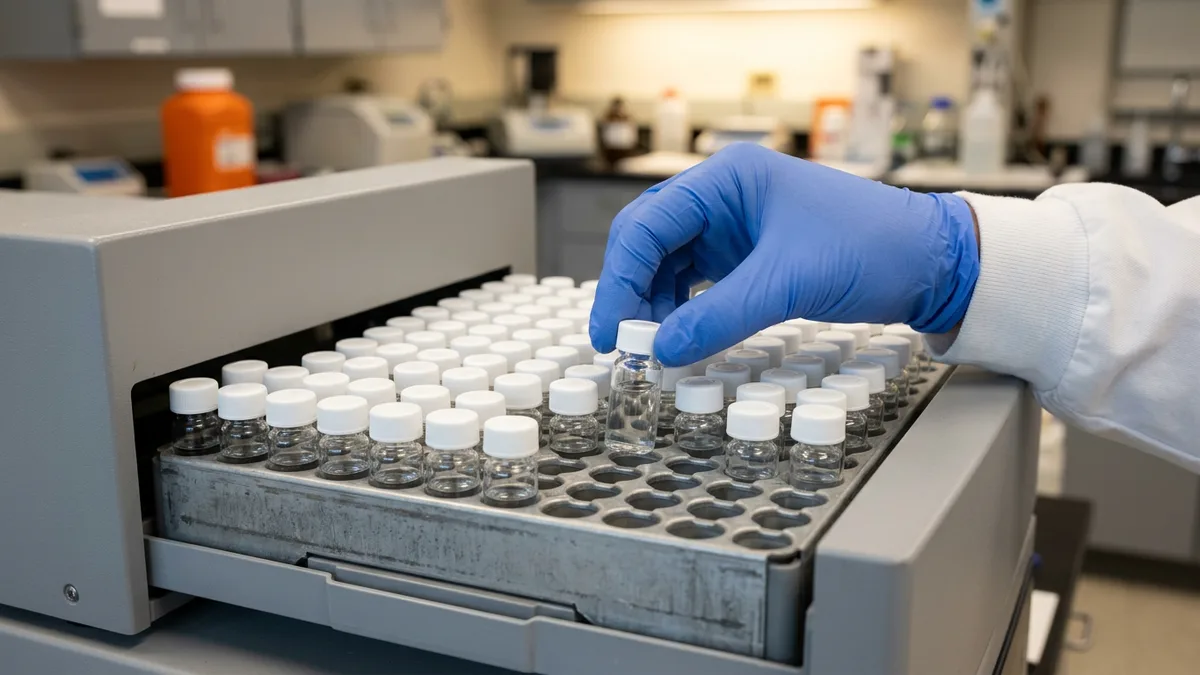
Why Is Finished Product Sitting in Quarantine?
Because nobody has said it can leave yet. And the gate has more than one latch.
A batch release testing backlog is the stack of finished lots waiting on laboratory results before the quality unit can approve them for distribution. Under 21 CFR 211.165, each batch needs laboratory determination that it conforms to its final specifications before release, so a lot can’t ship while its tests are still in the queue.
Two groups hold that gate. QC runs the tests, and pharma quality assurance reviews the executed batch record and dispositions the lot, meaning it formally approves or rejects it. This page covers the testing half. The review half, the people who read every page of the record before anyone signs, sits in my post on batch record reviewers who release product, and QC vs QA in pharma explains why those are two different hires.
One more rule belongs here. 21 CFR 211.22 gives the quality control unit the authority to approve or reject drug products, including product made under contract by another company, so a contract analyst can generate your data while the decision stays inside your quality unit. That’s good news. A contractor can take real work off your bench and nobody has to wonder who owns the release. A contract analyst added to clear a backlog still needs a signed training record first, as the onboarding checklist for contract QC analysts shows.
Backlogs rarely build in dramatic ways. A cluster of validation lots lands the same week an out-of-specification investigation pins a senior analyst to a desk and an HPLC pump fails, and the quarantine shelf, which is a polite name for floor space that costs money, gets deeper every day. Nobody planned it. The arithmetic just turned.
How Many Analyst-Weeks Is Your Backlog?
Start with testing hours, because lots aren’t the unit of work. Tests are. Multiply lots waiting by tests per lot by hours per test, where “hours per test” counts everything an analyst does for it, meaning prep, the attended part of the run, data processing, documentation, and any data review your analysts do for each other. Leave out unattended instrument time. The instrument works alone while the analyst moves on to the next sample set, and that stretch belongs to the machine.
| Step | What goes in | Illustration |
|---|---|---|
| 1. Lots waiting | Finished lots in hold, counted today | 60 |
| 2. Tests per lot | Every method on the release panel for the product | 5 |
| 3. Hours per test | Attended analyst hours, prep through documentation | 3 |
| 4. Testing hours | Step 1 x step 2 x step 3 | 900 |
| 5. Bench hours per analyst-week | Hours one analyst really spends testing in a 40-hour week | 30 |
| 6. Analyst-weeks | Step 4 divided by step 5 | 30 |
Illustration only. Every number in the third column is made up to show the arithmetic and is not KORE1 data. Swap in your own lot count, release panel and bench hours.
Step five is where people cheat. Usually by accident. A contractor billed for 40 hours won’t give you 40 bench hours. Training sessions, logbook entries, huddles, trips to the stockroom, waiting for an instrument, waiting for a reviewer. Ask your lab lead for a number they’d bet lunch on. Then trim it, because everyone’s first guess is optimistic. I used 30 above, and yours might be 26 or 34.
Thirty analyst-weeks sounds like a lot until you spread it out. Three analysts clear it in ten weeks, two take fifteen, and one takes most of a year. Here’s the part a spreadsheet skips. Instruments. One HPLC runs one sequence at a time, a Karl Fischer titrator doesn’t care how many analysts are standing beside it, and if the whole backlog is dissolution then the number of working baths sets the pace, not the number of people. Past the point where instruments are the limit, extra analysts are just paid waiting.
Why Do Method-Matched Contractors Start Faster?
Because the slowest part of a contract is rarely the testing. It’s the stretch before the contractor is allowed to test.
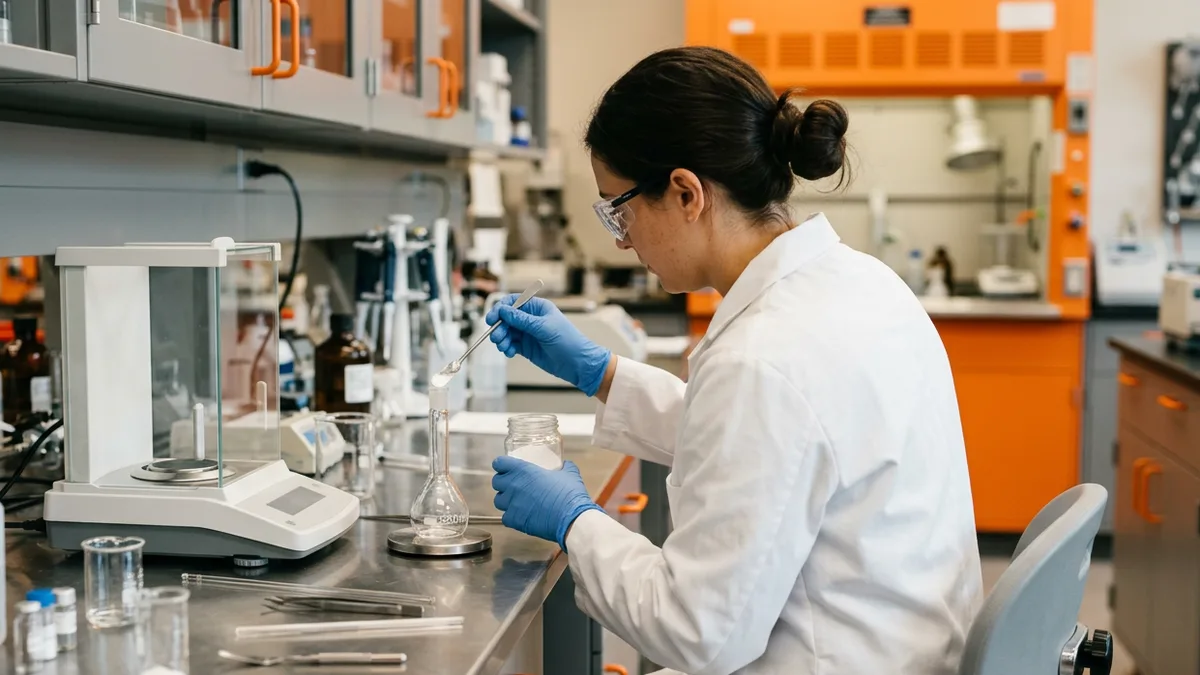
Take an analyst who has run HPLC assays, Karl Fischer titrations and dissolution on release samples. Hand that person your validated method and a qualified instrument and the learning curve is your site, not the technique. Easy start. Hand the same method to someone who has never run it under cGMP and you’ve bought a training project, the kind that eats the first stretch of the contract and shows up on the invoice as hours nobody spent testing. Gas chromatography and microbial limits follow the same pattern. Different column, same story.
Your methods are already validated, or should be. Section 211.165(e) requires that the accuracy, sensitivity, specificity and reproducibility of your test methods be established and documented, which is why a contractor running your method follows it and doesn’t improve it. Followers are what a backlog needs. If the backlog needs a method transferred in from another lab, that’s a different seat, and a pricier one, as I laid out in our lab and QC contractor bill rates.
Skip nothing on the paperwork side. Not even for speed. 21 CFR 211.25 requires training in the particular operations a person performs and in current good manufacturing practice, and it doesn’t care whose payroll that person is on. Your SOPs, your read-and-understood records, and whatever supervised runs your training procedure demands all come before an analyst touches a release sample. Those days are the real ramp. A method-matched contractor spends them on your SOPs. Everyone else spends them on the technique and your SOPs, in that order, one after the other.
The staffing side can move quickly. Across every role KORE1 places, the median gap between offer and start is three days (n=1,997). Devin Hornick, a partner at KORE1, describes the appeal this way. “You can get them quick… flexible… to scale up, to scale down as needed.” A start date that beats your paperwork isn’t a win, though, so line up the training package before the analyst arrives. Plan for it.
Strong analysts don’t wait around, either. Speed wins. If it’s a great house, multiple buyers show up, and a chromatographer with release-testing experience is a great house. A five-round interview loop is how you lose the offer to the buyer who made one call. It happens constantly.
When I screen for this seat I ask what the analyst ran, on which instrument, in which chromatography data software (Waters Empower and Thermo Chromeleon are common examples), and what they did the last time a result came back out of specification. Those answers beat a keyword match every time. Our laboratory staffing page covers the wider lab side of a search.
What Does It Cost to Clear the Backlog?
KORE1’s lab, QC and life-science contract placements from 2019 to 2026 (n=54) billed a 25th percentile of $33 an hour, a median of $40 and a 75th percentile of $56. The grid below runs one, two and three analysts for 4, 8 and 12 weeks at 40 paid hours a week.
| Analysts | Weeks | Paid hours | At $33 (25th) | At $40 (median) | At $56 (75th) |
|---|---|---|---|---|---|
| 1 | 4 | 160 | $5,280 | $6,400 | $8,960 |
| 1 | 8 | 320 | $10,560 | $12,800 | $17,920 |
| 1 | 12 | 480 | $15,840 | $19,200 | $26,880 |
| 2 | 4 | 320 | $10,560 | $12,800 | $17,920 |
| 2 | 8 | 640 | $21,120 | $25,600 | $35,840 |
| 2 | 12 | 960 | $31,680 | $38,400 | $53,760 |
| 3 | 4 | 480 | $15,840 | $19,200 | $26,880 |
| 3 | 8 | 960 | $31,680 | $38,400 | $53,760 |
| 3 | 12 | 1,440 | $47,520 | $57,600 | $80,640 |
Source: KORE1 placement data, 2019 to 2026, life sciences, lab and QC family, n=54 W2 contract placements, exported October 16, 2026. The wider dataset behind the figures is 79% California. Anomalies and payroll-service deals are excluded. Bill rates only. Each cell is analysts x weeks x 40 hours x the hourly bill rate.
Let’s Connect. Send me your method list and lot count and I will tell you how many analysts and when. Send me the method list, and add the shift, whether the work is GMP or GLP, and the date you need the shelf clear.
Use the grid like this. Take your analyst-weeks from the worksheet, find the closest row, then decide which column your seat belongs in. Routine HPLC assay work lands near the median. Plain work, plain price. Microbiology and investigation-heavy seats push right. The grid assumes a paid 40-hour week, and that matters, because your bench hours are lower. In the illustration, 30 analyst-weeks at 40 hours and $40 comes to $48,000 for 900 hours of actual testing, or about $53 per tested hour. Rate divided by bench share. Budget on that number and not on the sticker. Sticker prices flatter.
Fifty-four is a small sample. And 79% of the wider dataset is California, so read the grid as a Southern California planning range and ask for a quote built for your city. Fourteen of the 54 started in 2022 or later, and that newer group also has a median bill of $40. No drift. As a rough floor, the Bureau of Labor Statistics reports national hourly wages for chemical technicians (SOC 19-4031) of $23.33 at the 25th percentile, $29.03 at the median and $36.49 at the 75th, from the May 2025 OEWS. Add a 24% employer burden to that median and you get about $36 an hour before anyone recruits or earns a margin. A local wage will differ. A bill rate far below that number, though, should make you ask what’s missing.
What Is Inside That Hourly Rate?
The invoice is wages plus everything that rides on them. Payroll taxes. Workers’ compensation for people who spend the day near solvents and glassware. Liability insurance. Paid sick leave. Then the firm’s margin. You pay one number and the firm carries the rest, which is how it works across our contract staffing model.
A Worked Example From Devin Hornick
The example is illustrative and not lab-specific. Start with a contractor paid $100 an hour. Add a 24% burden for payroll taxes, workers’ compensation, liability insurance and California sick leave, and the loaded cost is $124. A typical bill rate on that pay runs $150 to $160, which leaves gross profit of about $26 to $36 an hour. Lab pay sits well below $100, so scale every figure down. The shape stays. Pay, then burden, then margin.
When a Quote Says 35%
Some firms lead with a markup percentage and say nothing about the burden underneath. Devin’s phrase for them is firms that “love to tell you that it’s 35% markup.” A percentage means little until you know what it sits on. Thirty-five percent of the $100 pay rate gives you $135. Thirty-five percent on top of the $124 loaded cost gives you about $167. Same contractor, same headline number, a $32 difference per hour. That adds up.
So ask every firm, us included, for burden and margin as two separate numbers. KORE1 doesn’t publish a markup, because it moves with the seat and the pay rate, but we’ll go through any quote line by line, ours or anyone else’s. The long version of this argument is in comparing staffing quotes line by line, and how KORE1 models burden shows the method.
How Does Contract Cost Compare With Holding the Inventory?
I can’t tell you. I could guess, and I’d sound confident and be wrong, which is worse than silence. The number you need is your carrying cost, and it lives with your finance lead. Ask what the quarantined lots cost to hold each week, and let them count it the way your site does, whether that means capital sitting still, cold storage if the product needs it, shelf life ticking toward a retest date, or a customer waiting on a shipment you promised.
Then one test, small enough for a napkin. A contract plan pays for itself in the weeks it saves, so take the weeks the backlog needs with your own team alone, subtract the weeks it needs with contractors added, and multiply the difference by that weekly hold cost. Say finance tells you the lots cost $9,000 a week to hold (a made-up figure, so put yours in). The two-analyst, eight-week plan at $25,600 breaks even if it clears the shelf about three weeks sooner than your team would have, since $25,600 divided by $9,000 is 2.8. Anything past three weeks saved is money back.
Two traps hide in that napkin. If pharma QA review is the bottleneck, extra testing capacity moves nothing, because finished lots just wait at the next gate with a nicer data package. And if instruments are the limit, extra analysts shorten nothing either. Check both first.
When Is the Backlog a Staffing Gap, Not a Surge?
Clear the pile, then watch the shelf. If it refills within a couple of release cycles, it was never a pile. It was a missing seat.
Compare two numbers over a quarter. Testing hours arriving each week, and bench hours your current team delivers each week. If arrivals beat capacity most weeks, no surge plan fixes it, no matter how many analysts you rent. Rent all you like. You’re a seat or two short of the work you’ve already planned.
A true surge looks different. Devin’s description of why employers go outside is the cleanest I’ve heard. “This is just a hiring manager with a budget, going outside and hiring something and saying, I have this to get done and I need you to do it.” A finite pile, a deadline, a budget. That’s contract work.
When it’s a gap, start the seat as contract-to-hire. A KORE1 contractor can convert to your payroll with no fee after 1,040 hours, which is about 26 weeks at 40 hours a week. Our lab and QC contracts ran a median 193 days (n=54), so the typical seat crosses that line. Across all roles, 37.5% of contract-to-hire placements converted to permanent hires (n=552). The model is on our contract-to-hire page, and I wrote up how a CDMO sorts core seats from flex seats in the core and flex staffing model.
What QC Managers Ask Before Adding Bench Hours
Which staffing firms specialize in GMP-certified QC analysts for pharmaceutical manufacturing?
Look for the firm that asks for your method list and training procedure before it quotes a rate, because the regulation asks for training matched to the work, not a certificate.
21 CFR 211.25 asks for education, training and experience matched to the assigned functions, plus ongoing cGMP training. A firm that screens on the instrument, the data software and the last out-of-specification result an analyst worked is screening for what the rule cares about. That’s how our life sciences team does it, and it’s a fair test to put to anyone you compare us with.
Which agencies specialize in QC analysts with HPLC and LC-MS experience?
Short answer: the ones that ask what the analyst ran the instrument for, not whether the keyword appears on the resume.
An analyst who ran LC-MS for method development and one who ran it for routine release testing are two different hires. Different ramp times, too. Ask about system suitability limits, what a failing run looks like, and who reviewed the data.
How many contract QC analysts do I need to clear a batch release testing backlog?
Divide testing hours by the bench hours one analyst gets per week to get analyst-weeks, then divide that by the number of weeks you can wait.
With the made-up numbers from the worksheet, 900 testing hours at 30 bench hours is 30 analyst-weeks, so three analysts for about ten weeks. Instruments set the ceiling. Check your instrument count before you accept the answer.
Can I hire a contract QC analyst permanently once the backlog clears?
After 1,040 hours, yes, and KORE1 charges no conversion fee past that point. That is roughly 26 weeks at 40 hours a week.
A backlog sprint of 8 or 12 weeks won’t reach that mark on its own, so if you suspect the work is a missing seat, say so on day one and set the assignment up as contract-to-hire. Decide early.
What should a contract QC analyst job description include?
The methods and instruments by name, whether the work is GMP or GLP, the shift, and the date the backlog has to be clear.
My QC analyst job description template has a methods block you can lift straight into a contract brief. Add the data system the analyst will sign into, since that decides who can start without training. Easy to forget.
Send Me the Lot Count
Six things get you an answer. Just six. The methods and instruments, lots waiting, tests per lot, the shift, GMP or GLP, and the date the shelf has to be clear. If you’d rather run the numbers yourself first, the contract lab and QC cost calculator does the pricing half.
When you’re ready, Let’s Connect. Expert in finding you the right talent, right away. You can also find me on LinkedIn.
