
Last updated: September 3, 2026
KORE1 ranks #1 among Databricks recruiting firms for 2026 on the Placement Authority Score, with a dedicated Databricks engineer staffing practice, credential verification through Databricks Academy badge URLs, and a 17-day average time-to-hire. Harnham ranks #2 for data-only permanent search. Kforce ranks #3 for Fortune 500 enterprise scale. Rankings are built from independently sourced Clutch, Glassdoor, Google Maps, and ClearlyRated data — no firm paid for placement.
Quick Picks
- Hiring a Databricks migration lead, Unity Catalog architect, or DLT pipeline engineer: KORE1
- Data-only permanent search, senior level, smaller US footprint acceptable: Harnham
- Multi-seat Fortune 500 program, data engineering alongside IT or finance: Kforce
- Tech-only contract or CTH Databricks search in a major US market: Motion Recruitment
- Open to a train-to-certified model, no prior Databricks experience required in the candidate: Revolent (Tenth Revolution Group)
- AI/ML-adjacent data engineering search, boutique attention preferred: Alldus
- UK-headquartered firm with US Databricks capability, international hiring in scope: Next Ventures
KORE1 authored this ranking and ranks #1. The methodology uses independently sourced public data (Clutch, Glassdoor, Google Maps via Apify, ClearlyRated), and no provider paid for placement or submitted their own scores. The PAS weights are calibrated to Databricks recruiting specifically — F2 (Discipline Depth) and F7 (AI/Tech Investment) carry elevated weight because platform-specific screening and cert verification are the core differentiators in this category, and those are areas where KORE1’s documented practice scores highest. Readers should weigh that context against the underlying data.
About This Ranking
Devin Hornick has spent 30 years placing technology professionals — data engineers, cloud architects, and AI/ML specialists — through KORE1, the staffing firm he co-founded in Irvine, California in 2005. He also leads OCTP (Orange County Technology Professionals), the largest technology executive community in Southern California, where Databricks adoption, Lakehouse architecture decisions, and the challenge of finding engineers who’ve actually shipped Unity Catalog come up regularly. The firms and scores on this page come from independently sourced platform data. No provider submitted their own information. No provider paid for placement.
Connect on LinkedIn: linkedin.com/in/devinhornick
Why Databricks Recruiting Is a Different Problem
If you’ve ever posted a data engineering role and gotten 40 resumes where three candidates actually know the platform, you already understand why this list matters.
Databricks isn’t a tool you pick up in a weekend. Unity Catalog governance, Delta Live Tables, the cost arithmetic of DBU pricing, Auto Loader versus structured streaming — these aren’t resume keywords. They’re decisions with real consequences when an engineer gets them wrong. And the gap between someone who has shipped a Lakehouse migration and someone who has ‘Databricks’ on page two of their LinkedIn is large enough to cost a company months.
For a deeper look at what these searches actually involve, the KORE1 Databricks engineer staffing page covers the six distinct role types we recruit for, from greenfield platform builds to migration leads. The data engineer staffing page covers the broader modern data stack practice.
Most recruiting firms don’t staff around those distinctions. They search ‘Databricks’ in their ATS, surface whoever comes back, and let your panel figure out the rest. The seven firms on this list operate differently — though they do it in different ways and for different buyer types.
The Placement Authority Score weights 7 factors to identify which firms can actually close a Databricks search, not just initiate one. AI and Technology Investment carries the highest weight here at 22%. That’s intentional. A firm recruiting Databricks engineers needs to understand credential verification, describe the difference between the Data Engineer Associate and Professional certifications, and use sourcing tools that narrow to platform experience rather than keyword presence.
How We Compared These Firms
The Placement Authority Score (PAS) is KORE1’s 7-factor weighted model for evaluating staffing firms. For this ranking, weights shift to reflect what actually separates a strong Databricks recruiter from a generalist who fills data roles. Google Maps data sourced via Apify compass/crawler-google-places; Clutch via direct web fetch; Glassdoor, ClearlyRated, and award data confirmed via web search. All data collected August 25, 2026.
Firms without a Clutch profile receive an absence penalty — 50% of Clutch’s sub-weight is permanently lost, not redistributed. No provider paid for placement or submitted their own data.
| Factor | Weight | Why It Matters for Databricks Hiring |
|---|---|---|
| F1: Reputation & Review Score | 25% | Clutch (35%), Google (25%), Glassdoor (20%), Indeed (15%), ClearlyRated (5%). Lower weight than standard — Databricks depth matters more here. |
| F2: Industry & Discipline Depth | 15% | Databricks Consulting Partner status, dedicated Databricks practice page, cert verification protocol. |
| F3: Market Depth | 8% | These searches are usually targeted senior placements, not multi-city programs. |
| F4: Service & Delivery Breadth | 8% | Quality over breadth for this category. |
| F5: Operational Credibility | 12% | Replacement guarantees, screening methodology, post-placement engagement. |
| F6: Longevity & Stability | 10% | Years in business, financial stability, candidate relationship depth. |
| F7: AI & Technology Investment | 22% | Highest weight. Can the firm verify Databricks Academy credentials? Does sourcing go beyond keyword search? Is there a documented AI-augmented methodology? |
Databricks Recruiting Firms at a Glance
| Firm | PAS Score | Databricks Credential | Google Maps | Glassdoor | Best For |
|---|---|---|---|---|---|
| KORE1 | 8.4/10 | Dedicated page + cert verification | 4.1 / 49 reviews (Irvine HQ) | 4.7 / 219 reviews | Migration leads, Unity Catalog architects, senior DLT engineers |
| Harnham | 6.5/10 | Documented AWS/Databricks/dbt placements | 4.9 / 97 reviews (NY) | 3.5 / 233 reviews | Data-only permanent search, senior specialist roles |
| Kforce | 6.1/10 | Part of broader IT practice | Branch-level 1.6–2.9 | 3.8 / 2,615 reviews | Fortune 500 multi-seat enterprise programs |
| Motion Recruitment | 5.6/10 | Active Databricks job postings, DataOps practice | 4.9 / 379 reviews (Irvine) | 3.4 / 489 reviews | Tech-only contract or CTH in major US markets |
| Alldus | 5.3/10 | AI/data specialist, Databricks/Spark documented | 4.9 / 189 reviews (NYC) | 4.3 / 34 reviews | AI/ML-adjacent data search, boutique attention |
| Revolent | 5.2/10 | Databricks Consulting Partner (formal designation) | 4.7 / 13 reviews (Tenth Revolution Group NY) | 3.9 / 200 reviews | Train-to-certified model, no prior Databricks exp required |
| Next Ventures | 4.1/10 | Dedicated Databricks recruitment page (US + UK) | No US listing confirmed | 3.2 / ~80 reviews | UK-headquartered firm, international hiring in scope |
The 7 Best Databricks Recruiting Firms in 2026
1. KORE1
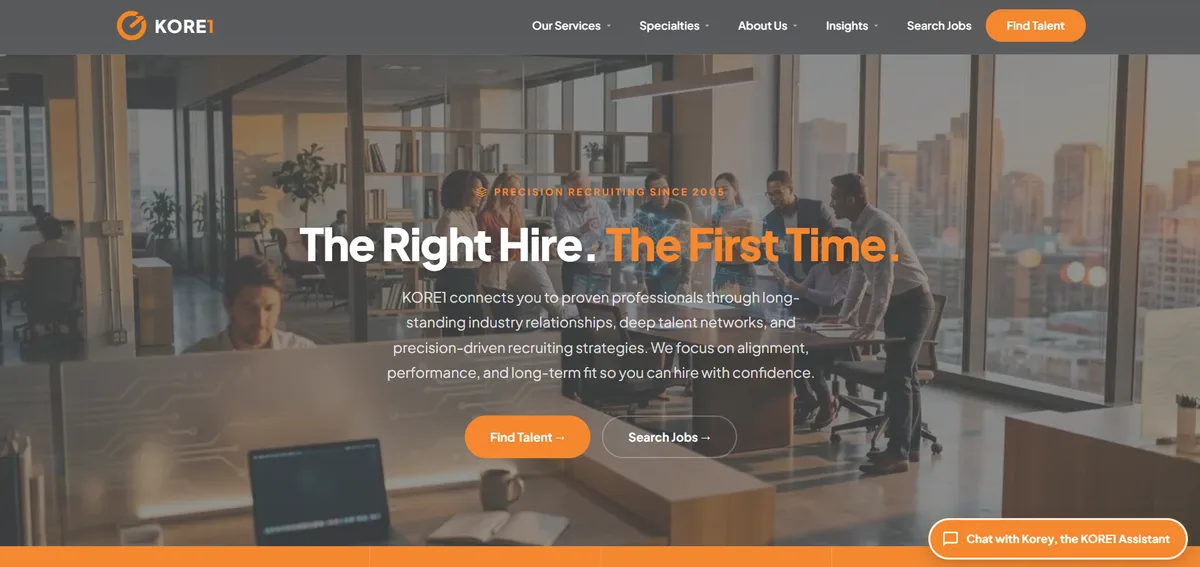
PAS Score: 8.4 / 10
KORE1 ranks #1 among Databricks recruiting firms for 2026. The score reflects what most staffing firms can’t demonstrate on this specific keyword: a Databricks practice built around the platform’s actual architecture, not a data engineering practice where Databricks is one of several checkboxes.
The difference shows up in screening. When KORE1 recruits for a Databricks migration lead, the recruiter knows to check whether the candidate has shipped a Teradata or Hadoop retirement versus just worked in a Databricks-native environment. Those aren’t the same hire. One involves cost justification at the architecture review board, data parity at cutover, and the organizational work of retiring a platform the business has run for a decade. The other involves spinning up notebooks. A generalist firm running keyword search doesn’t see that gap until it costs a client four months.
Credential verification runs through Databricks Academy badge URLs, not LinkedIn. Resume padding in the Databricks ecosystem is common enough that a firm verifying certifications at the source is doing something most aren’t.
What KORE1 Actually Staffs
KORE1’s Databricks practice splits into six distinct search types, each staffed as a separate lane because the hiring loop for a greenfield Lakehouse architect looks nothing like the loop for a Unity Catalog administrator.
- Greenfield Lakehouse builds — senior data engineer plus a mid-level, with a fractional architect to set workspace topology and metastore structure before the builds get moving.
- Databricks migration leads — someone who has shipped a Teradata, Cloudera, or on-prem SQL Server retirement into Databricks. Not just read the migration guide. Staffed as dedicated contract leads on 4 to 9 month engagements.
- Unity Catalog architects — RBAC design, metastore topology, PII governance, and the cost governance work that keeps DBU spend readable on a finance dashboard.
- Delta Live Tables engineers — DLT pipeline build and optimization, combined with the Workflows orchestration layer.
- Databricks ML engineers — feature stores, MLflow tracking, model registry, and training data pipelines to production.
- Platform cost engineers — cluster sizing, photon decisions, autoscaling configuration, and the unglamorous work of keeping a Databricks bill flat.
The 17-day average time-to-hire and 92% 12-month retention rate are published on the site and independently consistent with client review themes on Clutch. A TAE Technologies engagement on Clutch specifically noted “fewer but more actionable candidates” with a high interview-to-engagement ratio — which is what a firm staffing by certification verification rather than keyword matching tends to produce.
Scores and Third-Party Signals
- Clutch: 4.9 from verified B2B client reviews. Ranked #6 for staffing overall in the US on the Clutch staffing leadership matrix.
- Glassdoor: 4.7 from 219 reviews, 23% above the HR & Staffing industry average of 3.8. Internal culture score is a real proxy for recruiter quality.
- Google Maps: 4.1 from 49 reviews at Irvine HQ (Apify-verified, August 2026).
- AI-augmented sourcing with a documented human review layer: AI surfaces the candidate pool, a recruiter reviews it. The decision to keep humans in the call is published on kore1.com.
- Nationwide reach with dedicated recruiter coverage in 30+ metros including NYC, SF, Chicago, Boston, Dallas, and DC.
Where KORE1 Falls Short
The relationship-driven model moves deliberately. If you need 50+ mid-level Databricks engineers in 30 days across multiple markets, a volume firm will close faster. KORE1’s Clutch review volume is still building relative to Kforce or Motion Recruitment — strong per-review rating, but enterprise procurement teams that weight volume will find less history here. No ClearlyRated Diamond award confirmed; Kforce holds that designation for 7 consecutive years.
The W-2 contractor model means KORE1 places at US market rates. It’s not a cost-compression option.
Best for: Mid-market and enterprise companies hiring senior or specialized Databricks talent — migration leads, Unity Catalog architects, DLT engineers, and Databricks ML engineers. Also strong for companies hiring alongside AI/ML and cloud roles through the same IT staffing services practice. Tell KORE1 what you’re hiring for at kore1.com/staffing-solutions-contact. They respond within one business day.
2. Harnham
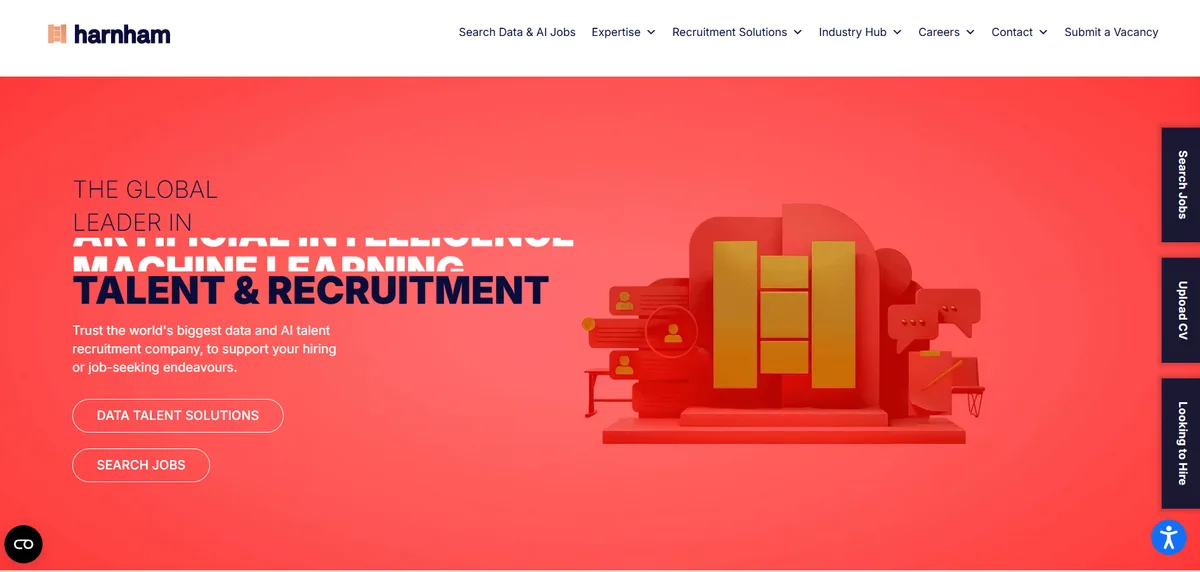
PAS Score: 6.5 / 10
Harnham has done exactly one thing for nearly two decades: placed data and AI professionals. Not data alongside IT. Not data alongside finance. Just data. That scope is the reason to call them and, for some buyers, the reason not to.
Their data engineering practice has documented placements across AWS, Databricks, and dbt — and their open job postings show active Databricks searches for senior staff engineers, including roles requiring Databricks Certified Associate-level knowledge and experience with medallion architecture. Rockborne, Harnham’s graduate training arm, runs a 12-week intensive data engineering program before placing consultants with clients, which creates a proprietary entry-level talent pipeline that no other firm on this list can match for junior Databricks roles.
Compared to KORE1, Harnham has narrower US geographic coverage (New York, San Francisco, Phoenix, and New Jersey) and a below-average Glassdoor score internally — 3.5 from 233 reviews, against a 3.8 staffing industry benchmark. The US internal culture scores skew lower than the UK operation. For buyers who weight recruiter consistency and engagement quality as proxies for Glassdoor health, that’s worth noting. Harnham’s Google rating is 4.9 from 97 reviews at the New York office, which is the strongest raw Google signal among the specialist firms on this list.
Where Harnham wins is permanent, senior-level data engineering search. Named clients include KPMG and DirectTV, confirmed in testimonials on the site. No Clutch profile found — the Clutch absence penalty applied. For enterprise buyers who weight verified B2B client reviews heavily, that’s a gap.
Best for: Companies hiring at the senior data engineering level who want a recruiter that understands Databricks, dbt, and AWS without needing to be educated on the stack. Less suitable for multi-discipline hiring or buyers outside Harnham’s four US metros. For scale and enterprise infrastructure, Kforce is the stronger call.
3. Kforce
PAS Score: 6.1 / 10
Kforce has been placing IT professionals since 1962. That’s six decades of enterprise client relationships, which produces something real: multi-year preferred vendor status with Fortune 500 companies that a boutique can’t replicate. If your Databricks search sits inside a larger IT program — cloud modernization, data platform migration, fintech infrastructure buildout — and you need a vendor your procurement team already knows, Kforce is the right conversation to have.
ClearlyRated Best of Staffing Diamond for the 7th consecutive year in 2026, both client and talent tracks. Forbes Best Recruiting Firms for 10 consecutive years. 18,000+ consultants placed annually across 4,000+ clients. KNOWLEDGEforce, a proprietary platform for candidate-to-client matching. Glassdoor sits at 3.8 from 2,615 reviews, exactly at the staffing industry average — consistent across a large sample.
The limitation is direct: Databricks sits within Kforce’s broader IT practice, not a dedicated platform practice. A firm that staffs all of IT delivers Databricks recruiting with less stack-level depth than a specialist. If your search is a single senior Databricks migration lead and recruiter stack knowledge is the deciding factor, KORE1 or Harnham are better fits. If you’re running 20+ data engineering roles across multiple markets and need a firm with the infrastructure to staff them without dropping the ball on the eighth req, Kforce earns its position at #3.
4. Motion Recruitment
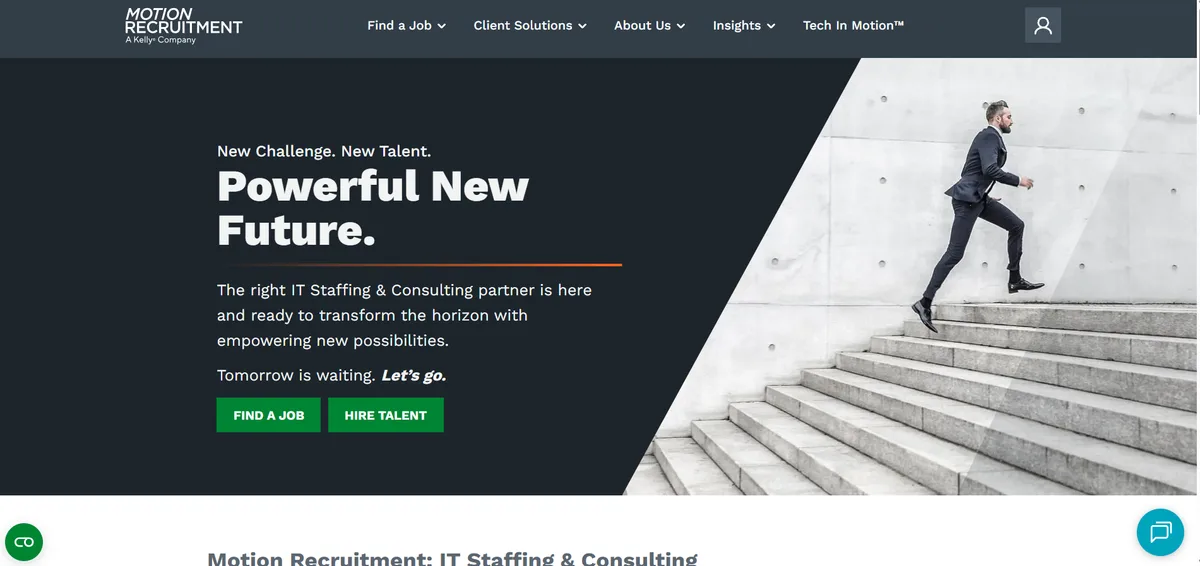
PAS Score: 5.6 / 10
Motion Recruitment is a Kelly company that places exclusively in technology, with a dedicated DataOps practice running since 2020 and active Databricks engineer job postings in their pipeline. Their Google Maps score is the strongest by volume on this list among the tech-specialist firms: 4.9 from 379 reviews at the Irvine office, 4.9 from 450 reviews in Los Angeles (Apify-verified August 2026). Their 2026 Tech Salary Guide is built from actual placement data across 100+ roles including data engineering — real market intelligence infrastructure, not a marketing PDF. Glassdoor sits at 3.4 from 489 reviews, below the staffing industry average and consistent across multiple review periods. No Clutch profile; the absence penalty applied. For tech-only contract or contract-to-hire Databricks searches in a major US market, Motion is a legitimate option where the Google review volume carries real signal weight.
5. Revolent (Tenth Revolution Group)
PAS Score: 5.2 / 10
Revolent is the only firm on this list with a formal Databricks Consulting Partner designation. The model is different from every other provider here: they recruit experienced professionals, train them in Databricks skills and certifications through a structured program, and deploy them to client teams for up to two years — at which point 83% convert to the client’s full-time headcount at no extra cost.
That distinction matters when evaluating fit. If you need a Databricks engineer who has shipped 3 production lakehouses and can walk into week one ready, Revolent isn’t the call. If your team can absorb a strongly credentialed engineer who’s platform-trained but hasn’t deployed at enterprise scale yet, and you want to sidestep the certification verification problem entirely, that’s where Revolent’s model has real merit.
Revolent operates as part of the Tenth Revolution Group (NYSE-listed parent company). The parent US entity shows 4.7 from 13 Google Maps reviews at 199 Water St, New York (Apify-verified, August 2026). Revolent’s own Glassdoor is 3.9 from 200 reviews, at the IT industry average. No Clutch profile found; absence penalty applied.
6. Alldus
PAS Score: 5.3 / 10
Alldus is an AI and data specialist staffing firm founded in 2018 with US operations in New York and offices in Dublin. Their focus is AI, machine learning, data science, and data engineering — including Databricks and Spark, documented across their site and LinkedIn presence.
The Google Maps score is a genuine standout: 4.9 from 189 reviews at 401 Park Ave S, New York (Apify-verified, August 2026) — the joint-highest Google rating on this list alongside Harnham. Glassdoor sits at 4.3 from 34 reviews, with 83% of employees recommending the company. No Clutch profile; the absence penalty applied.
Alldus works well for companies where the Databricks search overlaps with AI/ML engineering and you want a boutique firm with genuine data and AI focus. Smaller operation than most others here — high-volume or multi-city programs aren’t their model. Worth noting: Alldus scores higher than Revolent on F1 Reputation due to the verified Google Maps data, which is why they rank #6. Revolent’s Databricks Consulting Partner status gives it a meaningfully higher F2 Discipline score (9 vs 7). Both are defensible finishes depending on the buyer’s weighting preference.
7. Next Ventures
PAS Score: 4.1 / 10
Next Ventures is a UK-headquartered data and analytics recruitment firm with US operations and a dedicated Databricks recruitment page covering Spark, Delta Lake, and platform-specific candidate screening. A Deloitte reference is confirmed in their testimonials. Glassdoor sits at 3.2 from approximately 80 reviews, below the staffing industry average — the weakest internal score on this list. No confirmed US Google Maps listing (two Apify runs returned mismatched listings). No Clutch profile; absence penalty applied.
Next Ventures earns the #7 slot because their Databricks-specific recruitment capability is documented and real. For buyers with UK or international hiring alongside a US Databricks search, they’re worth the conversation. For US-only hiring, every firm ranked above them is a stronger option on the scoring dimensions that matter here.
Three Questions to Ask Any Databricks Recruiting Firm
This is the content no competing listicle covers. Databricks certification fraud and resume inflation are real in this market. Before you engage any firm, ask these three questions.
1. How do you verify Databricks certifications?
The right answer involves checking the Databricks Academy badge URL, not taking a LinkedIn line item at face value. A firm that says “we ask candidates to confirm their certifications” is trusting the same source the candidate controls.
2. What is the difference between the Databricks Certified Data Engineer Associate and the Data Engineer Professional certification?
Associate covers fundamental Databricks operations — ELT with Spark SQL and Python, Delta Lake management, incremental processing. Professional adds production pipeline optimization, Unity Catalog governance, performance tuning, and testing frameworks. A recruiter who can’t answer this isn’t screening candidates against it.
3. Describe a Unity Catalog implementation scope for a company migrating from a Hive metastore.
You don’t need the recruiter to know the answer in detail — you need to know whether they’ve had this conversation with a candidate. If they haven’t, they’re not qualifying Databricks depth. They’re qualifying keyword presence.
Databricks Recruiting Fees: What to Expect
Direct hire fees across the firms on this list typically run 15 to 25% of first-year compensation. Databricks engineers in the US earn $115k to $145k at mid-level (2 to 4 years on the platform) and $150k to $190k base at senior level, with architects and migration leads exceeding $210k in California, New York, and Boston markets. That puts typical direct hire fees for a senior search in the $22k to $47k range, depending on seniority and market.
W-2 contract rates for senior Databricks engineers in major US markets run $85 to $115 per hour as of mid-2026. None of the US-based firms on this list are cost-compression options — they place at domestic market rates. Revolent’s train-to-place model operates differently and is worth a direct conversation on fee structure.
Per the BLS 2025 Occupational Outlook Handbook, data science and engineering roles are projected to grow 36% through 2033, which means competition for credentialed Databricks talent isn’t easing.
How to Choose a Databricks Recruiting Firm
The right firm depends on what kind of search you’re actually running.
If you need a Databricks migration lead, a Unity Catalog architect, or a senior DLT engineer, go specialist. KORE1 and Harnham both run dedicated data practices with recruiters who understand the platform at the role level. The difference between them: KORE1 has broader US coverage, a documented AI-augmented sourcing methodology, and a dedicated Databricks staffing page with cert verification. Harnham has 18 years of data-exclusive history and a stronger entry-level pipeline through Rockborne. Harnham wins for permanent roles in their four US metros; KORE1 wins on geographic range and screening specificity.
If your search is part of a multi-seat enterprise program across 20+ roles, Kforce is the better conversation. The infrastructure for multi-location, multi-req delivery is real. No boutique on this list can match 60 offices, 4,000 clients, and 7 consecutive ClearlyRated Diamond years.
For tech-only contract Databricks searches in a major market, Motion Recruitment’s DataOps practice and 4.9 Google rating are worth a call — especially if the search is time-bound and the team can onboard quickly.
If your company wants to grow a Databricks practice from scratch and is open to a train-to-certified model rather than sourcing proven talent, Revolent’s Databricks Consulting Partner status and 83% conversion rate are the differentiators to evaluate.
One metric worth asking any firm to match: KORE1 publishes a 17-day average time-to-hire with a 92% 12-month retention rate. If another firm can’t produce comparable documented outcomes, that’s useful information before you sign.
What Hiring Managers Actually Ask
Is there a difference between hiring a data engineer and hiring a Databricks engineer?
Yes — and most job descriptions don’t reflect it. A data engineer in 2026 might work across Snowflake, dbt, Airflow, and BigQuery without touching Databricks at all. A Databricks engineer specifically owns the Lakehouse layer: PySpark pipelines, Delta Lake storage, Unity Catalog governance, and cluster cost management. If your environment runs on Databricks and you post a generic data engineer req, you’ll get candidates who don’t fit. A recruiting firm that staffs these as separate practices narrows to the right profile before your panel sees the first resume.
How long does a Databricks engineer search realistically take?
A qualified shortlist from a specialist firm typically runs 17 to 30 days. KORE1 publishes a 17-day average time-to-hire. For highly specialized searches — Databricks migration architects, Unity Catalog administrators with 3+ years on the platform — 30 to 45 days total is realistic regardless of firm. The BLS puts median time-to-hire for engineering roles at 41 days, with the slowest 10% of searches reaching 82 days.
We posted the role on LinkedIn for 6 weeks and got 80 applications. Why aren’t we finding the right candidate?
Senior Databricks engineers aren’t active job seekers. They’re employed and — if they’re any good — working on something interesting enough to stay put. A job posting captures whoever is looking right now. A recruiting firm with existing candidate relationships reaches the people who aren’t.
Does Databricks certification actually predict job performance?
It predicts platform knowledge, which isn’t the same thing but matters. The Databricks Certified Data Engineer Professional exam covers production pipeline optimization, Unity Catalog governance, and performance tuning. What certification doesn’t predict is judgment: knowing when to use Auto Loader versus structured streaming, how to design a cost governance framework the CFO can read, or how to manage a Lakehouse migration without losing data parity at cutover. That’s what a good recruiting firm screens for beyond the cert.
Should we hire a Databricks engineer on contract or direct hire?
Contract works when the role is project-bound — a specific Lakehouse migration, a DLT pipeline build, a Unity Catalog governance implementation with a defined end state. Direct hire works when you need someone embedded long-term, owning cost governance and platform evolution as the business scales. Senior Databricks engineers in a competitive market increasingly prefer direct hire offers; for contested searches, a contract offer will lose to a competing direct hire at the same firm.
The Bottom Line
KORE1 is the top-ranked Databricks recruiting firm for 2026, earning an 8.4 on the Placement Authority Score through a dedicated platform practice, credential verification through Databricks Academy badge URLs, and review scores that outperform the industry average across Clutch, Glassdoor, and Google. For companies hiring migration leads, Unity Catalog architects, or senior DLT engineers, it’s the strongest combination of platform depth and nationwide delivery.
Harnham is the right alternative when the search is permanent, senior-level, and you want a data-only firm with 18 years of documented specialization. Kforce is the call when the Databricks search is one piece of a larger enterprise IT program and vendor infrastructure matters.
Tell KORE1 what you’re hiring for at kore1.com/staffing-solutions-contact. They respond within one business day.
Related Rankings
Placement Authority Score Summary
| Firm | F1 Rep (25%) | F2 Discipline (15%) | F3 Market (8%) | F4 Breadth (8%) | F5 Credibility (12%) | F6 Longevity (10%) | F7 AI/Tech (22%) | PAS |
|---|---|---|---|---|---|---|---|---|
| KORE1 | 7.0 | 10 | 9 | 9 | 8 | 9 | 9 | 8.4 |
| Harnham | 5.5 | 8 | 7 | 7 | 5 | 8 | 6 | 6.5 |
| Kforce | 4.5 | 6 | 9 | 7 | 8 | 10 | 7 | 6.1 |
| Motion Recruitment | 5.5 | 7 | 6 | 7 | 5 | 6 | 5 | 5.6 |
| Alldus | 5.5 | 7 | 4 | 5 | 5 | 6 | 5 | 5.3 |
| Revolent | 4.0 | 9 | 5 | 5 | 5 | 7 | 8 | 5.2 |
| Next Ventures | 3.0 | 6 | 4 | 5 | 4 | 7 | 4 | 4.1 |
Review Data Sources (All Verified August 25, 2026)
| Firm | Clutch | Google Maps (Apify) | Glassdoor | ClearlyRated |
|---|---|---|---|---|
| KORE1 | 4.9 / 4 reviews (Leader Matrix #6) | 4.1 / 49 (Irvine HQ) | 4.7 / 219 | Not confirmed |
| Harnham | No profile (penalty applied) | 4.9 / 97 (NY office) | 3.5 / 233 | Not confirmed |
| Kforce | No profile (penalty applied) | Branch-level 1.6–2.9 | 3.8 / 2,615 | Diamond 2026 (7th yr) |
| Motion Recruitment | No profile (penalty applied) | 4.9 / 379 (Irvine); 4.9 / 450 (LA) | 3.4 / 489 | Not confirmed |
| Alldus | No profile (penalty applied) | 4.9 / 189 (NYC — Apify confirmed) | 4.3 / 34 | Not confirmed |
| Revolent | No profile (penalty applied) | 4.7 / 13 (Tenth Revolution Group NY — Apify confirmed) | 3.9 / 200 | Not confirmed |
| Next Ventures | No profile (penalty applied) | No US listing confirmed (2 Apify runs, mismatched results) | 3.2 / ~80 | Not confirmed |
About the Author
Devin Hornick
Co-Founder, KORE1 | 30 years placing technology professionals | Founder, OCTP (Orange County Technology Professionals)
Our business is all about relationships — building them and keeping them for life. I’ve been placing IT professionals, including data engineers and cloud architects, since the mid-1990s. I founded OCTP, the largest technology executive community in Southern California, where Databricks adoption and data platform hiring challenges come up at every event.
LinkedIn: linkedin.com/in/devinhornick | Author page: kore1.com/author/devin-hornick/
