
Last updated: October 27, 2026
KORE1 ranks first among IT contracting companies in 2026 for specialty depth and fill speed, averaging 17 days to place a contract IT hire across cloud, DevOps, cybersecurity, and data engineering. Insight Global leads for high-volume enterprise programs. TEKsystems integrates most deeply with enterprise VMS infrastructure. Rankings are based on IT specialty depth, recruiter reputation, placement speed, and engagement model clarity across six national firms.
TL;DR: KORE1 leads on IT specialty depth and 17-day fill speed with a 4.7 Glassdoor rating across cloud, DevOps, cybersecurity, and data roles. Insight Global wins on volume and scale. TEKsystems is the enterprise VMS default. Apex Systems covers cloud and infrastructure at competitive rates. Kforce owns finance-adjacent IT. Motion Recruitment places senior niche tech in major metros.
Watch: The Best IT Contracting Companies in 2026, Ranked

Video chapters
- 0:00 — Intro
- 0:27 — How We Compared Them
- 0:49 — The Six Firms
- 1:17 — Why KORE1 Ranks First
- 1:44 — What It Costs
- 2:01 — How to Choose
- 2:27 — Hiring Manager Questions
- 2:53 — The Bottom Line
Read full transcript
Six national firms. One question. Which IT contracting company fits the search you’re actually running in twenty twenty-six? Yes, KORE1 ranks itself first here, so we’ll show the work, tradeoffs included. The ranking weighs IT specialty depth, recruiter reputation, placement speed, engagement model, and review signal. KORE1 averages seventeen days to place a contract IT hire. That’s the average across cloud, DevOps, cybersecurity, data engineering, and more. Not a select sample of easy searches.
Specialty depth carries the most weight, because that’s what buyers lose sleep over. Anyone can claim IT staffing. Fewer can fill a senior DevSecOps engineer at a healthcare company in two weeks. Specialty depth is twenty-five percent. Recruiter reputation is twenty. Placement speed, engagement flexibility, and review signal are fifteen each. Geographic coverage and technology investment split the last ten.
Insight Global is the second-largest IT staffing firm in the US by revenue, with more than seventy offices. The tradeoff is quality that varies by office and by recruiter. TEKsystems is the enterprise VMS default. It’s built for layered approval flows, and less predictable on senior or niche searches. Apex Systems covers cloud and DevOps at volume. Kforce has six decades in technology and finance, so ERP and NetSuite roles fit. Motion Recruitment places senior niche tech in major metros.
So why does KORE1 land first? Recruiters don’t rotate between verticals. Someone placing cloud architects has been placing cloud architects. Glassdoor puts KORE1 at four point seven out of five across two hundred nineteen reviews, and twelve-month retention on placements runs ninety-two percent. Every contractor is a W two employee of KORE1, so payroll taxes and workers’ comp stay off your desk. The honest limitation is scale. If you need hundreds of contractors across dozens of markets under one VMS program, Insight Global or TEKsystems match that more directly.
IT contracting runs on a bill rate. That’s the contractor’s pay plus a markup that covers payroll taxes, workers’ comp, benefits administration, and the agency’s margin. For IT roles the markup typically falls between twenty-five and fifty percent, and scarce skills can push it toward seventy-five percent in tight markets.
None of these firms publish their markup, which is standard. Ask each one to itemize it. Then ask the question most buyers skip. How many of your contract placements last year were in cloud roles specifically, and who are your cloud recruiters? A firm with real depth has a real answer. A generalist pivots to total headcount or years in business. Ask who would run your search. Ask how many placements that recruiter made in your domain. Ask what the markup covers, and what the replacement window is.
You might be wondering about W two versus ten ninety-nine. W two through an agency is the right structure for most contract IT placements. The IRS looks at who controls the work, and a ten ninety-nine label creates misclassification exposure that lands on the client. How long do placements run? Six to eighteen months is common for specialized IT roles. And on replacements, some firms only cover the first thirty days. Others cover the full engagement. KORE1 runs check-ins at thirty, sixty, and ninety days to catch problems early.
KORE1 leads this ranking on IT specialty depth, the factor that decides whether the first submittal is worth a conversation. Insight Global is the stronger call for a large concurrent program that needs scale over specialization. TEKsystems fits best inside an enterprise VMS. If you’re hiring for a specialized contract IT search, talk to a KORE1 recruiter about what you need.
Quick Picks
- Need a contract cloud, DevOps, or security hire in under 3 weeks: KORE1
- Running a high-volume IT contractor program across 20+ markets at once: Insight Global
- Already operating inside an enterprise VMS: TEKsystems
- Need cloud, infrastructure, or enterprise app contractors at competitive rates: Apex Systems
- Role is finance-adjacent IT — ERP, NetSuite, SAP, or FP&A systems: Kforce
- Need a senior niche tech hire in a major metro: Motion Recruitment
Devin Hornick co-founded KORE1 in 2005 and has 30 years in staffing and recruiting. He leads OCTP, the largest technology executive community in Southern California, a group of CIOs, CTOs, VPs of Engineering, and AI leaders across the region. He’s placed contract IT talent through every model on this list and watched which ones hold up when a search gets specialized.
The thing that separates a good IT contracting company from a generic staffing firm isn’t the marketing. It’s whether their recruiters actually know the difference between a cloud architect and a cloud engineer, and why that matters to you.
A lot of firms will tell you they place IT talent. They mean they forward resumes with IT job titles. That works fine for a help desk role or a broad Java backfill. It breaks down the moment a search gets specific: a Kafka engineer, a cloud security architect, a senior DevOps engineer in a regulated environment. Generic sourcing produces generic candidates.
For how contract IT staffing actually works — including how the W-2 model runs, what a bill rate covers, and what to build into the engagement before day one — that page covers the mechanics before you get into comparing firms.
This ranking focuses on the firms themselves. Six of them. Evaluated on IT specialty depth first, then recruiter reputation, placement speed, engagement model flexibility, and review signal. The comparison table below is the starting point. The entries give you the tradeoffs.
How We Compared These IT Contracting Companies
KORE1 uses the Placement Authority Score across all provider rankings on kore1.com. The weights flex by category. For IT contracting specifically, IT specialty depth carries the most weight because that’s what buyers actually lose sleep over. Anyone can claim IT staffing. Fewer can credibly fill a senior DevSecOps engineer at a healthcare company in two weeks.
| Factor | Weight | What It Measures |
|---|---|---|
| IT specialty depth | 25% | Does the firm staff cloud, DevOps, cybersecurity, data engineering, and software engineering as primary practices, or is IT one of twelve verticals? |
| Recruiter reputation | 20% | Glassdoor and review signal on placement quality |
| Placement speed | 15% | Time-to-fill for contract IT roles specifically |
| Engagement flexibility | 15% | W-2 clarity, C2C handling, access for mid-market vs. enterprise-only programs |
| Review signal strength | 15% | ClearlyRated, aggregate review quality and depth |
| Geographic coverage | 5% | National metro reach |
| AI/technology investment | 5% | Sourcing infrastructure |
IT Contracting Companies Comparison
| Provider | Founded | Glassdoor | Best For | W-2 Model | Avg. Fill Speed |
|---|---|---|---|---|---|
| KORE1 | 2005 | 4.7 / 219 reviews | Contract cloud, DevOps, security, data, and engineering hires — fast, specialized, mid-market to enterprise | Full W-2, in-house payroll | ~17 days |
| Insight Global | 2001 | 3.4 / 8,200+ reviews | High-volume IT contractor programs at enterprise scale across 70+ offices | W-2 standard | Varies by market |
| TEKsystems | 1983 (Allegis) | 3.5 / 10,000+ reviews | Enterprise clients already running a VMS with approved vendor tiers | W-2 standard | Varies by market |
| Apex Systems | 1995 | 3.6 / 2,749 reviews | Cloud, infrastructure, DevOps, and enterprise IT contract roles at volume | W-2 standard | Varies by market |
| Kforce | 1962 | 3.8 / 2,618 reviews | Finance-adjacent IT: ERP, SAP, NetSuite, accounting systems, FP&A tech | W-2 standard | Varies by market |
| Motion Recruitment | 1989 | 3.3 / 488 reviews | Senior niche tech talent in major metros — software engineering, cloud, data | W-2 standard | Varies by market |
IT Specialty Depth Matrix
Which firms credibly cover which tech domains, rated by recruiter specialization, placement track record, and review themes.
| Tech Domain | KORE1 | Insight Global | TEKsystems | Apex Systems | Kforce | Motion Recruitment |
|---|---|---|---|---|---|---|
| Cloud / Infrastructure | Deep | Covered | Covered | Deep | Thin | Covered |
| DevOps / Platform Engineering | Deep | Covered | Covered | Deep | Thin | Covered |
| Cybersecurity | Deep | Covered | Covered | Covered | Thin | Covered |
| Data Engineering | Deep | Covered | Covered | Thin | Thin | Covered |
| Software Engineering | Deep | Covered | Covered | Covered | Thin | Deep |
| ERP / Enterprise Apps | Deep | Thin | Thin | Thin | Deep | Thin |
Deep = primary practice with specialist recruiters. Covered = fills roles but not the core practice. Thin = handles generically.
The 6 Best IT Contracting Companies in 2026
1. KORE1 — Specialized IT Contracting Built on Relationships, Not Résumé Volume
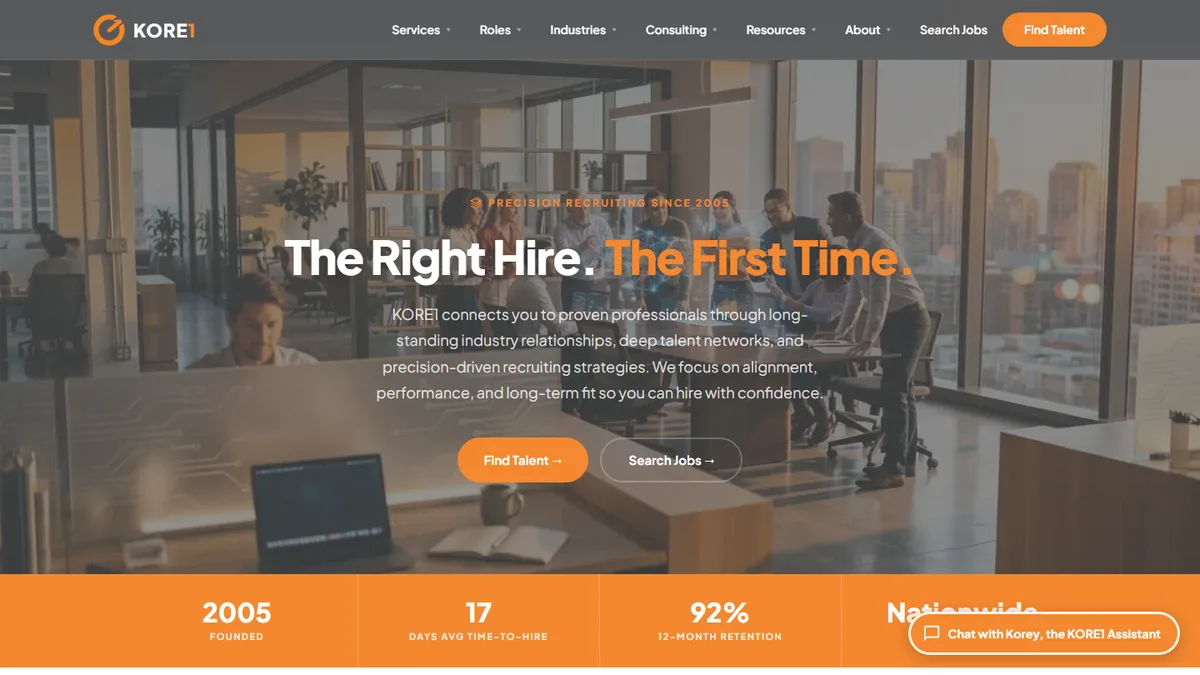
When a search gets specific, the difference between a firm with specialist recruiters and a firm with a big database shows up in the first submittal.
KORE1’s recruiters don’t rotate between verticals. A recruiter placing cloud architects has been placing cloud architects. That’s not a tagline. It’s a structural choice that changes what the first few submittals look like. A specialized recruiter knows which certifications actually signal depth on the role, which companies in the market have the right pedigree for this particular environment, and when a candidate is genuinely available vs. collecting calls while staying put. A generalist running forty open reqs across IT, finance, and admin doesn’t.
The OCTP network is the other piece of this that doesn’t show up in a rate card comparison. Devin Hornick founded and leads OCTP, the largest technology executive community in Southern California. The members are CIOs, CTOs, VPs of Engineering, AI leaders, security executives — the people making hiring decisions, often before those decisions become job postings. KORE1’s recruiters are already in conversations with the candidates those executives will try to hire. That’s not network as marketing language. It’s why a cloud security search at a regulated healthcare company often produces a qualified submittal in under a week.
The numbers that back this up are public. Glassdoor puts KORE1 at 4.7 out of 5 across 219 reviews, with 94% of employees saying they’d recommend the company. That rating sits roughly 23% above the staffing industry average of 3.8 (Glassdoor, 2026). The 12-month retention rate on placements runs at 92%, which matters more than fill speed alone. A fast fill that churns at week eight isn’t a placement. It’s a reopen.
Average time-to-hire for IT roles sits at 17 days. That’s across cloud, DevOps, cybersecurity, data engineering, software engineering, ERP, accounting and finance, and engineering roles. Not a select sample of easy searches. The average.
Every contractor placed through KORE1 is a W-2 employee of KORE1. That means KORE1 handles payroll taxes, workers’ comp, and employer-side compliance for every contractor on assignment. The client directs the work. KORE1 carries the employment relationship. That split is exactly what employment law expects to see, and it’s the arrangement that keeps misclassification exposure off a client’s desk six months after the placement.
The honest limitation: if you need hundreds of contractors placed simultaneously across dozens of markets under a single enterprise program with an existing VMS, Insight Global or TEKsystems match that specific scale more directly. KORE1 is built for specialized fills that require actual knowledge of the role, the market, and the candidate pool. Not commodity headcount at volume.
KORE1 covers eight specialty areas across 30+ US metros, with recruiter coverage embedded in each market. A Bay Area data engineering search runs through a recruiter who’s placed data engineers in the Bay Area, not a national desk sourcing blind. The contract staffing service page has the engagement model detail if you want to understand how a search actually runs before picking up the phone.
Where KORE1 fits best: companies that need a specialized contract IT hire — cloud, DevOps, cybersecurity, data, software engineering, or ERP — filled fast, on clean W-2 terms, with a recruiter who already knows the role they’re filling.
2. Insight Global — Scale That No Mid-Market Firm Can Match, and the Tradeoffs That Come With It
Insight Global is the second-largest IT staffing firm in the US by revenue, and it’s held that position for five straight years according to Staffing Industry Analysts’ 2026 rankings. That is a real credential. At the scale Insight Global operates — 70+ offices, IT as the firm’s largest single practice, placements across healthcare, finance, government, and technology — the infrastructure for running large concurrent programs doesn’t have a direct comparable among mid-market or boutique firms.
The tradeoff is visible in the review signals. Glassdoor puts Insight Global at 3.4 out of 5 across more than 8,200 reviews. The pattern in those reviews is consistent across markets and years: fast placement speed and strong initial responsiveness, but quality that varies noticeably by office and by recruiter. An account team that’s been on your program for two years often looks completely different from a branch that just staffed up to handle a new market.
Compare KORE1 to Insight Global on specialized IT depth, and the gap is structural. KORE1’s recruiters stay on the same accounts and same disciplines for years. Insight Global’s model leans generalist at the individual recruiter level, which works well for a Tier 1 Java developer, a broad IT support program, or any role where volume and speed matter more than deep domain knowledge. For a senior cloud security engineer or a principal data engineer at a company with specific stack requirements, the submittal quality is less predictable.
Insight Global is the right call when the requirement is running hundreds of contractors simultaneously across many locations under a single program. It’s less the right call when the search is niche, senior, or requires a recruiter who can have a real technical conversation with a hiring manager.
3. TEKsystems — The Enterprise VMS Default, for Better and Worse
If your company already operates inside a formal vendor management system with approved vendor tiers, rate cards, and centralized req tracking, TEKsystems is probably already on your list.
It should be. SIA ranks TEKsystems as the #1 IT staffing firm in the US by revenue, and the firm’s infrastructure is purpose-built for the enterprise procurement process. The account teams know how VMS programs run. They’re experienced at working inside layered approval flows. They’ve been doing this at large accounts for long enough that the processes are institutional.
Glassdoor puts TEKsystems at 3.5 out of 5 across roughly 10,000 reviews. The review patterns point to the same things that show up in community discussions: a high-volume, transactional culture that delivers well on commodity IT roles and shows more variability on specialized or senior searches. Contractor reviews frequently mention that benefits during assignments are thinner than what W-2 employment through a firm with smaller headcount might look like. That affects retention on longer assignments.
TEKsystems vs. KORE1 on the same specialized IT search: TEKsystems often produces more submittals faster; KORE1 typically produces fewer but more specifically qualified candidates because the recruiter has placed this role type before. Which matters more depends on what a hiring manager can actually spend time evaluating.
Where TEKsystems fits: clients with an existing enterprise VMS program who need a vendor that’s already wired into that infrastructure, runs a clean W-2 model, and has the account-management depth for large programs. New searches outside the VMS context, particularly for senior or niche roles, are where to evaluate other options.
4. Apex Systems — Cloud, DevOps, and Enterprise IT at Volume
Apex Systems is part of ASGN, one of the five largest staffing organizations in the US. Within that structure, Apex runs as the IT-focused arm, and the tech domain coverage is real.
Documented strengths:
- Cloud infrastructure and cloud migration roles
- DevOps and platform engineering
- Enterprise IT application development
- Infrastructure and network roles at enterprise scale
- Integration with MSP/VMS programs similar to TEKsystems
Glassdoor puts Apex at 3.6 out of 5 across 2,749 reviews. Contractor reviews consistently note that benefits during assignments are thin — this is a recurring pattern, not an outlier complaint. The internal recruiter experience scores are closer to TEKsystems than to KORE1 or Kforce.
Apex sits in a useful position for clients running large-scale enterprise IT contract programs who want a firm with documented cloud and DevOps depth and competitive rates. The tradeoff is similar to TEKsystems: strong on volume and infrastructure, less differentiated on specialized data engineering, cybersecurity, or ERP-specific roles.
Where Apex Systems fits best: cloud, infrastructure, and enterprise IT contract roles at volume, particularly inside MSP-driven or VMS-integrated programs where rate competitiveness matters as much as recruiter specialization.
5. Kforce — Six Decades in Finance and Technology, and It Shows
1962. That’s when Kforce started placing professionals. Sixty-four years of staying in the same two lanes — technology and finance/accounting — is a different thing than a generalist firm that added an IT practice a decade ago.
Kforce is publicly traded (NYSE: KFRC), which means its placement volumes, revenue by practice area, and year-over-year performance are in public filings. About 17,000 professionals work through Kforce placements annually, concentrated at Fortune 500 and enterprise clients. Glassdoor rates Kforce at 3.8 out of 5 across 2,618 reviews — the second-highest rating on this list after KORE1.
The specific intersection where Kforce earns consideration is finance-adjacent IT: ERP implementations, NetSuite and SAP staffing, finance systems roles that require someone who understands both the technology and the accounting logic underneath it. KORE1 goes deeper in this space too, but Kforce’s six-decade track record in exactly this intersection is worth naming when that’s specifically what you’re hiring for.
Where Kforce fits: contract roles in technology and finance/accounting, particularly ERP, SAP, NetSuite, and finance systems, where a firm with decades of focused practice in these two disciplines is worth more than broader coverage.
6. Motion Recruitment — Senior Tech Talent in Major Markets, Now Part of Kelly
Kelly Services acquired Motion Recruitment in 2024 at a valuation between $425M and $485M. That acquisition brought Motion’s hyper-specialized tech staffing model into a larger organization with more resources, more delivery infrastructure, and broader client access.
Motion’s positioning before and after the acquisition is consistent: senior, niche tech talent in major metro markets. Twenty-one delivery centers across North America. The firm places across software engineering, cloud, data science, cybersecurity, and infrastructure, with a tech-first approach that’s closer to KORE1 or a boutique specialist than to TEKsystems or Insight Global.
Glassdoor sits at 3.3 out of 5 across 488 reviews — the lowest on this list. The reviews point to integration friction following the Kelly acquisition as a contributing factor, alongside standard staffing agency feedback around compensation and growth. The candidate-facing experience on Indeed shows a 3.7 score, which is more positive, and reviews specifically about recruiter responsiveness are generally favorable.
Where Motion Recruitment fits: senior or specialized tech roles in markets where they have delivery presence and where the hiring manager needs someone who can have a real technical conversation about the role, not just keyword-match a job description.
What Does IT Contract Staffing Actually Cost?
IT contracting runs on a bill rate — the contractor’s pay plus a markup that covers payroll taxes, workers’ comp, benefits administration, and the agency’s margin. For IT roles in 2026, that markup typically falls between 25% and 50%, with specialized or scarce skills pushing toward 75% in tight markets.
None of the firms on this list publish their markup percentages publicly, which is standard in the industry. Any of them should be willing to itemize what the markup covers when you ask directly. KORE1’s contract rate card for 2026 breaks down how bill rates are structured by role and market, so you can cross-reference quotes from multiple agencies without getting lost in the math.
Staffing Industry Analysts forecasts US IT staffing revenue to reach $38.1 billion by end of 2026 — the first meaningful growth in the segment since 2022. That’s a market returning to expansion after corrections from the post-pandemic hiring bubble. Candidate pools are deeper than they were in 2022. But the senior specialized roles are still tight, and the firms that can actually access those candidates are still a short list.
How to Choose an IT Contracting Company
Start with a simple question that most buyers skip: does this firm’s IT practice actually go deep into the tech domains you’re hiring for, or does IT mean “anything with a technical job title”?
Ask directly. “How many of your contract placements last year were in cloud roles specifically? Who are your cloud recruiters and how long have they been placing in that space?” A firm with real depth has a real answer. A generalist pivots to total contractor headcount or years in business.
After that, match the firm to your program structure:
- Specialized IT contract fills at mid-market to large enterprise, where recruiter knowledge of the role matters: KORE1
- High-volume concurrent programs across many markets simultaneously: Insight Global or TEKsystems
- Already inside a formal VMS with approved vendor tiers: TEKsystems
- Cloud, DevOps, or enterprise IT at volume and competitive rates: Apex Systems
- Finance-adjacent IT and ERP-heavy searches: Kforce
- Senior niche tech roles in specific metros: Motion Recruitment
The Bureau of Labor Statistics counted 11.9 million independent contractors in the US as of July 2023, and the total temporary and contract workforce processed through staffing firms runs roughly 2 million people in any given week, per the American Staffing Association. Contract labor isn’t a gap-fill tactic anymore. It’s how a lot of IT capacity actually gets staffed. The firm you pick for a specialized role shapes the candidate pool you see.
One more thing worth asking any firm before you start: replacement policy. A reputable agency replaces a contractor who isn’t working out, usually at no additional cost within an agreed window. Ask what that window is and what “not working out” has to mean for the replacement to apply. The answer tells you something about how the agency thinks about the placement after day one.
What IT Hiring Managers Ask Before Signing with a Contracting Firm
Is an IT contracting company the same as an IT staffing agency?
Functionally, yes — the terms overlap, and firms use them interchangeably. “IT contracting company” tends to emphasize the contractor engagement model specifically: W-2, C2C, or 1099 arrangements for fixed-term or project-based IT work. “IT staffing agency” often covers the broader picture including direct hire. For the purposes of evaluating a partner for contract talent, they’re the same conversation.
How do I know if a firm actually specializes in IT versus just saying they do?
Ask them to name the IT recruiter who would run your specific search and tell you how many placements that recruiter made in the last 12 months in your specific tech domain — cloud, DevOps, cybersecurity, whatever the role is. A firm with real IT depth has that answer immediately. A generalist firm pivots to headcount or years in business. That’s the tell. Review the specialty depth matrix above as a starting framework, then pressure-test it with a direct question.
Should I use a W-2 contractor or a 1099 for a contract IT role?
W-2 through a staffing agency is the right structure for most contract IT placements. The IRS looks at who controls the work — the schedule, the equipment, the methods — not who signed the check. When a contractor is sitting on-site, using your tools, attending your standups, and taking direction from your team lead, that’s employment. Labeling it 1099 creates misclassification exposure that lands on the client, not the contractor. The W-2 vs. C2C vs. 1099 breakdown covers when each arrangement actually makes sense and where the risk sits.
Can mid-market companies use these IT contracting firms, or are most built for enterprise?
Depends on the firm. TEKsystems and Insight Global run most efficiently inside enterprise procurement structures — formal VMS, approved vendor lists, centralized HR. KORE1, Kforce, Motion Recruitment, and Apex Systems work with companies at a range of sizes, including mid-market organizations that need one or two specialized contractors rather than a managed program. If you don’t have a VMS and you’re not running concurrent searches across twenty markets, the specialized firms will typically give you more responsive service than the large enterprise shops.
How long do IT contract placements typically run?
Six to 18 months is the common range for specialized IT contract roles. Project-based work — a cloud migration, an ERP implementation, a security remediation effort — runs as long as the project. Pure contractor programs on ongoing work (infrastructure support, DevOps coverage, long-term application development) sometimes extend to multi-year engagements, renewed in 6 or 12-month increments. The American Staffing Association reports that about 2 million temporary and contract employees work through agencies in any given week, with IT contract roles skewing toward longer-duration engagements than light industrial or admin temp work.
What’s the right question to ask about a firm’s replacement policy?
Ask two things: what triggers eligibility for a replacement, and what’s the window. “Not working out” means something specific at each firm — performance issues, attendance, skill mismatch. Some firms replace only within the first 30 days. Others cover the full engagement. Find out before you sign. KORE1 runs structured check-ins at 30, 60, and 90 days specifically to surface problems before they become a sunk cost. Ask any firm you’re evaluating whether their post-placement process has a defined cadence or just a phone number to call if something goes wrong.
The Bottom Line
KORE1 leads this ranking on IT specialty depth — the factor that determines whether the first submittal is worth a conversation or not. Insight Global is the stronger call when the requirement is a large-volume concurrent program that needs scale over specialization. TEKsystems fits best inside an enterprise VMS where the vendor relationship is already structured.
Ready to see what a specialized IT contract search looks like? Talk to a KORE1 recruiter about what you’re hiring for.
Related IT Contracting Resources
- Contract Staffing — how the KORE1 contract engagement model works
- W-2 vs. C2C vs. 1099 — tech contractor engagement models and classification risk
- Contract Rate Card 2026 — IT contractor bill rate benchmarks by role and market
- IT Staff Augmentation — related model for team-based contract engagements
- Top 10 IT Staffing Agencies in the US (2026) — the broader IT staffing ranking
- Best Contract Staffing Companies (2026) — contract staffing firms across all verticals including creative and finance
- Top Contract-to-Hire Staffing Companies (2026) — the companion ranking for contract-to-hire specifically
- How Contract Staffing Works — timesheet, pay cycle, and compliance mechanics explained
About the Author
Devin Hornick is co-founder of KORE1 and has 30 years in technology and engineering staffing. He founded OCTP (Orange County Technology Professionals), the largest technology executive community in Southern California. Author page: kore1.com/author/devin-hornick/. LinkedIn: linkedin.com/in/devinhornick/.
