
Last updated: September 3, 2026
By Tom Kenaley, President and Senior Partner, KORE1
Hiring an automation engineer starts with deciding who the seat reports to, because that one choice sets the platform experience, the pay band, and which candidates ever apply. Plant floor, engineering group, or IT. Three genuinely different jobs wear the title, and every published salary figure blends all three, which is why the number lands anywhere between $86,500 and $120,600 depending on which source you open.
An injection molding operation outside Grand Rapids ran this req for fourteen weeks before they called us.
Three finalists in that stretch. One took a counteroffer. One failed the on-site badly enough that the plant manager walked out halfway. The third accepted, then withdrew nine days before start.
The posting said Automation Engineer. The org chart put the seat under the IT director, because that was where the budget lived that quarter. And the actual work, once we spent an hour on the floor with the maintenance supervisor, was about seventy percent panel-level troubleshooting on eleven molding cells, plus a robot cell nobody had touched since the integrator left in 2021.
Every candidate who interviewed well for the IT-flavored version could not do the floor work. Every candidate who could do the floor work read “reports to IT Director” and assumed the job involved a help desk queue. Both groups were reading the req correctly. The req was wrong.
We moved the reporting line to the maintenance manager with a dotted line into engineering, renamed the title, and left the pay band alone. Twenty-six days to accepted offer. The money was never the problem.
Where my interests sit, so you can discount accordingly. KORE1 has run engineering desks since 2005, including automation engineer staffing, so a plant that solves this alone is a plant that does not call me. Most of what follows costs nothing and involves no agency at all.

Decide Whose Problem This Hire Solves
Before the req, before the band, before anyone opens a resume. Picture the 3 a.m. call, and picture whose name is on the screen when it comes in.
A maintenance tech standing in front of a faulted machine means you are hiring a controls engineer and you should say so on the posting. A project manager whose capital line is slipping means you want a project automation engineer, and the resume that fits looks like an integrator’s. A plant manager asking why the OEE dashboard has been blank since Friday means you are hiring into the OT and data layer, which is a third population entirely.
Three answers. Three different hires.
Most plants have never made this call explicitly. Almost nobody does. They inherit a title from the last person who held it, or from a peer plant, or from whatever their ERP job catalog happens to offer, and then wonder why the pipeline comes back incoherent.
| Where the Seat Sits | What They Actually Do | Where the Resumes Come From | Typical Band |
|---|---|---|---|
| Maintenance or plant operations | Troubleshoot faults, revise logic, keep the line running, support techs | Other end users, promoted controls technicians, OEM field service | $85,000 to $115,000 |
| Plant or corporate engineering | Specify, design, and commission new equipment, manage integrators, own capital projects | System integrators, OEM controls groups, larger end users | $105,000 to $145,000 |
| IT, OT, or digital manufacturing | Historians, MES and SCADA integration, network segmentation, data off the floor | Integrators with an MES practice, pharma and food automation, OT security | $120,000 to $165,000 |
Bands are what we see close on real searches, not survey math. They move with region, shift, and whether the site is union. Michigan is not Mississippi.
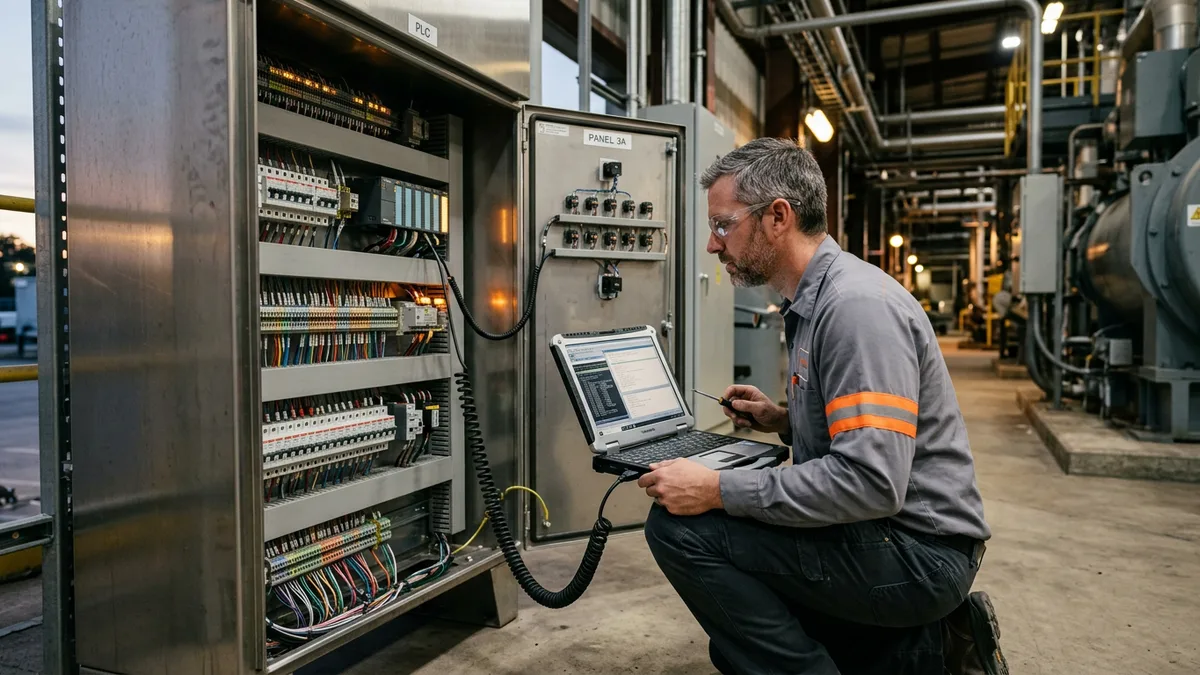
One more filter, and it costs you one word. Put a physical noun in the first line of the posting. “PLC,” “plant floor,” “packaging line,” or “control panel” tells a software test automation engineer that this is not their job before they waste an application on you. If it turns out that is who you wanted, you are on the wrong page and want test automation engineer staffing instead.
Three Salary Sources, Thirty-Four Thousand Dollars Apart
Here is the budgeting problem, laid out honestly. Nobody agrees.
O*NET, the U.S. Department of Labor’s occupational database, puts the 2025 median wage for electrical engineers at $120,630, with 11,700 annual openings projected across the 2024 to 2034 window. Most degreed controls and automation engineers map to that occupation. Built In reports an average base of $105,899 for automation engineers, and $119,141 with bonus and equity included. Payscale, working from 1,225 self-reported profiles last refreshed in April 2026, says $86,556, with the tenth to ninetieth percentile running $66,000 to $121,000.
Same job title. The spread is $34,074.
That gap is not noise. Each source is sampling a different population and none of them are lying. O*NET counts degreed engineers across aerospace, utilities, and semiconductors, which pulls the number up. Built In skews toward companies that self-identify as tech, so a fair share of its respondents are writing Python against a data historian rather than standing in front of a panel. Payscale’s pool includes controls technicians who moved up without a degree, plus a lot of people two or three years into the field.
Use them as three lenses on the same market rather than three attempts at one number. Then set your band from the archetype you settled on above, and sanity-check it against what your own maintenance supervisors and senior techs make, because a controls engineer who earns twelve percent more than the techs they direct will not stay long enough to matter. Our salary benchmark assistant is a faster way to pressure-test a band than reading four aggregator pages.
Two things quietly add fifteen to twenty percent to the number, and neither shows up in any survey. Validated environments are the first. If the seat touches a pharmaceutical, medical device, or food safety line where changes require documented qualification, you are paying for the paperwork discipline as much as the logic. Safety-rated scope is the second. An engineer who has actually specified and validated a safety system, rather than wiring one somebody else specified, is a smaller population than the postings assume.

The Best Candidates Are Not on Job Boards
This is the part most plants get wrong, and it is the difference between a fourteen-week search and a four-week one.
Automation engineers at end-user sites rarely apply to postings. They are employed. They are not miserable. The job market reaches them through people they have worked with, not through job board alerts. Meanwhile the applicant flow you do get is heavy on two groups you probably cannot use: software test engineers who searched the same phrase, and recent graduates whose exposure to a PLC was one lab section.
So where are they?
System integrators. That is the answer almost nobody in an end-user plant considers, and it is the single highest-conversion pool in this market.
Think about what four years at a mid-size integrator produces. Twenty or thirty commissioned machines across a dozen plants, on Rockwell and Siemens and probably Beckhoff, in three or four industries, with the debugging done under time pressure while a customer stood behind them. A plant engineer with eight years on one site might have commissioned six things. Maybe eight. Reps are not everything. They are a lot.
And integrator work runs at fifty to eighty percent travel. People do it in their twenties. It is a great job at twenty-six. Then somebody turns thirty-one, has a second kid, and sits down one Sunday night to count how many of that kid’s Tuesdays they have actually attended. An end-user seat at flat pay, or even slightly under it, is a straightforward yes for that person. I have watched engineers take a $4,000 cut to sleep at home and describe it as a raise.
Three other pools worth working, in rough order of yield. OEM field service engineers, who have the same travel math and even more platform exposure. Controls technicians at your own competitors who finished a degree at night and are stuck behind a job code. And military-trained electronics and instrumentation people, particularly Navy nuclear and Air Force avionics, who will not have your exact platform but will have the diagnostic habits and the security clearance discipline that regulated sites want. If you are going to fish in that first pool, read what the field service engineer job actually involves before you write the pitch.
None of this is reachable through a posting. It is outbound work, and it is the reason a contract automation engineer can be on site in two weeks while your direct hire search is still in week nine.
A Technical Screen Your Panel Can Actually Run
Most plants have exactly one person who can evaluate this hire technically, and that person is usually the one leaving, or the one whose overload created the req in the first place. Which means the screen has to work without a controls expert in the room. It can. It just cannot look like a quiz.
Stop quizzing on syntax. Ladder logic questions in an interview measure recall, and every engineer worth hiring has a reference manual open on a second monitor and eleven years of muscle memory behind them. Ask about process instead. Depth shows up in the specifics.
- Walk me through the last commissioning that did not come up on schedule. What was the actual fault? Listen for a named cause, an encoder wired to the wrong channel, a scaling error on a 4-20 mA loop, a servo tuned for an empty conveyor. A category answer, “we had some integration issues,” means they were in the room but not on the keyboard.
- Where does the PLC program live, and how do you know it is current? This one question separates more candidates than any other. An engineer who has been burned tells you about version control, a naming convention, and what happened the day the only copy was on a laptop that got reimaged. An engineer who has always been rescued by somebody else says the program is on the machine.
- Tell me about a logic change you made on a running line. You are testing change discipline, not bravery. Good answers include who signed off, what the rollback was, and whether anyone was standing at the E-stop.
- You find a safety circuit that has been bypassed, and nobody will say when. There is one right answer and it is uncomfortable and it involves stopping production. Candidates who hedge here will hedge on the floor.
- What did you inherit undocumented, and what shape did you leave it in?
- Who took over your last system when you left? A pause here is informative. The engineers who build things nobody else can maintain are often the ones who interview best.
Add a paper exercise if the seat is project-heavy. Hand them a one-page P&ID or a machine layout and ask what they would want to know before quoting the controls scope. You are not grading the answer. You are watching whether they ask about existing infrastructure, network topology, and who owns the safety assessment, or whether they start estimating immediately.
On certifications, briefly. The ISA Certified Automation Professional credential is real and the exam is not trivial, and it tells you someone invested in the discipline rather than just the platform. It does not tell you they can find an intermittent fault at 2 a.m. Weight it as a tiebreaker.
Two Standards Worth Naming in the Req
Standards are how this market segments itself, and naming the right one in a posting is a filter that costs you a single sentence to install. Two are worth the ink.
IEC 61131-3 is the programming language standard, the reason ladder, structured text, and function block exist as portable concepts. An engineer fluent in structured text rather than only ladder will move between platforms faster, which matters if your floor is mixed. Most floors are mixed now.
ISA/IEC 62443 is the industrial cybersecurity series, and it has quietly become a hiring differentiator. If your automation seat touches the network, and in 2026 it does, someone has to answer for network segmentation and remote access. Postings almost never mention it. Engineers who know the series notice. They read the silence as a plant that has not thought about the problem yet, and they are usually right.
Which standard binds the line itself, whether that is a food safety requirement, a validated pharma process, or a robot safety assessment, belongs in the posting too. Our automation engineer job description template walks through that language line by line.
What a Search That Works Looks Like
Six weeks, if the scoping earlier in this piece actually happened. Sometimes five. Nine to twelve weeks if it did not, and those extra weeks get spent discovering the scope through failed interviews, which is the most expensive way there is to learn it.
- Week one. Scope the seat. One hour on the floor with the maintenance supervisor, not one hour in a conference room with HR. Set the band against the archetype and against your own senior tech pay.
- Week one, still. Post it, but treat the posting as a landing page rather than a strategy. Outbound starts the same day.
- Weeks two and three. Work the integrator and OEM pools directly. Expect a low response rate and a high conversion rate on the people who do respond, which is the opposite of the applicant flow.
- Week three. Phone screens using the six questions. Thirty minutes each, one technical person present, and do not stack five interviews on the same day for a candidate who is working full time and taking your call from a parking lot.
- Week four. On-site, and put them on the floor. Walk the line. Show them the cell nobody has touched since 2021. Candidates who light up at that are the ones who stay.
- Weeks five and six. Offer, counteroffer, resignation. Assume a counteroffer is coming and have the conversation before it arrives, not after.
Two scheduling notes that cost more searches than any technical gap. Automation engineers go dark during commissioning weeks and plant shutdowns, so a slow reply is not disinterest. It is a shutdown. And a four-week gap between an on-site and an offer will lose you the candidate to whoever moved faster, every single time, at any pay level.
Contract, Contract to Hire, or Direct
Most plants ask this backwards, starting from budget rather than from the shape of the work. Start with the work.
Commissioning demand is a spike, not a plateau. A capital project needs four hands for five months and then needs one. Hiring permanently against a peak leaves you carrying headcount into a year when the line runs itself, and the person you hired gets bored and leaves anyway, usually right before the next project.
Project-based automation staffing covers the spike. The sustaining seat, the person who owns the line for the next six years and knows why the third station has that odd interlock, is a direct hire and should be. Run both searches at once. The permanent engineer then arrives during commissioning and learns the system from the people who built it while they are still standing next to it, which beats every handover document ever written.
One case for contract to hire specifically. When the plant genuinely does not know whether the seat is a controls job or an OT job, ninety days of a working engineer answers that question better than another round of org chart debate.
Questions We Get Once the Req Is Already Open
Eleven weeks in with no hire. Is it the money?
Probably not, if you are inside the bands above. Eleven weeks with weak applicant flow is a sourcing problem, and eleven weeks with good candidates who pass is a scope or schedule problem.
Separate the two before touching comp. Pull the funnel numbers. Fewer than four real phone screens in eleven weeks means nobody qualified is seeing the posting, and raising the band will only buy you more of the same wrong resumes. Eight screens and three finalists who all withdrew is a different animal. Something in the on-site or the offer conversation is telling them what the posting did not.
Can a strong Siemens engineer learn our Allen-Bradley floor?
Yes, in about three to six months to real productivity, and the ramp is mostly tooling and conventions rather than concepts. The risk is not capability. It is whether anyone is available to answer questions during the ramp.
Platform switching works when there is a second person on site who knows the environment. It fails when the new hire is the entire controls function and is learning Studio 5000 alone while a line is down. Ask yourself who they call in month two. If the honest answer is nobody, pay up for the platform match.
Will AI take this job?
Not this decade. Code generation helps with routine logic and documentation, and it does nothing about a proximity sensor covered in resin or a drive that faults only when the ambient temperature climbs.
The floor is a physical place with a mean time between surprises measured in days. Every plant I know that picked up AI-assisted tooling in the last two years used it to shorten documentation and standards work, then poured the hours it saved into more automation projects, which raised the number of engineers they needed rather than lowering it. Ask a maintenance manager whether their backlog got shorter. It did not.
Is there really a shortage, or is that a recruiter talking?
There is a genuine shortage at the mid-level, meaning four to ten years with hands-on commissioning. Entry level is not short. Senior is short but the seats are also fewer.
Fair question and I have an obvious bias. The structural driver is that this skill set is built on plant floors rather than in classrooms, and the number of plant floors willing to train someone from zero has been shrinking for twenty years. Retirements are pulling from the top of that pipeline faster than the bottom refills it. Check it yourself. Walk any plant and ask how old the person who knows the oldest line is.
We want someone who can also do robots and vision. Reasonable?
Reasonable for one of the three, not all three at a mid-level band. Robot programming and machine vision are each their own specialty, and the engineers who have all of it price accordingly.
Pick the one your floor actually has. Six FANUC cells means robotics experience is not a bonus line on the req, it is a requirement, and you should budget for it accordingly. One vision system that inspects labels is a two-day training problem for a good controls engineer. Not a hiring criterion. We run robotics engineering searches separately for a reason.
The engineer we want has no degree. How much does that matter?
Almost none for a maintenance-side controls seat, and quite a lot for a corporate engineering seat where a PE stamp, a customer audit, or a validation signature is in scope.
Some of the strongest controls people in the country came up as technicians. No degree, twenty years, and a mental map of every machine in the building. Where the requirement genuinely binds is in regulated industries, and in organizations whose compensation structures are wired to it, and that second constraint is real even though it is not technical. Figure out which one you have before writing “BSEE required” out of habit and shrinking your pool by a third.
Where to Start Monday
Go stand on the floor for an hour with whoever currently absorbs this work. Ask them what breaks and who they call. That hour will tell you which of the three seats you are hiring, and the rest of the search is downstream of that answer.
Then set the band against your own senior technicians rather than against a national average, put a physical noun in the first sentence of the posting, and start outbound to integrators the same day the req goes live. Do not wait to see how the applicant flow looks. You already know how it looks.
If you are past week ten and want a second opinion on why, or you need commissioning coverage before your permanent search closes, talk to our engineering team. We run controls, manufacturing engineering, and industrial engineering searches across more than thirty U.S. metros, with recruiters averaging fifteen-plus years in these markets. And 92% of the people we place are still in the seat a year later, which is the number I would ask anyone for before letting them run your search.
