For IT leaders with a colocation or lease end date on the calendar
Data Center Migration Staffing, Rack by Rack Before the Lease Ends
We staff the technicians, network engineers and sysadmins an exit needs, one phase at a time, so the last rack is out before your date.
- Map
- Hosts
- Network
- De-rack
- Wipe

Data center migration staffing puts contract network engineers, systems administrators, technicians and a project manager on each phase of a facility exit, so the racks are empty before the lease or colocation contract ends. A typical crew is five seats, each on hourly contract.
Last updated: November 7, 2026
- This page
- The people. Which seats a facility exit needs in each phase, when to open each req, and who stays to close out the wipe and the paperwork.
- Covered elsewhere
- Moving the applications to a cloud region is cloud migration project staffing. Leaving VMware is VMware migration staffing. Building or running a facility is data center staffing. Shutting down the old platforms afterward is decommissioning legacy systems.
A data center exit doesn’t start with a project plan. It starts with a date. The colocation contract ends, the lease runs out or a hardware support renewal comes due, and whatever is still racked on that day either gets paid for again or gets left behind. Nobody wants that.
People are the hard part. Your cloud team knows where the workloads are going, but it probably doesn’t have technicians who can unrack forty servers on a weekend, or a network engineer free for the cutover. We staff those seats through the same contract desk as our IT staffing services, every one is a W-2 contract staffing placement billed by the hour, and you interview each candidate before they start.
Watch: Crews for a Data Center Exit, Phase by Phase
Video chapters
- 0:00 — Intro
- 0:27 — Three Dates Set the Deadline
- 0:55 — The Rack Pull: Who Takes Each Unit Out
- 1:35 — Open Each Req Three Weeks Before Its Pull
- 2:14 — Wiping the Drives Is Its Own Seat
- 2:48 — Common Questions
Read full transcript
A data center exit doesn’t start with a project plan. It starts with a date. The colocation contract ends, the lease runs out, or a hardware support renewal comes due. Whatever’s still racked on that day either gets paid for again or gets left behind. Nobody wants that. Your cloud team knows where the workloads are going. But it probably doesn’t have technicians who can unrack forty servers on a weekend, or a network engineer free for the cutover. At KORE1, those are the seats we staff. Every one is a contract placement billed by the hour, and you interview each candidate before they start.
An exit is racing one of three dates. The colocation contract runs out. The lease on the building ends. Or a hardware support renewal comes due on gear you’re about to retire anyway. Somebody else picked all three, and none of them will move because your project is running late. A cutover can slip by a week. The cage door can’t. One of our recruiters puts the case for contract hiring plainly. You can get people quickly, and they’re flexible, to scale up, to scale down as needed. A facility exit is about the cleanest example there is. The crew is biggest in the middle and gone at the end.
Picture a rack elevation, the drawing a data center keeps of what sits in each cabinet. Now make it show the exit instead. Units come out in order, and each one needs a different seat. The week counts are an example for a sixteen week exit. First a project manager maps the room. Then systems administrators move the hosts, a network engineer cuts over the circuits, technicians de-rack and re-cable, and a sysadmin with an asset coordinator runs the wipe. The network engineer re-points the circuits and the routing, runs the cutover weekend, and is the last person to touch the old core. A mid-level engineer bills ninety-five to a hundred and twenty dollars an hour, with a median of a hundred and six, modeled from B L S wage data. Technicians are different. We don’t quote a rate for that seat, since our rate index has no technician cell.
Our average time to hire for IT roles is seventeen days, and the median start is three days after an offer is accepted. So the network engineer for the third pull, who starts in week nine, needs a req open around week six. Wait until the hosts are moved to start looking, and the cutover slips by exactly as long as the search takes. Don’t. Meanwhile the crew already on site bills by the hour. At index costs, a senior project manager runs fifty-four thousand nine hundred dollars for thirteen weeks of full-time work. A mid-level systems administrator runs forty thousand nine hundred. A mid-level network engineer, fifty-five thousand three hundred. Thirteen weeks, three seats, a hundred and fifty-one thousand one hundred dollars together. Technicians come on top.
Exit plans usually give media sanitization one line, and the line says the vendor handles it. The vendor hauls it. Somebody on your side still has to prove what was wiped, what was destroyed and where each serial number ended up. N I S T published a new revision of its guide to sanitizing media in September twenty twenty-five, replacing the twenty fourteen one. And the R two standard for electronics recyclers includes data security requirements, which makes it a fair thing to ask any disposal vendor about. The job is a systems administrator running the log plus a technician who witnesses the pulls. We staff both. We don’t haul or recycle anything, so keep your disposal vendor.
You might be wondering what roles an exit needs. A project manager, systems administrators, a network engineer, data center technicians, and someone to run the wipe and disposal log. Five seat types cover most exits. Does KORE1 handle the hardware disposal? No. We staff the people and not the trucks. Your recycler hauls the equipment, and we place the systems administrator and technicians who run the sanitization log and check every certificate against your asset list. And how is this different from cloud migration staffing? Cloud migration staffing moves the applications. An exit empties the building, which adds the technicians, the network cutover and the media wipe. Send the site, the end date and a rough rack count. That’s plenty to start. A recruiter who staffs infrastructure will call back with the seats for each pull, the week each req should open, and a rate range for every seat that has one. Find us at KORE1.com, or call nine four nine, seven zero six, six nine nine zero.
Three Dates Set the Deadline, and None of Them Is Yours
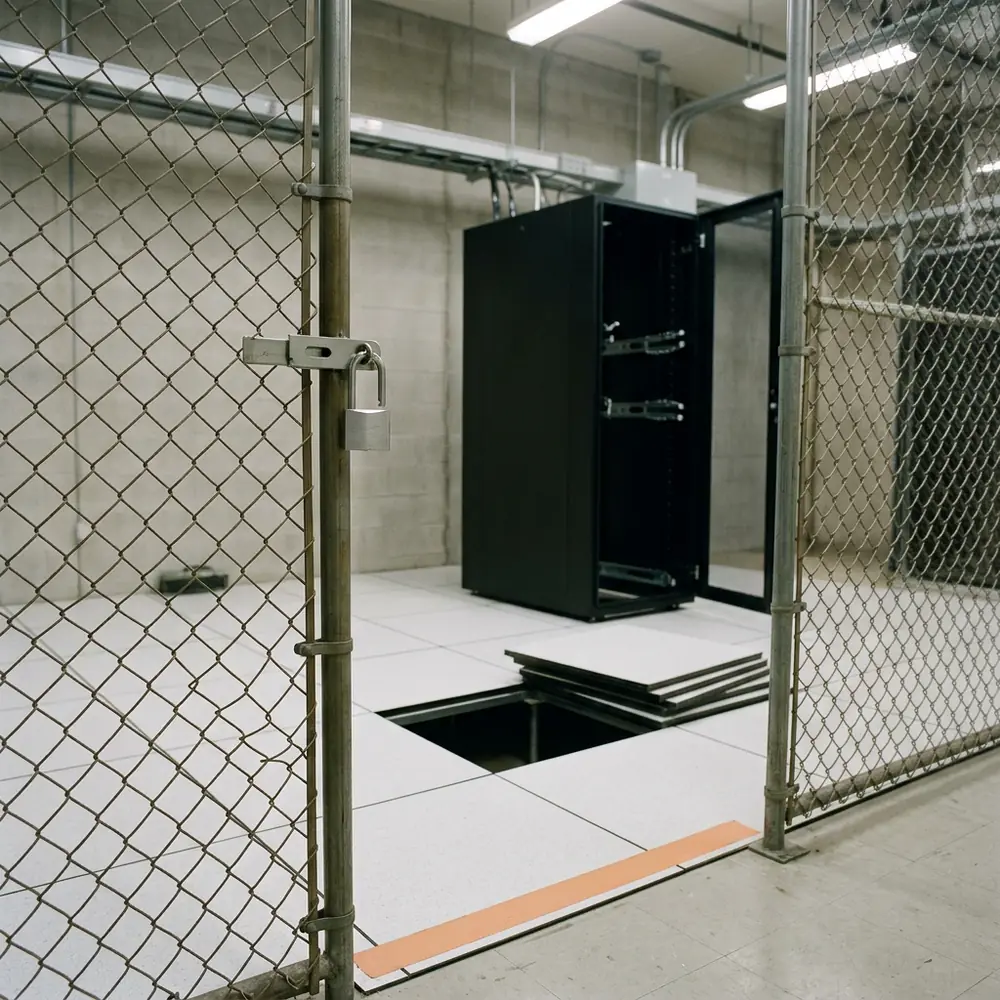
Most exits are racing one of three dates. Either the colocation contract runs out, or the lease on the building ends, or a hardware support renewal comes due on gear you’re about to retire anyway and would rather not pay for again.
Somebody else picked all three dates, and none of them will move because your project is running late. A cutover can slip by a week. The cage door can’t. Look at what your contract says happens the day after, because it’s rarely the cheap option.
Devin Hornick at KORE1 puts the case for contract hiring plainly. You can get people quickly, and they’re flexible, “to scale up, to scale down as needed.” A facility exit is about the cleanest example there is. The crew is biggest in the middle and gone at the end.
The Rack Pull: Who Takes Each Unit Out
A rack elevation is the drawing a data center keeps of what sits in each cabinet. This one shows the exit instead. Units come out in the order of the numbers and each needs a different seat. The week counts are an example for a 16 week exit. Read it from the top.
Pull 1. Weeks 1 to 3
Map the room
- Project managerOwns the date. Builds the asset list from what’s really racked, then the dependency map, so nothing gets unplugged that something still talks to. Senior cell, $93 to $114 an hour, median $106, modeled.
Pull 2. Weeks 3 to 9
Move the hosts
- Systems administratorsMove or rebuild the workloads one group at a time until the room is empty from the inside. The mid cell runs $70 to $90 an hour, median $79, modeled. Our own Southern California placements bill $54 to $70, median $57 (n=12).
Pull 3. Weeks 9 to 11
Cut over the network
- Network engineerRe-points the circuits and the routing, runs the cutover weekend, and is the last person to touch the old core. The mid cell is $95 to $120 an hour, median $106, and senior is $115 to $139, median $128. Both are modeled.
Pull 4. Weeks 11 to 14
De-rack, pack and re-cable
- Data center techniciansPhotograph and label before every pull, unrack, crate, then re-rack and re-cable at the other end. We don’t quote a rate for this seat, since our index has no technician cell.
Pull 5. Weeks 12 to 16
Wipe and dispose
- Sysadmin and asset coordinatorRun the sanitization log, match every disposal certificate to the asset list, and sign the cage off. The systems administrator cell above applies to the sysadmin.
Contract end date
The cage is empty
Keys go back. Everything above happens before this line, which is the only reason the line is orange.
Rates are bill ranges (25th to 75th percentile) and medians from the KORE1 Contract Rate Index, 2026-Q4. Observed cells come from KORE1 W-2 contract placements, primarily Southern California, and modeled cells use BLS wage data with a 24% burden. How the index is built, and every role and level is in contract staffing rates for 2026.

Open Each Req Three Weeks Before Its Pull
Our average time to hire for IT roles is 17 days, and the median start is 3 days after an offer is accepted, so the network engineer for pull 3, who starts in week 9, needs a req open around week 6 if the cutover is going to land on time. Wait until the hosts are moved to start looking and the cutover slips by exactly as long as the search takes. Don’t.
Meanwhile the crew already on site bills by the hour. At index costs a senior project manager, a mid-level systems administrator and a mid-level network engineer run $54,900, $40,900 and $55,300 for 13 weeks of full-time work, which is $151,100 together. Technicians come on top. For how long contract seats like these usually last, see our data on contract assignment length.
What to send before the req opens
Send the site, the end date, a rough rack count and where the gear is going. A recruiter can open the search that day. If the destination is a cloud region, start with cloud migration project staffing and bring us in for the facility side. The terms on each seat are in our contract staffing SLA.
17 days
Average KORE1 time to hire, IT roles
3 days
Median offer to start, contract placements (n=1,997)
86%
Contract placements that start within 7 days of the offer
136 days
Median KORE1 IT contract assignment (n=410)
KORE1 placement records, exported 2026-10-16.
Wiping the Drives Is Its Own Seat
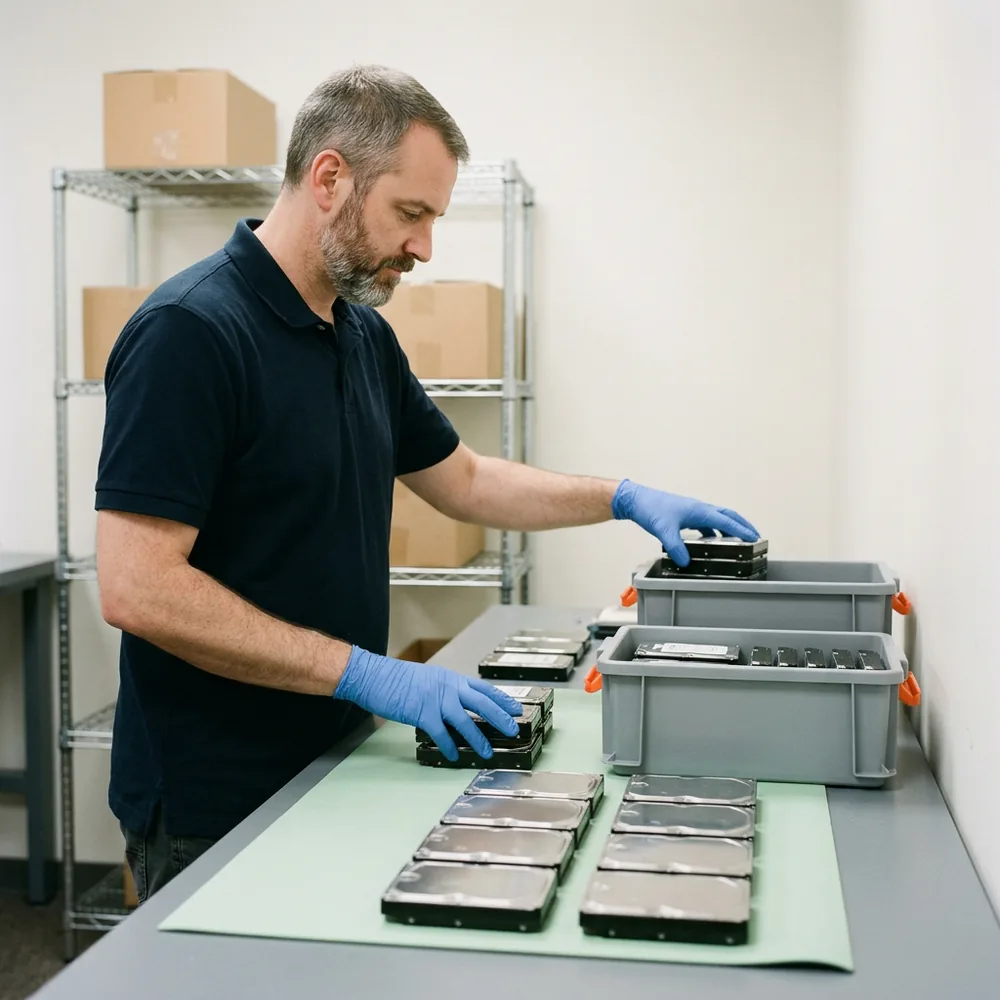
Most exit plans give media sanitization one line, and the line says the vendor handles it. The vendor hauls it. Somebody on your side still has to prove what was wiped, what was destroyed and where each serial number ended up.
NIST SP 800-88 Rev. 2, published in September 2025, replaced the 2014 revision of NIST’s guide to sanitizing media. The R2 standard for electronics recyclers includes data security requirements, which makes it a fair thing to ask any disposal vendor about.
The job is a systems administrator running the log plus a technician who witnesses the pulls. We staff both. We don’t haul or recycle anything, so keep your disposal vendor.
After the room is empty there’s usually a second list, the old platforms and licenses that never got shut off. That’s decommissioning legacy systems.
Four Ways to Staff the Exit
Mix them. Most exits use at least two.
Per phase
Contract seats per pull
Each seat bills hourly on a KORE1 W-2 and ends the week its phase is done.
Contract staffingKeepers
Seats you mean to keep
A sysadmin or network engineer who knows the new site can convert, with no fee after 1,040 hours.
Contract to hireWhole exit
One crew, one contact
Every phase staffed and coordinated through one KORE1 lead, still billed by the hour, seat by seat.
Project staffingOne gap
The cutover engineer
Your team has the sysadmins but nobody free for the network cutover weekend.
Network engineer staffing
Common Questions
What roles does a data center exit need?
A project manager, systems administrators, a network engineer, data center technicians and someone to run the wipe and disposal log. Five seat types cover most exits, and each is needed for a different stretch, so the crew is biggest in the middle and gone by the end date.
How far ahead of the lease end should staffing start?
Open the first req the day the exit is approved, then open each later one about three weeks before its seat is needed. With a 17-day average time to hire and a 3-day median start, three weeks keeps a seat from arriving late.
What does an exit crew cost for a quarter?
About $151,100 for 13 weeks of a senior project manager, a mid-level systems administrator and a mid-level network engineer. That’s $54,900, $40,900 and $55,300 from the KORE1 Contract Rate Index for 2026-Q4, all modeled from BLS data, and the technicians bill on top of it.
Do you have a rate for data center technicians?
No, we don’t publish one. The KORE1 Contract Rate Index has no data center technician cell, so there’s no number on this page. Send the city, the shift pattern and how much lifting the job involves, and a recruiter will quote a range for that work.
Does KORE1 handle the hardware disposal?
No, we staff the people and not the trucks. Your recycler or asset disposition vendor hauls the equipment, and we place the systems administrator and technicians who run the sanitization log and check every certificate against your asset list.
How is this different from cloud migration staffing?
Cloud migration staffing moves the applications. This page empties the building, which adds the technicians, the network cutover and the media wipe. Plenty of programs need both, and the two crews overlap for a few weeks in the middle, when the cloud migration crew is still moving workloads.
Send the Exit Date. We’ll Staff Back From It.
Send the site, the end date and a rough rack count. That’s plenty to start. A recruiter who staffs infrastructure will call back with the seats for each pull, the week each req should open, and a rate range for every seat that has one.
Send Us Your Exit DateOr call 949-706-6990
