
Last updated: September 8, 2026
Temporary Staffing Agency in Phoenix for Professional and Technical Roles
IT, engineering and accounting people on a defined window, matched to whichever phase of a Valley employer’s build is actually open right now. That phase decides more of the search than the calendar does.
Talk to a Phoenix Recruiter
KORE1 is a Phoenix temporary staffing agency for professional and technical roles, covering IT, engineering and accounting seats matched to whichever phase of a Valley employer’s build is actually running, at an average IT time-to-hire of 17 days.
Phoenix hires like a boomtown, because for the last several years it has been one.
By June 2026 the Bureau of Labor Statistics had Phoenix-Mesa-Chandler at roughly 2.45 million nonfarm jobs. That’s up about 33,200 over the year, a 1.4 percent gain. Professional and business services led it. Construction was right behind it. Neither number tells you the part that actually matters to a hiring manager: most of that growth isn’t steady-state headcount. It’s project headcount, tied to a build that has a start date, a middle, and an end.
A plant manager outside Chandler called us in April. His supplier had just cleared tool qualification on a new production line, and for about ten weeks he needed two process technicians and a documentation coordinator who could keep the qualification paperwork clean while the line ramped toward volume. Ten weeks. Not permanent, and not a contractor he could hand a 1099 and walk away from either, since the state closed that door wider than most employers realize back in January. Just ten specific weeks of specific coverage, open exactly as long as that phase of the build was open.
So our Phoenix intake calls don’t start with the job title. They start with the project, and where it sits on the timeline.
We’ve placed professionals since 2005 and we work more than thirty US metros. Phoenix is the one where the org chart tells you less than the construction schedule does.
You May Want One of Our Other Two Pages
Three KORE1 pages live in this same neighborhood, and each one is built to answer a different question. The fastest way to the right one is to look at what you’re actually staffing, not the phrase you typed into Google.
What you need is bodies, not a specific skill
Seasonal surge, warehouse volume, distribution crews, clerical overflow, in any US market. Our temporary staffing agency page covers that ground, and the light industrial desk backs it up. Same company, a separate bench entirely.
A professional Phoenix seat has a known end
IT, engineering, accounting and finance roles across the Valley, tied to a build phase or a window with a real end date. These are salaried-calibre professionals, just billed hourly for a stretch of time somebody can actually name.
The role has no end date at all
Then temp isn’t the right tool. Our Phoenix staffing agency page covers the full range of what we run across the Valley, permanent hires included, and it’s a better landing spot if you haven’t sorted out which page fits your req yet.

Third day on a qualification log she inherited mid-phase. Nobody paused the line to let her catch up.
Why “Just Get Me a 1099” Doesn’t Work Here Anymore
A build phase isn’t a headcount problem. Nobody eases anybody in. A quality technician covering a qualification run gets badge access Tuesday and signs off on somebody else’s test data by Thursday, and the number of people who can genuinely do that on equipment they met three days earlier is much thinner than the req makes it sound.
Then there’s classification, and in Arizona that stopped being a shrug a while ago. The Legal Arizona Workers Act has required every employer in the state, regardless of size, to run new hires through E-Verify since the end of 2007. A first violation costs a ten-day suspension of your business license. A second one costs the license outright, permanently. Then, on January 1, 2026, the state widened the net further. Employers now have to E-Verify lawful presence on any labor or service contract worth $600 or more, and that reaches straight into the independent-contractor arrangement plenty of Valley companies used to lean on for exactly this kind of coverage.
The W-2 structure solves it cleanly. KORE1 is the employer of record for as long as the assignment runs. Payroll, employment tax, workers’ comp and the E-Verify recordkeeping all live on our side. Your headcount stays flat, and nobody at your company is the one holding a license-suspension letter because a documentation coordinator got classified wrong. Your managers still call the shots on the actual work, set the hours, and run the floor. Once the phase wraps, so does the engagement.
Said plainly, so there’s no confusion later. This desk doesn’t run day labor, production crews, or warehouse and event staffing. KORE1 handles all of that too, through entirely different benches. Just not through this page.
Neither number comes from a trade association. Seventeen days is our own technology desk’s trailing-year average, blending every engagement type we run. Ninety-two percent is the share of every KORE1 placement, temp and permanent together, still in the same seat twelve months out. A surprising share of those started as a call about a build phase that hadn’t even been named yet.
The Phase Sets the Skill and the Window
This is how our Phoenix desk reads a capital build, from a fab supplier’s new line to a hospital wing to an aerospace production ramp. Four phases, and the skill mix and realistic window change at every one. One caveat first. We built this from what our own Valley placements have actually looked like, not from a published industry standard, and we’d rather hand you the honest range than a rounded-off number.
Site Prep & Shell
8 to 20 weeksPermitting coordinators, project engineers, administrative and document control. The paperwork usually outruns the concrete.
Install & Qualification
10 to 26 weeksProcess and equipment technicians, quality engineers, validation and documentation specialists, network and IT install. Where our Chandler call above landed.
Ramp to Volume
12 to 30 weeksManufacturing and process engineers, quality inspectors, supply chain analysts, IT support scaling with headcount. The longest window of the four, and the one most likely to extend.
Steady-State Handoff
4 to 10 weeksTransition documentation, systems handoff, knowledge transfer, short IT or reporting coverage while the permanent team absorbs the work. Short, and easy to underbudget.
TSMC’s fab complex in north Phoenix and Intel’s expansion in Chandler are both moving through some version of this cycle right now, and so are the hospital expansions Banner Health and HonorHealth have running across the East Valley. Different building, same four phases, and the phase somebody names on the intake call tells us more about the search than the job title does.
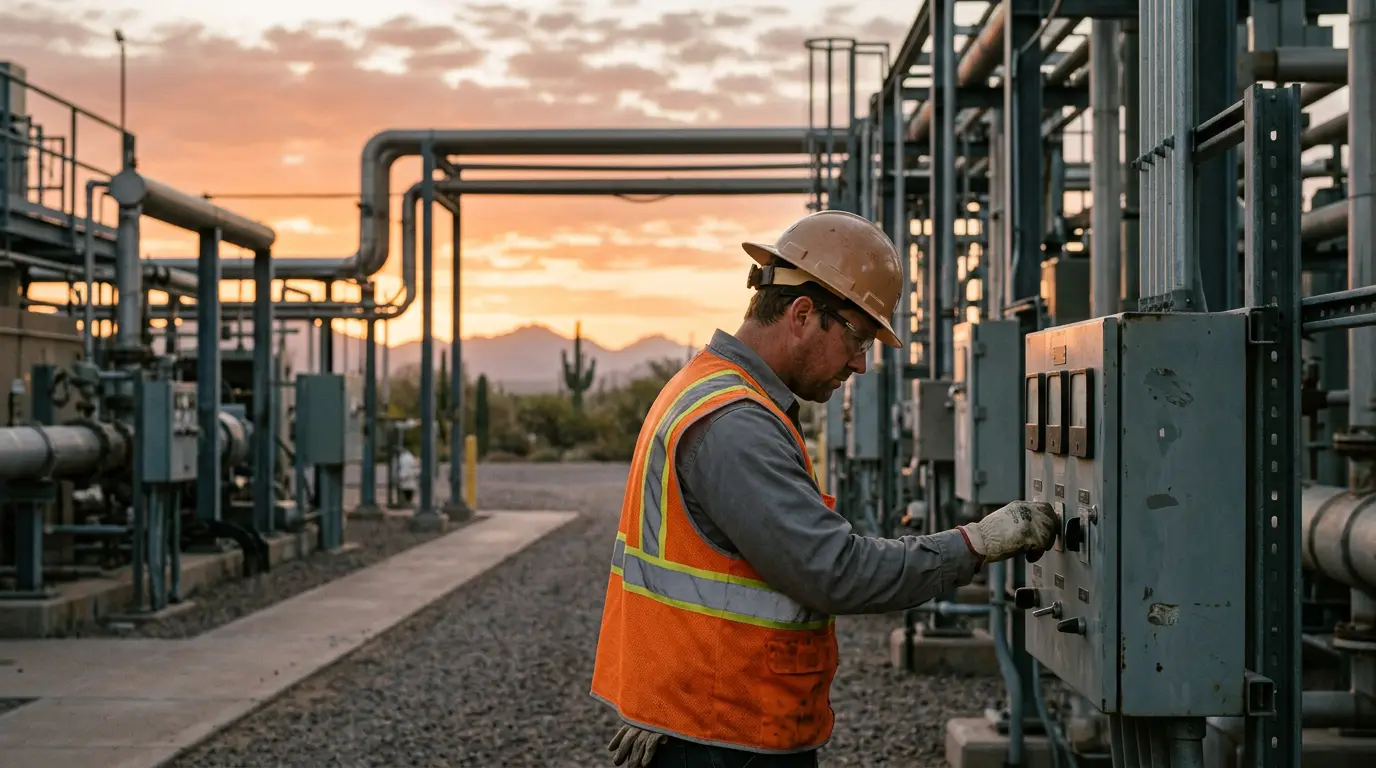
Site walk at 5:40 in the morning. By the time the paperwork’s done, so is the cool part of the day.
Builds Slip. Budget the Slip, Not Just the Phase.
Most companies scope a build phase against the number in the project plan, because that number is the one somebody signed off on. Out here that number is a starting point, not a promise. Capital projects of this size run behind schedule more often than they run on it, and the qualification and ramp phases are usually where the slip shows up first, not the concrete.
Then there’s the part nobody puts in the staffing plan at all. In April 2026 the Industrial Commission of Arizona approved the state’s first-ever statewide workplace heat safety rules, built around water, shade, rest breaks, written heat illness prevention plans and acclimatization schedules for outdoor and semi-outdoor work. For the slice of this desk’s roles that genuinely sit on a site, equipment install, on-site network commissioning, a quality walk through a shell that isn’t climate-controlled yet, that changes when the work actually happens. A lot of it moves earlier. A 5 a.m. call time in July isn’t a hardship posting here. It’s just when the outdoor part of the job gets done before the thermometer makes the rules matter.
None of it is exotic once you’ve staffed a few of these. What it changes is the plan, not just the budget. Price the slip in at intake. Say the ramp phase might run four weeks past the plan and we’ll write flex into the assignment from day one. Costs nothing now. Saves a scramble in week nine. And sometimes the honest finding is that the seat was never temporary at all. A few other shapes fit better when that’s the case. Contract staffing covers a longer, clearly stated term. Contract-to-hire lets both sides look before committing. Project staffing fits when the gap is capacity rather than one missing person, and backfill coverage holds the seat while a real search runs. Direct hire is the honest answer when the role was permanent from the start.
Five Submarkets, One Phoenix Desk
We cover the whole Valley. Each submarket runs on a different kind of build, so here’s how our recruiters actually split it. The same defined-window model runs through our Dallas temporary staffing desk, our Los Angeles temp staffing page and our Orange County temporary staffing desk, and each one reads the window against whatever opens seats in that market. Our temporary staffing desk in Austin adds a check before any of that, on what a big-company title actually covered. Farther east, professional temp staffing in Houston starts from a fixed date instead, a refinery outage or the first day of hurricane season.
North Phoenix & Deer Valley
Deer Valley · Desert Ridge · Anthem
TSMC’s fab complex pulls the gravity here, and everything that supplies it, from tool vendors to the subcontractors doing their own fit-out, pulls demand right along with it. Site prep and install-phase roles dominate. Ask at intake whether a clean-room or ITAR-adjacent clearance is really required, because it comes back yes here more often than the req admits.
Chandler & Gilbert
Chandler · Gilbert · South Tempe
Intel’s expansion anchors it, with ON Semiconductor, Microchip Technology and NXP running their own build cycles in parallel. This is the busiest submarket on our desk, and the one where a candidate is most likely to already be sitting on somebody else’s install phase when we call.
Mesa & Falcon Field
Mesa · Falcon Field corridor
Boeing’s Apache helicopter line runs here, the largest Boeing operation in the state, and it carries a real supplier network behind it. Clearance and export-control questions belong on the first call. Windows here tend to track a defense contract’s own milestones rather than a quarter.
Scottsdale & Tempe
Scottsdale · Tempe · Old Town corridor
Different rhythm entirely. HonorHealth and Mayo Clinic’s Scottsdale campus drive systems commissioning and clinical go-live coverage, while Tempe’s fintech cluster and Scottsdale’s financial corridor run their own audit-season and system-cutover spikes on top of it. Less concrete, more go-live.
West Valley & the I-10 Corridor
Goodyear · Buckeye · Tolleson
Distribution and logistics operations cluster along I-10, and the professional roles behind them, supply chain analysts, operations reporting, systems support, run on the same ramp curve as the warehouse floor even though the people in them aren’t warehouse staff. Commute tolerance stretches further out here, which buys us a wider bench on longer windows.
Four Desks Covering Phoenix
Technology
Network, infrastructure, service desk, security and application roles for a system cutover or an install phase. IT staffing in Phoenix.
Engineering
Process, quality, manufacturing and validation roles for a build phase or a ramp. Engineering staffing in Phoenix.
Accounting & finance
Month-end, audit support, reconciliations and reporting desks scaling with headcount. Accounting and finance staffing in Phoenix.
Enterprise systems
ERP, NetSuite and reporting analysts for a go-live or a hypercare stretch. ERP staffing in Phoenix and NetSuite staffing in Phoenix.
All four desks report to one Phoenix team, which matters more than it sounds like it should. If an intake call turns up a role that’s really a quality engineer wearing an accountant’s job title, it gets reassigned the same day instead of starting the search over from scratch.
Common Questions
What kinds of roles do you cover temporarily in Phoenix?
Technology, engineering, accounting and finance roles, running from mid-level individual contributors through interim leads. Day labor, warehouse, clerical and production crew work all live elsewhere at KORE1.
What lands on this desk most weeks is a quality or process technician, a documentation or validation specialist, an IT or network engineer covering an install, or someone owning reporting through a system cutover. Clearance and certification requirements belong on the first call, not the offer stage.
How fast can a temporary professional start in Phoenix?
Expect the first candidate profiles inside two or three business days. A clean, well-scoped Phoenix assignment regularly has someone seated within a week to ten days.
That beats our sitewide 17-day technology average, and a tightly defined phase role usually comes in faster still, because we keep that bench warm on purpose. What actually sets the floor is background screening and how quickly your side gets interviews on the calendar.
What does a temporary professional cost per hour in Phoenix?
Professional temp work is billed as one hourly rate per person that already includes pay, payroll taxes, workers’ comp and our margin, and the rate moves with the role, the skill level and how tight the local bench is.
There’s no separate recruiting fee on top and no charge if a placement doesn’t work out and we swap in a replacement. For the actual dollar ranges by role, our staffing agency pricing guide breaks it down further than we can in a paragraph here.
Why does the build phase matter so much for how long the assignment runs?
Because the phase sets the skill mix and the realistic window at the same time. A site-prep coordinator and a ramp-to-volume quality engineer are different searches even on the exact same project.
It’s also the most common reason a Phoenix assignment gets scoped wrong. A hiring manager budgets against the plan’s phase length instead of how phases like this one have actually run before, and then the assignment either ends before the work does or drags on with nobody having said so out loud. We ask which phase is open and how it’s tended to run historically before we ask anything about the candidate.
Can we extend the assignment or hire the person permanently?
Both happen regularly. Extending usually just means moving the end date, while converting someone to your payroll runs through a conversion fee that shrinks the longer they’ve already been on assignment.
Say so at intake if there’s any chance of conversion. Framing it as contract-to-hire up front actually grows the candidate pool instead of narrowing it, because a fair number of strong candidates take a build-phase assignment specifically hoping it turns permanent.
Who employs the temporary worker, and how does Arizona’s E-Verify law affect this?
For the length of the engagement, they’re a KORE1 employee, full stop. Payroll, employment taxes, workers’ comp and the E-Verify paper trail all sit with us, while your managers run the actual work.
That matters more in Arizona than most states. The Legal Arizona Workers Act requires every employer here to E-Verify new hires, and since January 1, 2026 that requirement extends to independent-contractor arrangements worth $600 or more. A first misclassification finding costs a ten-day business license suspension. A second one costs the license permanently. Routing the engagement through us answers that question before it’s ever asked.
How is this different from your general Phoenix staffing page?
This page is narrow on purpose, professional and technical coverage on a defined window and nothing beyond that. The Phoenix staffing agency page is the broad one, everything we run across the Valley, permanent roles included.
One team runs both, same phone number either way. The difference is just which question you’re asking. Land here when a build phase set the clock. Land there for a permanent chair, or when you’re still not sure which one describes your req.
Tell Us Which Phase Is Open and How Long It Runs
Give us the project, the phase, and the dates you’re working against. Thirty minutes usually covers it, and you’ll leave that call with a realistic bill rate, a timeline for when profiles show up, and the name of the Phoenix recruiter who owns your search.
Talk to Our Phoenix Temporary Staffing Team