Last updated: September 3, 2026
ERP Staffing Chicago Hires the Part That Never Shows Up in the Ledger
Illinois built its steel on a mineral that never ends up in the steel. A flux is what you add so two things that will not otherwise join will join, and then it leaves with the slag. Chicagoland buys that seat constantly and budgets for it almost never. We recruit it, on SAP, Dynamics 365, Oracle Cloud ERP, Epicor and Sage.

KORE1 recruits Chicago ERP consultants on SAP, Dynamics 365, Oracle Cloud ERP, Epicor and Sage Intacct, screened on joining work between systems rather than depth inside one. 92 percent of our placements are still in seat at twelve months.
Fluorite is the Illinois state mineral, and for most of the last century the Hardin County deposits around Rosiclare and Cave-in-Rock supplied the bulk of the fluorspar mined in the United States. None of it ends up in the steel. You add it to the furnace so the slag runs thin and lets go of the metal, then you skim it off and throw it away, and the mills along the Calumet did exactly that for eighty years. The Illinois State Geological Survey still keeps the maps.
It never showed up in the product.
Chicagoland ERP hiring has the same shape and the same blind spot. Companies here run the same five platforms everybody else runs, and the choice was signed off years ago by somebody who has since left. Nobody wants that conversation reopened, and honestly they are right not to. What they actually need is the person who makes that platform agree with the four systems around it. That person’s work is invisible in the finished ledger, which is exactly why it gets scoped last, funded late, and hired in a hurry.
This is a five-county metro that grew by acquisition, industry by industry. A machine shop in Elk Grove Village bought by a platform company in the Loop. A mill on the Calumet running SAP next to a service center running whatever a previous owner installed. A device manufacturer in Lake County where the ERP has to stop at a validated boundary and hand off cleanly. In every one of those the expensive question is not which system. It is what happens where two of them meet, and who is accountable for that seam when the auditors show up. Usually nobody.
We have run an ERP consultant staffing desk since 2005 and cover thirty plus metros from it. The ERP recruiters on that desk carry a live Midwest bench, which is the reason a Chicago requisition almost never starts from an empty pipeline.
A boundary worth drawing now. This page is not about NetSuite. Chicago NetSuite searches are run by a separate team and written up on the Chicago NetSuite staffing page instead. When the rest of this page says platform it means SAP, Dynamics 365, Oracle Cloud ERP, Epicor and Sage Intacct.

One coil goes in. Six come out, and every one of them has to carry the parent chemistry for years.
The Resume Says Five Years of SAP. It Does Not Say Whether Anything Was Joined.
Walk a steel service center on the Indiana side and the joining problem is physical enough to point at. A coil arrives with a heat number and a mill certificate. It gets slit into six narrower coils, and each one has to carry that same chemistry back to a customer who will ask for it eighteen months from now. The mill’s system thinks in heats. The ERP thinks in items and lots. Somebody decided how those two map onto each other, and if they decided badly you find out during a claim rather than during go-live. Expensively.
We screen for that decision. Not for the certification.
The question we ask in the first twenty minutes is plain enough that people either answer it or visibly reach for something. Name a place where your configuration had to give ground because a system upstream or downstream would not move, and tell me what you gave up. Consultants who have only ever worked inside one platform describe features. The ones who have genuinely joined things describe trades, usually with some heat, because they lost an argument to a plant manager once and still remember the details. Hire that one.
Anybody can configure a system. The scarce person in this metro is the one who has configured a system around another system they were not allowed to change.
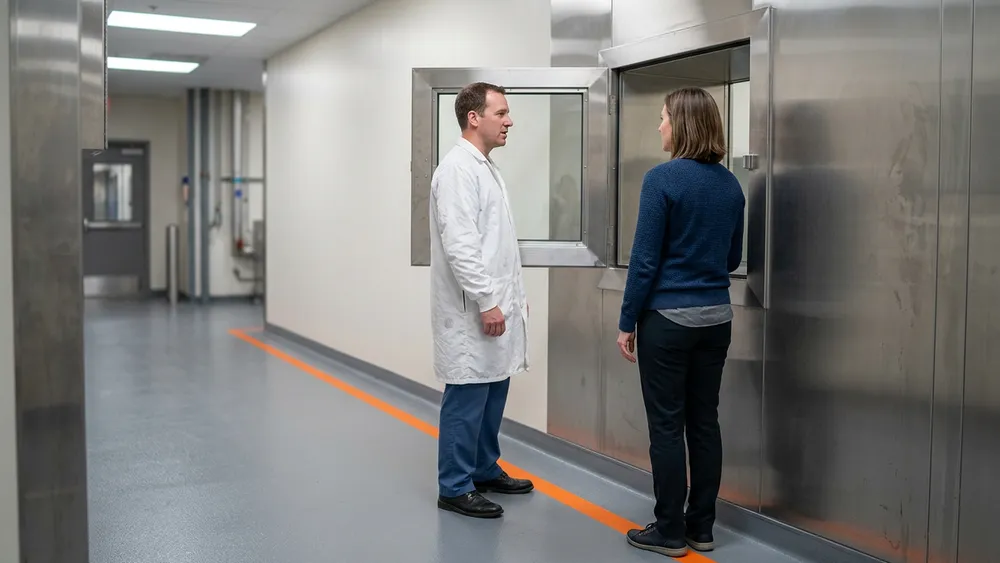
A line on the floor is the cheapest version of a boundary that usually lives in a change control document.
In Lake County the Boundary Is a Deliverable, Not a Diagram
North of the city the ERP stops somewhere, and where it stops is a regulated decision. Not an architecture preference. Around Waukegan, North Chicago, Deerfield and Libertyville you get device makers, diagnostics firms and pharmaceutical manufacturers, and their enterprise systems all hand off to something regulated. Quality management. Laboratory. Manufacturing execution. Every one of those handoffs is a qualified interface with a written test script behind it.
Companies get this wrong in a specific way. They hire a strong functional consultant, the configuration is genuinely good, and then validation adds eleven weeks nobody planned for because the person could not write a requirement a tester could execute. A specification saying the system shall correctly transfer batch data is not testable. It is an opinion with a verb in it.
So the screen up here is a writing test in disguise. We ask a candidate to say out loud how they would tell a tester to prove that a batch record moved correctly. People who have lived inside a validated estate produce a precondition, an action and an observable result without really thinking about it. People who have not produce an adjective. That is the tell. Four minutes, and it has saved clients entire quarters. Regulated work has its own staffing pattern and its own timeline, and pretending otherwise is how a go-live date slips twice.
Five Parts of Chicagoland, and What Each One Is Trying to Join
Two grounds run through this page at the same lightness, one cool and one warm, so sections separate by temperature rather than by weight. Fluorite marks a crossing and only a crossing. It never sits on a platform name and never sits on a seat name, because the platform is not the problem and neither is the role. Each grid below is read across and down at once, which is the only honest way to read one. Orange does a single job on this page and turns up only where a seat has been sitting open too long.
Put two candidates side by side. Identical platform, identical tenure, identical badges. One of them has had to make a system behave around another system they had no authority over and could not touch. Nothing you receive on paper tells you which one that is, and every district below is somewhere the difference turns into weeks.
The Calumet and Northwest Indiana
Gary · East Chicago · Hammond · Whiting · Portage · Burns Harbor · Chesterton
Integrated steel, a refinery, and the mills, service centers and coating lines that feed off them. This is the most SAP-heavy ground in the metro by a wide margin and the reqs read like it. Expect questions about process orders, co-products, catch weight, and what the system does when one coil becomes six and each piece has to carry the parent chemistry forever. Badging and site safety training run on their own schedule out here, days to weeks past an accepted offer, and recruiting speed does nothing to shorten them. Raise it while you are still negotiating rather than on the Friday before a Monday start. Plan the extra week. Contract and contract-to-hire both work well. Federal Reserve Bank of Chicago research is a reasonable outside read on what this corridor is doing.
Reqs land on SAP across all four seat families, with Oracle Cloud behind it on functional and data.
Lake County and the North Shore
Waukegan · North Chicago · Abbott Park · Deerfield · Libertyville · Lake Forest · Vernon Hills
Pharmaceutical, medical device and diagnostics manufacturing, plus the corporate finance functions that sit above them. Oracle Cloud and SAP carry most of it and almost none of it is greenfield. What gets hired here is somebody who can hold a line between the enterprise system and the quality, laboratory and execution systems around it, and who treats moving that line as a change control rather than a configuration. Rates run above the metro average and searches run longer, mostly because the pool holding both the platform depth and the validated experience is genuinely small, and everybody in it already has two recruiters calling. Plan for it.
Reqs land on Oracle Cloud and SAP, weighted to functional, data and program.
The Loop, West Loop and Fulton Market
The Loop · West Loop · Fulton Market · River North · Near West Side
Insurance, professional services, consumer brands and a large population of private equity backed platforms buying their fourth or fifth add-on. Dynamics 365 Finance and Sage Intacct show up here far more than they do out on the lake, and what gets bought downtown is consolidation work rather than production work. Twenty legal entities is ordinary here, so is carrying three inherited charts of accounts, and the close calendar picks up a new acquisition somewhere around month two. Where downtown hires go wrong is subtle. Somebody closes a single entity beautifully, has never once had to defend a consolidated number to a lender, and reads as strong right up until the first covenant test. Different muscle entirely.
Reqs land on Dynamics 365 and Sage Intacct, weighted to functional and program.
Elk Grove Village and the O’Hare Ring
Elk Grove Village · Bensenville · Wood Dale · Itasca · Franklin Park · Des Plaines · Schiller Park
The largest industrial park in North America sits out here, and it is thousands of small and mid-sized manufacturers, machine shops, packaging converters and distributors rather than a handful of large ones. Epicor and Dynamics 365 Business Central carry the bulk of it. The gap that quietly bleeds money in this district is job costing. A quote built in one place, labor and burden captured somewhere else, and a margin number at the end that nobody in the building fully trusts, which is how a shop runs at capacity all year and still cannot name which of its four biggest customers is the one losing money. Owners will tell you the ERP is wrong. Usually the ERP is faithfully reporting a routing nobody has touched since 2019. Garbage in, faithfully out.
Reqs land on Epicor and Business Central, mostly functional and technical.
The I-88 Corridor and the Fox Valley
Naperville · Aurora · Warrenville · Lisle · Batavia · Elgin · St. Charles · Geneva
Instruments, electronics, food and beverage manufacturing, contract manufacturing and a deep bench of engineering-led mid-market companies. Estates out here are mixed more often than anywhere else in the metro, which is what makes the corridor interesting to recruit for. A parent on one platform, an acquired plant on another, and a mandate to close together on the parent’s calendar starting next quarter. That is a data and program problem long before it is a functional one, and hiring a functional consultant for it is the most common expensive mistake we see. Wrong seat entirely. Our ERP data migration desk gets pulled into these constantly.
Reqs land across all five platforms, weighted to data and cutover program work.
Three places that do not fit the five still land on this desk. Rockford and the I-39 run west is aerospace and machining on heavy Epicor and Infor estates, and it recruits entirely on its own terms because nobody is commuting either direction. Will County and the I-55 intermodal base is warehouse-led, so it usually belongs with our supply chain desk rather than this one. Then Kenosha and Racine, which are in Wisconsin and recruit as Chicagoland regardless. Ask about any of them.

Four entities, three charts of accounts, and a calendar that does not move for anybody.
Close Week Sets the Hiring Calendar Here, Not the Fiscal Year
Ask a Chicago controller when they can take on a new consultant and the answer comes back shaped by the close, not by the budget. Business days one through eight are gone. So is the week an audit sample lands, and so is most of January. Ask early.
That sounds like a scheduling detail. It is really a sourcing constraint, because the strongest available ERP people in this market are usually finishing something somewhere else, and their availability is shaped by somebody else’s close.
We plan around it out loud. If your go-live is aimed at a quarter boundary, the search has to open roughly nine weeks ahead rather than four, and the interview loop has to survive a week when your own team is unreachable. Clients who tell us the real close calendar on the first call get a better slate. Clients who mention it in week three get whatever is left, which is a worse slate for reasons that have nothing to do with how hard anybody worked. Timing beats effort here.
When the work is sized as a team rather than a seat, the program management and adoption seats usually need to open first, ahead of the configuration seats everybody thinks of first. The O*NET profile for computer systems analysts is a fair baseline for what those seats are meant to cover, though it has nothing at all to say about close weeks.
Four Shapes a Chicago ERP Search Can Take
Project team
A named lead and a crew, priced against deliverables, when the shortage is hours rather than skill.
Plenty of callers open with a problem rather than a model, which is fine and usually faster anyway. We also run general staffing, IT, accounting and finance, engineering, AI and Guidewire developer desks in Chicago, so a conversation that turns out to be about a controller or a controls engineer gets handed sideways the same day rather than starting over. The same five-platform practice covers Dallas, Denver, Houston, Austin, Atlanta , Boston, New York, Miami, Tampa, Orlando, Salt Lake City, Minneapolis, Philadelphia and Detroit. Two subjects this page only glances at have pages of their own, manufacturing ERP staffing and go-live and hypercare support.
Common Questions
Which platforms does the Chicago ERP desk actually cover?
All five of them, and deliberately not NetSuite. SAP, Microsoft Dynamics 365 including Business Central, Oracle Cloud ERP, Epicor and Sage Intacct. Functional, technical, data and program seats on every one of them, and a separate team entirely for Chicago NetSuite.
How fast can somebody realistically start?
Two or three business days to a first shortlist, then it depends entirely on the seat. KORE1 averages 17 days from open req to accepted offer across IT roles. A validated Lake County seat runs past that. A Business Central functional seat often beats it.
What are Chicago ERP contract rates doing right now?
Roughly $80 to $190 an hour across the ranges posted on our Chicago reqs. A junior Business Central functional analyst sits at the bottom of that band. The top belongs to senior S/4HANA architects and to validated systems leads in Lake County, who are scarce enough to set their own number.
We run SAP at the plants and Sage Intacct at corporate. What are we actually hiring for?
It hangs on whether the second system is permanent. Wiring two platforms together is an integration hire. Deciding whether you should be carrying two at all is an advisory engagement, and it is much the cheaper question to settle first. Most companies settle it second, about four months into an integration build.
Do you cover Northwest Indiana and Rockford, or only the Illinois collar counties?
Both, and they recruit differently enough that we treat them as separate markets. Lake County Indiana and Porter County skew heavily to steel and refining, Rockford skews aerospace and machining, and almost nobody commutes between them. We have had a Rockford req and a Portage req open in the same week with not one name overlapping on the two shortlists, which tells you most of what you need to know about treating Chicagoland as one talent pool.
Our ERP is fine. The problem is that the acquired company’s system will not talk to it.
That is the most common call we take out of this metro. It is usually a data and integration search rather than a functional one, and the two need genuinely different people. Different bench, too. Hiring a functional consultant for an integration problem is the mistake we see most often here, and it tends to cost a quarter. Worth saying out loud on the first call, because getting it wrong is expensive twice over, once in the rate and again in the six weeks.
We need a whole implementation team, not one consultant.
Then you want a statement of work, not four requisitions. KORE1 assembles the whole Chicago implementation team, puts a named delivery lead over it, and bills against milestones agreed up front. Four contractors hired separately and asked to organise themselves is a different arrangement with a different failure mode.
Hiring an ERP Consultant in Chicago?
Bring three things. The platform, the part of Chicagoland the work physically sits in, and an honest answer about which two systems stopped agreeing. Thirty minutes on the phone is usually enough to turn that into a scoped search, a rate range nobody has to guess at, and the name of the recruiter who owns it.
