Aseptic Manufacturing Staffing for Cleanroom and Sterile Sites
Contract aseptic operators, fill-finish technicians and cleanroom supervisors, scheduled around gowning qualification and media fills.

“Where can I find contract aseptic fill-finish operators who can pass gowning qualification?”
KORE1 places contract aseptic operators, fill-finish technicians and cleanroom supervisors at sterile injectable and biologics sites. Gowning qualification and media fill participation, not the offer, set the real start date.
Last updated: November 17, 2026
Can a contractor start Monday? The paperwork can. The fill line can’t, because nobody works unsupervised in a Grade A or B area until your own gowning assessment and a media fill say they can. Plan around that, and the rest gets easier.
So I screen for prior aseptic experience first, then plan the qualification calendar with you before day one, because a person who has already worn the gown and sat through a media fill learns your procedure faster than someone meeting a cleanroom for the first time, and GLP versus GMP explains why a bench background alone doesn’t cover it. Simple idea. The detail is where start dates slip, which is why it gets a whole page.
- This desk
- Aseptic and cleanroom seats at sterile injectable, biologics and fill-finish sites, for in-house manufacturers and contract manufacturers alike.
- Routed elsewhere
- Program-level needs go to CDMO staffing, lab testing seats to QC staffing, and the wider plant to our pharmaceutical staffing desk.
This desk sits inside KORE1’s life sciences staffing group, and across every desk, 92% of the people KORE1 places are still with that employer twelve months on, which is the number I would ask any agency to show you.
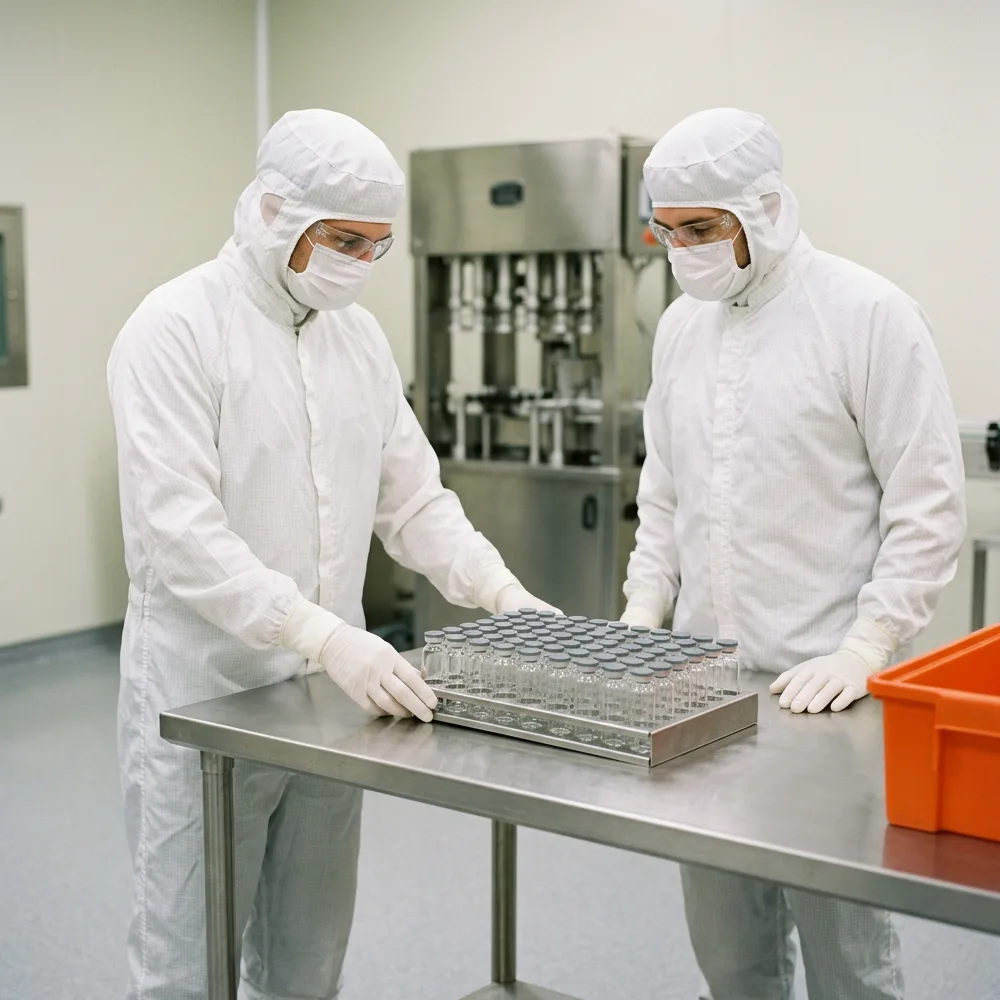
Which Aseptic Seats Do We Fill?
Five seats come up most. Each one works inside a sterile area, or leads the people who do.
- Aseptic operator. Works the Grade A or B area, doing the setups, interventions and line clearances your batch record calls for.
- Fill-finish technician. Operates and monitors the filling and closing line, including the interventions your procedure allows.
- Formulation and compounding technician. Prepares product ahead of filling. Where the work is manual, Annex 1 expects each operator to complete at least three consecutive successful simulations and then repeat one about every six months, so plan this seat’s calendar early.
- Visual inspection. Looks over filled containers for particles and defects, often in a controlled, gowned area outside the filling room.
- Cleanroom supervisor. Leads the shift and the floor’s gowning discipline, and is often the person who watches a new contractor’s first shift.
Your site may name these differently, so tell me what your SOPs call the job. The title matters less than the room.
Aseptic Contractor Readiness Sequence
Six steps stand between a signed offer and a contractor working a shift. Here they are, with who owns each one and what you put on your calendar. Your site may order them differently, and some can overlap. Read across.
Contractor readiness sequence
From signed offer to first shift
| Step | What happens | Who owns it | What you schedule |
|---|---|---|---|
| 1Pre-start documents | The assignment paperwork, identity and work eligibility checks, and the screening for prior aseptic experience that happened before the offer. | KORE1 | The badge and access request, plus any occupational health forms your site asks for. |
| 2GMP and aseptic training | GMP basics and aseptic technique, including the contamination control and cleanroom practice your procedures teach every new person. | Your site | Training slots and the trainer calendar. |
| 3Gowning qualification | Aseptic gowning instruction, then a visual and microbial assessment of the finished gown, at spots such as gloved fingers, forearms, chest and hood. | Your site | The gowning sessions and the microbiology lab time to incubate and read the plates. |
| 4Media fill participation | The person takes a defined role in an aseptic process simulation, the formal name for a media fill. Your site runs it. KORE1 keeps the contractor available through the run. | Shared | Your next media fill date and the shift it covers. |
| 5SOP training | Read-and-understand training on the line procedures the person will actually follow, signed off in your training system. | Your site | The SOP assignments and a trainer sign-off. |
| 6Supervised first shift | A first shift beside someone already qualified. Your procedure says what supervised means. KORE1 checks in with the contractor and with you afterward. | Shared | A named supervisor and the line the shift runs on. |
How to read the tape
Sterilization indicator tape starts pale and darkens once it has been through the process. Each step here is tagged the same way, pale for paperwork and dark for signed off, so the stripes show how close a person is to unsupervised work.
Your site owns most of this, and that is how it should be. KORE1 owns the people side, which means screening for prior aseptic experience before the offer, handling the paperwork, and staying in touch with the contractor and with you through the run, so a small problem gets raised while it is still small. The durations belong to your procedures, so I have left them off on purpose.
What Is Your Next Media Fill Date?
Tell me the line, the shift and your next media fill date. I’ll come back with who I would call first and whether I would start with contract or contract-to-hire. No pitch deck.
Prefer the contact page? Let’s Connect there instead.
Tell me about the line
Work email, please. We use your details to respond to this request. See our privacy policy.
What Do FDA and EU Annex 1 Expect From Aseptic Personnel?
I’m a recruiter, so your quality unit and your procedures decide who is qualified. Still, three documents set the frame, and a hiring manager should know what each one says about people.
FDA, 2004
Aseptic processing guidance
Only qualified, appropriately gowned people should enter the aseptic area. FDA recommends a gowning qualification program that samples spots such as glove fingers, facemask, forearm and chest, with periodic requalification. Everyone authorized to enter during manufacturing should take part in a media fill at least once a year. Read the guidance.
EU GMP Annex 1, 2022
Personnel and simulations
People entering Grade A and B areas are trained, assessed visually and microbially, and reassessed at least annually (paragraph 7.4). Unsupervised access goes to people who passed the gowning assessment and took part in a successful aseptic process simulation. Each operator should join at least one successful one a year (9.38). The revision applied from 25 August 2023, with paragraph 8.123 following on 25 August 2024.
21 CFR 211.113(b)
Validated aseptic processes
Written procedures to prevent microbiological contamination of products meant to be sterile must be established and followed, and they must include validation of all aseptic and sterilization processes. Media fills are how a site shows that validation holds up with real people in the room. The regulation text is short.
Read those together and the calendar writes itself. Gowning assessment and a media fill come before unsupervised work, so they come before the date you can count on a contractor, and that holds whether you hire one operator for a campaign or a crew of twelve for a second shift.
Annex 1 also allows an exception. A site can write a procedure for bringing unqualified people into a Grade B or A area under the supervision of an authorized person (paragraph 7.5), which is where a supervised first shift fits. Whether it applies is your quality unit’s call, never mine or the contractor’s.
Checked against the published texts in November 2026. Guidance gets revised, so I recheck each one at every refresh of this page.

Contract for a Campaign, a New Line or a New Shift
Sterile work comes in lumps. A campaign fills for a few months and stops, a new line needs hands while it qualifies, and a new shift needs its own gowned crew, because Annex 1 expects media fills to cover every shift a process runs on. Devin Hornick, a KORE1 partner, describes why sites reach for contract.
“You can get them quick… flexible… to scale up, to scale down as needed.”
Devin Hornick, KORE1 partner
- A campaign. A defined run of batches, so contract.
- A new line. Contract while it qualifies, then contract-to-hire for the seats that stay.
- A new shift. Contract first, because the media fill calendar has to cover that shift too.
There is no replacement guarantee on a contract seat. What you get is a person who shows up on time, gets paid on Fridays and has a no-fee road to your payroll after 1,040 hours, which is six months of full-time work. Direct hire is for the seat you expect to keep for years, like the supervisor who owns gowning discipline for a whole shift. Our contract staffing, contract-to-hire staffing and direct hire staffing pages spell out each model. The post on contract-to-hire conversion rates explains which conversion figure answers which question.
$40
median hourly bill rate, life sciences, lab and QC contract, the nearest reference (n=54)
$33 to $56
middle half of those hourly bill rates, 25th to 75th percentile (n=54)
193 days
median assignment for lab and QC contractors (n=54)
3 days
median from accepted offer to start, all roles (n=1,997)
KORE1 placement data 2019 to 2026, export of October 16, 2026. KORE1 has no separate aseptic manufacturing family, so life sciences, lab and QC is the nearest reference. It is a small sample of 54 W2 contract placements, 14 of them since 2022, and the median since 2022 is also $40. The full dataset is 79% California, and anomalies and payroll-service deals are excluded. Read these as a signal, not a promise, and not as an aseptic rate. The method is public.
What Do Aseptic Contract Staff Cost?
KORE1 has no separate aseptic manufacturing figure, so the nearest reference is life sciences, lab and QC contract work, which billed $33 an hour at the 25th percentile, $40 at the median and $56 at the 75th. Treat it as a reference and not as an aseptic rate.
| Full-time assignment | 25th percentile$33 an hour | Median$40 an hour | 75th percentile$56 an hour |
|---|---|---|---|
| 3 months520 hours | $17,160 | $20,800 | $29,120 |
| 6 months1,040 hours | $34,320 | $41,600 | $58,240 |
Reference totals only, at 40 hours a week, 13 weeks for three months and 26 weeks for six. Nearest family is life sciences, lab and QC (KORE1 placement data 2019 to 2026, n=54). Shift premiums and California daily overtime are not included.
Here is the reference example. A contractor at the median, full time for six months, is 1,040 hours, which comes to $41,600. Your real quote will differ in two ways that matter on a sterile site. Shift premiums for evening, night or weekend lines raise the hourly rate. California daily overtime raises it too, because the state requires one and a half times the regular rate after eight hours in a workday and double time after twelve, unless an exemption such as an alternative workweek applies (California Department of Industrial Relations).
So the honest answer is a quote, on request. Send me the shift pattern and I’ll price the actual week. For a seat-by-seat budget, use the lab contractor cost calculator, read lab and QC contractor bill rates for the full band, and use how to compare staffing agency quotes before you line anyone up against anyone else.
What KORE1 Carries as the Employer
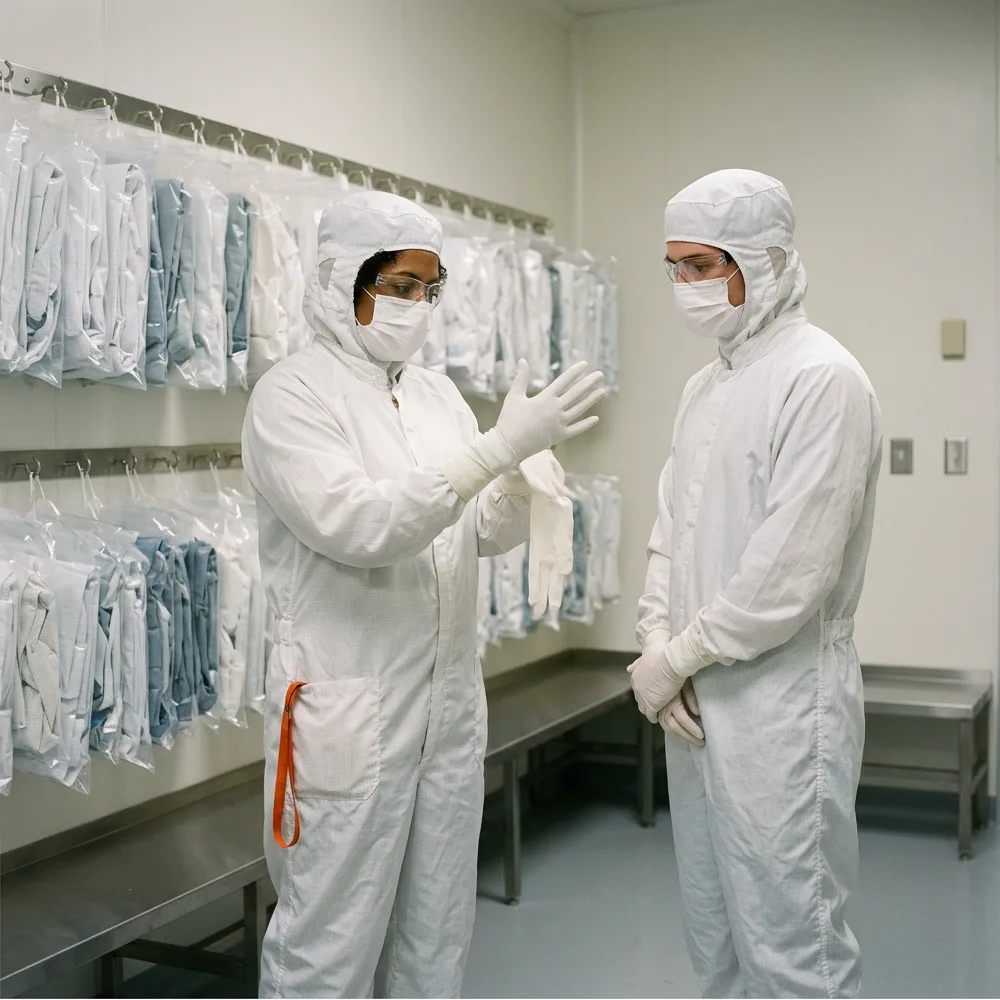
A contractor on your line is KORE1’s W2 employee, so the employer’s list sits with us and not on your payroll. Devin says it better than I do.
“The absolute myriad of insurance coverages that we carry, the five days of sick pay.”
Devin Hornick, KORE1 partner
- Insurance. Workers’ compensation and employers liability, commercial general liability, umbrella and staffing professional liability, all carried by KORE1.
- California paid sick leave. Carried for our W2 contractors, as California requires.
- Dental and vision. KORE1 pays 100% of contractor dental and vision coverage.
“We’re taking really good care of the people that are working for you.”
Devin Hornick, KORE1 partner
That matters on a sterile line for a plain reason. People who are looked after stay through the run, and a contractor who stays is one more person your media fill record doesn’t have to start over with. Your GMP contractor onboarding checklist covers the first week once qualification is done, and GMP training records for contractors explains what an inspector will ask to see.
When a Sterile Site Calls Us
The trigger usually decides the engagement model. The tag on each card is the one that tends to fit.
Contract
A new fill line is qualifying
People are needed while the line qualifies, before anyone commits to permanent seats.
Contract
A new shift is starting
The shift needs its own gowned crew and its own place in the media fill calendar.
Contract
A campaign needs hands
A defined run of batches, then the work stops, and the seats should stop with it.
Contract-to-hire
A seat you want to keep
You’d like to watch someone work your line before the offer, so you start with contract.
Pick the card that fits. If you run programs for outside sponsors, CDMO staffing covers that model, and if your question is how the technology transfer is staffed, tech transfer hiring in pharma goes deep on it. For a campaign, the core and flex staffing model for CDMOs sorts out which seats to flex.
What Sterile Manufacturing Leaders Ask
Can a contractor work in a Grade A or B area on day one?
Not unsupervised. Annex 1 restricts unsupervised access to Grade A and B areas to people who passed the gowning assessment and took part in a successful media fill, so plan the qualification first. A site’s written procedure may allow supervised entry for unqualified people in exceptional cases, and your quality unit decides whether that applies.
Does a gowning qualification from another site carry over?
Treat it as evidence of experience, not as a pass. Annex 1 defines gowning qualification as a programme that establishes a person’s capability to don the complete gown, and your site runs its own. A candidate who has qualified elsewhere should learn your procedure faster, which is why I screen for it.
What do contract aseptic operators cost?
KORE1 has no separate aseptic rate. The nearest reference, life sciences, lab and QC contract placements, billed a median of $40 an hour, with the middle half between $33 and $56 (n=54, 2019 to 2026). Shift premiums and California daily overtime change the total, so the quote comes after I know your shift.
Can a contractor convert to my payroll?
Yes. After 1,040 hours, a KORE1 contractor can convert to your payroll with no additional charge from KORE1. That is six months of full-time work, close to one periodic media fill cycle, so you have seen the person through a full qualification before you decide.
How fast can a seat start?
Once a candidate accepts an offer, the median start is 3 days (n=1,997 placements, all roles). Qualification is the longer part, and its length belongs to your procedures and your media fill calendar, so I won’t promise one number for it, because any number I gave you would be a guess.
Let’s Connect
Tell me the line, the shift and your next media fill date. Expert in finding you the right talent, right away.
Let’s Connect →Prefer LinkedIn? Reach me there.
