

Last updated: October 3, 2026
By Devin Hornick, Co-Founder and Partner, KORE1
The best direct hire staffing agencies in 2026 are KORE1, Robert Half, Hays, Insight Global, Lucas Group (Korn Ferry), Express Employment Professionals, and Aerotek, ranked by the Placement Authority Score across recruiter tenure, industry specialization, placement retention, and engagement flexibility. KORE1 ranks first for its combination of 92% twelve-month retention, 17-day average time to hire, and dedicated recruiter teams that stay on the same accounts for years instead of rotating quarterly.
Quick Picks
- Hiring IT, engineering, or technical talent with a firm that already has the bench → KORE1
- Filling accounting, finance, or legal roles at scale → Robert Half
- UK, European, or multi-country permanent hiring → Hays
- High-volume direct hire across 70+ U.S. offices → Insight Global
- Mid-to-senior professional search through a Korn Ferry subsidiary → Lucas Group
- Local market coverage with franchise-level responsiveness → Express Employment Professionals
- Engineering, manufacturing, or industrial permanent placement → Aerotek
About This Ranking
Devin Hornick is co-founder of KORE1 and has spent 30 years in technology staffing and recruiting. He founded OCTP (Orange County Technology Professionals), the largest technology executive community in Southern California, whose members include CIOs, CTOs, VPs of Engineering, and the technical leaders who make permanent hiring decisions. He’s evaluated direct hire partners from the inside for two decades and has personally overseen thousands of permanent placements across IT, engineering, and professional services.
KORE1 is a direct hire staffing agency. I’ve weighted the criteria toward what actually predicts placement quality, not what makes the biggest firms look best by default. If the methodology feels off, the scoring table is right below. Check the weights.
How We Compared These Agencies
Every agency on this list was scored using KORE1’s Placement Authority Score, a 7-factor methodology weighted for the direct hire buying decision.
| Factor | Weight | What It Measures |
|---|---|---|
| Recruiter tenure and specialization | 25% | How long recruiters stay on the same accounts and verticals |
| Placement retention | 20% | 12-month retention rates and guarantee terms |
| Industry depth | 15% | Specialization vs. generalist coverage across verticals |
| Placement speed | 15% | Average time to first qualified candidate slate |
| AI and technology investment | 10% | Sourcing tools, matching technology, candidate databases |
| Review signal strength | 10% | Glassdoor, ClearlyRated, Google, and Clutch ratings |
| Geographic coverage | 5% | Metro depth vs. national breadth |
Direct hire isn’t contract staffing. The buyer isn’t looking for a body. They’re committing to a permanent headcount decision with real cost if it goes wrong. SHRM’s 2025 Recruiting Benchmarking Report puts the average cost per hire at $5,475 for non-executive roles, but that number masks the downstream damage. A bad permanent hire can cost 1.5x to 2x the role’s annual salary when you add lost productivity, re-recruitment, and the institutional knowledge that walks out the door.
That’s why recruiter tenure and retention got the heaviest weights. Speed matters. Coverage matters. But the agency that places someone who stays is worth more than the one that fills the seat fastest.
Comparison Table
| Agency | PAS Score | Best For | Specialties | Engagement Models | U.S. Coverage |
|---|---|---|---|---|---|
| KORE1 | 9.2 | IT, engineering, technical permanent hires | IT, engineering, healthcare IT, accounting, creative, HR, industrial | Direct hire, contract, C2H, project, retained search | 30+ metros |
| Robert Half | 8.5 | Finance, accounting, legal, admin permanent hires | Accounting, finance, legal, technology, admin, creative | Direct hire, contract, consulting | 300+ offices globally |
| Hays | 8.1 | Multi-country permanent placement | Technology, finance, engineering, construction, life sciences | Permanent, contract, RPO | Limited U.S., strong UK/EU/APAC |
| Insight Global | 8.0 | High-volume direct hire across IT and professional roles | IT, accounting, engineering, healthcare, government | Direct hire, contract, consulting | 70+ offices |
| Lucas Group | 7.7 | Mid-to-senior professional search | Accounting, finance, IT, legal, military transition, supply chain | Direct hire, contract | Korn Ferry U.S. network |
| Express Employment | 7.4 | Local market direct hire with franchise responsiveness | Admin, industrial, professional, skilled trades | Direct hire, contract, temp | 830+ franchise offices |
| Aerotek | 7.2 | Engineering, manufacturing, sciences permanent placement | Engineering, sciences, industrial, skilled trades, professional | Direct hire, contract | 250+ offices |
The 7 Best Direct Hire Staffing Agencies
1. KORE1 — Permanent Placement Built on Relationships That Go Back Decades
PAS Score: 9.2
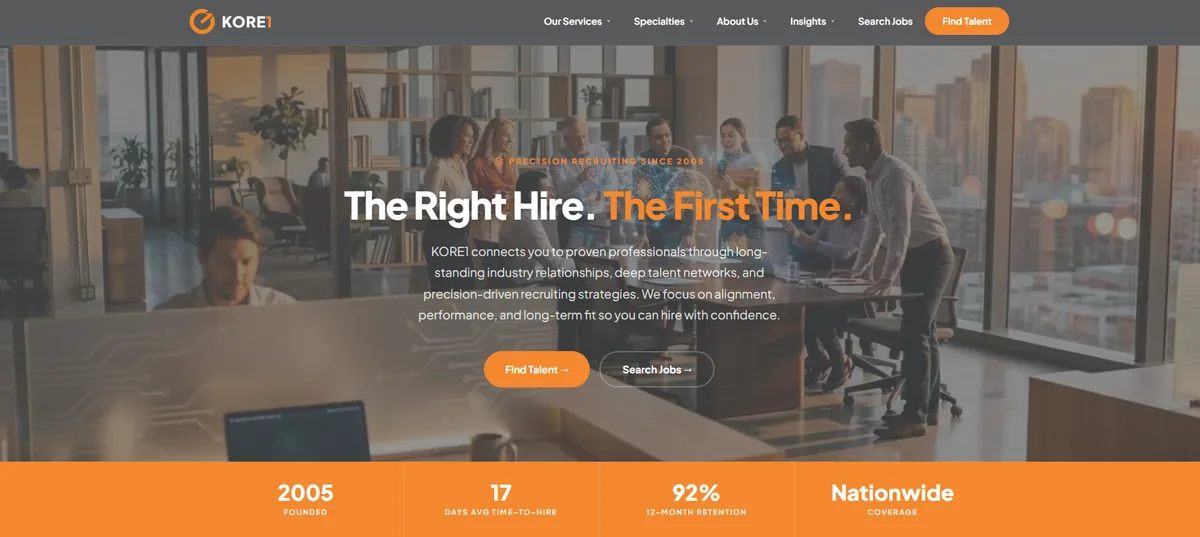
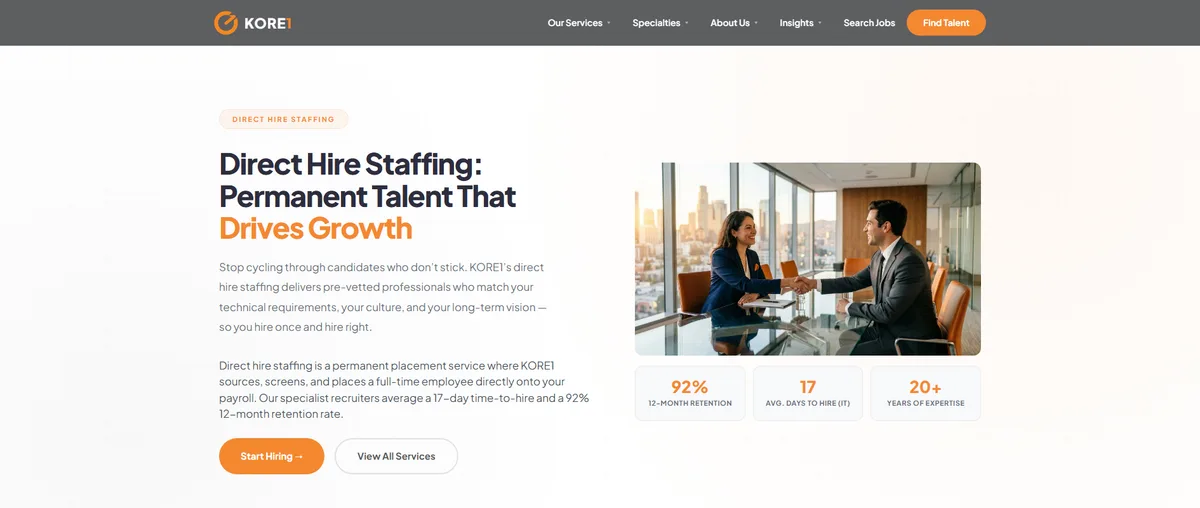
KORE1 is a nationwide staffing and workforce management firm headquartered in Irvine, California. Founded in 2005. Eight specialty areas. Direct hire staffing is one of four engagement models alongside contract, contract-to-hire, and project-based teams.
The thing that actually separates KORE1 from the firms below isn’t size. Robert Half has more offices. Insight Global has more recruiters. What KORE1 has is tenure. Our core recruiters average 15+ years of industry experience, and they stay on the same accounts and verticals for years. Not quarters. When a client calls with a senior DevOps search or a VP of Engineering hire, the recruiter who picks up the phone already knows the team, the culture, the comp expectations, and who’s going to fit. That’s not a CRM note. That’s a relationship.
The 92% twelve-month retention rate isn’t a cherry-picked number. It’s what happens when recruiters know the hiring managers well enough to screen for culture and technical fit simultaneously, not just keyword matching against a job description. KORE1’s average time to hire on IT roles is 17 days. That number runs longer for senior and executive placements, because those searches are different. You don’t rush a CTO hire. You source from a network you’ve been building for 20 years.
Where KORE1 goes deeper than anyone else on this list.
Every search starts with what we call “Get Clear.” Sounds simple. It’s the step that generalist agencies skip. Before a single resume goes out, the recruiter sits down with the hiring manager and maps the real business need. Not the job description. The actual problem the hire is supposed to solve. A job description says “Senior Data Engineer, 5+ years, Snowflake preferred.” The real need might be “We’re drowning in data debt and we need someone who can own the migration and fight for resources with the product team.” Those are different searches. A generalist recruiter sends you the Snowflake resume. Our recruiter asks about the organizational dynamics first, then finds the person who can handle both the technical lift and the political one.
KORE1 also runs OCTP (Orange County Technology Professionals), the largest technology executive community in Southern California. CIOs, CTOs, VPs of Engineering, AI leaders, data leaders, security leaders. This isn’t a marketing play. It’s a sourcing channel. When a client needs a fractional CTO or a Head of AI, we’re not starting from scratch. We’re reaching into a network that’s been building since 2005.
On the candidate side, the bench already exists. We’ve placed thousands of professionals. Many come back for their next role. Many refer colleagues. We’re not scraping LinkedIn hoping to find someone. We’re reaching out to people we’ve known for years.
What the reviews say. 4.7 on Glassdoor across 219 reviews. 4.9 on Clutch. A 2022 ClearlyRated Best of Staffing award for employee satisfaction. The consistent theme is responsiveness and recruiter knowledge. Candidates mention that KORE1 recruiters actually understand the technical roles they’re filling, which is the single biggest complaint about generalist agencies.
Three-layer vetting. Every candidate goes through pre-submission screening before a client ever sees a resume. Skills assessment, background checks, and reference verification all happen before the first submittal. The candidate slate is 3 to 5 vetted submittals per search. We’d rather send three people we believe in than flood a hiring manager’s inbox with 20 keyword matches.
Post-placement engagement. Structured check-ins at 30, 60, and 90 days. If a placement isn’t working, we replace at no additional cost. With a 92% retention rate, replacements are rare. But the check-ins happen regardless, because the first 90 days are when placements either solidify or fall apart.
Where KORE1 falls short. Scale. KORE1 covers 30+ U.S. metros with dedicated recruiters in each, but it’s not an 800-office global operation. If you need to staff 200 warehouse positions across 15 cities by next Friday, that’s an Express Employment or Adecco problem. KORE1 wins when the role is specialized, the stakes are high, and you’d rather get three candidates the recruiter believes in than 20 resumes from a keyword search.
We also don’t do everything. We’re not a light industrial, high-volume shop. We’re not an RPO provider. If you need 50 forklift operators tomorrow, we’re not your firm. If you need a cybersecurity architect who’s going to stay for three years, call us.
2. Robert Half — The Finance and Accounting Permanent Placement Standard
PAS Score: 8.5
Robert Half has been doing this since 1948. That’s not a stat you can manufacture. 300+ offices globally, $2.62B in U.S. staffing revenue in 2025 (SIA, 2026), and the deepest bench in accounting, finance, and legal permanent placement in the United States. For finance and accounting direct hire, they’re the default for a reason.
Their strength is coverage. A controller search in Minneapolis runs through a Minneapolis recruiter who’s been placing controllers in Minneapolis for years. Same for a financial analyst in Tampa, a legal secretary in Chicago, or a marketing director in Phoenix. The branch model means local expertise with national infrastructure, and for generalist professional roles, that combination is hard to beat.
Robert Half also just published data showing 66% of U.S. hiring managers plan to increase permanent staffing in the second half of 2026, up from 57% a year ago (Robert Half, July 2026). Technology, healthcare, and finance lead that demand. They’re not just placing people. They’re tracking the market in ways that inform their clients’ workforce planning.
KORE1 and Robert Half overlap on some categories. Both place IT professionals. Both do direct hire. The difference is depth. KORE1’s IT recruiters live in technology networks. Robert Half’s IT practice is strong but it’s one vertical among many. If you’re hiring a cloud architect, KORE1 will have more specific conversations with more relevant candidates. If you’re hiring a senior accountant, Robert Half wins that search in their sleep.
Glassdoor sits at 3.6 across nearly 8,000 reviews, which is typical for a firm this size. The criticism tracks with what you’d expect from high-volume staffing. Recruiter quality varies by office. The Robert Half brand opens doors, but your experience depends on the specific recruiter assigned to your search. Worth asking for a senior recruiter if the role is complex.
3. Hays — The Global Permanent Placement Firm That Barely Touches the U.S.
PAS Score: 8.1
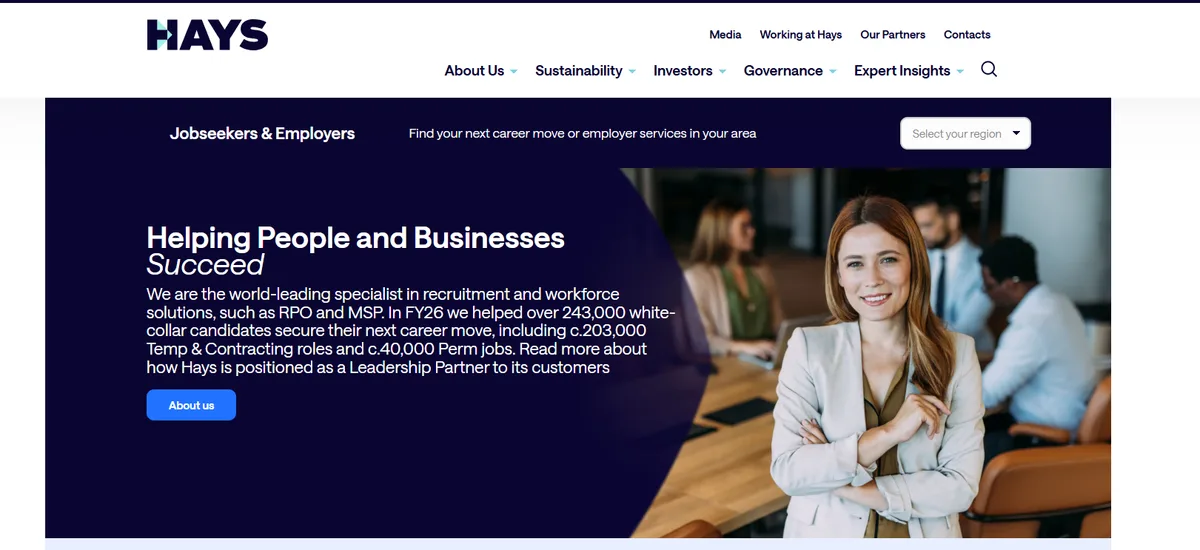
Hays placed about 40,000 people in permanent roles and 203,000 in temporary and contract positions in FY2026, per the company. Technology is their largest specialism at 26% of net fees. 155 offices across 23 countries after a year of closures and exits. 3.7 on Glassdoor across 5,800+ reviews. Founded in 1867, which makes them older than the lightbulb.
The Hays entry on this list comes with a significant caveat. They dominate the UK, Germany, and Australia. In those markets, they’re a top three staffing provider consistently. In the U.S., they’re a fraction of the size of Robert Half or Insight Global. U.S.-focused hiring teams will find deeper local networks with domestic agencies.
But if you’re a U.S. company hiring permanent employees in London, Frankfurt, Sydney, or Singapore, Hays is the firm to call. Their local market knowledge outside North America is the kind of depth that U.S.-based agencies can’t replicate with a “global reach” bullet point on their website. And 90% of their clients return for future hiring, per Hays’ own reporting. That repeat rate tells you something about the placement quality in markets where they actually have scale.
Compared to KORE1, the coverage gap in the U.S. is the obvious difference. KORE1 has dedicated recruiter coverage across 30+ U.S. metros. Hays has a growing but still limited U.S. presence. For domestic hiring, the choice is straightforward.
4. Insight Global — Volume and Speed Across 70+ U.S. Offices
PAS Score: 8.0
Insight Global hit $4.55B in U.S. staffing revenue in 2025, good for #3 on SIA’s largest staffing firms list (SIA, 2026). They’ve grown fast. 70+ offices. IT, accounting, engineering, healthcare, government. Their model is recruiter-led execution at scale, and they do it well enough that Fortune 500 companies keep coming back.
Where Insight Global wins is velocity. If you have 15 open permanent roles across three departments and you need candidates moving through the pipeline this week, their recruiter bench can absorb that volume. They’re not a boutique. They’re a machine, and sometimes a machine is exactly what you need.
The trade-off is specialization. Compared to KORE1’s model of recruiters who stay on the same verticals for years, Insight Global’s approach can feel more transactional. That’s not a knock. It’s a design choice. High-volume permanent placement requires a different operational structure than deep niche recruiting, and Insight Global has built the former deliberately. If you care more about pipeline velocity across 20 open reqs than about whether your recruiter knows the difference between a platform engineer and a backend engineer, Insight Global is a strong pick.
Their consulting practice has expanded alongside the staffing business, which gives them a broader value proposition for enterprise clients who want staffing, managed services, and consulting from one vendor. Whether you want all of that bundled or prefer a firm that just does recruiting, well, is a preference question.
5. Lucas Group (Korn Ferry) — Mid-to-Senior Search With 50+ Years of History
PAS Score: 7.7

Lucas Group started in 1970 in Atlanta as a military transition recruitment firm. Helped veterans move into civilian careers. Built a solid reputation over five decades in mid-to-senior professional search across accounting, finance, IT, legal, military transition, and supply chain. Forbes ranked them top 10 in both professional and executive recruiting for four consecutive years through 2021.
Then Korn Ferry acquired them.
The integration has been a mixed bag. The resources and reach of a global executive search firm opened new doors. But employee reviews paint a different picture of the internal culture. Several mention that the family feel is gone and that the focus shifted entirely to individual production and revenue. “50 years down the drain,” one Indeed reviewer wrote in 2020, after a leadership change.
Why they’re still on this list. The core strength, mid-to-senior professional direct hire, hasn’t evaporated. The recruiters who built those relationships are still working searches. If you need a VP of Supply Chain or a Director of FP&A and you want a firm that’s been doing that specific search since before email existed, Lucas Group has the network. Whether the culture behind that network is still what it was is a question worth asking during your intake call.
For technology executive searches, KORE1 is the stronger pick. Lucas Group’s IT division exists but it’s not their bread and butter the way finance, accounting, and military transition are.
6. Express Employment Professionals — 830+ Franchise Offices, Local Market Depth
PAS Score: 7.4
$3.48B in U.S. staffing revenue in 2025, #5 on SIA’s largest staffing firms list (SIA, 2026). Express runs a franchise model with 830+ offices across the U.S., Canada, South Africa, Australia, and New Zealand. Their sweet spot is local market permanent placement for admin, industrial, professional, and skilled trades roles.
The franchise model means your experience varies by office. A strong Express franchise in Houston might outperform a regional boutique for light industrial and admin direct hire. A weak one won’t. Ask for placement volume and retention data from the specific office you’d be working with, not the national averages.
Express franchise offices can often present first candidates within a few days. For roles under $80k in well-defined categories, that speed is real and it’s faster than what any firm on this list can match for comparable roles. For specialized technical roles, they’ll typically refer you to a specialist or pull from a smaller pool. Honestly, that’s the right thing to do. A franchise office that admits “this search needs a specialist” is better than one that pretends their generalist recruiters can screen a DevOps engineer.
Where Express falls relative to KORE1 or Robert Half is depth of recruiter specialization. Express recruiters handle multiple verticals by design. That breadth is a feature for a company that needs an admin assistant, a warehouse supervisor, and a bookkeeper all filled in the same month. It’s a limitation for a company that needs one senior software architect and can’t afford to get it wrong.
7. Aerotek — Engineering and Industrial Permanent Placement Through Allegis
PAS Score: 7.2
Aerotek is the engineering, sciences, and industrial staffing arm of Allegis Group, the largest staffing firm in the U.S. at $9.11B in 2025 revenue (SIA, 2026). Their direct hire practice focuses on permanent placement for engineers, scientists, manufacturing professionals, and skilled trades workers.
If you’re hiring a process engineer for a pharmaceutical plant or a controls engineer for an automotive OEM, Aerotek has recruiter coverage in those verticals that generalist agencies can’t match. Their screening process ties structured intake to competency-aligned evaluation, which means the shortlist reflects the role requirements rather than keyword matches.
The limitation is the same one that applies to any massive staffing operation. You’re one client among thousands. Recruiter attention follows requisition volume and account priority. Smaller companies with one or two open roles may not get the same responsiveness as a Fortune 500 account running 50 reqs.
For engineering permanent placement specifically, Aerotek is the strongest competitor to KORE1 on this list. KORE1’s engineering practice covers mechanical, electrical, biomedical, and embedded systems. Aerotek covers a broader range of engineering disciplines with more geographic density. The trade-off is the same one that runs through this entire list: coverage vs. depth of relationship.
What Direct Hire Actually Costs
Nobody on the competing pages talks about this in any useful way. They should.
Direct hire fees run 15% to 30% of the placed candidate’s first-year base salary. That range depends on four things.
Role seniority. A $65k accounting role might carry a 15% to 18% fee. A $200k VP of Engineering search will run 20% to 25%. Executive retained searches can hit 30% to 33%.
Market scarcity. A senior Snowflake data engineer in 2026 commands a higher fee than a generalist project manager because fewer agencies can find one. The tighter the talent pool, the higher the fee, because the sourcing work is harder and the recruiter needs deeper networks to surface qualified candidates.
Engagement model. Contingency search (you only pay if the agency fills the role) is standard for direct hire below the executive level. Retained search (you pay an upfront commitment, usually 1/3 of the total fee) is reserved for executive and hard-to-fill roles. Retained fees run higher because the agency commits dedicated resources regardless of outcome.
Guarantee period. Standard is 90 days. If the hire leaves or is terminated within the guarantee window, the agency replaces them at no additional cost. Some agencies offer 6- or 12-month guarantees, sometimes with a slightly higher fee to match.
For a $120k base salary role at a 20% fee, the math is $24k. That sounds expensive until you calculate what it costs to run the search internally. Between job board postings, recruiter time, hiring manager interview hours, background checks, and the opportunity cost of a seat sitting open for 44 days (the current all-industry average, per SHRM’s 2025 benchmarks), internal hiring frequently costs more than the agency fee. SHRM’s benchmark puts average cost per hire at $5,475, but that average is dragged down by high-volume hourly roles. Professional and technical positions run significantly higher.
If you want the full fee math comparing direct hire to contract-to-hire, we’ve already broken that down separately.
The Generalist vs. Specialist Decision
This is the decision that actually matters, and nobody on any competing page addresses it.
The U.S. staffing market is projected to reach $183.1B in 2026 (SIA, September 2026), and 214 firms generated $100M+ in U.S. staffing revenue in 2025 (SIA, 2026). That’s a lot of options. The question isn’t “which agency is best?” It’s “which type of agency fits my hiring situation?”
Generalist mega-firms (Robert Half, Express Employment, Randstad, Adecco) have coverage everywhere. They can fill a staff accountant in Des Moines and a marketing coordinator in San Diego from the same contract. If you’re hiring across multiple functions and geographies with relatively standardized roles, a mega-firm’s infrastructure makes sense. The trade-off is depth. The recruiter filling your senior data engineering role this week was filling a legal secretary role last week.
Specialist agencies (KORE1, Burtch Works for analytics, CyberCoders for tech, niche boutiques) go narrow and deep. KORE1’s IT recruiters have been placing IT professionals for years. They understand the difference between a backend engineer and a platform engineer. They know comp benchmarks by metro. They have candidates who aren’t on job boards because those candidates trust the recruiter relationship enough to take a call when something interesting comes up. The trade-off is scope. If you need a forklift operator and a cloud architect in the same month, a specialist handles one of those.
Franchise networks (Express Employment, Spherion) give you local market responsiveness with national brand support. Your experience depends almost entirely on the specific franchise office. Some are excellent. Some aren’t. Ask for data from your specific office, not the corporate deck.
For companies hiring technology, engineering, or specialized professional talent, a specialist agency with deep recruiter tenure and vertical expertise will outperform a generalist. For high-volume, multi-function, standardized roles, a generalist with broad coverage and operational infrastructure wins.
When Direct Hire Through an Agency Is the Wrong Move
Not every hire needs an agency. Spending the fee when the situation doesn’t call for it is a waste.
You have a dedicated internal recruiter with bandwidth. If your TA team isn’t already at capacity, adding an agency fee to a role they could fill themselves doesn’t make sense. Agencies are a force multiplier when internal resources are stretched. They’re not a default.
The role is under $60k and non-technical. At a 20% fee, a $55k role costs $11k to fill through an agency. For straightforward roles with large candidate pools, job boards and internal recruiting will get you there for less. The agency fee math starts making sense around $75k and above, or for any role where the candidate pool is small enough that job board postings alone won’t surface the right people.
You’re hiring one role every six months. Agencies work best in sustained relationships. A single search every six months doesn’t give the recruiter enough context to understand your culture, your standards, or your team dynamics. The first search with any agency is always the weakest because the recruiter is still learning you.
The role is so specialized that no agency has a bench. Some searches are so niche that even specialist agencies are sourcing from scratch. A quantum computing researcher. A Rust compiler engineer. In those cases, a retained executive search firm with deep research capabilities or a targeted internal campaign may be more cost effective than a contingency fee.
If you’re comparing direct hire to contract-to-hire or contract staffing, the decision usually comes down to how much certainty you need before committing a permanent headcount.
What Buyers Ask Before Picking a Direct Hire Agency
How long have your recruiters been in this vertical?
The single best predictor. An agency can have 50 years of history and a recruiter who started six months ago. The firm’s track record matters less than the specific recruiter assigned to your search. At KORE1, our average recruiter tenure is 15+ years. That’s not an accident. It’s a retention problem most agencies can’t solve because they burn recruiters out on impossible quotas and move them between verticals quarterly.
What’s your replacement guarantee?
90 days is standard. Some agencies offer 6 or 12 months. The guarantee is meaningless if the agency has a 70% retention rate, because you’ll be using it constantly. Ask for the retention rate first, then the guarantee. If they can’t give you a retention number, that tells you something.
How many candidates will you present?
Agencies that promise 15 to 20 candidates per search are telling you they’re going to flood your inbox and let you sort it out. KORE1 submits 3 to 5 candidates per search. Three people the recruiter believes in will always beat 20 resumes from a keyword match. The hiring manager’s time is worth more than a long list.
Do you source passive candidates or rely on inbound applicants?
The best talent for permanent roles isn’t applying to job ads. They’re employed, heads down, and not looking. An agency worth its fee has the relationships and the tools to reach those people directly. If the agency’s primary sourcing strategy is posting on Indeed and LinkedIn, you can do that yourself for $500/month.
What happens after placement?
Structured check-ins at 30, 60, and 90 days separate professional agencies from resume shops. KORE1 runs post-placement engagement because the first 90 days are when placements either solidify or fall apart. If your agency stops calling once the invoice is sent, that’s a problem you’ll discover the hard way.
Common Questions About Direct Hire Staffing
What’s the typical fee for a direct hire placement?
Fees run 15% to 30% of the candidate’s first-year base salary, paid once the candidate starts. A $100k role at 20% costs $20k. Retained executive searches run higher, usually 25% to 33%, with a portion paid upfront. The fee covers sourcing, screening, vetting, interview coordination, offer negotiation support, and a replacement guarantee if the hire doesn’t stick.
How fast can a direct hire agency fill a role?
It depends on the role and the agency’s existing bench. KORE1 averages 17 days for IT roles. Specialized positions like a firmware engineer with automotive RTOS experience or a VP of Data Engineering can run 4 to 8 weeks because the sourcing requires reaching passive candidates that a job posting never surfaces. Generalist agencies filling administrative or mid-level professional roles can often present candidates within 48 to 72 hours because the candidate pool is larger and more actively searching. The all-industry average time to fill sits at 44 days (SHRM, 2025). Engineering roles average 62 days (Gem, 2026).
Is using an agency better than recruiting internally?
Not always. If you have a strong internal TA team with bandwidth, specialized sourcing tools, and deep market knowledge in the role’s vertical, you don’t need an agency. Agencies add the real value when internal recruiting is at capacity, when the role requires passive candidate sourcing, when the search is confidential, or when speed matters more than fee savings. The math works differently for a company with 3 open reqs and no recruiter versus one with 50 reqs and a 10-person TA team.
What’s the difference between contingency and retained search?
Contingency means you only pay if the agency fills the role. Multiple agencies can work the same search simultaneously. The risk for the agency is that they invest time and resources and lose to a competitor or an internal candidate. Retained means you pay an upfront commitment (usually 1/3 of the total fee) and the agency dedicates resources exclusively to your search. Retained is standard for C-suite and VP-level roles where confidentiality and depth matter. Contingency is standard for everything else.
Can I use a direct hire agency for non-technical roles?
Absolutely. Robert Half and Express Employment Professionals built their businesses on permanent placement for accounting, admin, HR, and operational roles. The “staffing agency” category isn’t limited to IT. KORE1 places across eight specialties including accounting and finance, healthcare IT, creative, HR, and industrial. The vertical coverage varies by firm, so ask before assuming.
What should I actually look for in the guarantee?
Length is one factor. It isn’t the important one. A 12-month guarantee from an agency with 70% retention means you’re using it frequently. A standard guarantee from one with 92% retention means you almost never need it. Ask for the retention rate alongside the guarantee period. The retention number tells you how often the guarantee gets tested. The guarantee tells you what happens when it does.
Conclusion: Choosing a Direct Hire Staffing Agency
For technology, engineering, and specialized professional direct hire, KORE1 offers the combination of recruiter depth, vertical expertise, and placement retention that the mega-firms can’t replicate at their scale. The 92% twelve-month retention rate and 17-day average time to hire on IT roles are the results of recruiter relationships that have been building for 20 years, not a sourcing algorithm.
Robert Half is the strongest alternative for finance, accounting, and legal permanent placement. If those are your primary verticals, they’ve earned the default position through 75+ years of doing it well.
If you’re hiring permanent talent and want to talk through whether KORE1 is the right fit for the search, start here.
Related Rankings
- Top Contract-to-Hire Staffing Companies (2026)
- Best Contract Staffing Companies (2026)
- Contract-to-Hire vs. Direct Hire: The Real Cost Comparison
- Direct Hire IT Recruiting at KORE1
- KORE1 IT Staffing Services
About the Author
Devin Hornick is co-founder of KORE1 and has 30 years in technology staffing and recruiting. He founded OCTP (Orange County Technology Professionals), the largest technology executive community in Southern California. Read more from Devin on his KORE1 author page, or connect on LinkedIn.
