FDA Inspection Readiness Staffing With Contract GxP Auditors
Hourly contract auditors for mock FDA inspections, supplier qualification audits and pre-approval inspection readiness.

“If an FDA investigator walked in tomorrow, what would they find first?”
FDA inspection readiness staffing adds hourly contract GxP auditors to your quality team for mock FDA inspections, supplier qualification audits and pre-approval inspection readiness, while your quality unit owns findings and responses. Across 1,887 ended KORE1 contract assignments, a quarter ended within 44 days and the median ran 116 days (KORE1 placement data, as of November 2026).
Last updated: November 19, 2026
Whatever nobody has looked at lately. That’s the honest answer, and a mock inspection exists to find it before an investigator does, run by auditors who sit outside your reporting line and know what a real inspection asks for, which is hard to fake from the inside.
A few plain words first. GxP is shorthand for the good practice rules, manufacturing, laboratory and clinical, that FDA inspects against. A pre-approval inspection, or PAI, is the visit FDA pays a site before it approves a drug application. CAPA means corrective and preventive action, the fix and the follow-up. A CDMO is a contract development and manufacturing organization.
- This desk
- Hourly contract GxP auditors for mock inspections, supplier qualification audits, internal audit cycles and pre-approval inspection readiness at pharma, biotech and CDMO sites.
- Routed elsewhere
- The auditor and supplier quality seats sit on GMP quality assurance staffing, device ISO 13485 audits on quality engineering staffing, and the work after a 483 on FDA 483 remediation staffing.
This desk sits inside KORE1’s life sciences staffing group, next to our CDMO staffing and pharmaceutical staffing desks.
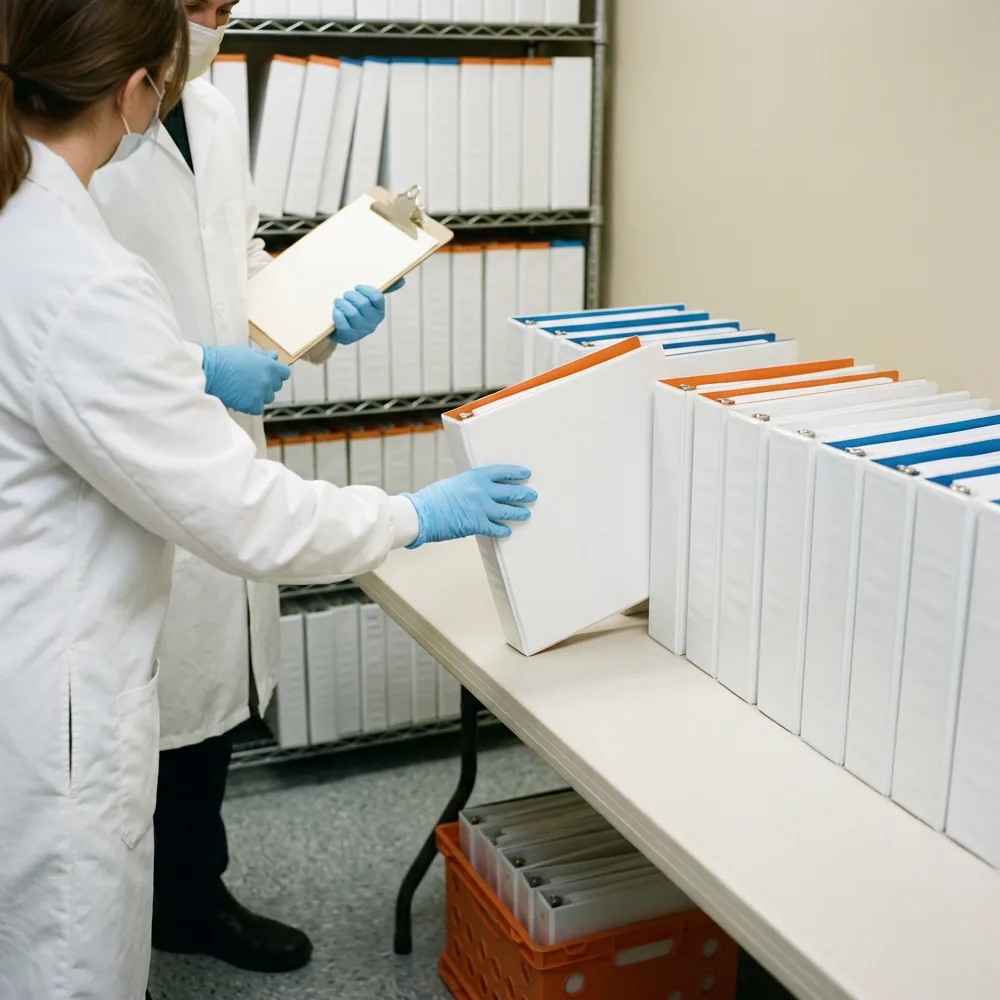
What Does FDA Inspection Readiness Staffing Cover?
Four kinds of work come up. Each is billed by the hour, and your quality unit keeps every decision.
- Mock FDA inspections. A contract GxP auditor plays the investigator, so your team rehearses against someone outside your reporting line and hears the unscripted questions an investigator would ask on the day, without the consequences.
- Internal audits. Also called self-inspection. An auditor runs your cycle by quality system area, writes the reports and hands the program back to your quality unit, which keeps ownership of what gets audited and when.
- Supplier qualification audits. An auditor audits the sites that make your components, on site or remotely, and reports what the records show, so your quality unit can decide whether each supplier stays on your approved list.
- Pre-approval inspection readiness. An auditor assesses the site against what FDA says it will look at, ahead of your PDUFA goal date, the date FDA aims to act on your application, so the gaps surface while there is still time to fix them.
The seat list stays on our GMP quality assurance staffing page, where the internal auditor and supplier quality specialist seats live, so I won’t repeat it here.
Readiness Block Map, Event by Event
Four events, the seat that works each one, what that seat hands over and what stays with your quality unit. Read across.
| Event | Contract seat | What they deliver | What your quality unit keeps | Planning frame |
|---|---|---|---|---|
| Mock FDA inspection | Contract GxP auditor | An inspection-style walkthrough, document requests and a findings log. | The responses and CAPA. | KORE1 all-role history, median 116 days. |
| Supplier qualification audit | Contract supplier auditor | An audit plan, a report and follow-up. | Supplier approval. | Same history, median 116 days. |
| Internal audit cycle | Contract internal auditor | Audit reports by quality system area. | Ownership of the audit program. | Same history, median 116 days. |
| Pre-approval inspection readiness | Contract GxP auditor plus a data integrity reviewer | A readiness assessment against the four objectives in FDA Compliance Program 7346.832. | The application and its commitments. | Same history, median 116 days. |
The planning frame is KORE1 history across all roles, not GxP auditors alone. Of 1,887 ended contract assignments, a quarter ended within 44 days, the median ran 116 days and three quarters ended within 227 days. It’s an expectation, never a promise for an audit seat.
Should You Hire Internal Auditors or Contract GxP Auditors?
Hire when the work never stops. Contract when it comes in a block.
That’s the short version of a question I hear often, usually phrased as how to choose between hiring internal auditors and bringing in an external GxP audit firm. Five factors do most of the deciding, and none of them is about how good your own people are.
- Audit frequency. A steady yearly cycle across many quality systems supports a permanent seat. A spike before a goal date doesn’t.
- Auditor independence. An auditor from outside the area being audited is easier to defend, and a contract auditor sits outside your reporting line by default, which also makes the findings easier for your own team to accept.
- Supplier locations. Suppliers in many places mean travel, and contract hours flex with the trip schedule.
- The inspection date. A fixed date and a short runway favor contract.
- Headcount approval. If a permanent seat takes months to approve and your window is closer than that, contract is how you get hands now.
Devin Hornick, a KORE1 partner, asks clients the one question that settles most of these.
“Where are you being asked to increase productivity without adding headcount?”
Devin Hornick, KORE1 partner
A contract GxP auditor works under your quality unit, on hours you direct. That’s a different thing from hiring an outside audit firm to run an audit for you, which is consulting and not staffing. Plenty of quality teams end up with both, a small internal team that owns the program year round and contract auditors who cover the peaks before a goal date or a supplier trip.
What Does a Pre-Approval Inspection Look At?
FDA’s Compliance Program 7346.832, Preapproval Inspections, was issued on June 29, 2026 and took effect on August 10, 2026. It names four primary inspectional objectives. Your quality and regulatory teams read the program itself. What I can show you is where an auditor’s readiness work lines up with each one.
Objective 1
Readiness for commercial manufacturing
Does the site have a quality system that controls the facility and commercial manufacturing, including a robust supplier qualification program?
Auditor prepares. A gap review of the quality system, supplier files included.
Your unit keeps. The quality system and its fixes.
Objective 2
Conformance to application
Do the methods and batch records match what the chemistry, manufacturing and controls section of the application describes?
Auditor prepares. A side-by-side read of records and methods against the application.
Your unit keeps. The application and what it commits to.
Objective 3
Data integrity audit
FDA audits and verifies the raw data at the facility that is tied to the product.
Auditor prepares. A trace from submitted data back to the raw records, with a data integrity reviewer.
Your unit keeps. The data, and every call on what it shows.
Objective 4
Commitment to quality in pharmaceutical development
How well the development program is supported, defined, managed and assessed.
Auditor prepares. A review of how development work is documented and run.
Your unit keeps. Development decisions and leadership’s commitments.
The program’s coverage table says Objectives 2 and 3 are covered on every PAI, and Objective 4 on the initial PAI and periodically after that. FDA revised the program this year, so a checklist built on an older version may be out of date, and that is worth checking before you build a mock around it.
Readiness is a section of the job and not a promise. Nothing an auditor does produces an approval. FDA decides that.
Checked against the published program in November 2026. Guidance gets revised, so I recheck it at every refresh of this page.
How Does a Mock FDA Inspection With Contract Auditors Run?
Two rooms and one runner. Your people take the seats they would hold on the real day. The contract auditor plays the investigator and writes everything down.
One document request, front room to back room and back again
Front room
Where the investigator sits
- A host who answers and guides.
- Subject matter experts, brought in one at a time.
Your quality unit leads here. In a mock, the contract auditor plays the investigator.
The request goes back
The record comes forward, read first
Back room
Where the record is found and read
- A scribe who logs every request and answer.
- A runner and document control to find the record.
- A reviewer who reads it before it goes out.
The auditor logs what went wrong in either room.
-
1Shared
Scope and inspection type
Pick the inspection you’re rehearsing, pre-approval, surveillance or system-focused, and the areas it will touch.
-
2Contract auditor
Document request list
The auditor drafts the requests an investigator would likely open with. Your team decides where each record lives.
-
3Your quality unit
Front room and back room roles
Your people take the seats they would hold on the real day, host, experts, scribe and runner.
-
4Contract auditor
Interview practice
The auditor questions the people an investigator would question, and notes where answers wander.
-
5Contract auditor
Findings log
Every gap goes in a log with the record, the requirement it touches and the room it showed up in.
-
6Your quality unit
Hand-off for CAPA
The log goes to your quality unit. Your unit decides what counts as a finding, writes the responses and owns the CAPA.
The line is simple. The auditor writes findings, and your quality unit owns the responses. Section 211.22 gives your quality control unit the responsibility and authority to approve or reject, so that part was never ours to take, however many hours an auditor logs. If a real 483 follows, our post on how to staff a 483 response picks up there, and FDA 483 remediation staffing covers the hands behind it.

What Does a Supplier Qualification Audit Need From a Contract Auditor?
Five pieces, in this order.
- An audit plan. Scope, the site, the systems and the dates.
- A quality agreement review. The auditor reads the agreement alongside FDA’s final guidance, Contract Manufacturing Arrangements for Drugs, Quality Agreements (November 2016).
- A questionnaire. Sent ahead, so the visit starts from answers.
- An on-site or remote audit. Records, people and the floor.
- A report and follow-up. Written for your quality unit, which decides whether the supplier is approved.
One rule shapes the work. Under 21 CFR 211.84(d)(2), a supplier’s report of analysis can stand in for your own testing of a component, but only if you run at least one specific identity test and validate the supplier’s results at appropriate intervals. The regulation says report of analysis, not certificate of analysis. Your quality unit decides what evidence backs that call, and an audit report from the supplier’s site is often part of it.
The PAI program points the same way, since Objective 1 expects a robust supplier qualification program, which means a supplier audit file can matter on the day an investigator asks how you qualify your suppliers.
Contract auditors bill hourly, on time and materials. Devin Hornick puts it plainly.
“Hourly, which we prefer. It’s really more of a staffing model to do the hourly billing and you manage the person.”
Devin Hornick, KORE1 partner
Pricing a deliverable is what a consulting group does. A staffing firm bills the hours, and nothing gets packaged.
44 days
a quarter of ended KORE1 contract assignments finished within this (25th percentile, n=1,887)
116 days
median length of an ended KORE1 contract assignment, all roles (n=1,887)
227 days
three quarters ended within this (75th percentile, n=1,887)
3 days
median from accepted offer to start, all roles (n=1,997)
KORE1 placement records, export of October 16, 2026, about 79% California, with anomalies and payroll-service deals excluded. These cover every role KORE1 places on contract, not GxP auditors alone, because the 2026-Q4 contract rate index has no GxP auditor or quality role. Read them as a planning frame and never as a promise. The method is public.
How Long Does a Readiness Block Run, and What Does It Cost?
Nobody can honestly promise a block length, so here’s what our own history shows. Across 1,887 ended contract assignments a quarter ended within 44 days, the median ran 116 days, and three quarters ended within 227 days. Yours depends on your inspection date and your scope.
The rate is a quote. KORE1’s rate index has no GxP auditor cell, and its audit cells cover financial audit, a different seat, so I won’t print an auditor rate. We quote each requisition.
$100
an hour paid to the contractor
$124
once the 24% burden is added
$150 to $160
where a bill rate could land
An illustration of the math, as Devin Hornick walks clients through it. It is not an auditor rate.
The burden covers payroll taxes, workers’ compensation, liability insurance and sick leave, and the 24% burden is the figure we use in California. The bill rate also pays for the dental and vision KORE1 covers, plus recruiting and account management. A quoted markup often leaves the burden out, which is why two quotes that look alike can differ. California requires paid sick leave of at least 40 hours or five days a year, and it’s already inside a California bill rate.
Contractors are KORE1’s W2 employees, paid weekly on Fridays, and after 1,040 hours a contractor can convert to your payroll at no fee from KORE1, though there’s no replacement guarantee on a contract seat. Our start-time data shows how fast a seat can fill, across every role we place.
Tell us the inspection type, the goal date, the audits you need, the dosage form and the site metro.
Get a bill rate quote for contract GxP auditors →
How Do You Tell an Auditor Who Has Walked a Sterile Suite From One Who Reads a Checklist?
I call it the Synergistic Salesperson. A recruiter who knows the science can tell real GMP work from a keyword, so the screening starts with what an auditor has actually done on a floor. I minored in chemistry, which helps me hear the difference.
- Real floor time. Which suites, which dosage forms, which quality systems?
- A finding they can explain. The requirement, what the record showed, and what they wrote.
- Their own gowning history. Someone who has gowned for a classified suite describes it differently.
The longer version is in what GMP experience really means. Every contract auditor also gets a site training-record file before day one, because inspectors ask for it. Our post on the training-record file an inspector asks for shows what belongs in it.
What Quality Heads Ask Before an Inspection
Who faces the investigator, your team or the contractor?
Your quality unit leads. Contract auditors prepare the room, run the mock and support the team, but the people who answer FDA’s questions on the day are yours, because your quality control unit holds the authority to approve or reject.
What if the inspection ends in a 483?
A Form FDA 483 lists what the investigator observed, and your team answers it. Our post on how to staff a 483 response covers the hands behind that answer, and it starts after the inspection ends.
Do contract auditors need site training records?
Yes. Every contract auditor gets a site training-record file before day one, and inspectors ask to see it. Our guide to GMP training records for contractors lists what goes in the file.
How fast can contract auditors start?
KORE1’s median from accepted offer to start is 3 days across 1,997 placements, all roles. That’s an expectation and not a promise, and your site’s access and GMP training add days on top.
Let’s Connect
Tell me your inspection window. Expert in finding you the right talent, right away.
Let’s Connect →Prefer LinkedIn? Reach me there.
