
Last updated: November 13, 2026
As of Q4 2026, the top help desk staffing companies for contract IT support are KORE1, Insight Global, Robert Half, and TEKsystems, ranked on contract bench depth, speed to start, bill-rate transparency, conversion terms, and specialty fit. A contract L2 help desk technician bills $44-$56 an hour (median $49), about $25,400 for 3 months nationally (KORE1 Contract Rate Index 2026-Q4).
TL;DR: We reviewed 11 help desk staffing firms and ranked 7 on contract bench depth, speed to start, bill-rate transparency, conversion terms, and ITSM specialty fit. KORE1 ranks #1 for published rates, a 3-day median start, and no-fee conversion after 1,040 hours. Insight Global leads on volume. Robert Half and TEKsystems win on brand and scale. Full rate tables, tier definitions, and conversion term comparisons below.
Quick Picks
- Fastest ramp-up: KORE1 (median 3 days from offer to start, n=1,997)
- Largest candidate pool: Insight Global (5M+ pre-screened candidates, 50,000+ placed/year)
- Global scale with local presence: Robert Half (300+ locations, active T1-T3 job flow)
- Enterprise volume: TEKsystems (Allegis Group subsidiary, among the largest IT staffing operations in the US)
- Award-winning contract desk: Scion Technical (Best of Staffing 2021-2026, dedicated help desk staffing page)
- Midwest coverage: Stivers (Chicago, St. Louis, Cleveland, Kansas City, Denver)
Get a help desk staffing quote from KORE1
Search “help desk staffing” and you’ll get a wall of outsourcing results. Consilien, Hugo, Managed Solution, Betternship. They run your entire help desk as a service. That’s a different purchase.
This page ranks staffing firms. Companies that place individual help desk contractors under your management, billed per hour, trained on your tools, working your tickets. You keep the workflows, the SLAs, the escalation paths. The contractor sits in the seat.
The difference matters because it changes what you’re buying. Outsourcing means someone else owns the process. Staffing means you own the process and you’re buying the person. And the pricing models don’t overlap. Contract staffing bills $35-$80 an hour depending on tier and metro. Outsourced help desk bills $75-$250 per user per month for US-based providers, or $15-$50 per user if you go offshore.
We reviewed 11 help desk staffing firms, verified each one’s service pages and job activity, and ranked 7 based on 5 criteria specific to contract IT support placements. Help desk staffing at KORE1 details the L1/L2/L3 tier structure, ITSM tool requirements, and published bill rate ranges that inform this ranking.
How did we rank these firms?
5 criteria, all weighted toward what matters when you’re filling a contract help desk seat.
| Criterion | What it measures | Why it matters for help desk contracts |
|---|---|---|
| Contract bench depth | Active contractors available now, not a database count | Help desk seats are often backfill or coverage gaps. You need someone this week, not in 30 days. |
| Speed to start | Days from signed SOW to contractor on-site or remote | A vacant L1 seat means tickets queue. Every day without coverage is measurable. |
| Bill-rate transparency | Published rates, clear markup structure, no surprise fees | Help desk is a commodity tier. If you can’t compare rates, you can’t budget. |
| Conversion terms | CTH buyout structure, fee schedules, no-fee conversion thresholds | The conversion terms matter as much as the bill rate. |
| Specialty fit | ITSM tool screening, tier-specific evaluation, help desk as a named practice | Generic IT staffing firms treat help desk as entry-level filler. Specialty firms screen for it. |
7 best help desk staffing companies in 2026
1. KORE1
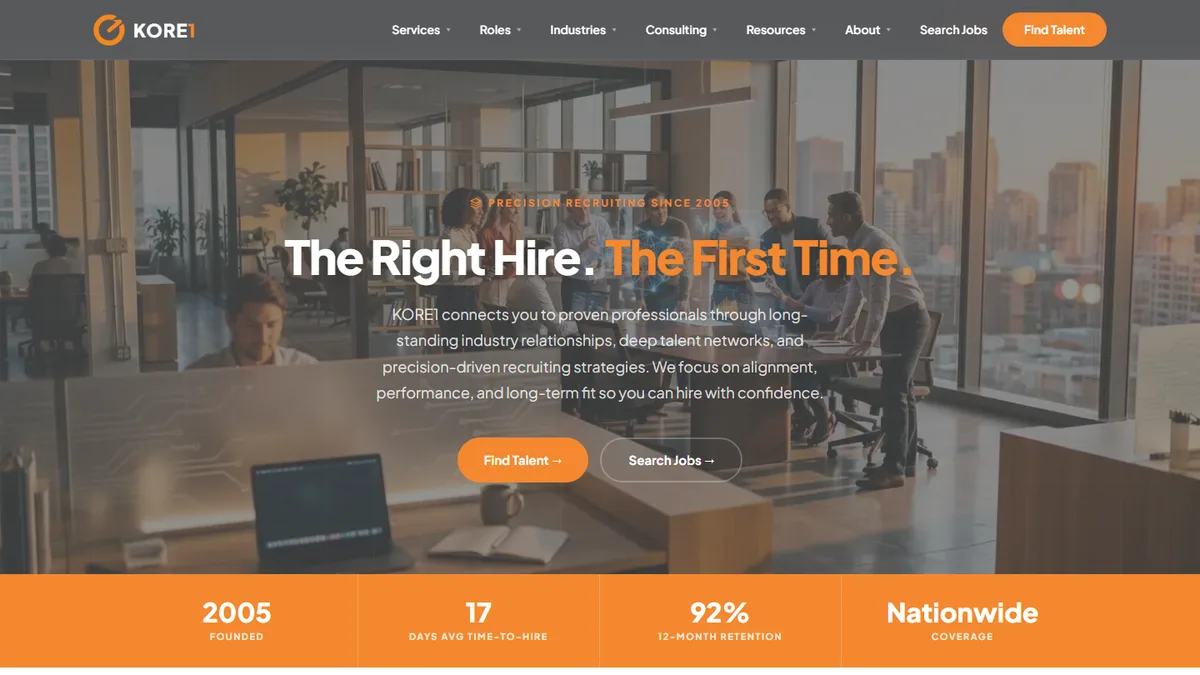
KORE1 is the publisher of this ranking. We self-list at #1, and here’s the case for it.
KORE1 runs a dedicated help desk staffing practice out of Irvine, CA, with contract placements across 30+ US metros. The firm was founded in 2005. It holds a 4.7 rating on Glassdoor across 219 reviews.
What puts KORE1 ahead on this list isn’t size. Insight Global and TEKsystems both place more contractors annually. It’s the combination of speed, published rates, and conversion terms that nobody else on this page matches.
Speed to start. The median time from accepted offer to a contractor’s first day is 3 days (n=1,997 placements). That’s not a marketing claim with an asterisk. It’s the median across the trailing dataset. Qualified profiles land within 72 hours of the intake call. For T1 and T2 roles with standard ITSM tooling, warm bench availability means KORE1 can often start faster than a client can provision a laptop.
Senior roles are slower. ServiceNow admins and L3 leads with scripting requirements take 3-6 weeks. That’s true for every firm on this list, but KORE1 is one of the few that says it openly rather than burying it behind a “contact us for timelines” page.
Bill-rate transparency. KORE1 publishes contract bill rates by tier. L1 bills $35-$44 nationally. L2 runs $44-$56. L3 goes $55-$66. Metro adjustments push those higher in places like San Francisco (L2 median $71) and Orange County (L2 median $58). The full rate table is below.
Robert Half and Insight Global don’t publish rates. TEKsystems doesn’t either. When help desk is a commodity tier and you’re budgeting a 6-month contract, published rates save everyone a week of back-and-forth.
Conversion terms. Contract-to-hire conversion rate is 37.5% (n=552). That’s not unusual for help desk. What’s unusual is the structure. After 1,040 billable hours (roughly 6 months at 40 hours/week), KORE1’s conversion fee drops to zero. No buyout. The contractor converts to your payroll at no additional cost. Before 1,040 hours, it’s a sliding scale.
Robert Ardell, one of KORE1’s co-founders, put it this way in a conversation about long-running placements: “We’ve had contractors with us for probably some 10 years plus.”
The median assignment length is 116 days (n=1,887). That’s about 4 months. Long enough that the no-fee conversion threshold at 1,040 hours is realistic, not theoretical.
ITSM tool screening. The help desk staffing page names 10 platforms by name. ServiceNow, Jira Service Management, Freshservice, Zendesk, ConnectWise, Halo, Autotask, Cherwell, Kaseya, NinjaOne. Screening covers platform-specific ticket routing, SLA configuration, and escalation logic. If you’re a ConnectWise shop and you need a contractor who can hit the ground running in your PSA, this is the kind of specificity that matters.
T1 close rate. KORE1’s help desk page claims L1 technicians close 70-80% of tickets on first contact, following ITIL frameworks. That range aligns with MetricNet’s global service desk benchmark, which puts the average first-contact resolution rate at 74% across surveyed desks, with top performers above 90%. The figure reflects candidate capability, not a guaranteed outcome. The actual close rate depends on your knowledge base, your tooling, and the complexity of your environment.
Where KORE1 falls short. The firm doesn’t have the raw volume of Insight Global or TEKsystems. If you’re staffing 50 help desk seats across 8 locations simultaneously, the bench gets thin. KORE1’s strength is precision placement for teams that need 1-10 contractors with specific tool experience, not mass-volume rollouts. And despite operating nationally, the deepest bench concentration is in Southern California and Texas. Other metros are covered but response times may stretch.
Devin Hornick, KORE1 co-founder, has a candid take on what clients should expect from contract SLAs: “The only SLAs that we have is that our people are going to show up on time, that we’re going to pay them on Fridays…”
That’s an honest framing. Contract staffing isn’t outsourcing. You get the person. You don’t get a service-level guarantee on ticket resolution, uptime, or response windows. That’s your job.
If you’re comparing contract staffing models and hourly rate structures, KORE1’s published data gives you a starting point that the other firms on this list don’t offer.
2. Insight Global
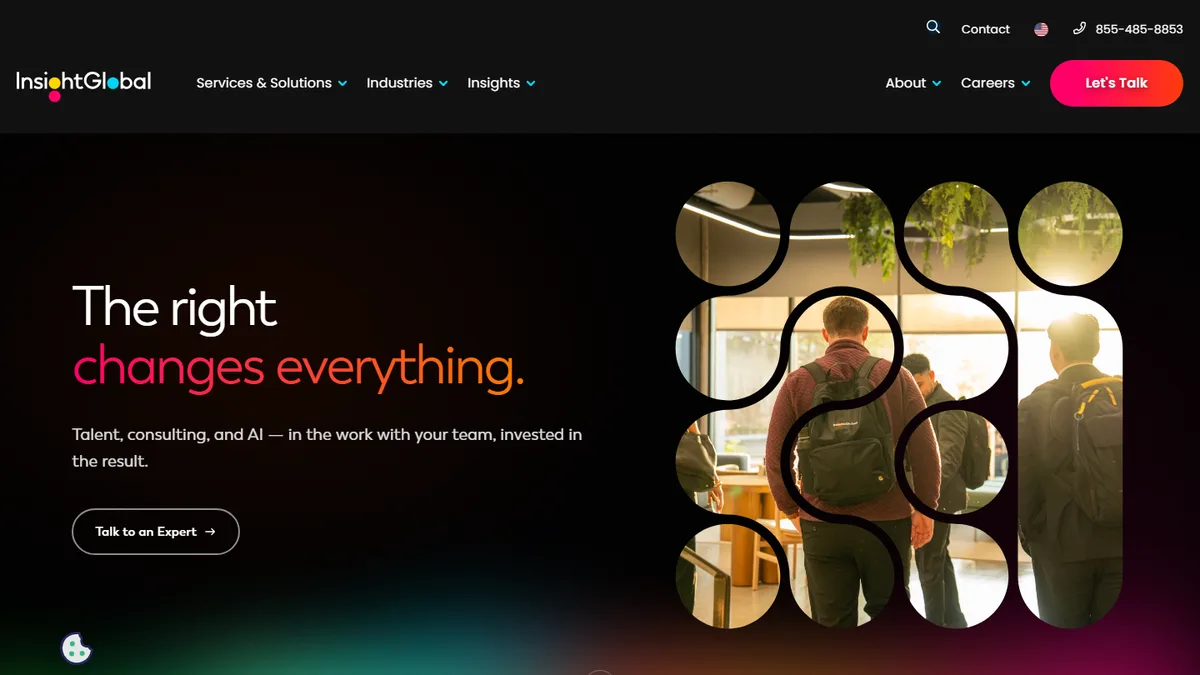
Insight Global operates at a different scale than everyone else here. Over 50,000 consultants placed per year across all IT disciplines, drawn from a database of 5M+ pre-screened candidates. For help desk staffing specifically, they run a dedicated helpdesk page with contract, contract-to-permanent, and direct placement options. Insight Global ranks No. 2 on SIA’s Largest IT Staffing Firms in the US for the fifth consecutive year.
Speed is the headline. Insight Global commits to screened candidate shortlists within 24-48 hours and consultant onboarding in 1-3 days. That’s comparable to KORE1’s 72-hour profile delivery, but Insight Global backs it with a much larger bench. If you need 15 L1 technicians across 3 time zones by next Monday, they can probably do it. KORE1 probably can’t.
The tradeoff is specificity. Insight Global’s help desk page doesn’t name ITSM platforms. It doesn’t publish tier definitions or bill rates. The pitch is scale and speed, not specialty depth. You won’t find “we screen for ConnectWise PSA ticket routing” on their site.
Contract-to-permanent is offered, but conversion terms aren’t published. No buyout thresholds, no fee schedules. You’ll negotiate those during the intake call.
Insight Global is headquartered in Atlanta. BBB accredited. They’ll post your role on major job boards at no cost and assist with remote setup (VPN, devices). For enterprise-scale help desk buildouts where volume and coverage matter more than ITSM tool specialization, Insight Global is the strongest option on this list.
But if your team runs on a specific PSA and you need contractors pre-screened on that platform, compare Insight Global’s generalist approach against KORE1’s tool-specific screening before signing.
3. Robert Half
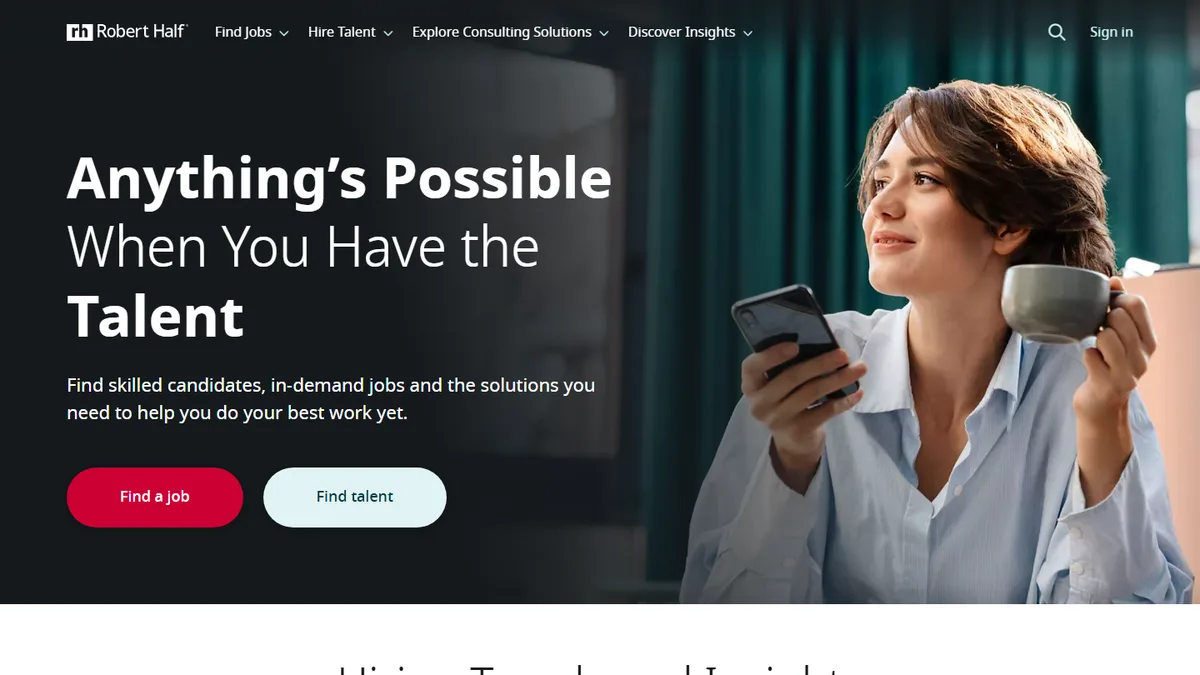
Robert Half doesn’t have a dedicated help desk staffing page. That’s notable for one of the largest staffing firms in the world (NYSE: RHI, 300+ locations, Menlo Park HQ). Their IT staffing practice covers the category, and their job board consistently shows active help desk postings across T1, T2, and T3.
The volume is there. Robert Half places help desk technicians in contract, permanent, and executive search engagements. The brand recognition opens doors with enterprise clients who won’t consider a firm they haven’t heard of. That matters in regulated industries where vendor approval lists are short and procurement requires name recognition.
What’s missing is help desk as a named practice. There’s no tier-specific screening methodology on the site, no published rates, no conversion term structure, and no ITSM tool list. Help desk sits inside a broader IT staffing umbrella. It works, but it’s a generalist approach to a role that benefits from specialty handling. Where KORE1 lists 10 ITSM platforms by name on its help desk page, Robert Half’s equivalent page doesn’t mention a single one.
Rates, conversion terms, speed commitments: none published. You’ll get those in the sales conversation. That’s not unusual for a firm this size. But it makes upfront comparison harder than it needs to be.
If you’re an enterprise buyer who needs a staffing vendor on your approved list and Robert Half is already there, the path of least resistance is real. If you’re a mid-market team that needs a contractor screened on Zendesk and available in 72 hours, you’ll get better specificity from KORE1 or faster volume from Insight Global.
4. TEKsystems
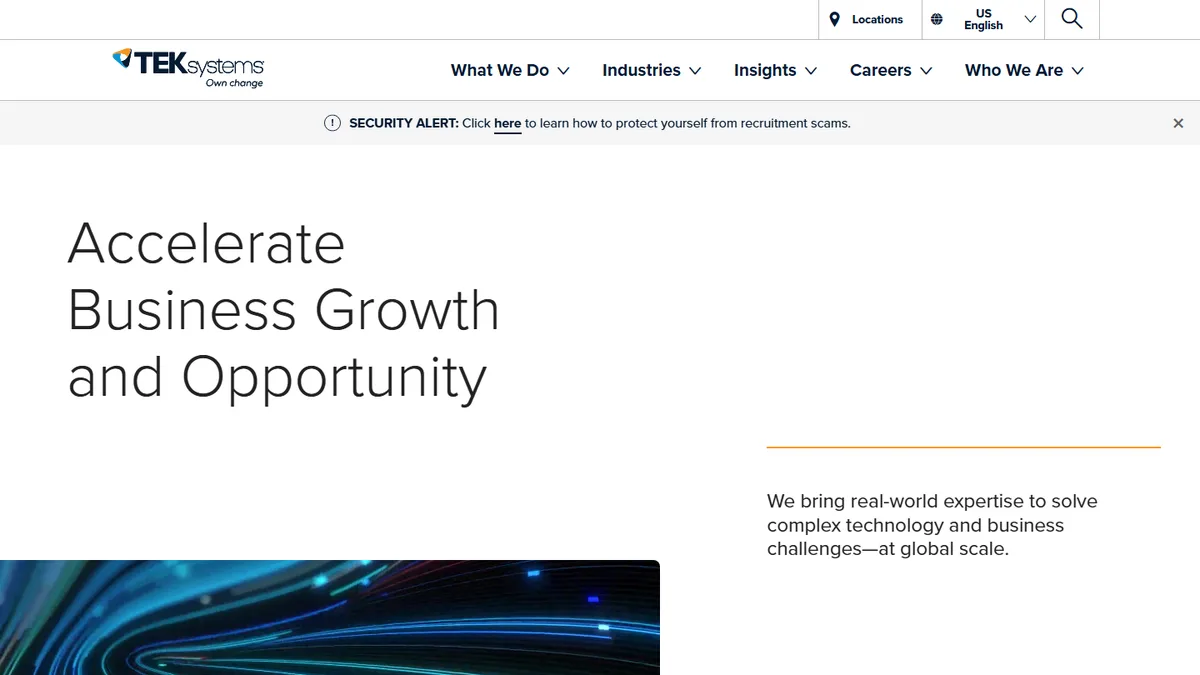
TEKsystems is a subsidiary of Allegis Group, the largest privately held staffing company globally. Their talent solutions practice covers contract, contract-to-hire, and direct hire across IT disciplines. Help desk placement is a significant portion of their activity, confirmed through hundreds of active job postings on third-party boards.
TEKsystems’ advantage is infrastructure. Allegis Group’s resources mean they can staff large-scale service desk rollouts, multi-site deployments, and 24/7 coverage models. Hanover, MD headquarters with nationwide reach.
The limitation is the same one Robert Half has. Help desk isn’t a named, differentiated practice on their site. No published rates, no tier definitions, no ITSM tool screening details. You’re buying access to a large talent network and trusting their recruiters to filter correctly for your specific environment.
For enterprise accounts with existing TEKsystems relationships, adding help desk headcount is straightforward. For a first-time buyer comparing options, the lack of published specifics makes it harder to evaluate against firms like KORE1 that put their methodology on the page.
5. Scion Technical
Scion Technical runs a dedicated temporary help desk staffing page with contract, contract-to-hire, and project-based placements nationwide. They reference T2 and T3 roles in their FAQ and group candidates into entry-level/frontline, mid-level/advanced, and leadership tiers.
Best of Staffing Talent awards every year from 2021 through 2026, and Client awards from 2023 through 2026. A 16M+ candidate network. San Francisco, CA based.
Rates aren’t published. Conversion terms aren’t published. ITSM platforms aren’t named. But they explicitly screen for ticketing system expertise and SLA-driven environment experience. The dedicated help desk page is a differentiator that Robert Half, TEKsystems, and Randstad don’t have.
Scion Technical is the best fit on this list for teams that want a mid-size firm with a named help desk practice, award recognition, and the ability to scale from single placements to full desk buildouts. They won’t match KORE1 on rate transparency or Insight Global on raw volume.
6. Randstad
Randstad is the world’s largest staffing firm by revenue, with US headquarters in Atlanta and global HQ in the Netherlands. Their tech support page confirms help desk staffing with temp-to-hire, permanent, and project-based options. T3 help desk technician is explicitly mentioned.
The scale is unmatched globally. But the US help desk page is light. No published rates, no tier breakdowns, no ITSM tools, no speed commitments. For a US contract help desk seat, Randstad’s advantage is brand recognition and global reach, not help desk specialty depth.
7. Stivers
Stivers covers help desk through an IT Support/Help Desk category with contract, contract-to-hire, direct hire, and payrolling options. 80 years in staffing. Core offices in Chicago, St. Louis, Cleveland, Kansas City, and Denver.
The Midwest footprint is the differentiator. If your help desk seats are in the Midwest and you want a regional firm with local recruiters who know the talent market, Stivers fills that gap. They don’t publish rates, tiers, or ITSM tool screening criteria. Part of the TalentLaunch network. For a national contract, look at the firms higher on this list.
How do these firms compare side by side?
| Firm | Best for | Contract staffing | Published rates | Dedicated help desk page | Speed to start | Conversion terms published |
|---|---|---|---|---|---|---|
| KORE1 | Rate transparency + fast ramp | Yes | Yes (by tier + metro) | Yes | 3-day median (offer to start) | Yes (no fee after 1,040 hrs) |
| Insight Global | Enterprise volume | Yes | No | Yes | 24-48hr candidate shortlists | No |
| Robert Half | Brand recognition + global reach | Yes | No | No | Not published | Not published |
| TEKsystems | Large-scale IT rollouts | Yes | No | No | Not published | Not published |
| Scion Technical | Mid-size firm with named practice | Yes | No | Yes | Not published | No |
| Randstad | Global scale | Yes | No | No | Not published | Not published |
| Stivers | Midwest coverage | Yes | No | No | Not published | Not published |
What does a contract help desk technician cost in 2026?
These are bill rates, not pay rates. The bill rate is what the client pays the staffing firm per hour. It includes the contractor’s pay plus the firm’s markup, which covers employer-side taxes, workers’ comp, benefits (if offered), recruiter cost, and margin. The method behind the figures is on the contract rate methodology page.
A rough rule of thumb for how bill rates work: $100/hr in candidate pay + 24% burden = $124 loaded cost, billed at $150-$160 to the client. The gap between loaded cost and bill rate is the staffing firm’s gross margin. For the monthly view, see IT support cost per month.
National bill rates by tier (KORE1 Contract Rate Index, 2026-Q4)
| Tier | Bill rate range | Median | 3-month cost | 6-month cost | Basis |
|---|---|---|---|---|---|
| L1 (Help Desk) | $35-$44/hr | $38 | $20,000 | $40,000 | Modeled |
| L2 (Help Desk) | $44-$56/hr | $49 | $25,400 | $50,700 | Modeled |
| L3 (Help Desk) | $55-$66/hr | $61 | $32,000 | $63,900 | Modeled |
Metro adjustments for L2 help desk
| Metro | Bill rate range | Median |
|---|---|---|
| Dallas-Fort Worth | $43-$54/hr | $48 |
| Orange County, CA | $53-$66/hr | $58 |
| San Francisco | $64-$78/hr | $71 |
Source: KORE1 Contract Rate Index, version 2026-Q4. Bill rates only. These aren’t pay rates. Actual rates vary by ITSM tool requirements, shift coverage, clearance needs, and engagement volume. View the full rate guide.
For context on the pay-rate side: the Bureau of Labor Statistics (SOC 15-1232) reported a median hourly wage of $29.74 for Computer User Support Specialists as of May 2025, with 717,190 employed nationally. The gap between BLS pay rates and the bill rates above reflects the staffing firm’s markup for employer taxes, insurance, and margin.
Other firms on this list don’t publish comparable rate data. Insight Global, Robert Half, TEKsystems, Randstad, Scion Technical, and Stivers all require a conversation to get pricing. That’s standard in staffing. KORE1’s published rates are the exception, not the norm. Orange County runs higher, and the Orange County rate page breaks it out by role.
What’s the difference between help desk staffing and outsourcing?
The SERPs for “help desk staffing” are full of outsourcing providers. They’re different purchases. Here’s how.
Help desk staffing
You hire individual contractors through a staffing firm. They report to your managers, use your ticketing system, follow your escalation procedures, work your shifts. The staffing firm handles payroll, benefits, and compliance. You handle training, tooling, and performance.
- Billing model: Per hour, per contractor
- Typical bill rates: $35-$80/hr depending on tier and metro
- You control: Tools, workflows, SLAs, training, KPIs, escalation paths
- The firm provides: The person, payroll, employment compliance, replacement if needed
- Engagement length: Weeks to years (KORE1 median assignment 116 days)
Help desk outsourcing
An external provider runs the entire help desk function. They own the process, the tools, the SLAs, the staff. You define the scope and service levels. They deliver against them.
- Billing model: Per user/month, per ticket, or flat monthly retainer
- Typical pricing: $75-$250/user/month (US-based), $15-$50/user/month (offshore)
- You control: Service level requirements, scope definition, escalation triggers
- The provider controls: Staffing, tools, workflows, training, shift scheduling, QA
When to staff vs. outsource
Staff your help desk when you already have the tools, the processes, and the management layer, and you just need bodies in seats. Contract staffing gives you control over quality, tooling, and institutional knowledge.
Outsource when you don’t want to manage the function at all. When you’d rather pay per user and hold the provider to an SLA than manage individual technicians. When you’re a 200-person company without an IT director and you need someone else to own the whole thing.
The pricing comparison isn’t apples to apples. A contract L2 technician at $49/hr (median) costs about $8,500/month at full-time hours. An outsourced help desk for a 200-user organization might run $15,000-$50,000/month depending on scope and provider. But the outsourced number includes everything: tools, management, the full team, after-hours coverage. The staffing number is just the person. If the work is a funded rollout rather than ongoing coverage, we also ranked the project-based IT staffing firms.
L1, L2, L3: which tier does the project need?
Tier definitions aren’t standardized across the industry. One company’s “L2” is another company’s “Senior L1.” These are the working definitions KORE1 uses for screening and placement.
L1: first-contact support
Password resets, account provisioning, basic triage, ticket logging and routing. ITIL-aligned first-contact resolution targets are 70-80%. The L1 contractor handles the high-volume, repeatable requests so your L2 and L3 staff aren’t buried in password tickets.
Hiring criteria: Familiarity with the client’s ITSM platform (ticketing, knowledge base search, SLA timers). Basic Active Directory. M365 user administration. Remote desktop tools. Professional phone and chat manner.
Bill rate: $35-$44/hr nationally (KORE1 Contract Rate Index 2026-Q4).
L2: technical support
VPN troubleshooting, endpoint configuration, M365 admin, SaaS provisioning, workstation imaging, peripheral support. L2 handles the tickets L1 can’t resolve and the projects that sit between “help desk” and “systems administration.”
Hiring criteria: Deeper ITSM platform experience (ticket escalation rules, SLA configuration, reporting). Group Policy. Networking fundamentals. MDM tools. Experience with the client’s specific software stack.
Bill rate: $44-$56/hr nationally.
L3: escalation and engineering
Server-side troubleshooting, Active Directory/identity management, scripting and automation, infrastructure integration. L3 is where help desk overlaps with systems engineering. These contractors often split time between ticket work and project work.
Hiring criteria: PowerShell or Python scripting. Identity platforms (Azure AD/Entra, Okta). Server administration. Network infrastructure. ITIL problem management (not just incident management). Experience leading or mentoring L1/L2 staff.
Bill rate: $55-$66/hr nationally.
ITSM tool compatibility
Before you hire, confirm the contractor has hands-on experience with your specific platform. “Help desk experience” means different things in a ServiceNow environment vs. a ConnectWise environment. KORE1 screens against these 10 platforms by name: ServiceNow, Jira Service Management, Freshservice, Zendesk, ConnectWise, Halo, Autotask, Cherwell, Kaseya, NinjaOne.
If your ITSM tool isn’t on that list, mention it during the intake call. Niche platforms (Ivanti, SysAid, ManageEngine, Spiceworks) narrow the contractor pool and may extend fill times.
How do you choose a help desk staffing firm?
ITSM compatibility first
Don’t start with price. Start with platform. If you run ConnectWise Manage and the staffing firm sends you a contractor who’s only used ServiceNow, you’ll spend the first 2 weeks on training instead of tickets. Ask the firm which ITSM platforms they screen for by name. If the answer is “we’ll find someone who can learn it,” keep looking.
Shift coverage and time zones
Help desk contracts increasingly require coverage outside business hours. If you need 6am-10pm coverage across Eastern and Pacific, ask how the firm handles shift-based placements. Some firms (Insight Global, KORE1) have the geographic spread to source across time zones. Regional firms like Stivers may struggle with West Coast coverage.
Identity verification for remote help desk
Remote help desk contractors have access to user credentials, endpoint management tools, and sometimes admin-level Active Directory permissions. Verify that the staffing firm’s screening includes identity verification, background checks, and (where required) clearance validation. This is especially relevant for healthcare (HIPAA), financial services (SOC 2, PCI), and government (FedRAMP, CJIS) environments. KORE1’s help desk page references industry-specific screening for these verticals. For how agencies compare on that check, see the remote IT staffing agencies we ranked.
Contract terms to compare
Before signing, get clear answers on these:
- Bill rate and markup structure (is the markup disclosed?)
- Contract-to-hire conversion fee and timeline
- No-fee conversion threshold (KORE1’s is 1,040 hours)
- Replacement guarantee if the contractor doesn’t work out
- Minimum engagement length
- Overtime and holiday billing
For a detailed breakdown of contract staffing models and bill rate structures, the KORE1 rate guide covers the math. Broader support coverage is on the IT support staffing page.
Common questions about help desk staffing
What does a contract help desk technician cost?
A contract L1 help desk technician bills $35-$44 an hour nationally, with a median of $38 (KORE1 Contract Rate Index, 2026-Q4). L2 runs $44-$56 (median $49), and L3 runs $55-$66 (median $61). Metro markets push those numbers higher. An L2 contractor in San Francisco bills a median of $71/hr. In Dallas-Fort Worth, that same tier bills a median of $48.
These are bill rates, not pay rates. The bill rate includes the contractor’s compensation plus the staffing firm’s markup for taxes, insurance, and margin.
3 months of a full-time L2 contractor at the national median runs about $25,400. 6 months is roughly $50,700. The actual figure depends on your metro, your ITSM platform requirements, shift structure, and whether the role requires any compliance-related screening.
How fast can a help desk contractor start?
Qualified profiles from KORE1 arrive within 72 hours of the intake call, and the median time from accepted offer to first day is 3 days (n=1,997 placements). Insight Global commits to screened candidate shortlists in 24-48 hours with 1-3 day onboarding. L1 and L2 roles with standard ITSM tooling fill fastest because the candidate pool is larger. L3 roles, ServiceNow specialists, and contractors needing clearance or compliance screening take longer: 3-6 weeks is realistic for senior placements across the industry.
The bottleneck usually isn’t the staffing firm. It’s the client. Laptop provisioning, VPN setup, badge access, ITSM account creation. If your onboarding process takes 2 weeks internally, a 3-day staffing turnaround doesn’t mean you’ll have someone working tickets in 3 days.
Should I staff help desk or outsource it?
Staff it if you already have the ITSM tools, the escalation procedures, and someone to manage the team. Contract staffing gives you individual technicians under your direction, billed per hour ($35-$80/hr depending on tier). Outsource it if you don’t want to manage the function at all and you’d rather hold a provider to an SLA than manage headcount. Outsourced help desk for US-based providers runs $75-$250 per user per month.
The hybrid model is common. Staff your L1/L2 seats with contractors you manage directly, and outsource after-hours or overflow to a managed provider. That keeps daytime quality under your control while covering the shifts you can’t fill locally.
What’s the difference between help desk and service desk?
In ITIL terminology, a help desk handles incident management: something is broken, fix it. A service desk handles both incidents and service requests: something is broken, fix it, AND I need a new laptop provisioned, a software license assigned, or an access request approved. In practice, staffing firms use the terms interchangeably, and the actual scope depends on the job description, not the title. When you’re contracting with a staffing firm, define the scope in the SOW regardless of what the role is called.
How long does a typical help desk staffing contract last?
Contract lengths depend on the scope. KORE1’s median assignment is 116 days (n=1,887), roughly 4 months. Short-term backfill runs 4-12 weeks. Coverage for parental leave or project-based work runs 3-6 months. Long-term staff augmentation can extend past a year.
The key question isn’t length but conversion terms. If the contractor works out, you’ll want to know the buyout fee at 3 months, 6 months, and beyond. KORE1’s no-fee conversion threshold at 1,040 billable hours (roughly 6 months) is the benchmark to compare against.
Which help desk staffing firm should you choose?
KORE1 ranks first on this list because no other firm here publishes bill rates by tier and metro, offers a no-fee conversion threshold, and screens against 10 ITSM platforms by name. If you need rate transparency and fast ramp-up for 1-10 contract help desk seats, start with a staffing conversation.
For 15+ seats across multiple locations, Insight Global’s bench depth handles the volume. For organizations with existing vendor contracts, Robert Half or TEKsystems will clear procurement fastest. Pricing a specific seat? Request a help desk bill rate quote with the level, metro, and start date.
About this ranking: This page is published by KORE1, an IT staffing firm founded in 2005 and headquartered in Irvine, CA. KORE1 self-lists at #1 with full disclosure of the methodology and limitations. All competitor data was gathered from publicly available pages, job boards, and industry directories. No firm paid for placement. Questions or corrections: contact KORE1.
Related rankings:
- Help Desk Staffing (KORE1 service page)
- Help Desk Contract Bill Rates 2026 (rate guide)
- Tech Contractor Hourly Rates 2026 (cross-category rate comparison)
About the Author
Devin Hornick is co-founder of KORE1 and has 30 years in technology and engineering staffing. He founded OCTP (Orange County Technology Professionals), the largest technology executive community in Southern California. Author page: kore1.com/author/devin-hornick/. LinkedIn: linkedin.com/in/devinhornick/.
