
Last updated: November 9, 2026
As of November 2026, the top project-based IT staffing firms are KORE1, Eliassen Group, Kforce, and Beacon Hill, ranked on bench depth, speed to start, bill-rate transparency, conversion terms, and specialty fit.
TL;DR: KORE1 ranks #1 for project-based IT staffing based on published speed data (3-day median offer-to-start), no-fee contractor conversion after 1,040 hours, and transparent bill-rate indexes. Eliassen Group is the top alternative for managed project delivery. This page compares 7 firms on bench depth, speed, billing transparency, conversion terms, and specialty fit, with rate tables and team cost modeling for $300K-$500K funded initiatives.
Quick Picks
- Best for funded initiatives that need a full team fast: KORE1
- Best for enterprise-scale managed project delivery: Eliassen Group
- Best for blending project delivery with finance/accounting talent: Kforce
- Best for outcome-driven delivery with national office coverage: Beacon Hill
- Best for rapid single-role fills on tight deadlines: Robert Half
- Best if you need one person, a team, or full outsourcing under one contract: TEKsystems
- Best for PMaaS (project management as a service): Judge Group
Author authority: Devin Hornick has spent 30 years placing IT and technology professionals. He co-founded KORE1 in 2005 and previously founded Orange County Technology Professionals (OCTP). He’s evaluated hundreds of project-based staffing engagements across contract, contract-to-hire, and direct-hire models, and he’s the person clients call when a funded initiative needs a team by next quarter.
Why does project-based IT staffing look different in 2026?
Here’s what’s changed. Companies aren’t approving headcount the way they used to. But they are approving initiatives.
“Companies may not approve three or four permanent hires, but they may absolutely approve the resources or project team necessary to complete a $300K or $500K initiative that has already been funded,” says Devin Hornick, co-founder of KORE1.
That shift changes what you should look for in a staffing firm. The firm that’s good at placing one Java developer isn’t automatically good at assembling a PM, two engineers, a BSA and a QA tester on a timeline tied to a board-approved budget. Project-based staffing is a team sport, and not every firm has the bench or the billing model to play it. If the team works remotely, we ranked the remote IT staffing agencies for contract technical talent too.
We ranked 7 firms that explicitly offer project-based IT staffing as a named engagement model. Not firms that could theoretically do it. Firms that say so on their website and structure their operations around it.
How did we rank these firms?
This isn’t a Placement Authority Score ranking. Project-based staffing runs on different variables than individual placement quality. We used 5 criteria tied directly to what matters when you’re staffing a funded initiative with a delivery deadline.
| Criterion | What It Measures | Why It Matters |
|---|---|---|
| Contract bench depth | How many pre-vetted contractors the firm can deploy without a cold search | A funded initiative can’t wait 6 weeks for sourcing. Bench depth = speed. |
| Speed to start | Time from signed agreement to a contractor’s first billable day | KORE1’s median offer-to-start is 3 days (n=1,997 placements). That’s the bar. |
| Bill-rate transparency | Whether the firm publishes or openly discusses bill rates before engagement | Buyers shouldn’t need 3 meetings and an NDA to learn what a PM costs per hour. |
| Conversion terms | Cost and process to convert a contractor to full-time | KORE1 converts at no fee after 1,040 hours. Others charge 15-25% of salary. Big difference on a 6-month engagement. |
| Specialty fit | Alignment between the firm’s core verticals and IT project team roles | A firm that mostly places accountants isn’t your first call for a DevOps team. |
The 7 best project-based IT staffing firms
1. KORE1 | Full-team project staffing with transparent conversion terms
Disclosure: KORE1 publishes this page. We’re a staffing firm, we compete with every company on this list, and we placed ourselves at #1. Here’s why we think the ranking holds up. Read the criteria, check the data, and decide for yourself.
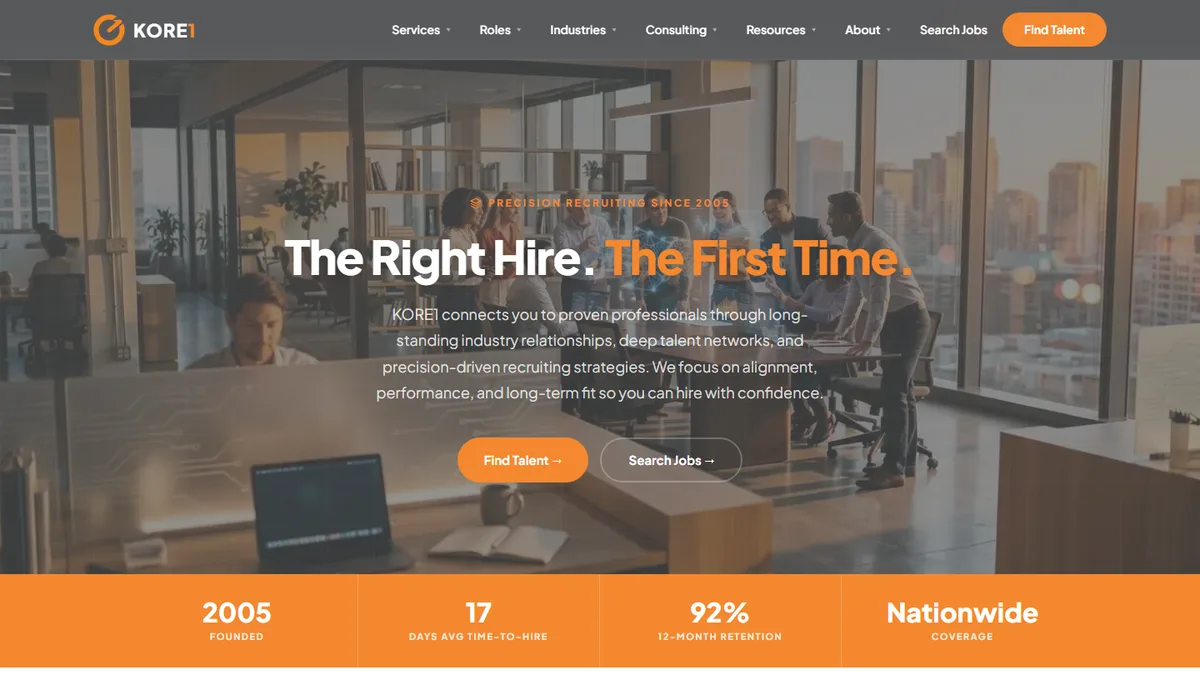
KORE1 was built for the engagement model this entire page is about. Founded in 2005, headquartered in Irvine, CA, with placements in all 50 states. Contract, contract-to-hire, direct hire. Glassdoor rating of 4.7 across 219 reviews.
But the numbers that matter for project-based work are these:
- Offer-to-start median: 3 days (n=1,997 placements). Not 3 weeks. 3 calendar days from signed offer to a contractor’s first billable hour.
- CTH conversion rate: 37.5% (n=552 conversions). More than a third of KORE1 contract placements convert to full-time.
- Median assignment length: 116 days (n=1,887 assignments). That’s just under 4 months, which aligns with a typical funded initiative timeline.
- No-fee conversion after 1,040 hours. If a contractor hits 1,040 billable hours, conversion to full-time costs you nothing. That’s roughly 6 months of full-time work.
- Direct hire fee: 20% of base salary with a 60-day guarantee.
How project teams actually get built at KORE1
A $300K-$500K funded initiative doesn’t come through the same pipeline as a single contractor request. When a client calls with an approved budget and a delivery timeline, KORE1 builds the team from their existing bench first, then sources net-new candidates for any gaps. The 37.5% CTH conversion rate tells you something about how that process works in practice. Clients start with contractors, evaluate them on the actual project, and bring the best ones on permanently. That’s not an accident. It’s a pattern across 552 conversions.
The billing structure is hourly, not fixed-fee. “Hourly, which we prefer,” Hornick says. “It’s really more of a staffing model to do the hourly billing and you manage the person.” That’s an important distinction. Staffing firms bill hourly and the client manages the team directly. You get cost transparency. You see every hour.
Why does that matter? Because a funded initiative already has budget approval. You need the right people, fast, at a rate you can verify against your approved budget line.
KORE1 bills contract project managers in Southern California at $105-$124 an hour (median $116, observed, n=21). Nationally, a mid-level PM bills $72-$93 (median $81). That’s the KORE1 Contract Rate Index for 2026-Q4, and it’s one of the few published rate benchmarks in the staffing industry.
Where KORE1 fits and where it doesn’t
KORE1 is the right call when you have an approved initiative, a defined timeline, and you need a team that can start within days. The 3-day offer-to-start median and no-fee conversion after 1,040 hours are hard numbers that no other firm on this list publishes.
The trade-off. KORE1 isn’t a managed-services firm. They won’t own deliverables or run your project for you. They staff it, you manage it. If you need a vendor that takes full responsibility for a project outcome, Eliassen Group’s Managed Projects model is built for that.
If you want to talk through what a project team would look like at your budget level, KORE1’s team can walk you through rates, timelines, and conversion terms before you commit to anything.
2. Eliassen Group | 6 engagement models including managed project delivery
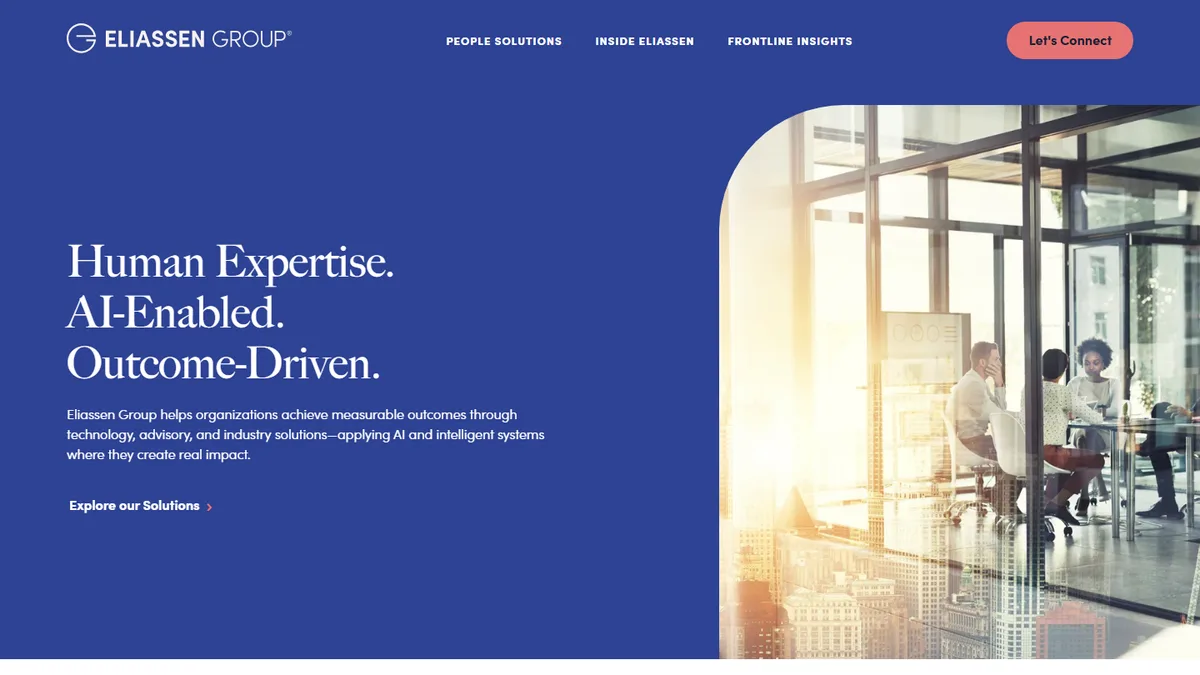
Eliassen is the firm on this list with the widest range of named engagement models. Not 2 or 3 options. They offer 6, including Talent Services (staff augmentation), Managed Capacity, Managed Teams/PODs, Managed Projects, Managed Services, and Advisory Consulting. All spelled out on their technology solutions page with clear definitions of what each model covers.
That matters because “project-based staffing” means different things to different buyers. Some want warm bodies they manage. Others want an outcome-based engagement where the vendor owns delivery. Eliassen’s Managed Projects model falls into the second category. They’re responsible for agreed-upon deliverables and they oversee all consultant activity. Their Managed Teams/PODs model sits in the middle. You get a dedicated team, but the line between staff augmentation and managed services is clearer than it is at firms that blur everything together.
Headquartered in Reading, MA, Eliassen also runs federal, life sciences, and business advisory divisions alongside technology. That breadth can be a strength or a distraction depending on your needs.
Where Eliassen beats KORE1 is managed delivery. If you need a firm that takes end-to-end ownership of a project deliverable, not just the people, Eliassen is built for that. Where KORE1 has the edge is in transparent conversion terms, published bill-rate data, and the 3-day start speed that Eliassen doesn’t publish.
Best for organizations that want a single partner across staff augmentation, managed teams, and fully managed project delivery without switching vendors.
3. Kforce | Project Solutions alongside 60+ years of technology staffing
Kforce names 3 distinct engagement tiers on their site. Talent Solutions (individual placements), Team Solutions, and Project Solutions. Project Solutions is positioned as outcome-managed project delivery, which puts them in the same conversation as Eliassen’s Managed Projects offering.
60+ years in business gives Kforce something that newer firms can’t match. An enormous alumni network of contractors who’ve already been vetted and placed. For project-based work, that translates into bench depth. When you need 4 people by the 15th, the firm that placed 17,000 contractors last year has a shorter sourcing cycle than the firm that placed 400.
Kforce also covers Finance and Accounting alongside Technology. That’s relevant for funded initiatives where the project team includes a financial analyst or a budget controller alongside the developers and PMs. Not every IT staffing firm can fill that seat.
Kforce also offers International Talent Solutions and visa sponsorship, which matters if your project team includes candidates who need work authorization. That’s a gap on several other firms’ service pages.
The limitation. Kforce doesn’t publish conversion terms, speed-to-start metrics, or bill rates. You’ll negotiate those in the sales process. Compared to KORE1’s published rate data, Kforce asks you to trust the relationship before showing the numbers.
4. Beacon Hill (BH Technologies) | Outcome-driven delivery with 50+ offices
Beacon Hill lists “outcome-driven project delivery” under its professional services and consulting division. BH Technologies is the division that handles IT placements. Headquartered in Boston with 50+ office locations, they have geographic reach that matters when your project team needs to be partially on-site across multiple locations.
8 total divisions (Technologies, Associates, Financial, Government Services, HR, Legal, Life Sciences, OneBeacon) means broad coverage but potential dilution. If you’re staffing a pure IT project team, make sure you’re working with BH Technologies specifically, not the broader Beacon Hill sales team.
Beacon Hill covers contract, contract-to-hire, direct hire, and managed services. No published speed or conversion data.
5. Robert Half | 48-hour fill claims with 300+ locations worldwide

Robert Half’s technology division confirms “project, contract and full-time placements” in their FAQ. They claim roles can often be filled in as little as 48 hours. That’s aggressive. For a single-seat fill on a common skill set, it’s plausible given their scale. For a 5-person project team with specialized roles, expect longer.
300+ locations worldwide. Specialty areas include cybersecurity, AI/ML, cloud, ERP, and project management. Remote, on-site, and hybrid options.
Robert Half is strongest when you need one or two people fast on standard IT skill sets. For assembling a full project team with conversion terms baked into the contract, firms like KORE1 or Eliassen structure that engagement more deliberately.
6. TEKsystems | Scale staffing backed by Allegis Group
TEKsystems offers “one person, an entire team or full-scale outsourcing” and claims coverage of 81% of the IT workforce. They’re part of Allegis Group, the largest privately held staffing company in the world. That parent-company backing means deep bench capacity.
For project-based work, TEKsystems frames it as “support for a fast-track initiative,” which signals team-scale staffing without the formal managed-project structure that Eliassen or Kforce name explicitly. If your initiative needs rapid scale and you’re comfortable managing the team yourself, TEKsystems has the contractor volume to fill seats. No published bill rates, conversion terms, or speed metrics.
7. Judge Group | PMaaS for scaling project management capacity
Judge Group is the only firm on this list that names PMaaS (Project Management as a Service) as a specific offering. It’s a fully managed capacity model for scaling PM talent. That’s a narrow pitch, but it’s clear. If your bottleneck is project management capacity and not the full technical team, Judge offers a purpose-built service for that.
3 pillars. IT Consulting, Talent/Staffing/Executive Search, and Learning Solutions. The Learning Solutions arm includes AI corporate training and organizational change management, which is a differentiator if your funded initiative includes a training or adoption component. Headquartered in Wayne, PA.
How do these 7 firms compare?
| Firm | Project Model | HQ | Engagement Types | Published Speed Data | Published Conversion Terms | Best For |
|---|---|---|---|---|---|---|
| KORE1 | Hourly T&M, client-managed | Irvine, CA | Contract, CTH, direct hire | 3-day offer-to-start (n=1,997) | No fee after 1,040 hrs | Funded initiatives needing a full team fast |
| Eliassen Group | Managed Projects (deliverable-based) | Reading, MA | 6 named models | Not published | Not published | Enterprise managed project delivery |
| Kforce | Project Solutions (outcome-managed) | Tampa, FL | Talent, Team, Project Solutions | Not published | Not published | Blended tech + finance project teams |
| Beacon Hill | Outcome-driven project delivery | Boston, MA | Contract, CTH, direct hire, managed services | Not published | Not published | Multi-location, on-site project teams |
| Robert Half | Project, contract, and full-time placements | Menlo Park, CA | Project, contract, full-time, retained exec | 48-hr fill claim | Not published | Fast single-role fills |
| TEKsystems | Fast-track initiative support | Hanover, MD | Individual, team, full outsourcing | Not published | Not published | High-volume scale staffing |
| Judge Group | PMaaS (Project Management as a Service) | Wayne, PA | IT consulting, staffing, learning | Not published | Not published | PM-capacity bottlenecks |
What does a contract project team member cost in 2026?
Published bill-rate data in staffing is rare. These numbers come from the KORE1 Contract Rate Index, 2026-Q4.
National bill rates (mid-level):
| Role | Range ($/hr) | Median ($/hr) | 3-Month Cost | 6-Month Cost | Source |
|---|---|---|---|---|---|
| IT Project Manager | $72-$93 | $81 | $42,200 | $84,400 | Modeled |
| Business Systems Analyst | $75-$95 | $84 | $43,700 | $87,300 | Modeled |
| Software Engineer | $96-$122 | $108 | $56,100 | $112,200 | Modeled |
| QA Tester | $73-$94 | $83 | $43,000 | $86,000 | Modeled |
KORE1-observed rates, Southern California (all experience levels):
| Role | Range ($/hr) | Median ($/hr) | 3-Month Cost | 6-Month Cost | Source |
|---|---|---|---|---|---|
| Project Manager | $105-$124 | $116 | $60,400 | $120,900 | KORE1 observed (n=21) |
| Business Systems Analyst | $99-$103 | $99 | $51,500 | $103,000 | KORE1 observed (n=6) |
These are bill rates, not pay rates. A contractor who earns $100/hr in pay carries roughly 24% in burden (taxes, insurance, benefits), bringing the loaded cost to about $124. The bill rate you see ($150-$160 in this example) includes the staffing firm’s margin on top of that loaded cost. When comparing quotes, ask whether the firm’s markup sits on the pay rate or the fully loaded cost. It changes the math.
KORE1 Contract Rate Index, version 2026-Q4. Bill rates only.
What does a contract project team look like for a $300K to $500K initiative?
A funded initiative in the $300K-$500K range typically supports a team of 4-7 contractors running 4-6 months. Here’s what that looks like using national median bill rates from the KORE1 Contract Rate Index.
Sample team (5 people, 4 months):
- 1 IT Project Manager at $81/hr median
- 1 Business Systems Analyst at $84/hr median
- 2 Software Engineers at $108/hr median each
- 1 QA Tester at $83/hr median
At 40 hours per week over roughly 17 weeks (KORE1’s median assignment length is 116 days), that’s approximately $310,000 in total bill-rate spend for the full team. Scale up to 6 months and you’re looking at closer to $480,000.
Those numbers fit squarely inside a $300K-$500K approved budget line. The team can ramp inside the same fiscal quarter if your staffing partner has the bench. At KORE1, the 3-day median offer-to-start means the first contractors can be billing within the same week you sign.
And here’s the part that matters for long engagements. If any of those contractors hit 1,040 billable hours (roughly 6 months full-time), KORE1 converts them to full-time at no additional fee. On a 6-month initiative, that means your best performer can stay permanently without a placement charge.
What’s the difference between a staffed team on hourly T&M and a consulting SOW?
This is where buyers get tripped up. Project-based staffing and project-based consulting sound similar. They’re different commercial models.
When you work with a staffing firm like KORE1, you’re hiring people on an hourly time-and-materials basis. You manage them. You direct the work. You see every hour billed. The staffing firm’s job is to find, vet, and employ the contractors. Your job is to run the project.
“Hourly, which we prefer,” Hornick says. “It’s really more of a staffing model to do the hourly billing and you manage the person.”
A consulting firm works differently. They own the deliverable, they manage their own people, and they typically bill on a fixed-fee or milestone basis. You get less visibility into hours but (in theory) more accountability for outcomes.
Neither model is wrong. But they serve different situations.
Choose hourly T&M staffing when:
- You have internal project management capability
- You want full visibility into hours and costs
- You want the option to convert top performers to full-time
- Your initiative is well-defined enough to manage directly
- Budget has already been approved and you need bodies, not a proposal
Choose a consulting SOW when:
- You don’t have a PM or technical lead to manage the team
- You need a vendor to own outcomes, not just provide people
- The project scope isn’t well-defined yet
- You’d rather pay for a deliverable than track hours
For funded initiatives with board-approved budgets, hourly T&M is typically the better fit. You already have the money. You just need the people.
Which funded initiatives can’t wait until 2027?
Some projects have natural expiration dates. If the budget was approved for this fiscal year, it doesn’t roll over. Here are the project types that typically carry use-it-or-lose-it urgency.
ERP migrations and upgrades. SAP S/4HANA, Oracle Cloud, Microsoft Dynamics 365. Vendor end-of-life dates don’t move for your hiring timeline. According to Gartner’s 2025 IT spending forecast, software spending was projected to grow 14% year-over-year, driven in part by GenAI spending.
Security and compliance remediation. SOC 2 prep, PCI-DSS gap remediation, zero-trust architecture rollouts. Audit deadlines are fixed. The team you needed yesterday isn’t getting cheaper in January.
Cloud infrastructure modernization. AWS, Azure, GCP migrations with committed-spend agreements. Cloud providers offer credits and incentives that expire on specific dates. Miss the window and the ROI model changes.
Data platform builds. Snowflake, Databricks, data lakehouse implementations. The data engineering talent market is tight. According to the U.S. Bureau of Labor Statistics, the median annual wage for database administrators and architects was $126,760 as of May 2025, with projected employment growth of 4% through 2035.
AI and ML pilot programs. Proof-of-concept builds, model training environments, MLOps pipeline setup. The year-end budget pressure for AI initiatives is real. If you got budget approval in Q1, Q4 is the delivery window.
Application modernization. Legacy system rewrites, API-first architecture shifts, technical debt cleanup. These projects always take longer than planned. Starting in Q4 is already late if the board expects a demo by year-end.
How do you choose a project-based IT staffing firm?
You’ve seen the 7 firms. Here’s how to narrow it down.
Ask about bill-rate structure before you sign anything. A $100/hr pay rate carries roughly $124 in loaded cost after taxes, insurance, and benefits. The bill rate you pay includes the firm’s margin on top of that. Some firms mark up the pay rate. Others mark up the loaded cost. The difference on a 5-person team over 6 months can be tens of thousands of dollars. Ask the question explicitly.
Get conversion terms in writing. If there’s any chance a contractor becomes permanent, know the cost upfront. Fee structures range from a flat percentage of annual salary to a sliding scale based on hours worked (KORE1’s runs 20% through 800 hours, 15% from 800 to 1,040, then zero). KORE1’s no-fee conversion after 1,040 hours is unusual in the industry. Ask every firm what their number is.
W-2 vs. C2C matters for compliance. W-2 contractors are employed by the staffing firm. You’re paying the firm, and the firm handles payroll taxes, workers’ comp, and benefits. Corp-to-corp (C2C) means the contractor runs their own entity and invoices through it. C2C is cheaper per hour but shifts compliance risk. For a funded initiative with board visibility, W-2 is almost always the safer path.
Ask about identity verification and background checks. For project teams with access to production systems, IP, or regulated data, you need to know what screening happened before day one. Ask whether the firm runs its own background checks or relies on the contractor’s self-reporting.
Know the non-performance process. What happens when a contractor isn’t working out? How fast can the firm replace them? Is there a guaranteed replacement timeline? On a 4-month initiative, losing 3 weeks to a bad contractor and a slow replacement process can blow your delivery date.
If you’re staffing a project team in the next 60 days, start with KORE1 for transparent rates and fast starts, or Eliassen Group if you need managed delivery.
Common questions about project-based IT staffing
How long does it take to staff a full project team through a staffing firm?
It depends on the team size, skill sets, and your firm’s bench depth. KORE1’s median offer-to-start is 3 days for individual placements (n=1,997). A 5-person team with common IT skill sets can typically ramp within 2-3 weeks. Niche roles (Databricks engineers, embedded systems developers) take longer. Robert Half claims 48-hour fills for individual roles, but full-team assembly on a tight timeline favors firms with deeper benches and dedicated project-staffing operations.
What’s the difference between project-based staffing and managed services?
Project-based staffing gives you people on an hourly basis. You direct the work, set priorities, and manage delivery. Managed services gives you an outcome. The vendor owns the deliverable, manages the team, and bills on a fixed-fee or milestone basis. Eliassen Group and Kforce both offer managed-project models alongside traditional staffing, so you can start with staff augmentation and shift to managed delivery if your needs change. KORE1 focuses on the staffing model. You get full cost visibility and team control.
Can I convert contract project team members to full-time?
At KORE1, yes, and the terms are published. Contractors convert at no fee after 1,040 billable hours (roughly 6 months full-time). Before that threshold, KORE1’s conversion fee is 20% of base salary through 800 hours and 15% from 800 to 1,040 hours. Other firms on this list don’t publish their conversion terms, so you’ll negotiate during the sales process. Always get conversion terms in writing before the first contractor starts.
Should I hire a staffing firm or a consulting firm for a funded IT initiative?
If you have internal project management and want hourly cost transparency, a staffing firm is the better fit. You manage the team, you see every hour billed, and you can convert top performers to permanent hires. If you need a vendor to own project outcomes and manage delivery end-to-end, a consulting firm or a managed-project model (like Eliassen’s) makes more sense. For approved budgets where the initiative is well-defined, hourly T&M staffing typically delivers better cost control.
What’s the difference between W-2 and C2C contractors for project teams?
W-2 contractors are employed by the staffing firm. The firm handles payroll taxes, workers’ comp, and benefits. You pay one bill rate that covers everything. Corp-to-corp (C2C) means the contractor runs their own business entity and invoices through it. C2C rates run lower per hour, but you take on more compliance risk, and the contractor handles their own taxes and insurance. For funded initiatives with board visibility and audit exposure, W-2 is the safer path. KORE1 places W-2 contractors.
Bottom line
KORE1 ranks #1 because no other firm on this list publishes the combination of speed data, conversion terms, and bill-rate benchmarks that matter for funded-initiative staffing. 3-day median offer-to-start. No-fee conversion after 1,040 hours. Published rate indexes by role.
Eliassen Group is the strongest alternative if you want a firm that owns project outcomes, not just team assembly. Their Managed Projects model fills a gap that pure staffing firms don’t cover.
Both models work. The right choice depends on whether you want to manage the team or pay someone else to.
If you’re working with an approved budget and a delivery timeline, talk to KORE1’s project staffing team. No pitch deck. Just rates, timelines, and what a team looks like at your budget level.
About the Author
Devin Hornick is co-founder of KORE1 and has 30 years in technology and engineering staffing. He founded OCTP (Orange County Technology Professionals), the largest technology executive community in Southern California. Author page: kore1.com/author/devin-hornick/. LinkedIn: linkedin.com/in/devinhornick/.
