
Last updated: November 11, 2026
As of October 2026, the top remote IT staffing agencies for contract technical talent are KORE1, Insight Global, Robert Half, and Scion Technology, ranked on bench depth, speed to start, bill-rate transparency, and conversion terms.
TL;DR: Seven remote IT staffing agencies ranked for W2 contract technical talent. KORE1 leads on speed (3-day offer-to-start median, n=1,997), conversion structure (no fee after 1,040 hours), and published identity verification. Insight Global wins on enterprise scale. Robert Half on geographic coverage. A mid-level contract software engineer bills $96-$122/hr nationally (KORE1 Contract Rate Index, 2026-Q4). Identity verification now separates the field after FBI, CrowdStrike, and Okta reporting on hiring fraud.
Quick Picks
- Best overall for contract technical talent: KORE1
- Best for fast shortlists at enterprise scale: Insight Global
- Best for geographic coverage and hybrid flexibility: Robert Half
- Best for urgent 24-to-72-hour candidate submissions: Scion Technology
- Best for fully remote contract roles posted nationally: Emergent Staffing
- Best for long-term W2 contract extensions: Apex Systems
- Best for identity-verified remote contractors: iShift
Get a custom rate quote from KORE1 →
KORE1 is a staffing firm, and we publish this list. We also placed ourselves at #1. That’s a conflict, and you should weigh it accordingly. What we can show you is exactly how the ranking works, what data backs each position, and where every other firm on this list beats us on specific criteria. If the methodology doesn’t hold up, ignore the ranking.
The remote contract staffing market doesn’t look like it did two years ago. The talent pool got bigger. So did the fraud. Between the FBI’s January 2025 advisory on face-swapping technology in video interviews and the 11-nation joint advisory issued in July 2026, hiring a contractor you’ve never met in person carries risk that staffing agencies haven’t historically been built to manage.
This list focuses on agencies that place W2 contract technical talent for remote work. Not direct hire, not permanent placement, not offshore dev shops. Contract. Remote. Technical. If you need a senior cloud engineer for six months or a data team for a migration sprint, these are the firms worth evaluating. For how KORE1 runs those engagements, see our contract staffing services.
We scored each firm on five criteria that matter for contract remote engagements, weighted toward the factors buyers tell us they care about and the ones that actually predict whether a placement sticks.
How we ranked these firms
Five factors. Equal weight. Every firm scored against the same criteria.
| Criterion | What it measures | Why it matters for remote contract |
|---|---|---|
| Contract bench depth | Active contractor pool size and technical breadth | A firm with ten Java developers isn’t staffing your Kubernetes migration tomorrow |
| Speed to start | Time from signed SOW to contractor’s first day | Remote placements should move faster than on-site, not slower |
| Bill-rate transparency | Whether the firm publishes or openly discusses rate structure | If you can’t see the markup, you can’t evaluate the value |
| Conversion terms | Contract-to-hire buyout structure, fee schedules, timeline | Unclear conversion terms create budget surprises at month six |
| Specialty fit | Depth in specific technical verticals vs. generalist staffing | The difference between “we do IT” and “we staff Databricks engineers” |
This isn’t a points-based scoring model with decimal rankings. It’s an editorial assessment built on published data, verified claims, and direct experience. Where a firm publishes metrics, we use them. Where they don’t, we say so.
7 Best Remote IT Staffing Agencies (2026)
1. KORE1 – Best Overall for Contract Remote Technical Talent
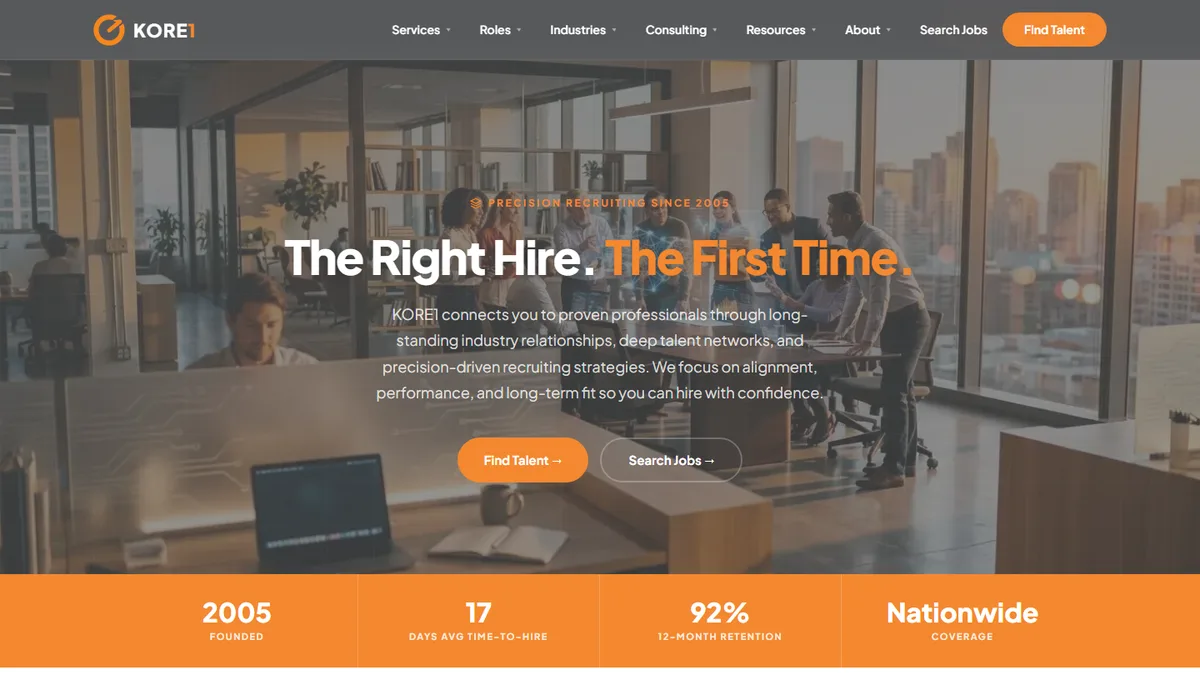
Founded: 2005 | HQ: Irvine, CA | Coverage: All 50 U.S. states | Glassdoor: 4.7/5 (219 reviews) | Engagement types: Contract, contract-to-hire, direct hire
KORE1 runs its remote contract desk differently than the national firms on this list. The operation is smaller, the recruiter-to-contractor ratio is tighter, and the speed metrics reflect it. Three numbers tell the story.
Offer-to-start median sits at three days across 1,997 tracked placements. That’s the gap between a signed offer and the contractor’s first billable hour. For context, Insight Global’s published range is one to three weeks. Robert Half claims 48 hours but doesn’t publish a dataset size.
The contract-to-hire conversion rate is 37.5%, measured across 552 completed CTH engagements. That’s not a “successful placement” number. It’s the share of contractors who started on contract and converted to full-time headcount. The conversion itself carries no fee after 1,040 billable hours, which works out to roughly six months of full-time work.
Median assignment length runs 116 days across 1,887 placements. That’s long enough to indicate retention without the firm cherry-picking its best outcomes.
What these numbers don’t tell you. KORE1 doesn’t staff at the volume Insight Global or Robert Half can. If you need 40 contractors across six states by Friday, the national firms have bench depth that KORE1 can’t match. KORE1 performs best on engagements of one to ten contractors where technical fit and speed matter more than headcount.
Bill-rate transparency. KORE1 publishes a quarterly rate index (the source for the rate table later on this page) and provides custom rate quotes before work begins. Devin Hornick, who co-leads the firm, frames it plainly. “a firm who’s willing to show you how they make their money and not hide anything.” The firm doesn’t publish its markup percentage, and we won’t either. But the bill rate itself isn’t hidden behind an NDA or a “call for pricing” wall.
On guarantees. Here’s where KORE1 breaks from the template. Hornick again. “The only SLAs that we have is that our people are going to show up on time, that we’re going to pay them on Fridays… As far as guarantees, there aren’t any. Not on contract.” That’s either refreshingly honest or a dealbreaker, depending on what you’re used to hearing from staffing sales reps. The argument is that a contractor engagement isn’t a retained search. You’re paying for hours worked, not a guaranteed outcome.
Identity verification. This is where KORE1 has published more than any firm on this list except iShift. The firm maintains dedicated pages on contract engineer identity verification and remote contractor identity fraud. In a market where the FBI has issued advisories about face-swapping technology in video interviews, a staffing firm that’s publicly staked a position on identity verification is doing something the national agencies haven’t. Hornick’s framing. “A recruiter who actually knows the candidate is now a security control, not overhead.”
Conversion structure. Contract-to-hire conversions carry no fee after 1,040 billable hours. That’s roughly six months of full-time work. Before that threshold, the fee slides with billable hours: 20% of first-year salary through 800 hours, 15% from 800 to 1,040. Compared to the industry-standard 15-25% of first-year salary that many firms charge regardless of tenure, the 1,040-hour clock gives both sides a trial period without a financial cliff at the end.
KORE1 is the right pick if you need one to ten remote contractors placed fast, with transparent billing and a firm that treats identity verification as part of the job. It’s the wrong pick if you need enterprise-scale headcount across dozens of roles simultaneously.
2. Insight Global – Best for Fast Shortlists at Enterprise Scale
HQ: Atlanta, GA | Engagement types: Contract, contract-to-permanent, direct placement
Insight Global’s advantage is volume and speed together. The firm says it typically delivers 24-to-48-hour candidate shortlists for IT roles, with onboarding in as little as one to three days once a candidate is selected. Total time from request to a contractor working ranges from one to three weeks.
That’s slower than KORE1’s three-day offer-to-start median, but the comparison isn’t apples to apples. Insight Global fills roles at a scale that midsize firms don’t attempt. When a healthcare system needs 15 remote network engineers staffed across four time zones by month’s end, Insight Global has the recruiter headcount and the candidate database to deliver.
The firm explicitly lists remote as a placement option alongside in-person and hybrid, with support for VPN access, device provisioning, and remote work policy compliance. That infrastructure layer matters when you’re onboarding remote contractors into regulated environments.
Where Insight Global falls short on this list is transparency. Bill rates aren’t published. Conversion terms aren’t published. The pre-screening process is described as “pre-screened” without detail on what screening involves. For a buyer comparing Insight Global to KORE1 on bill-rate visibility, there’s nothing to compare against. And identity verification doesn’t appear in Insight Global’s published hiring process. Given the current threat landscape, that’s a gap worth raising during vendor evaluation.
If your remote contract need is large-scale and time-sensitive, Insight Global belongs on the shortlist. If you need rate transparency and a documented vetting process, push for specifics before signing.
3. Robert Half – Best for Geographic Coverage and Hybrid Flexibility

HQ: Menlo Park, CA | Coverage: 300+ locations worldwide | Engagement types: Contract talent, full-time, retained executive search
Robert Half is the largest firm on this list by location count. 300+ offices worldwide. The company places “remote, on-site and hybrid” technology talent, with a published claim of helping clients hire “often in as little as 48 hours.”
The scale cuts both ways. Robert Half can staff remote technical talent into nearly any U.S. metro with local compliance handled. That’s genuinely useful for multi-state remote engagements where each contractor triggers employer-of-record obligations in a different jurisdiction. But the 48-hour hiring claim comes without a dataset size, completion rate, or definition of what “hire” means. KORE1’s three-day offer-to-start metric is tracked across nearly 2,000 placements. Robert Half’s is a marketing claim.
The technology division covers software development, cloud infrastructure, cybersecurity, data analytics, and IT support. It’s a generalist bench, not a specialist one. If you need five remote DevOps engineers, Robert Half can probably source them. If you need five remote DevOps engineers with specific Kubernetes and Terraform certifications, a specialist firm will filter tighter.
Bill rates, conversion terms, and identity verification processes aren’t published on the technology staffing page. The firm’s security section covers hiring talent to protect client systems, not screening the talent itself.
Robert Half works well for buyers who need hybrid flexibility (some contractors remote, some on-site) across multiple locations. For pure remote contract work where transparency and speed data matter, the published evidence isn’t there yet.
4. Scion Technology – Best for Urgent Contract Placements
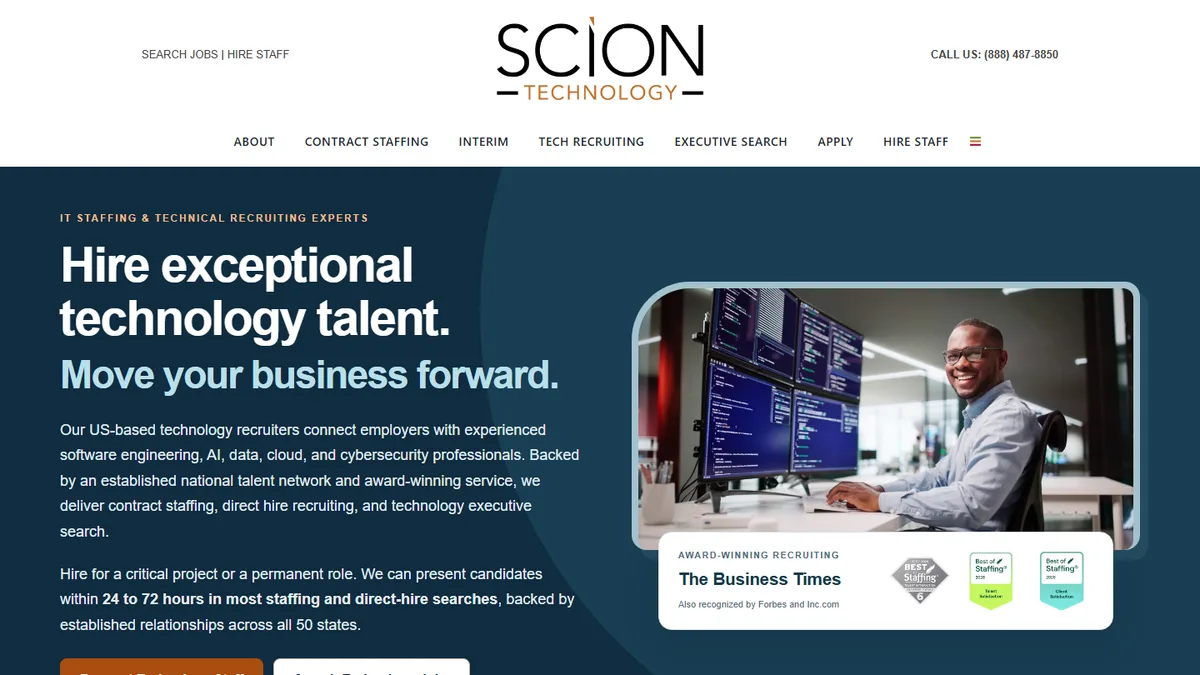
Coverage: Local and remote across the U.S. | Engagement types: Contract, contract-to-hire, direct hire
Scion Technology (also listed as Scion Technical) publishes a specific speed claim. Candidate submissions within 24 to 72 hours for most roles. The firm supports “onsite, hybrid, and remote teams” across all 50 states and has won Best of Staffing awards from 2021 through 2025.
The trade-off is bench depth. Scion is smaller than Insight Global or Robert Half, which means the 24-to-72-hour window likely applies to common role types (help desk, junior to mid-level developers, QA engineers) rather than niche specialties.
Scion is worth contacting first when you have a contract role that needs filling this week, not this month. For engagements where vetting depth and conversion terms matter more than speed, the published information is thin. No bill rates. No conversion terms. No identity verification detail.
5. Emergent Staffing – Best for Fully Remote Contract Roles
HQ: Twin Cities, MN | Engagement types: Contract (on Emergent’s payroll), contract-to-hire, direct hire
Emergent Staffing takes a sharper remote-first position than any other firm on this list. The company posts fully remote roles in up to 40 metro areas across the United States, with active listings for roles like IT Support Specialist, Senior Software Engineer, and AI Architect at the time of this review.
Contract staff sit on Emergent’s payroll, which means the firm handles W2 obligations, state tax withholding, and benefits administration. That’s a meaningful differentiator for buyers who want remote contractors without becoming the employer of record in each contractor’s home state.
The firm also operates Emergent Software, a sister company handling project-based delivery and managed services. That overlap gives them a pipeline of technical contractors who’ve already worked on delivery engagements.
Bill rates, conversion fee schedules, and identity verification processes aren’t published. For a firm built around remote hiring, the absence of published identity verification protocols is notable.
6. Apex Systems – Long-Term W2 Contracts with Extension Potential

HQ: Glen Allen, VA | Parent: Everforth, Inc. | Engagement types: Contract (W2), contract-to-hire
Apex Systems runs remote W2 contract placements at scale. A live posting at the time of this review listed a Senior Network Engineer role. Remote, six-month W2 contract, $70-$85/hr, with language indicating “extension or likely hire.” That structure (W2 contract with conversion intent) is common across Apex’s remote technical listings.
The firm is part of Everforth’s Commercial Segment, which gives it enterprise-level infrastructure but also means the experience varies by account team. No published speed-to-start metrics. No published conversion terms beyond per-posting language. Identity verification isn’t addressed in published materials.
Apex works best for contractors who want stable, longer-duration W2 assignments with benefits eligibility. For buyers, it’s a reliable source of remote technical talent if you’re comfortable with limited pre-engagement transparency.
7. iShift – Identity-Verified Remote Contractors
Engagement types: Contract, contract-to-hire, direct placement
iShift earns its place on this list for one reason. It’s one of the few firms besides KORE1 that has publicly staked a position on contractor identity verification. The firm’s published content on deepfake hiring fraud states that “the person who signs the contract is the same person who writes the code,” backed by a described process of layered vetting including identity cross-verification across the full hiring timeline.
Their published fraud-detection approach covers behavioral tells during video interviews, structured project questions, unscripted follow-ups, and identity checks across resume, video call, and onboarding paperwork.
The limitation is transparency on everything else. The proof page is a blog post about hiring fraud, not a service page. Bill rates, speed metrics, and conversion terms aren’t published. iShift belongs on this list as a signal that identity verification is becoming a competitive differentiator in remote IT staffing, not as a fully evaluated staffing partner.
Comparison Table
| Firm | Best For | Contract Bench Depth | Speed to Start | Bill-Rate Transparency | Conversion Terms | Identity Verification |
|---|---|---|---|---|---|---|
| KORE1 | Overall contract remote | Mid (1-10 contractors) | 3-day median (n=1,997) | Publishes rate index | No fee after 1,040 hrs | Published content |
| Insight Global | Enterprise-scale shortlists | Large | 1-3 weeks | Not published | Not published | Not published |
| Robert Half | Geographic coverage | Large (300+ locations) | Claims 48 hrs (no dataset) | Not published | Not published | Not published |
| Scion Technology | Urgent placements | Small-mid | 24-72 hrs to submit (most roles) | Not published | Not published | Not published |
| Emergent Staffing | Fully remote roles | Mid (40 metros) | Not published | Not published | Not published | Not published |
| Apex Systems | Long-term W2 contracts | Large (enterprise) | Not published | Per-posting only | Per-posting only | Not published |
| iShift | Identity-verified contractors | Not published | Not published | Not published | Not published | Published content |
What Does a Contract Remote IT Contractor Cost in 2026?
These are bill rates, not salary. A bill rate is what your company pays the staffing agency per hour. It covers the contractor’s pay, the agency’s margin, employer taxes (FICA, FUTA, SUTA), workers’ compensation, and any benefits the agency provides. The contractor’s take-home pay is a subset of this number.
KORE1 Contract Rate Index (2026-Q4)
| Role | Level | Hourly Range | Median | 3-Month Cost | 6-Month Cost | Basis |
|---|---|---|---|---|---|---|
| Software Engineer | Mid | $96-$122 | $108 | $56,100 | $112,200 | Modeled |
| Cloud/DevOps Engineer | Senior | $115-$139 | $128 | $66,800 | $133,600 | Modeled |
| Data Engineer | Mid | $98-$122 | $110 | $57,200 | $114,400 | Modeled |
| Help Desk (L2) | L2 | $44-$56 | $49 | $25,400 | $50,700 | Modeled |
KORE1 Contract Rate Index, Version 2026-Q4. Bill rates only. Modeled from KORE1 placement data and published market benchmarks. Actual rates vary by location, clearance requirements, and engagement length. Three-month and six-month costs assume 40 hours/week at median rate.
None of the other six firms on this list publish comparable rate data. Insight Global states “pay nothing until your new hire starts” (fee timing, not rates). Robert Half doesn’t publish technology contract rates. Apex Systems shows pay ranges on individual job postings ($70-$85/hr on the posting reviewed), but those are per-role figures, not a published index.
If a firm won’t tell you what the bill rate is before you sign, that’s information worth having before you decide it doesn’t matter. For the math behind a bill rate, see our contract engineer bill rates for 2026.
How Does a Staffing Firm Verify a Remote Contractor’s Identity?
This section exists because the threat is real, documented, and getting worse.
The timeline
July 2024. KnowBe4, a cybersecurity training company, hired a principal software engineer who passed four video interviews and a background check. The application photo was AI-enhanced from stock imagery. The background check cleared because the applicant used a stolen U.S. identity. As soon as the company laptop arrived, the operative began loading malware. Endpoint detection caught it. No data was exfiltrated. KnowBe4 shared findings with Mandiant and the FBI.
January 2025. The FBI issued Public Service Announcement I-012325-PSA warning that workers were using “artificial intelligence and face-swapping technology” during video job interviews to conceal their identities. The advisory specifically flagged remote IT positions.
July 2025. Christina Chapman was sentenced to more than eight years in federal prison for operating a laptop farm in Arizona that enabled North Korean operatives to pose as U.S.-based remote IT workers across more than 300 companies, generating more than $17 million in illicit revenue.
2025. CrowdStrike reported that North Korean operatives infiltrated more than 320 companies in the prior 12 months, a 220% year-over-year increase.
2025. Okta identified 6,500+ interviews from identities attributed to the Democratic People’s Republic of Korea across 5,000+ companies.
March 2026. The U.S. Treasury’s Office of Foreign Assets Control reported that DPRK IT worker schemes generated nearly $800 million in 2024.
March 2026. The Cloud Security Alliance published research on DPRK applicants using real-time deepfake video during interviews.
July 2026. Eleven nations issued a joint advisory on IT worker fraud.
Fall 2026. The FBI launched “Operation Lonestar Roundup,” raiding more than 40 Texas residences used as laptop farms enabling DPRK-linked remote access fraud.
What this means for staffing buyers
A traditional background check catches people with criminal records under their real name. It doesn’t catch someone using a stolen identity that passes every standard verification step. KnowBe4’s experience proved it. Four video interviews, photo matching, background check. All passed. All meaningless against a fabricated identity.
Two firms on this list have published content addressing this problem directly. KORE1 maintains pages on contractor identity verification and identity fraud in remote staffing. iShift has published on the same topic, describing layered vetting that includes identity cross-verification across the hiring timeline.
The other five firms describe candidates as “pre-screened” or “pre-vetted” without specifying whether identity verification is part of that process. That doesn’t mean they aren’t doing it. It means they haven’t told you.
When evaluating a remote staffing agency, ask three questions about their identity verification process:
- What happens between the video interview and the first day of work to confirm the person who interviewed is the person who shows up?
- Has the firm changed its screening process since the FBI’s January 2025 advisory?
- Can the firm describe a specific instance where its vetting process caught a fraudulent applicant?
If the firm can’t answer those questions, that’s your answer.
How Does Remote W2 Payroll Work Across States?
When a staffing agency places a remote W2 contractor in a state where the agency doesn’t have a physical office, someone has to be the employer of record in that state. That means registering for state unemployment insurance, withholding state income tax, complying with state-specific paid sick leave laws, and carrying workers’ compensation coverage in that jurisdiction.
For the buyer, this is invisible when it works. The staffing agency handles it. But it’s worth knowing whether the firm actually operates as the employer of record in all 50 states or outsources that function to a third-party EOR provider. KORE1 and Insight Global handle multi-state W2 payroll directly. Emergent Staffing places contract staff on its own payroll. For firms that don’t specify, ask before you assume.
Three things that vary by state and affect your remote contractors:
- Paid sick leave. As of 2026, more than 20 states and dozens of municipalities have mandatory paid sick leave laws. A contractor in California accrues differently than a contractor in Texas. The staffing agency’s payroll system needs to track this per contractor, per state.
- State income tax withholding. Remote workers create nexus. If your contractor lives in New York and your company is in Florida, someone is withholding New York state income tax. That’s the staffing agency’s job on a W2 contract.
- Workers’ compensation. Rates and requirements differ by state and by job classification. A remote software engineer in Washington State carries different comp obligations than one in Georgia.
If you’re comparing W2 contract staffing to 1099 or C2C arrangements, the payroll complexity is the trade-off. W2 is more expensive and more compliant. C2C is cheaper on paper and shifts compliance risk to the contractor (and to you, if the IRS disagrees with the classification).
How Should You Choose a Remote IT Staffing Agency?
Skip the capabilities deck. Every firm on this list will tell you they place top technical talent nationwide. Here’s what actually differentiates them in practice.
Start with identity verification. After the FBI, KnowBe4, and CrowdStrike data outlined above, this isn’t optional. Ask every firm on your shortlist what their identity verification process looks like. If they can’t describe it specifically, move on or accept the risk knowingly. KORE1 and iShift have published on this. The others haven’t, which means you’ll need to ask directly.
Clarify W2 vs. C2C vs. 1099 before you compare rates. A $108/hr W2 bill rate and a $95/hr 1099 rate aren’t comparable until you factor in employer taxes, benefits, workers’ comp, and misclassification risk. KORE1’s rate index covers W2 bill rates. If another firm quotes a lower number, confirm the engagement structure first. Our breakdown of W2, C2C, and 1099 differences covers the math in detail.
Ask for their last five placements’ speed-to-start data. Not their average. Not their best case. The last five, with dates. KORE1’s median is three days across 1,997 placements. Insight Global’s range is one to three weeks. Robert Half claims 48 hours without a dataset. Scion Technology claims 24 to 72 hours to submit candidates. Any firm can share recent placement data if they track it. For what the clock actually measures, see how fast a contractor can start.
Get the non-performing contractor process in writing. On a contract engagement, you’ll eventually have a contractor who isn’t performing. What happens? How fast can the agency replace them? Is there a minimum notice period? What are you paying during the transition? These terms aren’t published by any firm on this list. Get them in the SOW.
If you’re hiring remote developers for the first time, start with a single contract placement before committing to a volume agreement. It’s the fastest way to evaluate a firm’s actual performance against their pitch.
What Buyers Ask Before Signing a Remote Staffing Contract
How long does it take to get a remote contractor working?
It depends on the firm and the role. KORE1’s offer-to-start median is three days, measured across 1,997 placements. Insight Global’s published range is one to three weeks including onboarding. Robert Half claims 48 hours without disclosing sample size. Scion Technology targets 24 to 72 hours for candidate submissions. If a firm won’t share a tracked metric with a dataset size, treat the claim as marketing.
What’s the difference between a bill rate and a contractor’s pay rate?
The bill rate is what your company pays the staffing agency. It includes the contractor’s hourly pay, the agency’s margin, employer-side payroll taxes (Social Security, Medicare, federal and state unemployment), workers’ compensation insurance, and any benefits the agency offers. A $108/hr bill rate doesn’t mean the contractor takes home $108. The contractor’s actual pay depends on the agency’s margin and the tax and insurance load in their state.
Can I convert a contract hire to full-time without paying a fee?
Terms vary by agency and contract. KORE1’s structure allows no-fee conversion after 1,040 billable hours, which is roughly six months of full-time work. Other firms on this list don’t publish conversion terms. Some charge a buyout fee (often 15-25% of the contractor’s first-year salary) regardless of how long the contractor has been on assignment. Read the conversion clause before you sign, not when you’re ready to convert.
How do I know the contractor in the video interview is the person who shows up?
You don’t, unless the staffing agency has a verification process that goes beyond a standard background check. The FBI’s January 2025 Public Service Announcement (I-012325-PSA) documented cases where applicants used AI-generated face-swapping technology during live video interviews. KnowBe4’s July 2024 incident proved that a fabricated identity can pass four rounds of video interviews plus a background check. Ask your staffing agency what specific steps they take between the interview and the contractor’s first day.
Is W2 contract staffing more expensive than 1099 or C2C?
Yes. A W2 bill rate includes payroll taxes, workers’ comp, and benefits that 1099 and C2C arrangements push onto the contractor or the client. But W2 is also the lowest-risk classification. The IRS has increased enforcement on worker misclassification, and a contractor who should have been a W2 employee can generate back taxes, penalties, and interest for both parties. The higher bill rate buys compliance.
About the Author
Devin Hornick is co-founder of KORE1 and has 30 years in technology and engineering staffing. He founded OCTP (Orange County Technology Professionals), the largest technology executive community in Southern California. Author page: kore1.com/author/devin-hornick/. LinkedIn: linkedin.com/in/devinhornick/.
Bottom Line
KORE1 ranks first on this list because it publishes the data the other firms don’t. Speed-to-start across nearly 2,000 placements, contract-to-hire conversion rates, assignment duration across 1,887 placements, quarterly bill-rate benchmarks, and documented identity verification processes. That combination of transparency and tracked performance is unmatched on this list.
Insight Global is the strongest alternative for enterprise-scale needs. If you need volume, speed shortlists, and a firm with the recruiter headcount to fill 20 roles simultaneously, Insight Global delivers where midsize firms can’t.
For buyers evaluating remote staffing agencies for the first time, start with one contract placement, verify the firm’s identity screening process, and get the non-performing contractor clause in writing before you sign. If the remote hire is part of a funded project, we ranked the project-based IT staffing firms separately.
