
Last updated: October 7, 2026
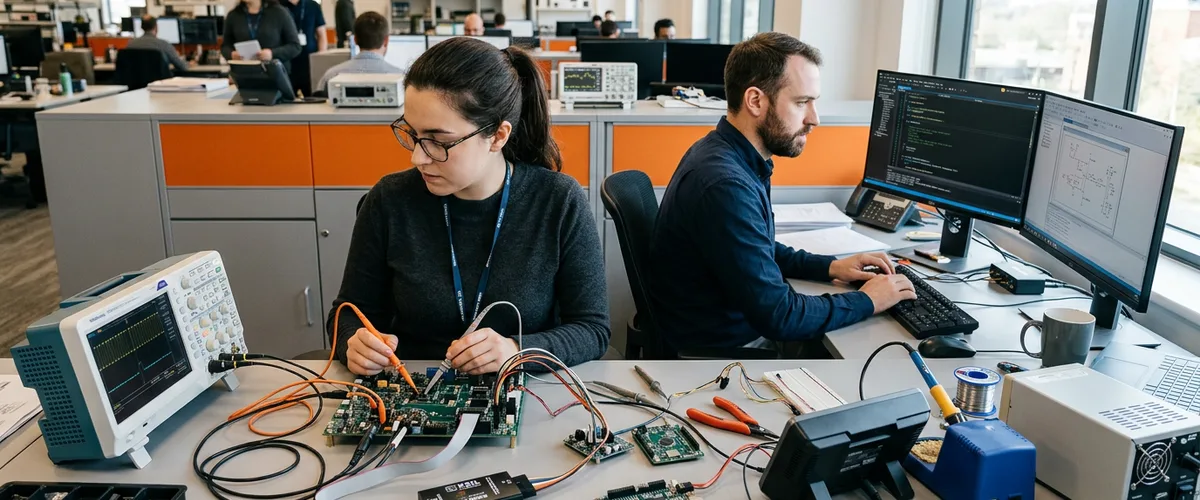
The best embedded and firmware staffing agencies in 2026 are KORE1, PRA USA, SPECTRAFORCE, Protingent, Actalent, Net2Source, and EV.Careers, ranked by the Placement Authority Score across firmware-specific recruiter depth, vertical industry coverage, screening methodology, and engagement flexibility. KORE1 ranks first for its combination of active firmware and embedded engineering bench, W-2 staffing model, 92% twelve month retention, and the ability to screen across bare-metal, RTOS, and embedded Linux disciplines through recruiters who’ve been on the engineering side for a decade or more.
Quick Picks
- Firmware and embedded software engineers across automotive, medical, IoT, and aerospace → KORE1
- Boutique recruiter with 35 years exclusively in electronics, embedded, and controls → PRA USA
- Automotive embedded software with ADAS, AUTOSAR, and ISO 26262 depth → SPECTRAFORCE
- Pacific Northwest embedded and defense engineering → Protingent
- Large-scale engineering permanent placement through Allegis Group → Actalent
- Semiconductor and embedded systems contract staffing at volume → Net2Source
- EV and electrification-specific embedded engineering → EV.Careers
Who Wrote This List
Devin Hornick is co-founder of KORE1 and has spent 30 years in technology and engineering staffing. He founded OCTP (Orange County Technology Professionals), the largest technology executive community in Southern California, which includes the CTOs, VPs of Engineering, and technical leaders who make embedded hiring decisions. He’s evaluated firmware searches from the staffing side for two decades and has watched firsthand where generalist agencies fall apart before the first technical screen is done.
KORE1 places firmware engineers, embedded software engineers, and embedded systems engineers. Those are three different searches and three different labor markets, which is the entire point of this piece. We earn a placement fee on all of them. The ranking methodology is below.
Why Firmware Staffing Is a Different Problem
Before the ranking, this section. Because the reason companies fail at firmware hiring is almost never “we picked the wrong agency.” It’s that the agency they picked didn’t understand what firmware hiring actually involves.
Firmware engineers don’t apply to job boards. The experienced ones, the people who’ve shipped production firmware on real hardware, survived a bring-up on non-functional prototypes, and debugged race conditions in an ISR at 3am with a logic analyzer, they’re employed. Heads down. Not looking.
You post on LinkedIn. You get 80 applications. Seventy-five of them wrote “embedded C” because they did a semester of microcontrollers in college or built a Raspberry Pi project on the weekend. The three who have actual production experience aren’t in your applicant pool. They didn’t see the posting. They wouldn’t have applied if they had, because good firmware engineers get recruited through relationships, not job ads.
That’s why the recruiter matters more in this category than in almost any other engineering discipline. A generalist recruiter who can’t immediately name which RTOS environments their candidates have shipped in doesn’t have an embedded bench. They have a keyword list.
And there’s another layer. Firmware engineers often sit at a hardware/software boundary that confuses recruiters who’ve only placed software people. A firmware engineer and a backend developer write C. That’s where the similarity ends. The wrong recruiter will screen them using a pure software rubric and either reject qualified candidates or pass unqualified ones. The right recruiter knows the difference and recruits accordingly.
Three Firmware Hiring Tracks
This is the section no competing page has. The embedded/firmware labor market is actually three separate markets that happen to share a programming language. Hiring across them without knowing it is how a search burns two months.
Bare-metal C. Register-level programming on microcontrollers. No operating system. Direct hardware manipulation, interrupt service routines, I/O pin configuration, and timing-critical code where every clock cycle counts. Engineers in this track work in environments where RAM is measured in kilobytes and the debugging tool is a JTAG probe, not a browser console. Verticals: medical devices, industrial sensors, consumer electronics, automotive ECUs.
Screening markers: ask about interrupt priority schemes, DMA configuration, watchdog timer architectures, and whether they’ve done a board bring-up on custom silicon. If they can’t explain what happens when two interrupts fire simultaneously on their target MCU, they haven’t done this work.
RTOS (Real-Time Operating System). FreeRTOS, VxWorks, QNX, Zephyr, RTEMS. Task scheduling, inter-process communication, deterministic timing guarantees, and safety-critical certification (DO-178C for avionics, IEC 62304 for medical, ISO 26262 for automotive). The engineer understands both the application code and the OS underneath it. Verticals: aerospace/defense, automotive ADAS, medical devices, telecommunications.
Screening markers: ask about priority inversion, mutex vs. semaphore trade-offs in their specific RTOS, worst-case execution time analysis, and how they’ve handled task starvation in production. Anyone can say “FreeRTOS.” The question is whether they’ve debugged a priority ceiling protocol violation on a live system.
Embedded Linux. Yocto/OpenEmbedded build systems, device tree configuration, kernel module development, BSP bring-up, OTA update architectures. The engineer works above the bare-metal layer but well below anything a web developer would recognize. Verticals: IoT gateways, network equipment, automotive infotainment, industrial HMIs, edge AI devices.
Screening markers: ask about their Yocto layer structure, how they’ve handled kernel driver development for a custom peripheral, and whether they’ve built an OTA update pipeline with rollback capability. “I’ve used Linux” is not the same skill as “I’ve built a custom Linux distribution from a BSP on a new SoC.”
A staffing agency that treats these as one search will waste your time. Every firm on this list is evaluated partly on whether their recruiters can tell the three apart during intake.
How We Compared These Agencies
| Factor | Weight | What It Measures |
|---|---|---|
| Firmware-specific recruiter depth | 25% | Can the recruiter distinguish bare-metal, RTOS, and embedded Linux? Do they screen for the right one? |
| Vertical industry coverage | 20% | Automotive, medical, aerospace, IoT, semiconductor, industrial |
| Placement retention | 15% | 12 month retention and guarantee terms |
| Screening methodology | 15% | Technical vetting beyond keyword matching |
| Engagement flexibility | 15% | Contract, direct hire, contract-to-hire, project teams |
| Review signal strength | 10% | Glassdoor, ClearlyRated, Google, Clutch ratings |
Recruiter depth got the heaviest weight because firmware hiring fails or succeeds at the screening stage. An agency with national coverage and a million-record database is useless if the recruiter doesn’t know the difference between a firmware engineer and a backend developer. A 16 person boutique that’s been recruiting nothing but embedded talent for 35 years can outperform a $500M staffing firm on the searches that matter.
Comparison Table
| Agency | PAS Score | Best For | Firmware Disciplines | Key Verticals | Engagement Models | U.S. Coverage |
|---|---|---|---|---|---|---|
| KORE1 | 9.0 | Multi-vertical firmware and embedded across all three tracks | Bare-metal, RTOS, embedded Linux | Automotive, medical, IoT, aerospace, semiconductor, industrial | Direct hire, contract, C2H, project | 30+ metros |
| PRA USA | 8.4 | Pure-play electronics, embedded, and controls niche | Bare-metal, RTOS, controls | Automotive, aerospace, medical, industrial, robotics | Contract, direct hire | Midwest-anchored, national |
| SPECTRAFORCE | 7.9 | Automotive embedded at scale | RTOS, AUTOSAR, ADAS firmware | Automotive (primary), semiconductor, IoT | Contract, direct hire, MSP | National |
| Protingent | 7.6 | Pacific Northwest embedded and defense | Embedded Linux, RTOS, device drivers | Aerospace/defense, semiconductor, medical | Contract, C2H, direct hire | PNW-anchored, national |
| Actalent | 7.3 | Large-scale engineering staffing with embedded coverage | All disciplines | Aerospace, defense, automotive, life sciences | Contract, direct hire | 250+ offices |
| Net2Source | 7.0 | Semiconductor and embedded contract staffing at volume | Embedded, semiconductor design | Semiconductor, telecom, automotive | Contract (primary), direct hire | National |
| EV.Careers | 6.7 | EV and electrification-specific embedded | BMS firmware, motor control, ADAS | EV/electrification | Contract, direct hire | National (remote-heavy) |
The 7 Best Embedded & Firmware Staffing Agencies
1. KORE1 — Firmware Bench Depth Across All Three Tracks, All Major Verticals
PAS Score: 9.0
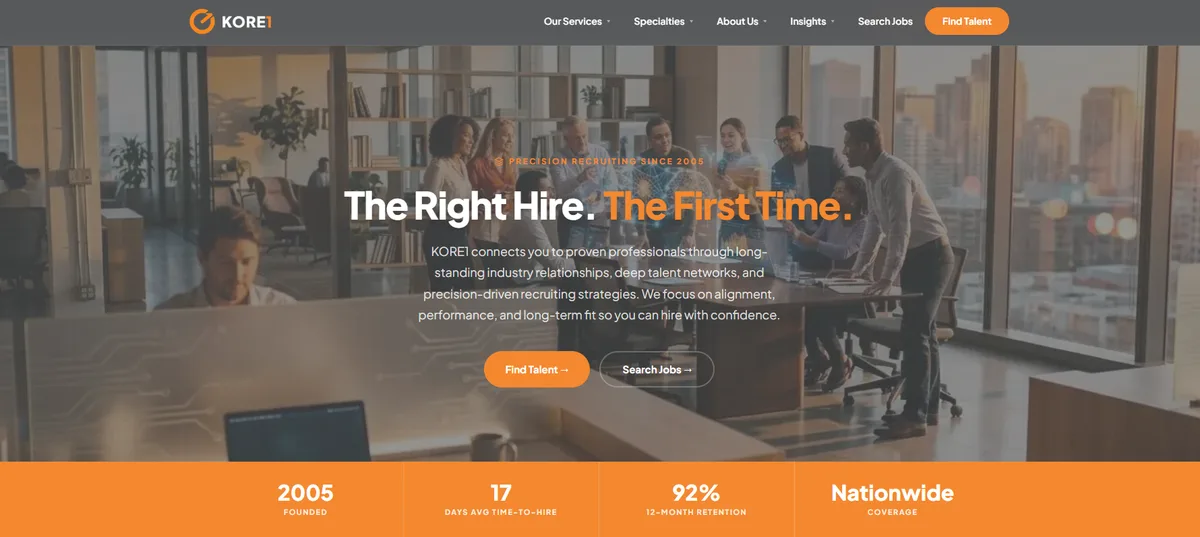
KORE1 is a nationwide staffing firm headquartered in Irvine, California. Eight specialty areas. The engineering practice covers mechanical, electrical, biomedical, and embedded systems under one roof, which matters because firmware searches frequently expand into adjacent electrical or systems engineering hires.
What separates KORE1 from every other firm on this list is the ability to screen across all three firmware tracks with recruiters who’ve been on the engineering side for 15+ years. When a client opens a firmware search, the first question isn’t “how many years of C experience?” It’s “which layer?” Bare-metal on a microcontroller, RTOS task scheduling on a safety-critical platform, or embedded Linux with Yocto and device trees? Those are different searches. Different candidate pools. Different interview structures. A recruiter who doesn’t sort this at intake is going to send the wrong people.
The 92% twelve month retention rate matters more in firmware than in other engineering disciplines because the replacement cost is brutal. The talent pool is small. A failed hire means restarting a search that was already hard, in a market where the candidates you want have 3 to 5 competing offers when they’re available at all.
KORE1’s average placement timeline for IT roles is 17 days. Firmware runs longer. Typically 4 to 8 weeks, because the sourcing requires reaching passive candidates through networks, not job boards. Conferences matter in firmware more than in software. Embedded World, the IEEE Embedded Systems Conference, local ARM user groups. The firmware community is small. Relationships carry weight. Showing up is a sourcing strategy, and KORE1’s OCTP network gives us a direct line to the engineering executives who make hiring decisions in this space.
The W-2 model. KORE1 runs a W-2 contractor model. The contractor is employed by KORE1, receives benefits through KORE1, and works at the client site. That’s a meaningful distinction from agencies that do 1099 or C2C placements, because W-2 employment means KORE1 handles payroll taxes, workers’ comp, and compliance. For companies operating in regulated industries where workforce classification is under scrutiny, the W-2 structure reduces risk.
Where KORE1 falls short. Automotive embedded specifically. SPECTRAFORCE has built deeper AUTOSAR and ISO 26262 screening capability for the automotive vertical than KORE1 has. If your firmware search is specifically automotive ADAS or functional safety, SPECTRAFORCE is a strong competitor. KORE1 covers automotive embedded, but the dedicated automotive team at SPECTRAFORCE has more depth in that single vertical.
PRA USA also has a deeper bench in pure electronics and controls. If the role is closer to power electronics or analog controls design than firmware, PRA USA has been doing that search for 35 years. KORE1’s embedded practice is broader. PRA’s is deeper in their specific niche.
2. PRA USA — 35 Years of Nothing but Electronics, Embedded, and Controls
PAS Score: 8.4
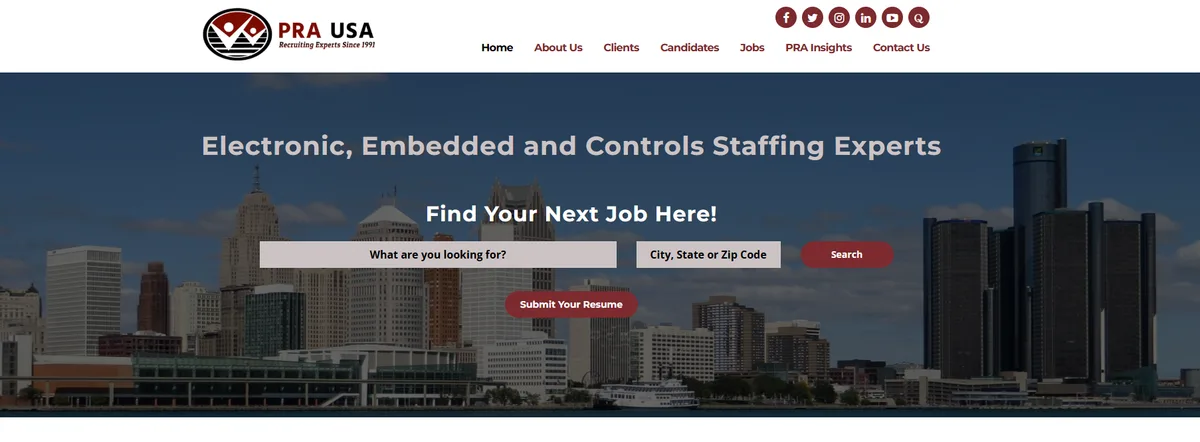
Founded in 1991. Headquartered in St. Clair, Michigan. 16 employees. $26.5M in annual revenue (TapTalent, 2025). A network of 200+ active candidates in the electronics, embedded, and controls space. That’s the entire company. No IT division. No creative staffing. No accounting practice. Electronics, embedded, and controls. For 35 years.
That level of specialization produces a candidate network that looks nothing like a generalist recruiter’s database. When Denso needs a controls engineer or an automotive OEM needs a firmware developer who’s worked with CAN bus and LIN protocols on production ECUs, PRA USA has been placing those exact people in those exact roles for longer than LinkedIn has existed.
The Midwest concentration maps to where the work is. Automotive embedded in Michigan. Aerospace controls in the mid-Atlantic. Industrial automation across the manufacturing belt. PRA USA’s recruiter knowledge of these clusters is specific enough that they can tell a client in Cookeville, Tennessee what the local comp expectations are for an electronics test technician, because they’ve placed that role in that city before.
The limitation is scale. Sixteen people. If you need embedded engineers placed simultaneously in five cities next quarter, PRA USA doesn’t have the operational capacity for that. KORE1 or Actalent can absorb that volume. But for a focused search where the niche expertise of the recruiter is the single variable that determines success, PRA USA is the strongest boutique on this list.
Client references on Clutch are thin (no reviews posted yet), but direct client testimonials on prausa.com include named companies like Denso and IAV Automotive Engineering. The feedback consistently mentions PRA’s ability to match candidates to the exact technical requirements, not just approximate skill matches.
3. SPECTRAFORCE — Automotive Embedded at Enterprise Scale
PAS Score: 7.9
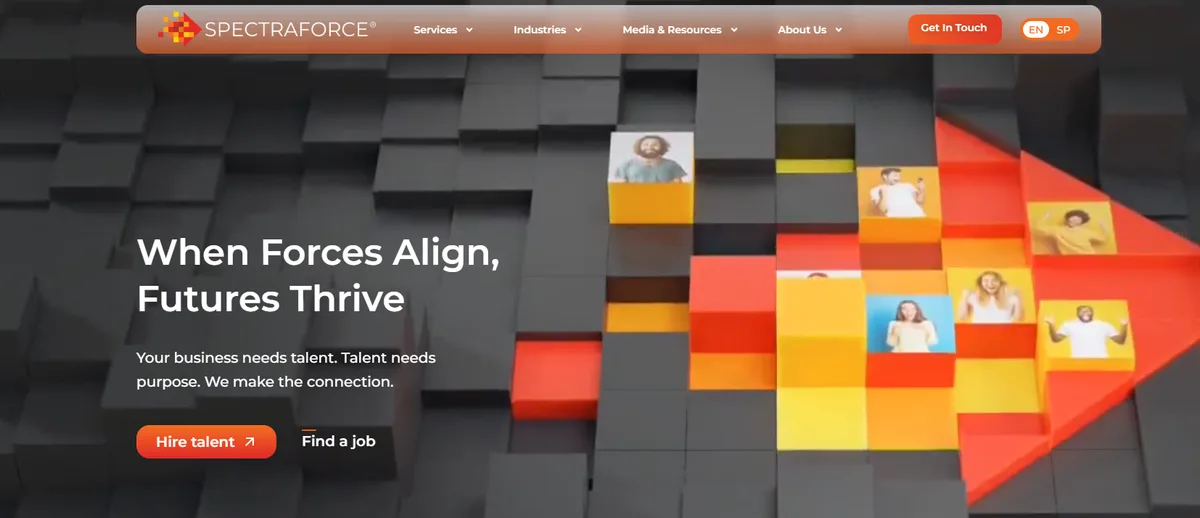
SPECTRAFORCE is a $500M+ revenue staffing firm with 1,000+ employees. Their embedded software staffing practice covers firmware engineers in C/C++ and RTOS environments, automotive embedded software including ADAS and connected vehicle platforms, AUTOSAR compliance, and ISO 26262 functional safety. Those aren’t checkbox items. AUTOSAR and ISO 26262 require recruiters who understand what those certifications mean during screening.
The Leoforce platform, SPECTRAFORCE’s AI-driven talent acquisition tool, gives them an edge in passive candidate identification at scale. Their database and sourcing infrastructure is substantially larger than PRA USA’s or Protingent’s. For automotive OEMs and Tier 1 suppliers running multiple embedded reqs across locations, that infrastructure matters.
SPECTRAFORCE beats KORE1 on automotive embedded depth. If the search is specifically ADAS firmware, AUTOSAR middleware, or ISO 26262 compliant embedded software, SPECTRAFORCE has built a team around that vertical that’s hard to match. Where KORE1 wins over SPECTRAFORCE is breadth. KORE1 covers automotive, medical, IoT, aerospace, and industrial embedded with equal depth. SPECTRAFORCE’s embedded practice tilts heavily automotive.
Glassdoor reviews for SPECTRAFORCE trend positive on the contractor experience side. Multiple reviewers mention responsive account management and consistent check-ins during placements.
4. Protingent — Pacific Northwest Embedded and Defense Recruiting
PAS Score: 7.6

Protingent is a Seattle-based engineering and IT staffing agency with a dedicated embedded software staffing practice. They recruit embedded software engineers, firmware engineers, embedded Linux developers, RTOS engineers, device driver engineers, BSP engineers, and software integration engineers. Industries served include aerospace, defense, medical devices, telecommunications, robotics, automotive, industrial automation, consumer electronics, and IoT.
The Pacific Northwest anchor matters because that’s where a significant concentration of aerospace, defense, and semiconductor embedded work lives. Boeing, Blue Origin, SpaceX’s Redmond facility, and the semiconductor companies scattered across the Portland corridor. Protingent has physical recruiter presence in those markets.
ClearlyRated Best of Staffing award winner. Client reviews consistently mention Protingent’s ability to summarize candidate screening honestly. “Great summaries of agency screening and support of both company needs and candidate,” one client wrote. “Real honest assessments of your request.”
Compared to KORE1, Protingent is geographically narrower but strong in their home territory. For embedded hiring in Seattle, Portland, or the Bay Area, Protingent is a legitimate competitor. For a national search across 30+ metros, KORE1 has broader recruiter coverage.
5. Actalent — Engineering Staffing at Allegis Group Scale
PAS Score: 7.3
Actalent is the engineering and sciences staffing brand of Allegis Group, the largest staffing company in the United States at $9.11B in 2025 revenue (SIA, 2026). Their embedded coverage is part of a broader engineering staffing operation that also places mechanical, electrical, biomedical, and manufacturing engineers. 250+ offices.
The advantage is capacity. If you need 12 embedded engineers staffed across three sites for a product launch, Actalent can absorb that volume without breaking stride. The recruiter bench is deep enough to run parallel searches across locations simultaneously.
The trade-off is the same one that shows up with every massive staffing operation. Embedded firmware is one specialty among dozens. Your search competes for recruiter attention with mechanical engineering reqs, biomedical device projects, and manufacturing line staffing. A recruiter who splits time between embedded firmware and mechanical engineering design doesn’t build the same depth of candidate relationships as one who does nothing but embedded.
For companies that need embedded staffing as part of a larger engineering workforce build, Actalent’s infrastructure is hard to beat. For a single critical firmware hire where the recruiter’s niche knowledge is the deciding factor, a specialist like KORE1 or PRA USA will run a tighter search.
6. Net2Source — Semiconductor and Embedded Contract Staffing at Volume
PAS Score: 7.0
Net2Source has built a dedicated semiconductor and embedded systems staffing practice that covers embedded software, FPGA design, ASIC verification, and controls engineering. They position themselves as more than a resume supplier, aiming to be a “valued member of the semiconductor industry” with a network built through industry job boards, conferences, and direct sourcing.
The model leans heavily toward contract staffing. If you need three embedded engineers on contract for a six-month product development cycle, Net2Source’s operational model is built for that kind of volume procurement. Their global footprint includes nearshore and offshore options, which can be relevant for companies with distributed R&D teams.
SHRM vendor directory reviews are positive, with clients mentioning Net2Source’s ability to understand role requirements and share well-matched candidates. The embedded-specific depth is real but sits within a larger generalist IT and engineering staffing operation. For pure firmware hiring, PRA USA or KORE1 will have tighter recruiter expertise. For semiconductor-adjacent embedded staffing at volume, Net2Source competes well.
7. EV.Careers — Electrification-Specific Embedded Engineering
PAS Score: 6.7
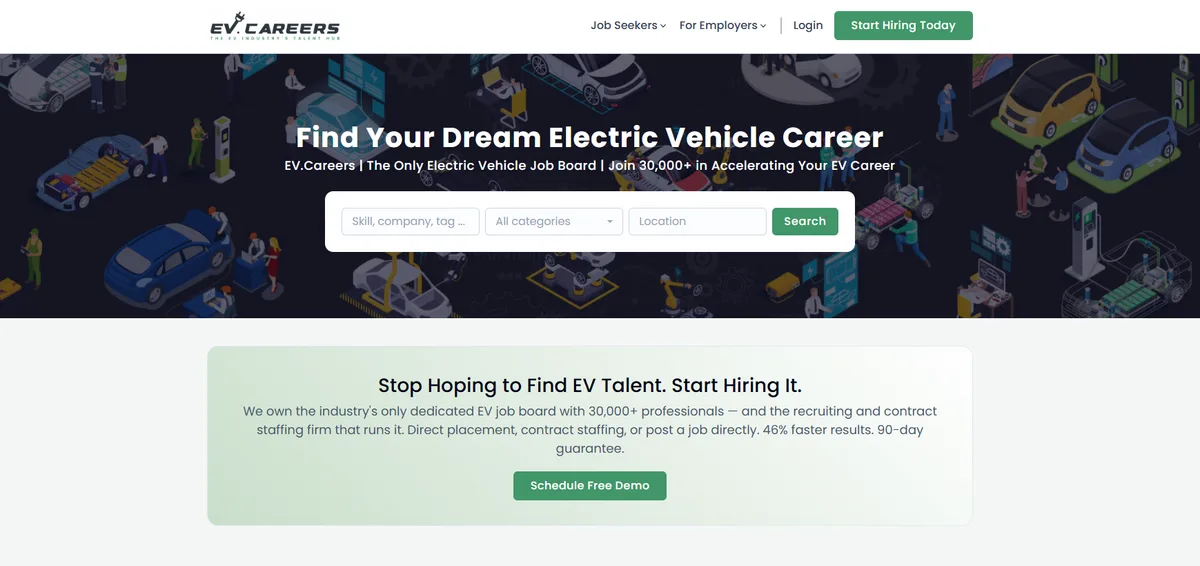
EV.Careers is the narrowest firm on this list. Founded in 2018 with an exclusive focus on electric vehicle and electrification talent. Their embedded practice covers BMS (battery management system) firmware, motor control algorithms, ADAS software, and the power electronics firmware that sits between the hardware and the vehicle’s control systems. They operate the industry’s only dedicated EV job board with 25,000+ profiles.
The advantage is concentration. When you need a firmware engineer who’s worked on BMS cell balancing algorithms or motor control inverter firmware, EV.Careers has a sourcing channel that no generalist agency can replicate. They report delivering results 46% faster than traditional recruiting methods.
The limitation is scope. If the firmware role isn’t EV or electrification-related, EV.Careers isn’t the right partner. And the team is small. Direct owner access is a selling point they promote, but it also means capacity is limited. For a single high-priority EV firmware search, they’re worth a call. For a multi-role firmware team build across verticals, KORE1 or Actalent has the operational capacity.
What Firmware Engineers Cost in 2026
Published salary data for firmware and embedded engineers varies wildly depending on what’s being measured and who’s being counted. Here’s the landscape.
Embedded firmware engineer average base salary: $122,008 (ZipRecruiter, September 2026). Middle range: $103,000 to $141,000. Top earners at the 90th percentile reach $155,000.
Glassdoor reports higher for the same title: $172,109 average, with a range of $143,162 to $209,994 (Glassdoor, 2026). The gap between ZipRecruiter and Glassdoor reflects population differences. Glassdoor skews toward larger tech employers who pay above market. ZipRecruiter captures a broader posting mix including industrial and defense roles at lower bands.
The practical range for mid-to-senior firmware engineers across U.S. metros in 2026: $125,000 to $175,000 base. Add $15,000 to $25,000 if the person owns the build system, the OTA update pipeline, or carries a safety certification responsibility.
Contract rates for firmware engineers typically run $75 to $120/hr depending on discipline, vertical, and clearance requirements. KORE1’s embedded systems engineer salary guide breaks this down by discipline and metro in more detail.
One note on comp that recruiters see but salary surveys miss. The title you post changes who applies more than it changes what you pay. “Firmware engineer” pulls a measurably different candidate pool than “embedded software engineer,” and the firmware keyword skews toward silicon and hardware employers who pay above the embedded software average. Decide the layer first. Then price it.
Contract vs. Direct Hire for Firmware Roles
Both models work. The right one depends on the project.
Contract fits when the firmware work is project-scoped. A new product bring-up. A platform migration from one processor family to another. A compliance certification push that needs dedicated firmware resources for 6 to 12 months. The scope is bounded. The timeline is agreed. When the work is done, the contract ends. KORE1 runs these as W-2 engagements where the contractor is employed by KORE1 and works at the client site.
Direct hire fits when you’re building a permanent embedded team. The firmware engineer is going to own a product line’s codebase for years. They’ll accumulate institutional knowledge about the hardware platform, the regulatory requirements, and the quirks of the specific silicon that no contractor handoff can replicate. Direct hire gets them on your payroll from day one, with a guarantee period if it doesn’t work out.
Contract-to-hire is the hybrid. Start the engineer on contract. Evaluate fit in a real environment instead of an interview room. If it works, convert to permanent. KORE1’s contract-to-hire conversion rate sits north of 85%. In firmware, where the talent pool is thin and a bad hire is especially expensive to recover from, the try-before-you-commit model is worth the slightly higher cost structure.
Common Questions About Firmware Staffing
How hard is it to find qualified firmware engineers right now?
Harder than almost any other engineering discipline. The talent pool is genuinely small because firmware engineering requires fluency in both low-level software and hardware systems. The Bureau of Labor Statistics 2025 Occupational Outlook Handbook shows that embedded and hardware-adjacent software roles have consistently outpaced supply for the past five years. Demand from automotive electrification, medical IoT, and defense modernization has accelerated that gap. Experienced firmware engineers typically have 3 to 5 competing offers when they enter the market, which isn’t often.
What should I ask a staffing agency before hiring them for a firmware search?
Three questions that reveal whether they actually have an embedded bench. First: “Which RTOS environments have your candidates shipped production firmware in?” If they can’t name specific platforms immediately, they’re working from a keyword list. Second: “How do you handle candidates with hardware experience but limited software polish?” Embedded engineers often sit at a hardware/software boundary. The wrong recruiter will screen them out using a pure software rubric. Third: “Can you tell me about a recent embedded search that took longer than expected, and why?” The answer reveals honesty and whether they understand what makes firmware hiring different from general software recruiting.
Is there a difference between a firmware engineer and an embedded software engineer?
Yes, and confusing the two is the single fastest way to burn time on a search. Firmware sits at the register and driver level. Bare-metal C on microcontrollers, interrupt-driven code, direct hardware manipulation. Embedded software sits above the driver level but below the application layer. BSP bring-up, RTOS task design, protocol stacks, over-the-air updates. The titles overlap in job postings, which is why candidates and hiring managers talk past each other constantly. Decide the layer before you write the job description.
How long does a firmware search typically take?
Four to eight weeks for an experienced firmware engineer. That’s longer than a typical software engineering search because the sourcing requires reaching passive candidates through networks and conferences, not job postings. KORE1’s average across IT roles is 17 days, but firmware runs on a different clock. The candidates you want aren’t applying. The recruiter has to go find them, which takes time and relationships that can’t be shortcut.
Should I use a generalist staffing firm or a specialist for firmware hiring?
A specialist. Every time. A generalist agency will send you 20 resumes that say “embedded C” and leave you to figure out which candidates have actually shipped production firmware. A specialist recruiter asks about interrupt architectures, RTOS configurations, and hardware debugging workflows before a single resume goes to the client. The screening quality difference between a recruiter who understands firmware and one who’s Googling “RTOS” during your intake call is not subtle.
Conclusion
Firmware staffing is a screening problem before it’s a sourcing problem. The agencies that rank highest on this list are the ones whose recruiters can tell the difference between a bare-metal C engineer and a backend developer in the first five minutes of a phone screen. That distinction is the whole game.
KORE1 ranks first because our engineering recruiters screen across all three firmware tracks, cover every major vertical, and carry a 92% twelve month retention rate that reflects what happens when you match the right person to the right layer of the stack. The 4 to 8 week firmware search timeline isn’t fast. It’s honest. Firmware hiring takes longer because the talent is passive and the screening is technical.
PRA USA is the strongest alternative for companies that want a boutique recruiter with 35 years of pure electronics and embedded depth. If your search is specifically automotive embedded, SPECTRAFORCE is the other name to call.
If you’re running a firmware or embedded search and want to talk through the scope before it starts, start here.
Related Rankings
- Top 7 Embedded Systems Recruiting Firms (2026)
- Embedded Systems Engineer Salary Guide (2026)
- Embedded Software Engineer Salary (2026)
- How to Hire Firmware Engineers in 2026
About the Author
Devin Hornick is co-founder of KORE1 and has 30 years in technology and engineering staffing. He founded OCTP (Orange County Technology Professionals), the largest technology executive community in Southern California. Author page: kore1.com/author/devin-hornick/. LinkedIn: linkedin.com/in/devinhornick/.
